CLEVR Resources

How Insurers Can Use Low Code To Meet ESG Reporting Requirements
Discover how insurers can use low code to meet ESG reporting requirements head-on.
Environmental, social, and governance (ESG) requirements have grown in importance for investors, creating special challenges for insurers. While insurance companies have complex systems built up over decades to support financial reporting, many lack ways to track and report on their sustainability efforts. This can make it difficult to comply with ESG reporting requirements, as well as increase sustainability costs and alienate investors who care about ESG values.
The good news is that low code offers a fast and efficient way for insurers to report on their ESG efforts. In this guide, we’ll explain how insurers can use low code to meet ESG reporting requirements.
Short on Time? Here’s a Brief Overview
- Insurers must navigate multiple ESG frameworks and changing regulatory requirements around sustainability reporting. Automation is key to ensuring compliance.
- Low code can help insurers build automated ESG reporting pipelines quickly and cost-effectively. It can also be used to build ESG dashboards for external stakeholders and maintain compliance with sustainability requirements.
- Your company can get started with low code by understanding your reporting requirements and ESG-related data sources, choosing a low code platform, and building an automated reporting workflow.
The ESG Reporting Challenge for Insurers
Insurers looking to remain competitive by incorporating ESG initiatives face a fragmented regulatory landscape. There are multiple governing bodies involved in ESG monitoring, including the Global Reporting Initiative, the Sustainability Accounting Standards Board, and the International Sustainability Standards Board. Europe has also implemented the Corporate Sustainability Reporting Directive, which requires most insurers operating in the EU to report on their ESG efforts.
On top of that, some regulatory agencies and investment firms require insurers to meet minimum ESG standards or make climate-related financial disclosures. This is especially important for insurers since climate-related risks can lead to physical risks to insured property and increased claims in the future. Falling behind on reporting requirements or producing inaccurate reports can lead to costly compliance issues.
However, collecting data about an insurer’s ESG efforts can be highly challenging. Companies must collect data from multiple teams—including underwriters, facilities managers, and HR—to get a full picture of their ESG efforts. This data must then be unified, validated, and organized into reports for different governing bodies and regulators. Changing requirements over time make this reporting process even more complex.
The solution for insurance companies is to automate as much of the ESG reporting process as possible. But due to the long time horizons and high costs of traditional development, many insurers have struggled to accomplish automation.
Leveraging Low Code Platforms for ESG Reporting
Low code software can help insurers overcome the challenges associated with traditional automation strategies. These platforms offer customizable templates, drag-and-drop interfaces, and ready-made software blocks, so you don’t need a dedicated team of developers to build ESG reporting pipelines.
This low code approach has several key advantages for insurance organizations. First, building an automated reporting process with low code tools is fast. You don’t need to wait for busy developers, which saves time and money. In addition, low code is well-suited to agile development, which means you can prototype and launch a functional data pipeline in weeks instead of months.
Another advantage to using low code for ESG reporting is that it makes integrating your company’s core systems, like underwriting, facilities management, and HR platforms, easy. Crucially, low code integrations don’t risk disrupting mission-critical software like writing new code for existing systems does.
Low code platforms are also highly flexible and scalable. So, you can easily update your reporting workflows as requirements change and ensure your ESG reporting processes remain aligned with your broader business strategies.
Key Benefits of Low Code Solutions in ESG Reporting
Low code solutions offer several key benefits for ESG reporting at insurance companies.
1. Data integration and management
Low code enables you to seamlessly integrate ESG data from a wide variety of disconnected sources. For example, you can automatically collect data from your HR information system, claims management platform, facilities management software, and customer relationship management software. Low code software also integrates with cloud databases, so you can store and aggregate your data.
2. Automation of reporting processes
Low code excels at automation and can help your business automate the ESG reporting process, which saves time and reduces manual errors. For example, you can create automations that generate ESG reports for various governing bodies. Low code also enables you to keep a human ESG officer in the loop to review and validate reports before they’re published.
3. Real-time dashboards and analytics
You can also use low code tools to build custom ESG dashboards for external stakeholders, like investors. This is a way to share up-to-date performance data so investors can make informed decisions. It also demonstrates your company’s commitment to ESG principles and meeting stakeholder expectations.
4. Compliance and audit readiness
Low code can also help ensure your company complies with ESG requirements by including automated compliance checks in your reporting workflows. You can also keep audit trails with low code tools, enabling you to trace ESG issues and resolve them before they result in costly penalties. In effect, low code serves as a form of compliance risk management.
Selecting the Right Low Code Platform
It’s important to choose the right low code platform for seamless ESG reporting. Key features to look for include:
- Scalability: Low code platforms should be modular and offer the ability to deploy workflows in the cloud so they can scale up as your company grows.
- Security: Low code platforms should offer role-based access permissions and data encryption to keep sensitive company information safe.
- Ease of use: Low code platforms should be user-friendly enough that non-technical employees can use them to build basic reporting workflows.
- Ready-made integrations: Ready-made integrations for popular HR information systems, customer relationship management platforms, and cloud providers can speed up the deployment of your ESG reporting pipeline.
Some of the top low code platforms for the insurance industry include Mendix, Appian, and Quickbase. We recommend Mendix as the best overall choice because of its agile collaboration tools, support for an incredibly wide range of data sources, and built-in quality assurance checks to ensure your ESG workflow is completely accurate.
Steps To Implement Low Code ESG Reporting Solutions
Here are the steps your company can take to implement ESG reporting with low code:
- Identify your reporting needs: Begin by considering which ESG frameworks your company must comply with and what data each framework requires to be reported.
- Map your data sources: Document what data sources your company has that are related to ESG efforts and must be reported.
- Choose a low code platform: Select a low code platform that’s scalable and offers integrations for your data sources. Mendix offers ready-made templates for ESG reporting.
- Build your pipeline: Use your low code platform to develop integrations for one or more ESG data sources and build a workflow to analyze and report that data. It may be helpful to start with reporting just one aspect of ESG, such as greenhouse gas emissions, as a pilot project.
- Validate your solution: Test and validate your workflow thoroughly before using it to deliver high-impact reports. Ensure the data is correct and the output meets your reporting requirements.
- Continuously improve: Once your ESG reporting workflow has been deployed, you can continuously improve it by adding data dashboards for stakeholders, integrating new data sources, and monitoring outputs to ensure your ESG reports remain compliant.
Embracing Low Code for Sustainable Insurance
Streamlined ESG reporting is crucial for insurers looking to attract sustainability-minded investors and comply with new ESG regulatory requirements. Using traditional development to automate reporting is cumbersome and expensive, but low code solutions provide a fast, cost-effective, and scalable alternative.
Ready to learn more? Check out our comprehensive guide to low code today.
How We Researched This Guide
This guide is based on insurance industry reports about ESG trends and expert analysis of low code’s role in ESG compliance. It also draws on case studies from other industries that have used low code for reporting automations.

The Future of Low Code Development: 5 Must-Knows for CIOs and Product Teams
Low code is a transformative technology for enterprise companies. Discover 5 things to know about the low code development future.
While low code has long been considered a niche product for citizen developers or basic apps, that’s no longer the case. It now plays a key role in enterprise-grade IT stacks and is critical in achieving an agile, scalable digital ecosystem.
In fact, chief information officers (CIOs), chief technology officers (CTOs), and product leads who fail to understand the role of low code as a strategic tool in their technological arsenals may find their businesses falling behind competitors and struggling to innovate.
Low code is only going to get more powerful from here, so now is the time to prepare. In this guide, we’ll take a closer look at the low code development future and offer five essential insights to future-proof your company’s approach to digitization.
Short on Time? Here Are CLEVR’s 5 Predictions for the Future of Low Code
- Low code will increasingly be used to build mission-critical enterprise software.
- App development will be driven by fusion teams that include business and IT users working side by side.
- Strong governance frameworks will be crucial to ensuring that low code is used effectively.
- The most significant impacts of low code will come from integrations with existing enterprise systems.
- Low code will transform product roadmaps and enable faster, more iterative delivery cycles.
5 Predictions for the Low Code Development Future
1. Low code is now enterprise-grade. And will continue scaling fast
Low code started as a tool citizen developers and non-technical teams used to build relatively basic software. However, over the past few years, low code capabilities have grown dramatically. Now, it’s increasingly being used to build robust, complex platforms and mission-critical apps at the center of companies’ IT stacks.
Advances like native integrations for cloud platforms, such as Amazon Web Services (AWS) and Snowflake, have significantly increased the scalability of low code platforms. It’s now possible, for example, to build a customer-facing app in Mendix low code and host it on an AWS cloud server to meet unlimited digital demand.
At the same time, performance improvements and a wider range of ready-made, secure integrations have made low code a better fit for existing enterprise-grade systems. Low code apps can plug in seamlessly wherever you need them, instead of requiring custom development to connect them to your company’s other software.
CLEVR predicts that in the coming years, enterprise-ready capabilities of low code will encourage more companies across more industries to adopt this technology. That, in turn, could fuel new use cases, new integrations, and more widespread proof that low code is built to scale—kicking off a flywheel of even more adoption and more investment in this space.
2. Fusion teams will be the face of app development
One of the big advantages of low code is that it enables an entirely new model of collaboration: fusion teams that include both business-side and IT-side users working together to build software.
Fusion teams are more agile since they allow business and IT users to prototype, build, and iterate in a single software platform. The result is faster product delivery with greater relevance to problems that business users and customers actually face.
IT users, meanwhile, can delegate certain aspects of software design and development, reducing technical debt. Fusion teams also promise to be more innovative by bringing together distinct perspectives and incorporating feedback from both business and IT users.
CLEVR predicts fusion teams will be as popular in the near future as agile workflows are today. Companies need to prepare for this today by breaking down traditional department silos and building frameworks for product leads, business analysts, and developers to work collaboratively.
3. Governance and security can’t be afterthoughts
While low code’s potential to enable fast development is exciting, it will also bring challenges. One of the chief challenges enterprises will face is governance—controlling who can access low code tools, how low code apps are overseen and audited, and how software lifecycles are managed.
In the absence of strong governance measures, it can be easy for companies to see many overlapping or single-purpose apps designed by different development teams. These “shadow” apps can also present security and compliance issues, particularly in regulated industries such as finance or healthcare.
The solution is to ensure your company has governance and security models in place proactively, before low code tools are rolled out widely to your workforce. In other words, governance and security need to be built into all low code products your company creates.
4. Integration will be the key to real impact
Low code platforms are great for designing standalone software, but their real impact comes when they’re connected to your business’s core systems. For instance, you can integrate low code into enterprise resource planning (ERP) and customer relationship management (CRM) software and existing databases.
Integration enables your company to use low code to extend and customize enterprise platforms, build new user interfaces for outdated systems, incorporate AI analysis pipelines, and much more.
Looking ahead, CIOs and CTOs will need to prioritize strategies that support integration. For example, application programming interfaces (APIs), middleware, and data synchronization pipelines all help connect data across enterprise systems, setting the stage for low code development. By building up integration capabilities now, your company will be able to implement low code more quickly and realize its full benefits.
5. Low code will redefine product roadmaps and innovation cycles
Lastly, CLEVR predicts low code will blur traditional lines within enterprise companies.
Product managers won’t just define requirements for new digital products and services—they’ll also be expected to co-own digital delivery alongside professional developers. At the same time, the distinction between internal apps and customer-facing apps may fade, as low code supports both and unlocks more customizability in user access management.
More broadly, business leaders should expect faster prototyping and a shift to iterative product development combined with continuous feedback loops. Low code is a major enabler of agile workflows, so companies need to be prepared to adopt an agile approach for product delivery and innovation.
How to Prepare Your Organization for the Low Code Future
CIOs, CTOs, and product leads need to start preparing for the future of low code to stay ahead. Here are four key changes you can make today:
Create a low code center of excellence
Establishing a working group on low code that includes business leaders, product managers, and developers can help set the stage for future implementation and scalability.
Within this center of excellence, you and your team members can discuss opportunities for low code deployment, create governance guidelines, and develop resources for employee training.
Invest in training
Training both technical and non-technical users on how to use low code tools effectively is essential. Training not only provides employees with the skills they need to use low code and adhere to governance requirements, but also helps break down resistance to change.
Build standards and guardrails that scale
You can start planning for low code governance now by instituting scalable processes and approval workflows for development. Make sure these workflows are applicable to cross-functional teams that include both business and IT collaborators.
Encourage a culture of experimentation
A major advantage of low code is that it enables faster, more iterative development cycles. Adopting agile workflows within your organization now can prepare your workforce to rapidly iterate with low code tools in the future.
How CLEVR Helps CIOs and Product Teams Lead the Way
CLEVR serves as a strategic partner for enterprise-scale companies interested in adopting low code. The company offers tailored consulting, technical expertise, and implementation support to help your business identify and act on opportunities for low code development.
CLEVR has real-world experience and proven outcomes across industries, including manufacturing, finance, the public sector, and healthcare.
Learn more about CLEVR’s low code solutions to find out how it can help your company scale securely and drive innovation across teams.
The Future Is Fast, Collaborative, and Low Code-Powered
Low code is a strategic enabler that helps enterprise companies be more agile and innovative—and the future of low code looks bright.
Organizations that embrace low code now will outpace competitors in speed, adaptability, and customer focus, giving them a serious advantage. To prepare for a low code-powered future, CIOs, CTOs, and product leaders should start evolving their mindsets, team structures, and governance today.
Ready to get started? Check out CLEVR’s guide to the best low code platforms.
Research Methodology
This guide is based on insights from CIOs, CTOs, product leads, and IT professionals currently using low code platforms in enterprise settings. It also draws on industry reports of low code trends and surveys of business leaders regarding their future expectations for low code.

How Digital Workflow Automation With Low Code Can Eliminate Operational Bottlenecks
Read how low code workflow automation eliminates bottlenecks, reduces errors, and helps businesses optimize processes and maintain IT governance.
Manual processes hinder operations—paper forms shuttle between departments, approvals take days to complete, and data is often re-entered repeatedly across disconnected systems. Despite ongoing digital transformation efforts, operational bottlenecks persist in most organizations, wasting employee time, causing human error, and preventing quick responses to market changes.
Low code digital workflow automation offers a solution: empowering business teams to digitize their processes while maintaining proper IT governance and security.
Short on Time? Here's a Brief Overview
- Traditional automation approaches fail due to lengthy development cycles, rigid tools, and growing IT backlogs.
- Low code platforms enable up to 10x faster workflow automation without extensive programming.
- Business users can digitize their own processes while IT maintains governance, security, and system integration.
- Organizations see immediate benefits, including reduced manual tasks, fewer errors, and greater operational transparency.
What Is Digital Workflow Automation?
Digital workflow automation transforms manual, paper-based processes into streamlined digital systems that automatically move work forward. Instead of employees manually routing information or updating spreadsheets, automated workflows handle these steps based on predefined rules.
For example, paper forms get replaced with digital versions that people fill out online. Then, instead of someone physically carrying that form to the next person, the system automatically sends it to whoever needs to see it next. The data from those forms is sent directly into your systems without requiring anyone to re-enter it.
Modern automation covers everything from simple approvals to complex cross-departmental workflows. Common examples include purchase requisitions, employee onboarding, contract reviews, and field service management.
Effective workflow automation eliminates bottlenecks by standardizing processes, ensuring consistent execution, and providing visibility into work status at any moment.
Why Traditional Automation Often Falls Short
Organizations often find workflow automation a challenge for several reasons.
1. Development resource constraints
Custom-built solutions require extensive development resources and specialized skills. Even mid-sized automation projects can take months to implement, with costs exceeding initial estimates. Once built, these custom applications demand ongoing maintenance, further straining IT resources.
2. Inflexible off-the-shelf software
Pre-packaged software often proves too rigid for unique business processes. Organizations face an uncomfortable choice: either alter their processes to fit the software or invest in expensive customizations that may break with each vendor update.
3. Growing IT bottlenecks
According to Gartner research, application development teams can’t keep up with business demands for new applications. With limited developer resources and changing priorities, business-critical workflow improvements languish in backlogs for months or years.
Troublingly, frustrated business units often end up implementing unauthorized tools that create security risks and complicate your internal technology further.
The Low Code Advantage: Automating Workflows Without the Wait
Low code platforms change the automation equation by providing visual development tools that reduce the technical skills needed to create workflow applications.
Visual process design
Low code platforms offer intuitive interfaces where processes can be modeled visually, similar to creating a flowchart, rather than needing to write code. This means that business analysts and process owners, who understand the workflows best, can now contribute directly to automation efforts.
Accelerated development
Low code development accelerates application delivery compared to traditional methods because people can build workflows by dragging and dropping pre-built components instead of writing thousands of lines of code from scratch. What might take months with conventional development can be accomplished in weeks or even days.
Rapid iteration
When requirements change, non-technical people can often make those changes themselves by simply adjusting the workflow in a visual editor, like rearranging a flowchart. There's no need to call in developers to rewrite complex code every time.
Common Bottlenecks Solved With Low Code Automation
Low code workflow automation addresses operational bottlenecks across multiple business functions.
Financial process optimization
Finance departments can streamline purchase approvals, invoice processing, and expense management through automated workflows. CED, a European claims management specialist, implemented an Automatic Damage Settlement Platform using low code that cut claim handling time by 50%, eliminating a previously paper-heavy process.
HR process acceleration
Human Resources teams can eliminate onboarding delays by automating document collection, system provisioning, and training assignments. When new employees join, the workflow automatically triggers the right tasks for IT, facilities, and department managers.
Field service coordination
Field service operations often benefit from digital coordination of schedules, work orders, and status updates. Eneco, a Dutch energy company, developed a scheduling application called Splash that reduced failed service visits from 40% to just 2%-5% by automating appointment management and route planning.
Cross-functional workflow management
Complex workflows spanning multiple departments—like product launches, regulatory compliance reporting, or customer onboarding—benefit most dramatically from automation. With proper visibility and clear handoffs, these cross-functional processes no longer stall during team transitions.
The Key Benefits of Low Code Workflow Automation
Organizations implementing low code workflow automation gain several advantages over manual processes.
1. Dramatic speed improvements
Process speed increases when automation eliminates waiting time between steps. Tasks that previously took days can be completed in hours or minutes. Purchase approvals that once required physical signatures now progress automatically based on simple rules, such as “anything under $1,000 receives automatic approval” or “expense reports are routed to the department manager first, then to finance.”
2. Enhanced operational visibility
Automated workflows provide process status visibility in real time. Managers identify bottlenecks as they emerge rather than discovering problems after deadlines pass. This visibility extends to compliance requirements, with every action automatically documented.
3. Reduced error rates
Manual data entry causes numerous mistakes, from transposed numbers to inconsistent formatting. Automated workflows enforce data quality through validation rules and eliminate redundant entry by sharing information across connected systems.
4. Improved employee experience
Employees spend less time on repetitive tasks and more time on meaningful work requiring human judgment. By automating routine activities, organizations free up talent to focus on innovation and customer experience.
5. Greater operational flexibility
Workflows become easier to modify in response to changing conditions. When new regulations require additional documentation or market shifts demand faster responses, low code platforms allow rapid process adaptation without lengthy development cycles.
Governance & Integration: Making It Work at Scale
While low code platforms democratize application development, successful implementation requires proper governance and an integration strategy.
Balanced IT oversight
IT involvement remains essential for platform selection, security configuration, and system integration. Effective organizations establish clear guidelines about which processes business users can automate independently and which require IT oversight.
Seamless system integration
Modern low code platforms provide connectors to common enterprise applications like SAP, Salesforce, and Microsoft 365, along with support for standard protocols. Workflows can incorporate data from multiple systems without creating new silos.
Centers of excellence
Many organizations establish centers of excellence that bring together IT and other departments to share best practices, reusable components, and governance standards. These collaborative groups help scale automation efforts while maintaining appropriate controls.
As CLEVR's Team Lead, Robert Huisintveld points out, “Low code governance can help companies build and innovate faster while also ensuring that software is scalable and future-proof.”
CLEVR's Approach: Fast, Scalable, and Business-Aligned Automation
CLEVR helps organizations implement effective workflow automation by combining technical expertise with practical business experience. Our work begins by understanding process challenges and identifying high-impact automation opportunities.
A process-first methodology ensures automation efforts deliver meaningful outcomes rather than simply digitizing existing inefficiencies. By mapping current workflows, identifying bottlenecks, and reimagining processes before implementation, organizations achieve transformative results.
CLEVR's expertise with low code platforms enables rapid development while maintaining enterprise-grade security, scalability, and integration capabilities. The technical foundation supports both simple departmental workflows and complex, cross-functional processes that span multiple systems.
Automation That Works for Everyone
Organizations relying on manual workflows and disconnected systems struggle to match the speed and efficiency of their more automated competitors.
Low code workflow automation offers a balanced path forward—combining rapid implementation with necessary governance, security, and scalability.
For organizations with operational bottlenecks and outdated manual processes, low code platforms provide the balance of speed and control needed to move forward. The significant cost savings and efficiency gains make this particularly valuable for businesses in any industry looking to modernize their operations.
Contact CLEVR to discuss how digital workflow automation can help eliminate your specific operational challenges.
Research Methodology
This analysis draws on documented case studies from organizations across multiple industries that have implemented low code workflow automation. We reviewed published research from Gartner, Forrester, and McKinsey to identify common challenges and success factors.

Extend Your IFS ERP With Mendix: Innovate Without the Risk
IFS Cloud is a robust Enterprise Resource Planning (ERP) platform designed to manage essential business functions—from finance and inventory to manufacturing and supply chain operations. While it offers a strong foundation, making direct changes to it often does more harm than good. Manual customization risks breaking future upgrades and ends up increasing your IT team's backlog of requested features.
Fortunately, keeping pace with growth and adopting new technologies doesn’t require replacing your ERP or taking unnecessary risks. By extending your IFS system with Mendix low code development, you can quickly add a flexible layer on top, enhancing functionality without disrupting the stability of your core systems.
Short on Time? Here's a Brief Overview
- Preserve your investment: You can keep your stable IFS Cloud system for essential business operations while adding new capabilities.
- Speed up innovation: You can build new features in weeks instead of months with visual development tools.
- Reduce development costs: Create custom applications without expensive specialized programmers.
- Connect everyone: Give employees, customers, and suppliers intuitive access to your ERP data.
- Protect your upgrade path: You can add functionality without modifying your core ERP system.
The Innovation Bottleneck: Why ERP Alone Can't Keep Up
ERP systems are great for standardized processes like accounting, inventory management, and order processing, but this standardization makes rapid change difficult.
Customization problems
Organizations running IFS often find themselves weighing the benefits of new functionality against the risks and costs of customization. Customize your ERP directly, and you can face several practical problems:
- Direct code modifications often break during system upgrades.
- Each customization requires specialized developers who charge premium rates.
- The more you customize, the harder future changes become.
- Testing and quality assurance consume significant resources.
IT backlogs delay critical business capabilities
Your business constantly evolves, and technological requirements only get more complex. For instance, sales teams request mobile apps for field representatives, operations departments need enhanced reporting dashboards, and finance requires specialized approval workflows. Every request joins an ever-growing queue that your IT department must try to address even while maintaining existing systems.
When organizations lack effective ways to handle these needs, departments often create independent solutions, such as stand-alone spreadsheets, isolated databases, or unauthorized shadow systems. Such fragmentation creates inconsistent data, wastes time, duplicates efforts, and increases error rates throughout your organization.
What Is Mendix and How Does It Work Alongside IFS?
Mendix is a low code development platform—a visual environment where you build applications by dragging and dropping elements instead of writing thousands of lines of code. The platform transforms complex programming into visual design, making application development more accessible to a wider audience across your organization.
Let’s see how it would work in a real-word example. Creating a customer portal with Mendix would typically involve:
- Visually designing screens by dragging elements like tables and buttons.
- Connecting these screens to your data using point-and-click tools.
- Adding logic with visual flowcharts instead of complex programming.
- Testing and deploying with built-in tools that handle technical details automatically.
With IFS, Mendix works as an extension layer that connects through secure APIs (application programming interfaces—essentially code that lets systems share information). This allows your extensions to leverage IFS Cloud's Industrial AI features, bringing advanced analytics and intelligent automation into your business workflows.
The result? Create modular, composable applications that can be quickly adapted as needs change.
For example, you can maintain customer master data in IFS but use a Mendix application where sales representatives update contact information and view order history on their tablets. The information stays synchronized automatically, without duplicate data entry.
Use Cases: How Organizations Extend IFS With Mendix
Companies in manufacturing, retail, energy, and financial industries use Mendix to enhance their IFS systems in various ways without disrupting core stability.
1. Self-service portals
Many businesses need to give external partners access to ERP data. Mendix excels at creating intuitive portals for vendors, customers, and field personnel.
With Mendix portals connected to IFS, organizations can provide real-time access to relevant data while maintaining security controls. Suppliers can view purchase order statuses and delivery schedules, customers can track their orders and access invoicing information, and field personnel can access work assignments and update job progress—all without requiring direct ERP system access or consuming internal resources for routine inquiries.
2. Mobile workforce solutions
Field service management works better when mobile apps connect technicians with your ERP. Mendix applications let field teams access work orders, update job statuses, and record time—even offline.
VodafoneZiggo, a Dutch telecommunications provider, had technicians complaining about juggling multiple systems during service calls. Its new application integrates data from multiple systems into one unified mobile tool. With technicians saving an average of 10 minutes per truck roll, VodafoneZiggo has seen significant efficiency gains.
3. Process automation and workflow
IFS offers standard workflows, but companies often require custom approval sequences or specialized notifications. Mendix can handle these unique workflows while keeping transactions in the ERP.
CED, a European specialist in claims management within the insurance industry, transformed its entire claims process using Mendix. Previously, handling the approximately one million claims worth more than €2.5 billion annually involved extensive paper processes, manual work, and duplicated efforts. Working with CLEVR, CED developed a platform that handles all process flows related to a claim—from initial damage report to final payout. The new automated system reduced the time required for the entire claims handling process by 50%.
4. Legacy application replacement
Many IFS customers have older applications alongside their ERP. These aging systems often create problems due to outdated technology and high maintenance costs. Mendix applications can replace these systems while connecting smoothly with IFS. This digital transformation strategy focuses on step-by-step modernization rather than replacing everything at once.
Integration and Governance: IT Still in Control
For IT leaders worried about system sprawl and security risks, Mendix offers governance features that maintain central control while enabling broader development capabilities.
Security and access control
Mendix applications integrate with your existing security infrastructure through multiple layers of protection. For instance, single sign-on seamlessly connects with your identity providers, while row-level security and role-based permissions ensure that users access only the appropriate data. Additionally, comprehensive audit logging tracks all system activity for compliance and security monitoring purposes.
Deployment management
IT maintains control through a structured deployment pipeline with dedicated environments for development, testing, and production use. The platform offers one-click deployment between environments and provides full version control with rollback capabilities, eliminating the need for complex manual processes.
Enabling citizen development safely
Mendix's visual development tools enable business analysts to build applications within guardrails established by IT, utilizing pre-approved components, standardized templates, and secure integrations. Automated quality and security checks prevent common mistakes throughout the development process.
Why CLEVR? Your Partner in IFS + Mendix Excellence
At CLEVR, we bring specialized expertise in connecting Mendix with ERP systems, such as IFS. With nearly 300 professionals across 18 countries serving over 500 clients, we understand both the technical details and business considerations in these integrations.
What really sets us apart is the fact that we work closely with business and IT teams to identify opportunities for enhancing their IFS environment. Our experts design Mendix applications that connect securely with your IFS ERP while meeting your specific business requirements. Using agile methodologies, we build, test, and refine applications with regular feedback to ensure they deliver exactly what you need.
Extend, don't rebuild
The best enterprise systems today use a single platform that combines specialized tools working together, rather than one system that does everything poorly. The IFS and Mendix combination gives you:
- Speed: Build customer portals, mobile apps, and workflows in weeks instead of months.
- Right Fit: Create exactly what your business needs without compromising.
- Safety: Protect your core ERP investment and upgrade path.
- Flexibility: Adapt quickly as your business evolves without expensive rework.
Creating a "best of both worlds" scenario, your trusted IFS system handles core business transactions while Mendix provides the agility to address changing market needs quickly. You can build an interactive user experience that puts the right information at your staff's fingertips. And governance topics like security, compliance, and system management remain straightforward with clear processes and responsibilities.
Mendix and IFS can work together for your company. Contact CLEVR for a personalized demo of our integration capabilities.
Research Methodology
This article combines insights from customer case studies with technical information from IFS and Mendix platform documentation. All implementation details reflect actual capabilities verified through practical application in enterprise environments.
FAQs
{% module_block module "widget_725cbdf4-f34d-4029-ada8-3d6ce080df0a" %}{% module_attribute "child_css" is_json="true" %}{% raw %}{}{% endraw %}{% end_module_attribute %}{% module_attribute "colors" is_json="true" %}{% raw %}{"background":"light-blue","text":"darker-blue"}{% endraw %}{% end_module_attribute %}{% module_attribute "css" is_json="true" %}{% raw %}{}{% endraw %}{% end_module_attribute %}{% module_attribute "definition_id" is_json="true" %}{% raw %}null{% endraw %}{% end_module_attribute %}{% module_attribute "faq" is_json="true" %}{% raw %}[{"content":"
No. Mendix applications connect through supported APIs, allowing you to maintain your IFS upgrade path without modifying core code. When upgrading IFS, integration points typically need only minor adjustments rather than complex rewrites.
","title":"Does extending IFS with Mendix affect our upgrade path?"},{"content":"
Most organizations deploy their first applications within six to 12 weeks. Simpler solutions may take just three to four weeks, while more complex applications require eight to 12 weeks—still much faster than traditional development approaches.
","title":"How long does it typically take to implement Mendix extensions to IFS?"},{"content":"
You'll benefit from having business analysts who understand your processes, IFS specialists who know your ERP configuration, and Mendix developers who build the applications. People can become productive Mendix developers with just two to three weeks of training, even without extensive programming backgrounds.
","title":"What skills do we need on our team to be successful?"}]{% endraw %}{% end_module_attribute %}{% module_attribute "field_types" is_json="true" %}{% raw %}{"colors":"group","faq":"group","padding":"group","squeeze":"choice","squeeze_position":"choice","structured":"boolean"}{% endraw %}{% end_module_attribute %}{% module_attribute "label" is_json="true" %}{% raw %}null{% endraw %}{% end_module_attribute %}{% module_attribute "module_id" is_json="true" %}{% raw %}61963180038{% endraw %}{% end_module_attribute %}{% module_attribute "path" is_json="true" %}{% raw %}"/clevr/modules/clevr_faq"{% endraw %}{% end_module_attribute %}{% module_attribute "schema_version" is_json="true" %}{% raw %}2{% endraw %}{% end_module_attribute %}{% module_attribute "smart_objects" is_json="true" %}{% raw %}[]{% endraw %}{% end_module_attribute %}{% module_attribute "smart_type" is_json="true" %}{% raw %}"NOT_SMART"{% endraw %}{% end_module_attribute %}{% module_attribute "squeeze" is_json="true" %}{% raw %}"s"{% endraw %}{% end_module_attribute %}{% module_attribute "tag" is_json="true" %}{% raw %}"module"{% endraw %}{% end_module_attribute %}{% module_attribute "type" is_json="true" %}{% raw %}"module"{% endraw %}{% end_module_attribute %}{% module_attribute "wrap_field_tag" is_json="true" %}{% raw %}"div"{% endraw %}{% end_module_attribute %}{% end_module_block %}

Agile Workflows: How Developing Applications with Low Code Bridges the Gap Between Business & IT
At many organizations, business teams typically identify a problem and rely on IT teams to build a solution. While this traditional separation of roles can be effective in certain cases, it often leads to delays, inefficiencies, and a lack of alignment between the end product and original business needs.
This happens because there is often a disconnect between how business and IT teams communicate their goals and capabilities, which often leads to friction. This gap is only getting worse as organizations strive to digitize their operations and keep pace with rapidly evolving technologies.
However, agile workflows that leverage low code development tools offer a solution. In this guide, we’ll explain how.
Short on Time? Here's a Brief Overview
- Agile workflows are essential to innovation because they enable faster software deployment and greater collaboration between business and IT users.
- Low code allows business and IT users to work in the same digital space, build feedback loops, and share ownership of digital transformation initiatives.
- Together, agile workflows and low code development ensure better alignment between business and IT teams, speed up software delivery, and reduce IT backlogs.
- When implementing agile workflows and low code, it’s important to consider governance, integrations, and change management.
The Case for Agile Workflows
Agile workflows are a series of project management and software development approaches that emphasize flexibility, collaboration, and continuous improvement. They can result in stronger fusion between business and IT users, which in turn speeds up digital transformation and yields higher-quality software products that better meet business needs.
An agile methodology is especially essential in today’s fast-paced business environment, where traditional, rigid workflows often struggle to keep up with change. The introduction of generative AI—and the potential business uses that come with it—clearly demonstrates the need for development workflows that accommodate rapid change in the face of technological innovation.
However, there’s significant friction between the agile framework and how companies traditionally approach collaboration between business and IT teams. In a recent survey, only 43% of IT professionals in enterprise-scale companies reported that agile principles are being used effectively. Siloed workspaces and vastly different communication methods can significantly hinder collaboration and harm business-IT alignment.
What Is Low Code Development?
Low code development is an approach to software development that uses customizable templates, drag-and-drop design tools, and pre-made content blocks. It minimizes the amount of code needed to create software tools such as apps, workflow automations, or integrations.
Since low code requires less code than traditional development approaches, it enables business users to act as citizen developers alongside IT professionals. For example, business analysts can design and build an analysis pipeline on their own, with little to no coding required. The democratization of development using low code has played a crucial role in helping many companies achieve rapid digital transformation.
How Low Code Bridges the Gap Between Business and IT
Low code is key to more effectively implementing agile principles and enabling business and IT users to work together.
First, low code platforms offer built-in tools to promote collaboration within cross-functional teams. Business employees can prototype in the same workspace as IT employees, which helps to break down silos in how they discuss ideas and suggest changes. The drag-and-drop interfaces and premade content elements also enable business employees to jumpstart the creation process while IT employees write code for more custom features.
Low code development also encourages faster iteration cycles in line with an agile approach. It’s much easier to quickly modify a piece of software when there are no concerns about breaking complex code or disrupting critical IT infrastructure. This faster pace of development helps eliminate project backlogs and supports agile teams overall.
Another way low code helps bridge the divide between business and IT users is by enabling feedback loops. The flexible nature of low code makes it easy to incorporate new ideas and continuously improve software to better meet business needs.
As a result, low code promotes transparency within and cross-functional ownership of digital transformation projects. Business and IT users are using the same tools and speaking the same language, which results in much stronger alignment between them.
Real-world use cases for low code
Low code platforms are very flexible and can be used for a wide range of digital transformation efforts. Example use cases include:
- Building internal tools for approvals, employee onboarding, asset tracking, and data analysis.
- Creating customer-facing apps for mobile shopping, account access, product tracking, and more.
- Modernizing outdated IT systems with new user interfaces or custom integrations for new business software.
Key Benefits for Business and IT
Implementing agile workflows with low code has several benefits for both your business and IT teams.
For business users, one of the most significant benefits is being able to play a bigger role in digital initiatives. With more visibility into and control over the development process, business users can ensure software products are well-aligned with their needs. This eliminates the problem that many companies currently face: wasting time and money on building custom software that employees don’t actually want to use.
Another key benefit is that you can deliver digital solutions faster. Since business users are empowered to design large portions of new software solutions on their own, they aren’t as dependent on overburdened IT teams. That reduces bottlenecks and speeds up time to deployment.
Apart from these, agile workflows and low code seem to shift some development responsibility onto business users, which brings a great deal of benefits for your IT team. IT employees can focus on more complex project components, such as architecture and security and significantly reduce their overall workload, helping prevent backlogs that can hinder your company’s digital transformation effort.
Challenges and Best Practices
While low code enables agile workflows and offers numerous benefits for business and IT teams, there are some challenges to be aware of when implementing this approach.
First, it’s important to think about software governance—how to control what types of developments business users can take on versus what types of development IT employees should be responsible for.
Good governance is essential to software quality and ensuring your business doesn’t end up with dozens of overlapping apps. As a rule of thumb, IT employees should remain in control of low code platforms and be required to oversee any new development, even if no code is required.
Another challenge is ensuring that low code software integrates smoothly with existing systems. Seamless integration is vital to prevent data silos and disconnected workflows. All new proposed development should involve a plan for how it will be integrated into your business’s core systems.
Lastly, it’s essential to manage the pace of change. Both business and IT employees need to buy into low code development and new forms of collaboration. It’s a good idea to start with a small pilot project to demonstrate the effectiveness of low code and agile approaches before adopting them more broadly.
How CLEVR Enables Agile, Low Code Transformation
CLEVR serves as an expert partner to help businesses implement agile workflows and low code development. The company has deep experience working with enterprise-scale companies across numerous industries to help them achieve digital transformation.
CLEVR’s approach supports both business users and IT teams by offering scalable platforms, proven collaboration methods, and assistance in identifying digitization opportunities.
It also implements enterprise-grade governance and change management strategies, ensuring that your business can quickly overcome challenges and maximize the benefits of agile and low code.
Check out customer success stories to learn more about how CLEVR can help you accelerate innovation with agile workflows and low code development.
The Future is Collaborative
Greater collaboration between business and IT teams is key to innovation. Agile workflows and low code development unlock shared product ownership, faster iteration, and greater alignment.
Check out CLEVR’s comprehensive guide to low code to learn more.
Research Methodology
This guide is based on input from business and IT leaders who use agile workflows and low code to facilitate cross-functional collaboration. It also draws on surveys of IT professionals, digital transformation success stories, and insights from companies that have successfully implemented low code tools.
FAQs
{% module_block module "widget_725cbdf4-f34d-4029-ada8-3d6ce080df0a" %}{% module_attribute "child_css" is_json="true" %}{% raw %}{}{% endraw %}{% end_module_attribute %}{% module_attribute "colors" is_json="true" %}{% raw %}{"background":"light-blue","text":"darker-blue"}{% endraw %}{% end_module_attribute %}{% module_attribute "css" is_json="true" %}{% raw %}{}{% endraw %}{% end_module_attribute %}{% module_attribute "definition_id" is_json="true" %}{% raw %}null{% endraw %}{% end_module_attribute %}{% module_attribute "faq" is_json="true" %}{% raw %}[{"content":"
Low code enables agile workflows by speeding up the software development process, giving business users the ability to prototype and build software components, and eliminating IT bottlenecks. It also promotes collaboration between business and IT users and enables rapid feedback for continuous improvement.
","title":"How does low code boost agility?"},{"content":"
Agile workflows are designed to be fast and flexible, whereas traditional workflows are slower and more rigid.
In a traditional workflow, a lot of time is spent upfront on planning, and each phase must be completed before the next one can begin. In an agile workflow, multiple project phases can be executed simultaneously, and projects are continuously updated based on user feedback.
","title":"What is the difference between agile and traditional workflows?"}]{% endraw %}{% end_module_attribute %}{% module_attribute "field_types" is_json="true" %}{% raw %}{"colors":"group","faq":"group","padding":"group","squeeze":"choice","squeeze_position":"choice","structured":"boolean"}{% endraw %}{% end_module_attribute %}{% module_attribute "label" is_json="true" %}{% raw %}null{% endraw %}{% end_module_attribute %}{% module_attribute "module_id" is_json="true" %}{% raw %}61963180038{% endraw %}{% end_module_attribute %}{% module_attribute "path" is_json="true" %}{% raw %}"/clevr/modules/clevr_faq"{% endraw %}{% end_module_attribute %}{% module_attribute "schema_version" is_json="true" %}{% raw %}2{% endraw %}{% end_module_attribute %}{% module_attribute "smart_objects" is_json="true" %}{% raw %}[]{% endraw %}{% end_module_attribute %}{% module_attribute "smart_type" is_json="true" %}{% raw %}"NOT_SMART"{% endraw %}{% end_module_attribute %}{% module_attribute "squeeze" is_json="true" %}{% raw %}"s"{% endraw %}{% end_module_attribute %}{% module_attribute "tag" is_json="true" %}{% raw %}"module"{% endraw %}{% end_module_attribute %}{% module_attribute "type" is_json="true" %}{% raw %}"module"{% endraw %}{% end_module_attribute %}{% module_attribute "wrap_field_tag" is_json="true" %}{% raw %}"div"{% endraw %}{% end_module_attribute %}{% end_module_block %}

Worldwide expansion software with a service
CLEVR announces global expansion and commitment to software-with-a-service innovation.
AMERSFOORT, NETHERLANDS – July 29, 2021 – CLEVR, the company that helps enterprises accelerate their digital transitions through the enormous power of low-code and no-code development solutions, today announced the launch of an international expansion of the CLEVR brand and the company’s unique business model.
When Mansystems and Flowfabric, two leading Mendix partners, merged to create a superpower in services and software development, they named the combined company CLEVR. The company now employs a hybrid business model, equal parts solution and services, that it calls Software with a Service (SWAS). The model is designed to assist the legions of people around the world involved in the daunting task of digitalizing enterprises: CIOs and enterprise architects, product owners, medium-sized-business owners and IT service providers.
Developing with low-code and no-code platforms is among the hottest trends in tech, and widely recognized as a way to dramatically accelerate and simplify software development. The CLEVR team relies on the Mendix platform, recognized by research firms Forrester and Gartner as a world leader in low-code and no-code. Not only has CLEVR accumulated years of expertise creating problem-solving software apps with Mendix, but the company now employs more expert Mendix developers than any other. Despite the hype surrounding so-called citizen developers, these experts supply the knowledge, experience and creative thinking enterprises need to realize the full benefits and value of low-code and no-code tools.
“There is a silent revolution happening in software development, hiding in plain sight,” said Angelique Schouten, who took over as CLEVR CEO in March. “And that’s the rise of low-code and no-code, a visual approach to software development with the power to accelerate the world’s digital transition. However, I believe many of the low-code and no-code companies are selling a false promise. Low-code and no-code by itself is not the solution to all your challenges because you still need to consider security, architecture, infrastructure and performance when developing software applications. If you use low-code and no-code solutions and don’t consider these areas, you’ll run into enormous problems when apps become more complex, start to scale and support business-critical processes.”
Part of CLEVR’s business is offering professional services and assisting companies – in financial services, energy, government and manufacturing – to create dynamic and useful applications that advance at a high velocity their own or their customers’ digitalization efforts. CLEVR helped the City of Rotterdam build greater functionality around a video-call application that enabled residents to communicate with their local government digitally during the pandemic. With CLEVR’s assistance, the service eventually featured a document exchange, payment services and tools that allowed citizens to transact business, such as register births and marriages, by enabling them to identify themselves through DigiD, the Dutch government’s digital ID system.

The future of fashion and retail with Mendix
CLEVR’s PLM system for fashion and retail now available in the SAP Store.
A cloud-native product lifecycle management system developed by CLEVR, the fast-growing technology solutions company, is now on the SAP Store.
Building on a rich history serving brands such as Marlies Dekkers, Van Bommel, and the Amsterdam Fashion Institute. CLEVR combines deep fashion and retail industry knowledge with market-leading expertise in Mendix low-code to deliver a solution that accelerates the design to sales process. Mendix DLM for Fashion and Retail:
- Uses a digital twin to innovate and reduce physical sampling.
- Provides a single source of truth that aligns teams.
- Cuts time to market.

Low-code powers the future of fashion
Produced under an OEM deal, Mendix DLM for Fashion and Retail harnesses the flexibility of low-code to power the future of fashion. It integrates with your system landscape (e.g., SAP ERP) and allows you to connect silos, improving collaboration both internally and with suppliers. Modernizing the process from design to delivery.
With integrated 3D modelling, you can go straight to e-commerce with photo-realistic product images. Capture, mine, and reuse design and production data to make the products of tomorrow. And deliver them to consumers on the platforms of the future. With personalisation being a trend in retail and fashion, this keeps you at the cutting edge.
Jeroen Hanekamp, CLEVR CEO, said: “We are proud of the technical and commercial quality of the Mendix DLM for Fashion and Retail solution, this recognition by SAP underlines that.”

Hanekamp noted the close partnership between CLEVR and Mendix. This is based on decades of experience that allows CLEVR to leverage the Mendix platform’s strengths, to meet industry challenges now and in the future.
Available in more than 200 countries and territories, the SAP Store is the online marketplace where customers can find solutions from SAP and trusted partners. Providing real-time access to innovative solutions that can digitally transform your business.
CLEVR combines expertise in both standard software and low-code solutions. “Our customers are global leaders focused on delivering the products and services of tomorrow. CLEVR helps them build the future – by harnessing our software and industry expertise,” said Hanekamp.

CLEVR and Mendix will be showcasing the solution at retail’s big show, NRF, in New York in January 2023.

The CLEVR Way to Change: CEO Jeroen Hanekamp Discusses Diversity, Inclusion, and Innovation
CEO Jeroen Hanekamp highlights CLEVR’s commitment to diversity, equity, inclusion, and innovation.
In today's interview, we have the privilege of hosting Jeroen Hanekamp, the CEO of CLEVR, a leading company in the world of digital transformation. Known for his dynamic leadership, Jeroen has been instrumental in shaping CLEVR's culture and strategy, with diversity and inclusion at the forefront. As in this month we commemorate International Women's Day, Jeroen shares his insights on the importance of gender equality, the strides made so far, and the challenges that lie ahead. He also highlights how diversity and inclusion are not just moral imperatives but strategic advantages that drive innovation and problem-solving within CLEVR.
This conversation is a testament to CLEVR's commitment to fostering an environment where everyone is valued and celebrated. Let's dive in and learn how we can all be more CLEVR in our pursuit of a diverse, equitable, and inclusive world.
A warm welcome to Jeroen Hanekamp. We're happy to have you with us today as we delve into an issue that is pivotal for our times – diversity and inclusion. Let's begin on a personal note. Your eldest daughter aspires to be a doctor, a profession that has seen a significant shift in gender balance in the Netherlands. How does this influence your stance on equality?
Jeroen Hanekamp: It's truly a source of inspiration to observe the strides we've made since the time Aletta Jacobs shattered stereotypes to become the first woman to acquire a medical degree in the Netherlands, almost a century and a half ago. Despite formidable opposition, she blazed a trail for future generations, demonstrating the power of resilience and determination.
Seeing the progress we've made since then is truly inspiring. It strengthens my belief that change is possible, even in the face of great adversity. But it's also a reminder that progress doesn't come easy. It requires continuous effort, courage, and commitment. This belief strongly influences my stance on equality. We have made substantial strides, but there's still more ground to cover. And this isn't just about my daughter or women aspiring to be doctors; it's about everyone, regardless of their gender, having equal opportunities to pursue their dreams.
Aletta Jacobs also campaigned for women's right to vote. It seems that today, we still need people pushing for inclusivity, equity and diversity. What are your thoughts on this?
Jeroen Hanekamp: It's unfortunate, but true, that these issues don't confine themselves to countries with more restrictive laws or traditional societies. They're prevalent even in Western countries, often perceived as progressive. Consider the gender pay gap, for instance. Despite advancements, women in many parts of the world, including Western nations, continue to earn less than their male counterparts for performing the same work. This is a clear indication of systemic inequality that we have yet to fully dismantle.
And then there's the issue of gender-based violence, a violation of human rights that affects millions of women and girls worldwide. It persists in every corner of the globe, crossing cultural, social, and economic boundaries. This is a stark reminder that our societies still have deeply ingrained prejudices and biases that we need to confront and address.
So yes, we need individuals who will stand up against injustices, challenge the status quo, and pave the way for a more equitable society, much like Aletta Jacobs did all those years ago. These issues are too important to be sidelined, and it's incumbent upon each one of us to do our part in driving change.
Let's bring this closer to home - CLEVR. Can you share your reflections on diversity and inclusion within your company?

Jeroen Hanekamp: At CLEVR, our commitment to diversity and inclusion is not just about checking boxes or meeting standards. It's an integral part of our identity and strategic vision. We believe that every individual brings a unique perspective and set of skills to the table, and it's this diversity that fuels innovation and drives us forward in the dynamic landscape of digital transformation.
Diversity for us isn't limited to gender—it encompasses a broad spectrum of characteristics like age, religion, disability, educational background, and socio-economic status. We strive to create an environment where everyone feels valued and respected for who they are and what they bring to the team.
Inclusion, on the other hand, is about ensuring that these diverse voices are heard and have equal opportunities to contribute and thrive. It's about creating a sense of belonging, where everyone can fully participate in our company's life and decision-making processes.
But let me also acknowledge that as much as we strive for diversity and inclusion, it's a journey, not a destination. We're proud of the strides we've made, but we also recognize that there's always room for improvement. We continuously challenge ourselves to learn, grow, and do better in fostering a truly inclusive workplace.
Could you explain more about why diversity and inclusion are so crucial in your industry?
Jeroen Hanekamp: Certainly. In the rapidly evolving field of digital transformation, diversity and inclusion serve as catalysts for innovation. A diverse team brings a multitude of perspectives to the table, fostering creativity and unique problem-solving approaches.
Understanding our diverse client base is another critical aspect. By mirroring this diversity within our team, we can better anticipate their needs and challenges.
Moreover, an inclusive culture attracts top talent, promotes continuous learning, and enhances adaptability—a crucial trait in our fast-paced industry.
In essence, diversity and inclusion are not just ethically right; they're also business imperatives that drive innovation, client satisfaction, and competitiveness.
Interviewer: Thank you, Jeroen. Throughout our conversation, it's become evident that diversity and inclusion are not merely on-trend topics at CLEVR. They form the essence of your company's culture and contribute to its success and growth.
Jeroen Hanekamp: Indeed, our commitment to diversity goes beyond moral or ethical considerations—it's a strategic advantage that enhances our resilience and adaptability in the dynamic digital transformation space. It is allowing us to anticipate changes, respond rapidly, and maintain a competitive edge.
We believe that our strength lies in our diversity and expertise. By embracing different perspectives, experiences, and skills, we enhance our collective intelligence and creativity. This inclusive environment empowers us to come up with innovative solutions and make a significant impact for our customers.
As we wrap up this conversation, Jeroen, what final thoughts would you like to leave us with?
Jeroen Hanekamp: I invite you all to envision a world of gender equality—a world devoid of bias, stereotypes, and discrimination. At CLEVR, we strive to not only imagine this world but actively work towards creating it. We aim to inspire inclusion, support change, and embody the spirit of being CLEVR in our approach.
Let's remember that the journey towards a more inclusive world isn't confined to a single day, it's a daily commitment. Let's continue to push for change and Build Tomorrow Together.
Thank you, Jeroen. We look forward to seeing how CLEVR continues to champion diversity and inclusion.

Industry Veteran Hired as CFO at CLEVR
CLEVR appoints Rob Blasman as new Chief Financial Officer.
Former EVBox, BlueCielo and AVG executive to drive buy & build strategy.
Amersfoort, April 28, 2021 – the supervisory board of directors of low-code and no-code Software-with-a-Service provider CLEVR has appointed Rob Blasman (54) as its new Chief Financial Officer (CFO). The former EVBox, BlueCielo and AVG executive will join the recently appointed CEO, Angelique Schouten, to scale the business internationally and pursue a buy-and-build strategy. The appointment is effective as of July 1st 2021.
Blasman has over 3 decades of experience in scaling software and technology businesses internationally through IPOs, funding and mergers and acquisitions. He most recently prepared EVBox for its IPO in the United States. Blasman started his career at Ernst & Young, after which he joined various software and technology companies incl. Baan / SSA Global / Infor, Torex, AVG Technologies, BlueCielo and lastly EVBox. Blasman brings extensive international experience having lived and worked in Chicago, the United States for four years, and in Prague, Czech Republic for another two years.
On his appointment, Blasman said: “CLEVR has huge potential to grow. It provides a compelling suite of industry specific software solutions and unique expertise enabling our customers to operate smarter by automating and optimizing core business processes. And that is what I look for after having scaled other companies before.”
Angelique Schouten, CLEVR CEO: “Rob is a firm believer of our mission to be the global leader in low-code and no-code sector specific Software-with-a-Service solutions. I cannot wait for him to join and help accelerate our continued growth by building a great company and team. With his experience in scaling strong knowledge-based technology companies together with his ambition I am confident that we can successfully accelerate and execute such an expansion. Finding our CFO was a crucial step together with uniting the three companies Mansystems, FlowFabric and BlockBrains under one brand.”

Mendix to unveil a new SaaS solution
Mendix and Siemens launch SaaS PLM solution for fashion and retail, built with CLEVR.
- Mendix PLM for Fashion and Retail is a new visually rich low-code cloud-native solution offering SaaS and adaptive SaaS subscription models
- Mendix PLM for Fashion and Retail developed in collaboration with CLEVR enables companies to manage their product development process from ideation to e-commerce
- Mendix PLM for Fashion and Retail will drive sustainability in a fast-changing world where augmented fashion will become the new normal
BOSTON – February 17, 2022 – Mendix, a Siemens business and global leader in enterprise application development, today announced Mendix PLM for Fashion and Retail, a new SaaS Product Lifecycle Management (PLM) solution targeting the Fashion and Retail industries, developed in partnership with CLEVR, a leading global low-code consulting and application development company.
"Currently, e-commerce is exploding in the fashion and retail industries. Large and emerging brands are adjusting to the paradigm shifts affecting the industry. Trends such as personalization, sustainability, metaverse and the effects of digital 3D design have challenged brands and companies to adapt and fit into the new paradigms. Mendix PLM for Fashion and Retail was designed to address these challenges," said Rohit Tangri, Global VP of Portfolio Strategy and Business Development at Mendix. "Assets from the design integrations are directly usable for stakeholders collaboration including supply chains, e-commerce, meta-commerce, AR and multi-verse applications. This accelerates the speed of innovation delivering value to our customers.”
Mendix PLM for Fashion and Retail provides an easy-to-use visual interface. Its True 3D Integration capabilities accelerate collaboration on product design and creation of accurate bill of materials by unlocking the metadata within 3D authoring applications for usage with the PLM solution. Multi-experience capabilities enable collaboration across the value chain and embedded mass photo-realistic image generation shortens time to market, allowing users to go direct to e-commerce or metaverse catalogs with designs.
“The Mendix PLM for Fashion and Retail solution is an addition to our strategy of providing high value low-code solutions built on the cloud-native Mendix platform. Leveraging the Mendix platform enables solutions with industry-leading capabilities in multi-experience, integration, and time to value,” said Ron Wellman, head of industry clouds at Mendix. “We intend to continually enhance our industry ecosystem by identifying and bringing to market solutions that provide immediate results for our customers. The Mendix industry vertical strategy is to work internally and with key industry partners to build and market a specific set of assets and solutions including, data source connectors, support for APIs and workflows, accelerator templates, and adaptive solutions.”
Getting this revolutionary solution developed required the speed of an excellent low-code platform and close collaboration between Mendix and CLEVR. "Partnering with the undisputed market leader in low-code, Mendix, will enable revolutionary digital transformation in the fashion and retail sector” said Angelique Schouten, CEO at CLEVR. “Together we will drive sustainability across the design-sales process in a fast-changing world where augmented fashion is gaining ground and will become the new normal. Brands and retailers must weave the digital thread into their DNA, and rejuvenate their production processes and that is why we have developed this specific solution."
Mendix solutions provide the advantages of a commercial off-the-shelf (COTS) solution with the benefits of a best in class low-code platform. Customers receive immediate benefits of a COTS solution with shorter time to value, superior integration and native multi-experience support.
For more information please https://www.mendix.com/solutions/mendix-plm-for-fashion-retail/


How Insurers Can Use Low Code To Meet ESG Reporting Requirements
Environmental, social, and governance (ESG) requirements have grown in importance for investors, creating special challenges for insurers. While insurance companies have complex systems built up over decades to support financial reporting, many lack ways to track and report on their sustainability efforts. This can make it difficult to comply with ESG reporting requirements, as well as increase sustainability costs and alienate investors who care about ESG values.
The good news is that low code offers a fast and efficient way for insurers to report on their ESG efforts. In this guide, we’ll explain how insurers can use low code to meet ESG reporting requirements.
Short on Time? Here’s a Brief Overview
- Insurers must navigate multiple ESG frameworks and changing regulatory requirements around sustainability reporting. Automation is key to ensuring compliance.
- Low code can help insurers build automated ESG reporting pipelines quickly and cost-effectively. It can also be used to build ESG dashboards for external stakeholders and maintain compliance with sustainability requirements.
- Your company can get started with low code by understanding your reporting requirements and ESG-related data sources, choosing a low code platform, and building an automated reporting workflow.
The ESG Reporting Challenge for Insurers
Insurers looking to remain competitive by incorporating ESG initiatives face a fragmented regulatory landscape. There are multiple governing bodies involved in ESG monitoring, including the Global Reporting Initiative, the Sustainability Accounting Standards Board, and the International Sustainability Standards Board. Europe has also implemented the Corporate Sustainability Reporting Directive, which requires most insurers operating in the EU to report on their ESG efforts.
On top of that, some regulatory agencies and investment firms require insurers to meet minimum ESG standards or make climate-related financial disclosures. This is especially important for insurers since climate-related risks can lead to physical risks to insured property and increased claims in the future. Falling behind on reporting requirements or producing inaccurate reports can lead to costly compliance issues.
However, collecting data about an insurer’s ESG efforts can be highly challenging. Companies must collect data from multiple teams—including underwriters, facilities managers, and HR—to get a full picture of their ESG efforts. This data must then be unified, validated, and organized into reports for different governing bodies and regulators. Changing requirements over time make this reporting process even more complex.
The solution for insurance companies is to automate as much of the ESG reporting process as possible. But due to the long time horizons and high costs of traditional development, many insurers have struggled to accomplish automation.
Leveraging Low Code Platforms for ESG Reporting
Low code software can help insurers overcome the challenges associated with traditional automation strategies. These platforms offer customizable templates, drag-and-drop interfaces, and ready-made software blocks, so you don’t need a dedicated team of developers to build ESG reporting pipelines.
This low code approach has several key advantages for insurance organizations. First, building an automated reporting process with low code tools is fast. You don’t need to wait for busy developers, which saves time and money. In addition, low code is well-suited to agile development, which means you can prototype and launch a functional data pipeline in weeks instead of months.
Another advantage to using low code for ESG reporting is that it makes integrating your company’s core systems, like underwriting, facilities management, and HR platforms, easy. Crucially, low code integrations don’t risk disrupting mission-critical software like writing new code for existing systems does.
Low code platforms are also highly flexible and scalable. So, you can easily update your reporting workflows as requirements change and ensure your ESG reporting processes remain aligned with your broader business strategies.
Key Benefits of Low Code Solutions in ESG Reporting
Low code solutions offer several key benefits for ESG reporting at insurance companies.
1. Data integration and management
Low code enables you to seamlessly integrate ESG data from a wide variety of disconnected sources. For example, you can automatically collect data from your HR information system, claims management platform, facilities management software, and customer relationship management software. Low code software also integrates with cloud databases, so you can store and aggregate your data.
2. Automation of reporting processes
Low code excels at automation and can help your business automate the ESG reporting process, which saves time and reduces manual errors. For example, you can create automations that generate ESG reports for various governing bodies. Low code also enables you to keep a human ESG officer in the loop to review and validate reports before they’re published.
3. Real-time dashboards and analytics
You can also use low code tools to build custom ESG dashboards for external stakeholders, like investors. This is a way to share up-to-date performance data so investors can make informed decisions. It also demonstrates your company’s commitment to ESG principles and meeting stakeholder expectations.
4. Compliance and audit readiness
Low code can also help ensure your company complies with ESG requirements by including automated compliance checks in your reporting workflows. You can also keep audit trails with low code tools, enabling you to trace ESG issues and resolve them before they result in costly penalties. In effect, low code serves as a form of compliance risk management.
Selecting the Right Low Code Platform
It’s important to choose the right low code platform for seamless ESG reporting. Key features to look for include:
- Scalability: Low code platforms should be modular and offer the ability to deploy workflows in the cloud so they can scale up as your company grows.
- Security: Low code platforms should offer role-based access permissions and data encryption to keep sensitive company information safe.
- Ease of use: Low code platforms should be user-friendly enough that non-technical employees can use them to build basic reporting workflows.
- Ready-made integrations: Ready-made integrations for popular HR information systems, customer relationship management platforms, and cloud providers can speed up the deployment of your ESG reporting pipeline.
Some of the top low code platforms for the insurance industry include Mendix, Appian, and Quickbase. We recommend Mendix as the best overall choice because of its agile collaboration tools, support for an incredibly wide range of data sources, and built-in quality assurance checks to ensure your ESG workflow is completely accurate.
Steps To Implement Low Code ESG Reporting Solutions
Here are the steps your company can take to implement ESG reporting with low code:
- Identify your reporting needs: Begin by considering which ESG frameworks your company must comply with and what data each framework requires to be reported.
- Map your data sources: Document what data sources your company has that are related to ESG efforts and must be reported.
- Choose a low code platform: Select a low code platform that’s scalable and offers integrations for your data sources. Mendix offers ready-made templates for ESG reporting.
- Build your pipeline: Use your low code platform to develop integrations for one or more ESG data sources and build a workflow to analyze and report that data. It may be helpful to start with reporting just one aspect of ESG, such as greenhouse gas emissions, as a pilot project.
- Validate your solution: Test and validate your workflow thoroughly before using it to deliver high-impact reports. Ensure the data is correct and the output meets your reporting requirements.
- Continuously improve: Once your ESG reporting workflow has been deployed, you can continuously improve it by adding data dashboards for stakeholders, integrating new data sources, and monitoring outputs to ensure your ESG reports remain compliant.
Embracing Low Code for Sustainable Insurance
Streamlined ESG reporting is crucial for insurers looking to attract sustainability-minded investors and comply with new ESG regulatory requirements. Using traditional development to automate reporting is cumbersome and expensive, but low code solutions provide a fast, cost-effective, and scalable alternative.
Ready to learn more? Check out our comprehensive guide to low code today.
How We Researched This Guide
This guide is based on insurance industry reports about ESG trends and expert analysis of low code’s role in ESG compliance. It also draws on case studies from other industries that have used low code for reporting automations.
The Future of Low Code Development: 5 Must-Knows for CIOs and Product Teams
While low code has long been considered a niche product for citizen developers or basic apps, that’s no longer the case. It now plays a key role in enterprise-grade IT stacks and is critical in achieving an agile, scalable digital ecosystem.
In fact, chief information officers (CIOs), chief technology officers (CTOs), and product leads who fail to understand the role of low code as a strategic tool in their technological arsenals may find their businesses falling behind competitors and struggling to innovate.
Low code is only going to get more powerful from here, so now is the time to prepare. In this guide, we’ll take a closer look at the low code development future and offer five essential insights to future-proof your company’s approach to digitization.
Short on Time? Here Are CLEVR’s 5 Predictions for the Future of Low Code
- Low code will increasingly be used to build mission-critical enterprise software.
- App development will be driven by fusion teams that include business and IT users working side by side.
- Strong governance frameworks will be crucial to ensuring that low code is used effectively.
- The most significant impacts of low code will come from integrations with existing enterprise systems.
- Low code will transform product roadmaps and enable faster, more iterative delivery cycles.
5 Predictions for the Low Code Development Future
1. Low code is now enterprise-grade. And will continue scaling fast
Low code started as a tool citizen developers and non-technical teams used to build relatively basic software. However, over the past few years, low code capabilities have grown dramatically. Now, it’s increasingly being used to build robust, complex platforms and mission-critical apps at the center of companies’ IT stacks.
Advances like native integrations for cloud platforms, such as Amazon Web Services (AWS) and Snowflake, have significantly increased the scalability of low code platforms. It’s now possible, for example, to build a customer-facing app in Mendix low code and host it on an AWS cloud server to meet unlimited digital demand.
At the same time, performance improvements and a wider range of ready-made, secure integrations have made low code a better fit for existing enterprise-grade systems. Low code apps can plug in seamlessly wherever you need them, instead of requiring custom development to connect them to your company’s other software.
CLEVR predicts that in the coming years, enterprise-ready capabilities of low code will encourage more companies across more industries to adopt this technology. That, in turn, could fuel new use cases, new integrations, and more widespread proof that low code is built to scale—kicking off a flywheel of even more adoption and more investment in this space.
2. Fusion teams will be the face of app development
One of the big advantages of low code is that it enables an entirely new model of collaboration: fusion teams that include both business-side and IT-side users working together to build software.
Fusion teams are more agile since they allow business and IT users to prototype, build, and iterate in a single software platform. The result is faster product delivery with greater relevance to problems that business users and customers actually face.
IT users, meanwhile, can delegate certain aspects of software design and development, reducing technical debt. Fusion teams also promise to be more innovative by bringing together distinct perspectives and incorporating feedback from both business and IT users.
CLEVR predicts fusion teams will be as popular in the near future as agile workflows are today. Companies need to prepare for this today by breaking down traditional department silos and building frameworks for product leads, business analysts, and developers to work collaboratively.
3. Governance and security can’t be afterthoughts
While low code’s potential to enable fast development is exciting, it will also bring challenges. One of the chief challenges enterprises will face is governance—controlling who can access low code tools, how low code apps are overseen and audited, and how software lifecycles are managed.
In the absence of strong governance measures, it can be easy for companies to see many overlapping or single-purpose apps designed by different development teams. These “shadow” apps can also present security and compliance issues, particularly in regulated industries such as finance or healthcare.
The solution is to ensure your company has governance and security models in place proactively, before low code tools are rolled out widely to your workforce. In other words, governance and security need to be built into all low code products your company creates.
4. Integration will be the key to real impact
Low code platforms are great for designing standalone software, but their real impact comes when they’re connected to your business’s core systems. For instance, you can integrate low code into enterprise resource planning (ERP) and customer relationship management (CRM) software and existing databases.
Integration enables your company to use low code to extend and customize enterprise platforms, build new user interfaces for outdated systems, incorporate AI analysis pipelines, and much more.
Looking ahead, CIOs and CTOs will need to prioritize strategies that support integration. For example, application programming interfaces (APIs), middleware, and data synchronization pipelines all help connect data across enterprise systems, setting the stage for low code development. By building up integration capabilities now, your company will be able to implement low code more quickly and realize its full benefits.
5. Low code will redefine product roadmaps and innovation cycles
Lastly, CLEVR predicts low code will blur traditional lines within enterprise companies.
Product managers won’t just define requirements for new digital products and services—they’ll also be expected to co-own digital delivery alongside professional developers. At the same time, the distinction between internal apps and customer-facing apps may fade, as low code supports both and unlocks more customizability in user access management.
More broadly, business leaders should expect faster prototyping and a shift to iterative product development combined with continuous feedback loops. Low code is a major enabler of agile workflows, so companies need to be prepared to adopt an agile approach for product delivery and innovation.
How to Prepare Your Organization for the Low Code Future
CIOs, CTOs, and product leads need to start preparing for the future of low code to stay ahead. Here are four key changes you can make today:
Create a low code center of excellence
Establishing a working group on low code that includes business leaders, product managers, and developers can help set the stage for future implementation and scalability.
Within this center of excellence, you and your team members can discuss opportunities for low code deployment, create governance guidelines, and develop resources for employee training.
Invest in training
Training both technical and non-technical users on how to use low code tools effectively is essential. Training not only provides employees with the skills they need to use low code and adhere to governance requirements, but also helps break down resistance to change.
Build standards and guardrails that scale
You can start planning for low code governance now by instituting scalable processes and approval workflows for development. Make sure these workflows are applicable to cross-functional teams that include both business and IT collaborators.
Encourage a culture of experimentation
A major advantage of low code is that it enables faster, more iterative development cycles. Adopting agile workflows within your organization now can prepare your workforce to rapidly iterate with low code tools in the future.
How CLEVR Helps CIOs and Product Teams Lead the Way
CLEVR serves as a strategic partner for enterprise-scale companies interested in adopting low code. The company offers tailored consulting, technical expertise, and implementation support to help your business identify and act on opportunities for low code development.
CLEVR has real-world experience and proven outcomes across industries, including manufacturing, finance, the public sector, and healthcare.
Learn more about CLEVR’s low code solutions to find out how it can help your company scale securely and drive innovation across teams.
The Future Is Fast, Collaborative, and Low Code-Powered
Low code is a strategic enabler that helps enterprise companies be more agile and innovative—and the future of low code looks bright.
Organizations that embrace low code now will outpace competitors in speed, adaptability, and customer focus, giving them a serious advantage. To prepare for a low code-powered future, CIOs, CTOs, and product leaders should start evolving their mindsets, team structures, and governance today.
Ready to get started? Check out CLEVR’s guide to the best low code platforms.
Research Methodology
This guide is based on insights from CIOs, CTOs, product leads, and IT professionals currently using low code platforms in enterprise settings. It also draws on industry reports of low code trends and surveys of business leaders regarding their future expectations for low code.
How Digital Workflow Automation With Low Code Can Eliminate Operational Bottlenecks
Manual processes hinder operations—paper forms shuttle between departments, approvals take days to complete, and data is often re-entered repeatedly across disconnected systems. Despite ongoing digital transformation efforts, operational bottlenecks persist in most organizations, wasting employee time, causing human error, and preventing quick responses to market changes.
Low code digital workflow automation offers a solution: empowering business teams to digitize their processes while maintaining proper IT governance and security.
Short on Time? Here's a Brief Overview
- Traditional automation approaches fail due to lengthy development cycles, rigid tools, and growing IT backlogs.
- Low code platforms enable up to 10x faster workflow automation without extensive programming.
- Business users can digitize their own processes while IT maintains governance, security, and system integration.
- Organizations see immediate benefits, including reduced manual tasks, fewer errors, and greater operational transparency.
What Is Digital Workflow Automation?
Digital workflow automation transforms manual, paper-based processes into streamlined digital systems that automatically move work forward. Instead of employees manually routing information or updating spreadsheets, automated workflows handle these steps based on predefined rules.
For example, paper forms get replaced with digital versions that people fill out online. Then, instead of someone physically carrying that form to the next person, the system automatically sends it to whoever needs to see it next. The data from those forms is sent directly into your systems without requiring anyone to re-enter it.
Modern automation covers everything from simple approvals to complex cross-departmental workflows. Common examples include purchase requisitions, employee onboarding, contract reviews, and field service management.
Effective workflow automation eliminates bottlenecks by standardizing processes, ensuring consistent execution, and providing visibility into work status at any moment.
Why Traditional Automation Often Falls Short
Organizations often find workflow automation a challenge for several reasons.
1. Development resource constraints
Custom-built solutions require extensive development resources and specialized skills. Even mid-sized automation projects can take months to implement, with costs exceeding initial estimates. Once built, these custom applications demand ongoing maintenance, further straining IT resources.
2. Inflexible off-the-shelf software
Pre-packaged software often proves too rigid for unique business processes. Organizations face an uncomfortable choice: either alter their processes to fit the software or invest in expensive customizations that may break with each vendor update.
3. Growing IT bottlenecks
According to Gartner research, application development teams can’t keep up with business demands for new applications. With limited developer resources and changing priorities, business-critical workflow improvements languish in backlogs for months or years.
Troublingly, frustrated business units often end up implementing unauthorized tools that create security risks and complicate your internal technology further.
The Low Code Advantage: Automating Workflows Without the Wait
Low code platforms change the automation equation by providing visual development tools that reduce the technical skills needed to create workflow applications.
Visual process design
Low code platforms offer intuitive interfaces where processes can be modeled visually, similar to creating a flowchart, rather than needing to write code. This means that business analysts and process owners, who understand the workflows best, can now contribute directly to automation efforts.
Accelerated development
Low code development accelerates application delivery compared to traditional methods because people can build workflows by dragging and dropping pre-built components instead of writing thousands of lines of code from scratch. What might take months with conventional development can be accomplished in weeks or even days.
Rapid iteration
When requirements change, non-technical people can often make those changes themselves by simply adjusting the workflow in a visual editor, like rearranging a flowchart. There's no need to call in developers to rewrite complex code every time.
Common Bottlenecks Solved With Low Code Automation
Low code workflow automation addresses operational bottlenecks across multiple business functions.
Financial process optimization
Finance departments can streamline purchase approvals, invoice processing, and expense management through automated workflows. CED, a European claims management specialist, implemented an Automatic Damage Settlement Platform using low code that cut claim handling time by 50%, eliminating a previously paper-heavy process.
HR process acceleration
Human Resources teams can eliminate onboarding delays by automating document collection, system provisioning, and training assignments. When new employees join, the workflow automatically triggers the right tasks for IT, facilities, and department managers.
Field service coordination
Field service operations often benefit from digital coordination of schedules, work orders, and status updates. Eneco, a Dutch energy company, developed a scheduling application called Splash that reduced failed service visits from 40% to just 2%-5% by automating appointment management and route planning.
Cross-functional workflow management
Complex workflows spanning multiple departments—like product launches, regulatory compliance reporting, or customer onboarding—benefit most dramatically from automation. With proper visibility and clear handoffs, these cross-functional processes no longer stall during team transitions.
The Key Benefits of Low Code Workflow Automation
Organizations implementing low code workflow automation gain several advantages over manual processes.
1. Dramatic speed improvements
Process speed increases when automation eliminates waiting time between steps. Tasks that previously took days can be completed in hours or minutes. Purchase approvals that once required physical signatures now progress automatically based on simple rules, such as “anything under $1,000 receives automatic approval” or “expense reports are routed to the department manager first, then to finance.”
2. Enhanced operational visibility
Automated workflows provide process status visibility in real time. Managers identify bottlenecks as they emerge rather than discovering problems after deadlines pass. This visibility extends to compliance requirements, with every action automatically documented.
3. Reduced error rates
Manual data entry causes numerous mistakes, from transposed numbers to inconsistent formatting. Automated workflows enforce data quality through validation rules and eliminate redundant entry by sharing information across connected systems.
4. Improved employee experience
Employees spend less time on repetitive tasks and more time on meaningful work requiring human judgment. By automating routine activities, organizations free up talent to focus on innovation and customer experience.
5. Greater operational flexibility
Workflows become easier to modify in response to changing conditions. When new regulations require additional documentation or market shifts demand faster responses, low code platforms allow rapid process adaptation without lengthy development cycles.
Governance & Integration: Making It Work at Scale
While low code platforms democratize application development, successful implementation requires proper governance and an integration strategy.
Balanced IT oversight
IT involvement remains essential for platform selection, security configuration, and system integration. Effective organizations establish clear guidelines about which processes business users can automate independently and which require IT oversight.
Seamless system integration
Modern low code platforms provide connectors to common enterprise applications like SAP, Salesforce, and Microsoft 365, along with support for standard protocols. Workflows can incorporate data from multiple systems without creating new silos.
Centers of excellence
Many organizations establish centers of excellence that bring together IT and other departments to share best practices, reusable components, and governance standards. These collaborative groups help scale automation efforts while maintaining appropriate controls.
As CLEVR's Team Lead, Robert Huisintveld points out, “Low code governance can help companies build and innovate faster while also ensuring that software is scalable and future-proof.”
CLEVR's Approach: Fast, Scalable, and Business-Aligned Automation
CLEVR helps organizations implement effective workflow automation by combining technical expertise with practical business experience. Our work begins by understanding process challenges and identifying high-impact automation opportunities.
A process-first methodology ensures automation efforts deliver meaningful outcomes rather than simply digitizing existing inefficiencies. By mapping current workflows, identifying bottlenecks, and reimagining processes before implementation, organizations achieve transformative results.
CLEVR's expertise with low code platforms enables rapid development while maintaining enterprise-grade security, scalability, and integration capabilities. The technical foundation supports both simple departmental workflows and complex, cross-functional processes that span multiple systems.
Automation That Works for Everyone
Organizations relying on manual workflows and disconnected systems struggle to match the speed and efficiency of their more automated competitors.
Low code workflow automation offers a balanced path forward—combining rapid implementation with necessary governance, security, and scalability.
For organizations with operational bottlenecks and outdated manual processes, low code platforms provide the balance of speed and control needed to move forward. The significant cost savings and efficiency gains make this particularly valuable for businesses in any industry looking to modernize their operations.
Contact CLEVR to discuss how digital workflow automation can help eliminate your specific operational challenges.
Research Methodology
This analysis draws on documented case studies from organizations across multiple industries that have implemented low code workflow automation. We reviewed published research from Gartner, Forrester, and McKinsey to identify common challenges and success factors.
Extend Your IFS ERP With Mendix: Innovate Without the Risk
IFS Cloud is a robust Enterprise Resource Planning (ERP) platform designed to manage essential business functions—from finance and inventory to manufacturing and supply chain operations. While it offers a strong foundation, making direct changes to it often does more harm than good. Manual customization risks breaking future upgrades and ends up increasing your IT team's backlog of requested features.
Fortunately, keeping pace with growth and adopting new technologies doesn’t require replacing your ERP or taking unnecessary risks. By extending your IFS system with Mendix low code development, you can quickly add a flexible layer on top, enhancing functionality without disrupting the stability of your core systems.
Short on Time? Here's a Brief Overview
- Preserve your investment: You can keep your stable IFS Cloud system for essential business operations while adding new capabilities.
- Speed up innovation: You can build new features in weeks instead of months with visual development tools.
- Reduce development costs: Create custom applications without expensive specialized programmers.
- Connect everyone: Give employees, customers, and suppliers intuitive access to your ERP data.
- Protect your upgrade path: You can add functionality without modifying your core ERP system.
The Innovation Bottleneck: Why ERP Alone Can't Keep Up
ERP systems are great for standardized processes like accounting, inventory management, and order processing, but this standardization makes rapid change difficult.
Customization problems
Organizations running IFS often find themselves weighing the benefits of new functionality against the risks and costs of customization. Customize your ERP directly, and you can face several practical problems:
- Direct code modifications often break during system upgrades.
- Each customization requires specialized developers who charge premium rates.
- The more you customize, the harder future changes become.
- Testing and quality assurance consume significant resources.
IT backlogs delay critical business capabilities
Your business constantly evolves, and technological requirements only get more complex. For instance, sales teams request mobile apps for field representatives, operations departments need enhanced reporting dashboards, and finance requires specialized approval workflows. Every request joins an ever-growing queue that your IT department must try to address even while maintaining existing systems.
When organizations lack effective ways to handle these needs, departments often create independent solutions, such as stand-alone spreadsheets, isolated databases, or unauthorized shadow systems. Such fragmentation creates inconsistent data, wastes time, duplicates efforts, and increases error rates throughout your organization.
What Is Mendix and How Does It Work Alongside IFS?
Mendix is a low code development platform—a visual environment where you build applications by dragging and dropping elements instead of writing thousands of lines of code. The platform transforms complex programming into visual design, making application development more accessible to a wider audience across your organization.
Let’s see how it would work in a real-word example. Creating a customer portal with Mendix would typically involve:
- Visually designing screens by dragging elements like tables and buttons.
- Connecting these screens to your data using point-and-click tools.
- Adding logic with visual flowcharts instead of complex programming.
- Testing and deploying with built-in tools that handle technical details automatically.
With IFS, Mendix works as an extension layer that connects through secure APIs (application programming interfaces—essentially code that lets systems share information). This allows your extensions to leverage IFS Cloud's Industrial AI features, bringing advanced analytics and intelligent automation into your business workflows.
The result? Create modular, composable applications that can be quickly adapted as needs change.
For example, you can maintain customer master data in IFS but use a Mendix application where sales representatives update contact information and view order history on their tablets. The information stays synchronized automatically, without duplicate data entry.
Use Cases: How Organizations Extend IFS With Mendix
Companies in manufacturing, retail, energy, and financial industries use Mendix to enhance their IFS systems in various ways without disrupting core stability.
1. Self-service portals
Many businesses need to give external partners access to ERP data. Mendix excels at creating intuitive portals for vendors, customers, and field personnel.
With Mendix portals connected to IFS, organizations can provide real-time access to relevant data while maintaining security controls. Suppliers can view purchase order statuses and delivery schedules, customers can track their orders and access invoicing information, and field personnel can access work assignments and update job progress—all without requiring direct ERP system access or consuming internal resources for routine inquiries.
2. Mobile workforce solutions
Field service management works better when mobile apps connect technicians with your ERP. Mendix applications let field teams access work orders, update job statuses, and record time—even offline.
VodafoneZiggo, a Dutch telecommunications provider, had technicians complaining about juggling multiple systems during service calls. Its new application integrates data from multiple systems into one unified mobile tool. With technicians saving an average of 10 minutes per truck roll, VodafoneZiggo has seen significant efficiency gains.
3. Process automation and workflow
IFS offers standard workflows, but companies often require custom approval sequences or specialized notifications. Mendix can handle these unique workflows while keeping transactions in the ERP.
CED, a European specialist in claims management within the insurance industry, transformed its entire claims process using Mendix. Previously, handling the approximately one million claims worth more than €2.5 billion annually involved extensive paper processes, manual work, and duplicated efforts. Working with CLEVR, CED developed a platform that handles all process flows related to a claim—from initial damage report to final payout. The new automated system reduced the time required for the entire claims handling process by 50%.
4. Legacy application replacement
Many IFS customers have older applications alongside their ERP. These aging systems often create problems due to outdated technology and high maintenance costs. Mendix applications can replace these systems while connecting smoothly with IFS. This digital transformation strategy focuses on step-by-step modernization rather than replacing everything at once.
Integration and Governance: IT Still in Control
For IT leaders worried about system sprawl and security risks, Mendix offers governance features that maintain central control while enabling broader development capabilities.
Security and access control
Mendix applications integrate with your existing security infrastructure through multiple layers of protection. For instance, single sign-on seamlessly connects with your identity providers, while row-level security and role-based permissions ensure that users access only the appropriate data. Additionally, comprehensive audit logging tracks all system activity for compliance and security monitoring purposes.
Deployment management
IT maintains control through a structured deployment pipeline with dedicated environments for development, testing, and production use. The platform offers one-click deployment between environments and provides full version control with rollback capabilities, eliminating the need for complex manual processes.
Enabling citizen development safely
Mendix's visual development tools enable business analysts to build applications within guardrails established by IT, utilizing pre-approved components, standardized templates, and secure integrations. Automated quality and security checks prevent common mistakes throughout the development process.
Why CLEVR? Your Partner in IFS + Mendix Excellence
At CLEVR, we bring specialized expertise in connecting Mendix with ERP systems, such as IFS. With nearly 300 professionals across 18 countries serving over 500 clients, we understand both the technical details and business considerations in these integrations.
What really sets us apart is the fact that we work closely with business and IT teams to identify opportunities for enhancing their IFS environment. Our experts design Mendix applications that connect securely with your IFS ERP while meeting your specific business requirements. Using agile methodologies, we build, test, and refine applications with regular feedback to ensure they deliver exactly what you need.
Extend, don't rebuild
The best enterprise systems today use a single platform that combines specialized tools working together, rather than one system that does everything poorly. The IFS and Mendix combination gives you:
- Speed: Build customer portals, mobile apps, and workflows in weeks instead of months.
- Right Fit: Create exactly what your business needs without compromising.
- Safety: Protect your core ERP investment and upgrade path.
- Flexibility: Adapt quickly as your business evolves without expensive rework.
Creating a "best of both worlds" scenario, your trusted IFS system handles core business transactions while Mendix provides the agility to address changing market needs quickly. You can build an interactive user experience that puts the right information at your staff's fingertips. And governance topics like security, compliance, and system management remain straightforward with clear processes and responsibilities.
Mendix and IFS can work together for your company. Contact CLEVR for a personalized demo of our integration capabilities.
Research Methodology
This article combines insights from customer case studies with technical information from IFS and Mendix platform documentation. All implementation details reflect actual capabilities verified through practical application in enterprise environments.
FAQs
{% module_block module "widget_725cbdf4-f34d-4029-ada8-3d6ce080df0a" %}{% module_attribute "child_css" is_json="true" %}{% raw %}{}{% endraw %}{% end_module_attribute %}{% module_attribute "colors" is_json="true" %}{% raw %}{"background":"light-blue","text":"darker-blue"}{% endraw %}{% end_module_attribute %}{% module_attribute "css" is_json="true" %}{% raw %}{}{% endraw %}{% end_module_attribute %}{% module_attribute "definition_id" is_json="true" %}{% raw %}null{% endraw %}{% end_module_attribute %}{% module_attribute "faq" is_json="true" %}{% raw %}[{"content":"
No. Mendix applications connect through supported APIs, allowing you to maintain your IFS upgrade path without modifying core code. When upgrading IFS, integration points typically need only minor adjustments rather than complex rewrites.
","title":"Does extending IFS with Mendix affect our upgrade path?"},{"content":"
Most organizations deploy their first applications within six to 12 weeks. Simpler solutions may take just three to four weeks, while more complex applications require eight to 12 weeks—still much faster than traditional development approaches.
","title":"How long does it typically take to implement Mendix extensions to IFS?"},{"content":"
You'll benefit from having business analysts who understand your processes, IFS specialists who know your ERP configuration, and Mendix developers who build the applications. People can become productive Mendix developers with just two to three weeks of training, even without extensive programming backgrounds.
","title":"What skills do we need on our team to be successful?"}]{% endraw %}{% end_module_attribute %}{% module_attribute "field_types" is_json="true" %}{% raw %}{"colors":"group","faq":"group","padding":"group","squeeze":"choice","squeeze_position":"choice","structured":"boolean"}{% endraw %}{% end_module_attribute %}{% module_attribute "label" is_json="true" %}{% raw %}null{% endraw %}{% end_module_attribute %}{% module_attribute "module_id" is_json="true" %}{% raw %}61963180038{% endraw %}{% end_module_attribute %}{% module_attribute "path" is_json="true" %}{% raw %}"/clevr/modules/clevr_faq"{% endraw %}{% end_module_attribute %}{% module_attribute "schema_version" is_json="true" %}{% raw %}2{% endraw %}{% end_module_attribute %}{% module_attribute "smart_objects" is_json="true" %}{% raw %}[]{% endraw %}{% end_module_attribute %}{% module_attribute "smart_type" is_json="true" %}{% raw %}"NOT_SMART"{% endraw %}{% end_module_attribute %}{% module_attribute "squeeze" is_json="true" %}{% raw %}"s"{% endraw %}{% end_module_attribute %}{% module_attribute "tag" is_json="true" %}{% raw %}"module"{% endraw %}{% end_module_attribute %}{% module_attribute "type" is_json="true" %}{% raw %}"module"{% endraw %}{% end_module_attribute %}{% module_attribute "wrap_field_tag" is_json="true" %}{% raw %}"div"{% endraw %}{% end_module_attribute %}{% end_module_block %}
Agile Workflows: How Developing Applications with Low Code Bridges the Gap Between Business & IT
At many organizations, business teams typically identify a problem and rely on IT teams to build a solution. While this traditional separation of roles can be effective in certain cases, it often leads to delays, inefficiencies, and a lack of alignment between the end product and original business needs.
This happens because there is often a disconnect between how business and IT teams communicate their goals and capabilities, which often leads to friction. This gap is only getting worse as organizations strive to digitize their operations and keep pace with rapidly evolving technologies.
However, agile workflows that leverage low code development tools offer a solution. In this guide, we’ll explain how.
Short on Time? Here's a Brief Overview
- Agile workflows are essential to innovation because they enable faster software deployment and greater collaboration between business and IT users.
- Low code allows business and IT users to work in the same digital space, build feedback loops, and share ownership of digital transformation initiatives.
- Together, agile workflows and low code development ensure better alignment between business and IT teams, speed up software delivery, and reduce IT backlogs.
- When implementing agile workflows and low code, it’s important to consider governance, integrations, and change management.
The Case for Agile Workflows
Agile workflows are a series of project management and software development approaches that emphasize flexibility, collaboration, and continuous improvement. They can result in stronger fusion between business and IT users, which in turn speeds up digital transformation and yields higher-quality software products that better meet business needs.
An agile methodology is especially essential in today’s fast-paced business environment, where traditional, rigid workflows often struggle to keep up with change. The introduction of generative AI—and the potential business uses that come with it—clearly demonstrates the need for development workflows that accommodate rapid change in the face of technological innovation.
However, there’s significant friction between the agile framework and how companies traditionally approach collaboration between business and IT teams. In a recent survey, only 43% of IT professionals in enterprise-scale companies reported that agile principles are being used effectively. Siloed workspaces and vastly different communication methods can significantly hinder collaboration and harm business-IT alignment.
What Is Low Code Development?
Low code development is an approach to software development that uses customizable templates, drag-and-drop design tools, and pre-made content blocks. It minimizes the amount of code needed to create software tools such as apps, workflow automations, or integrations.
Since low code requires less code than traditional development approaches, it enables business users to act as citizen developers alongside IT professionals. For example, business analysts can design and build an analysis pipeline on their own, with little to no coding required. The democratization of development using low code has played a crucial role in helping many companies achieve rapid digital transformation.
How Low Code Bridges the Gap Between Business and IT
Low code is key to more effectively implementing agile principles and enabling business and IT users to work together.
First, low code platforms offer built-in tools to promote collaboration within cross-functional teams. Business employees can prototype in the same workspace as IT employees, which helps to break down silos in how they discuss ideas and suggest changes. The drag-and-drop interfaces and premade content elements also enable business employees to jumpstart the creation process while IT employees write code for more custom features.
Low code development also encourages faster iteration cycles in line with an agile approach. It’s much easier to quickly modify a piece of software when there are no concerns about breaking complex code or disrupting critical IT infrastructure. This faster pace of development helps eliminate project backlogs and supports agile teams overall.
Another way low code helps bridge the divide between business and IT users is by enabling feedback loops. The flexible nature of low code makes it easy to incorporate new ideas and continuously improve software to better meet business needs.
As a result, low code promotes transparency within and cross-functional ownership of digital transformation projects. Business and IT users are using the same tools and speaking the same language, which results in much stronger alignment between them.
Real-world use cases for low code
Low code platforms are very flexible and can be used for a wide range of digital transformation efforts. Example use cases include:
- Building internal tools for approvals, employee onboarding, asset tracking, and data analysis.
- Creating customer-facing apps for mobile shopping, account access, product tracking, and more.
- Modernizing outdated IT systems with new user interfaces or custom integrations for new business software.
Key Benefits for Business and IT
Implementing agile workflows with low code has several benefits for both your business and IT teams.
For business users, one of the most significant benefits is being able to play a bigger role in digital initiatives. With more visibility into and control over the development process, business users can ensure software products are well-aligned with their needs. This eliminates the problem that many companies currently face: wasting time and money on building custom software that employees don’t actually want to use.
Another key benefit is that you can deliver digital solutions faster. Since business users are empowered to design large portions of new software solutions on their own, they aren’t as dependent on overburdened IT teams. That reduces bottlenecks and speeds up time to deployment.
Apart from these, agile workflows and low code seem to shift some development responsibility onto business users, which brings a great deal of benefits for your IT team. IT employees can focus on more complex project components, such as architecture and security and significantly reduce their overall workload, helping prevent backlogs that can hinder your company’s digital transformation effort.
Challenges and Best Practices
While low code enables agile workflows and offers numerous benefits for business and IT teams, there are some challenges to be aware of when implementing this approach.
First, it’s important to think about software governance—how to control what types of developments business users can take on versus what types of development IT employees should be responsible for.
Good governance is essential to software quality and ensuring your business doesn’t end up with dozens of overlapping apps. As a rule of thumb, IT employees should remain in control of low code platforms and be required to oversee any new development, even if no code is required.
Another challenge is ensuring that low code software integrates smoothly with existing systems. Seamless integration is vital to prevent data silos and disconnected workflows. All new proposed development should involve a plan for how it will be integrated into your business’s core systems.
Lastly, it’s essential to manage the pace of change. Both business and IT employees need to buy into low code development and new forms of collaboration. It’s a good idea to start with a small pilot project to demonstrate the effectiveness of low code and agile approaches before adopting them more broadly.
How CLEVR Enables Agile, Low Code Transformation
CLEVR serves as an expert partner to help businesses implement agile workflows and low code development. The company has deep experience working with enterprise-scale companies across numerous industries to help them achieve digital transformation.
CLEVR’s approach supports both business users and IT teams by offering scalable platforms, proven collaboration methods, and assistance in identifying digitization opportunities.
It also implements enterprise-grade governance and change management strategies, ensuring that your business can quickly overcome challenges and maximize the benefits of agile and low code.
Check out customer success stories to learn more about how CLEVR can help you accelerate innovation with agile workflows and low code development.
The Future is Collaborative
Greater collaboration between business and IT teams is key to innovation. Agile workflows and low code development unlock shared product ownership, faster iteration, and greater alignment.
Check out CLEVR’s comprehensive guide to low code to learn more.
Research Methodology
This guide is based on input from business and IT leaders who use agile workflows and low code to facilitate cross-functional collaboration. It also draws on surveys of IT professionals, digital transformation success stories, and insights from companies that have successfully implemented low code tools.
FAQs
{% module_block module "widget_725cbdf4-f34d-4029-ada8-3d6ce080df0a" %}{% module_attribute "child_css" is_json="true" %}{% raw %}{}{% endraw %}{% end_module_attribute %}{% module_attribute "colors" is_json="true" %}{% raw %}{"background":"light-blue","text":"darker-blue"}{% endraw %}{% end_module_attribute %}{% module_attribute "css" is_json="true" %}{% raw %}{}{% endraw %}{% end_module_attribute %}{% module_attribute "definition_id" is_json="true" %}{% raw %}null{% endraw %}{% end_module_attribute %}{% module_attribute "faq" is_json="true" %}{% raw %}[{"content":"
Low code enables agile workflows by speeding up the software development process, giving business users the ability to prototype and build software components, and eliminating IT bottlenecks. It also promotes collaboration between business and IT users and enables rapid feedback for continuous improvement.
","title":"How does low code boost agility?"},{"content":"
Agile workflows are designed to be fast and flexible, whereas traditional workflows are slower and more rigid.
In a traditional workflow, a lot of time is spent upfront on planning, and each phase must be completed before the next one can begin. In an agile workflow, multiple project phases can be executed simultaneously, and projects are continuously updated based on user feedback.
","title":"What is the difference between agile and traditional workflows?"}]{% endraw %}{% end_module_attribute %}{% module_attribute "field_types" is_json="true" %}{% raw %}{"colors":"group","faq":"group","padding":"group","squeeze":"choice","squeeze_position":"choice","structured":"boolean"}{% endraw %}{% end_module_attribute %}{% module_attribute "label" is_json="true" %}{% raw %}null{% endraw %}{% end_module_attribute %}{% module_attribute "module_id" is_json="true" %}{% raw %}61963180038{% endraw %}{% end_module_attribute %}{% module_attribute "path" is_json="true" %}{% raw %}"/clevr/modules/clevr_faq"{% endraw %}{% end_module_attribute %}{% module_attribute "schema_version" is_json="true" %}{% raw %}2{% endraw %}{% end_module_attribute %}{% module_attribute "smart_objects" is_json="true" %}{% raw %}[]{% endraw %}{% end_module_attribute %}{% module_attribute "smart_type" is_json="true" %}{% raw %}"NOT_SMART"{% endraw %}{% end_module_attribute %}{% module_attribute "squeeze" is_json="true" %}{% raw %}"s"{% endraw %}{% end_module_attribute %}{% module_attribute "tag" is_json="true" %}{% raw %}"module"{% endraw %}{% end_module_attribute %}{% module_attribute "type" is_json="true" %}{% raw %}"module"{% endraw %}{% end_module_attribute %}{% module_attribute "wrap_field_tag" is_json="true" %}{% raw %}"div"{% endraw %}{% end_module_attribute %}{% end_module_block %}

What German A&D Contractors Need To Know About VS-NfD Compliance
German aerospace and defense contractors must be able to manage classified information securely while keeping projects moving forward. Securing Verschlusssache-Nur für den Dienstgebrauch (VS-NfD) data has become a make-or-break capability for companies seeking Bundeswehr (military) and NATO contracts.
Yet many engineering teams have scattered data systems and inconsistent security practices that put compliance at risk.
This guide unpacks how contractors can weave VS-NfD compliance into their everyday product development workflows.
Short on Time? Here's a Brief Overview
- VS-NfD classification represents the lowest tier of classified information in Germany, equivalent to NATO/EU Restricted, requiring specific security controls for handling.
- PLM systems provide the essential foundation for compliance by centralizing product data with integrated security controls and audit trails.
- Security features like encryption, role-based access, and audit logging are mandatory for systems handling VS-NfD information.
- Combining PLM with targeted low code applications enables organizations to build custom compliance workflows while maintaining security.
What Is VS-NfD and Why It Matters to A&D Contractors
Verschlusssache-Nur für den Dienstgebrauch (VS-NfD), which translates to “Classified-For Official Use Only,’ sits at the entry level of Germany's four-tier classification system. It ranks below VS-Vertraulich (Confidential), Geheim (Secret), and Streng Geheim (Top Secret).
According to the German Federal Office for Information Security (BSI), information tagged as VS-NfD could potentially harm German interests if it falls into unauthorized hands.
How it compares
VS-NfD matches the NATO/EU “Restricted” level, requiring consistent protection for equivalent data in international projects. Even at this lower classification level, leaks of information like technical drawings or operational details could harm national interests, reveal capabilities, or provide adversaries with insights.
Handling VS-NfD data correctly is often mandatory for Bundeswehr contracts. Companies must commit to protection in accordance with specific guidelines, such as the VS-NfD Merkblatt. Non-compliance risks legal trouble and contract termination, while any accidental breaches could severely damage reputations and trust.
As such, strong VS-NfD compliance offers a competitive edge, since secure firms are better positioned in bids, while less secure businesses risk exclusion entirely.
The Role of PLM in Supporting VS-NfD Compliance
Product Lifecycle Management (PLM) systems create a secure home for all product-related information. Instead of scattering sensitive data across multiple systems, PLM provides one central repository with built-in security controls.
Digital thread maintenance
PLM's strength in classification management lies in its ability to maintain the “digital thread” that connects all product information. When engineers create designs containing VS-NfD information, the PLM system preserves that classification as the design moves through development, manufacturing, and support. In short, sensitive information is prevented from slipping through security cracks.
Configuration and access management
Configuration management becomes straightforward with PLM. The system tracks every document version, recording who made changes, when they occurred, and what was modified. This means auditors and security officers can easily find exactly what they need.
Furthermore, access management in PLM applies the “need-to-know” principle essential for classified information. For instance, a hydraulic system engineer might review VS-NfD specifications for their component without accessing classified details about unrelated electronics.
Security Features A&D Contractors Should Look for in a PLM System
For a PLM system to properly support VS-NfD compliance, it needs specific security functions aligned with German standards.
Encryption and access controls
Strong encryption is vital in VS-NfD data protection. Your PLM should encrypt sensitive information both at rest and in transit.
PLM systems should implement encryption methods that comply with BSI Technical Guideline TR-02102, which specifies approved cryptographic algorithms (such as AES-256, RSA-2048, and ECDSA with P-256 or higher curves) and minimum key lengths. Systems should also support secure key management through hardware security modules (HSMs) that have received BSI approval for VS-NfD use.
Role-based access control with detailed permissions helps enforce the need-to-know principle. So, the PLM should let administrators set precise access rules based on job roles, projects, and security clearances.
Audit and classification features
Comprehensive audit logging captures a complete record of classified information handling. A good PLM system tracks who accessed information, when and where they accessed it, what actions they performed, and what changes they made. These logs should be tamper-resistant and available for security reviews.
Next, classification labeling ensures VS-NfD markings stay attached to sensitive information. The PLM should support classification tags that travel with documents throughout their lifecycle. Automatic marking of new documents prevents accidental exposure when information moves between systems.
Finally, integration with existing security tools rounds out the picture. PLM systems should connect with identity management systems, certificate authorities, and network security tools used for VS-NfD approval.
The link between PLM and low code (an optional extra)
Low code platforms can enhance PLM systems for VS-NfD environments by speeding up the development of security-focused applications. These platforms let organizations build custom interfaces and workflows for specific compliance needs while inheriting the PLM system's underlying security controls.
A contractor might use a low code platform to create the key processing for a dashboard showing all VS-NfD-classified components in a product, along with their current approval status and access history. This means security officers get a clear view of classification status without requiring deep PLM expertise.
Common Challenges and How To Overcome Them
Implementing VS-NfD-compliant systems presents several notable challenges for German aerospace and defense contractors.
1. Legacy systems and data migration
Legacy systems and scattered data create frequent headaches. Many contractors have sensitive information spread across various systems and moving this information into a secure PLM environment requires careful planning to maintain proper classification and access controls.
Companies that do that successfully typically begin with a thorough data inventory to identify all repositories that hold potential VS-NfD information. They then create a migration strategy with clear classification guidelines, ensuring that data receives appropriate security tags as it is moved to the new system.
2. Cross-border collaboration
Cross-border collaboration adds another layer of complexity. Defense projects often involve teams from multiple countries working under different security frameworks. A design classified as VS-NfD in Germany might connect with components governed by different classification schemes elsewhere.
Effective approaches include creating clear information exchange processes built on formal partner agreements. These typically establish security-equivalency mappings between classification systems and implement secure sharing portals.
3. Cultural resistance
Human factors can undermine even the best technical security measures. Engineers used to freely sharing information may view new security protocols as roadblocks to getting work done.
Companies that navigate this challenge successfully invest in practical training. They highlight the business value of compliance—securing contracts and avoiding penalties—while designing security procedures that minimize disruption to daily work.
About CLEVR and How We Can Help
CLEVR specializes in implementing secure solutions enhanced with low code capabilities for regulated industries. We understand the unique challenges faced by aerospace and defense contractors that need to manage VS-NfD-classified information across complex supply chains.
Our team brings together deep knowledge of Siemens Teamcenter PLM with advanced low code development expertise. We help organizations build secure foundations for managing classified product data alongside intuitive applications that make compliance straightforward.
Get in touch to learn more or schedule a consultation.
Research Methodology
This analysis draws on information from German Federal Office for Information Security (BSI) publications, NATO security mechanisms, and established best practices for handling classified information in defense environments. We included insights from security specialists working in aerospace and defense and examined real-world implementation challenges.
FAQs
{% module_block module "widget_725cbdf4-f34d-4029-ada8-3d6ce080df0a" %}{% module_attribute "child_css" is_json="true" %}{% raw %}{}{% endraw %}{% end_module_attribute %}{% module_attribute "colors" is_json="true" %}{% raw %}{"background":"light-blue","text":"darker-blue"}{% endraw %}{% end_module_attribute %}{% module_attribute "css" is_json="true" %}{% raw %}{}{% endraw %}{% end_module_attribute %}{% module_attribute "definition_id" is_json="true" %}{% raw %}null{% endraw %}{% end_module_attribute %}{% module_attribute "faq" is_json="true" %}{% raw %}[{"content":"
VS-NfD and NATO Restricted are essentially equivalent classification levels; VS-NfD being Germany's national designation. Both require similar security approaches, including controlled access, secure storage, and managed distribution.
","title":"What is the difference between VS-NfD and NATO Restricted classifications?"},{"content":"
Commercial PLM systems typically don't come with direct VS-NfD approval. Instead, they provide security features that, when properly set up and combined with approved components like encryption modules, can satisfy VS-NfD requirements.
","title":"Do commercial PLM systems have VS-NfD approval from BSI?"},{"content":"
When sharing VS-NfD data internationally, establish formal security agreements that map classification systems, verify that all partners meet security requirements, and create secure exchange channels that limit exposure to only what's necessary for the collaboration.
","title":"How do we handle VS-NfD data when collaborating with international partners?"}]{% endraw %}{% end_module_attribute %}{% module_attribute "field_types" is_json="true" %}{% raw %}{"colors":"group","faq":"group","padding":"group","squeeze":"choice","squeeze_position":"choice","structured":"boolean"}{% endraw %}{% end_module_attribute %}{% module_attribute "label" is_json="true" %}{% raw %}null{% endraw %}{% end_module_attribute %}{% module_attribute "module_id" is_json="true" %}{% raw %}61963180038{% endraw %}{% end_module_attribute %}{% module_attribute "path" is_json="true" %}{% raw %}"/clevr/modules/clevr_faq"{% endraw %}{% end_module_attribute %}{% module_attribute "schema_version" is_json="true" %}{% raw %}2{% endraw %}{% end_module_attribute %}{% module_attribute "smart_objects" is_json="true" %}{% raw %}[]{% endraw %}{% end_module_attribute %}{% module_attribute "smart_type" is_json="true" %}{% raw %}"NOT_SMART"{% endraw %}{% end_module_attribute %}{% module_attribute "squeeze" is_json="true" %}{% raw %}"s"{% endraw %}{% end_module_attribute %}{% module_attribute "tag" is_json="true" %}{% raw %}"module"{% endraw %}{% end_module_attribute %}{% module_attribute "type" is_json="true" %}{% raw %}"module"{% endraw %}{% end_module_attribute %}{% module_attribute "wrap_field_tag" is_json="true" %}{% raw %}"div"{% endraw %}{% end_module_attribute %}{% end_module_block %}

Dual-Use Compliance: The Hidden Cost of Getting It Wrong in Aerospace and Defense
For European aerospace and defense companies, dual-use compliance is business survival. One export control error can freeze shipments, cancel contracts, and trigger penalties in the millions. With regulations tightening across the EU following geopolitical shifts, companies handling items with both civilian and military applications face unprecedented scrutiny.
The costs of getting compliance wrong extend far beyond fines, creating ripple effects through operations, reputation, and market access. Let's look at why forward-thinking organizations are discovering that robust compliance can be a competitive edge.
Short on Time? Here's a Brief Overview
- Dual-use items account for 2.5% of total EU exports, valued at approximately €147 billion annually.
- A single documentation gap can trigger investigations and penalties even when physical exports were properly licensed.
- Sanctions violations can result in fines of up to 5% of worldwide turnover or fixed penalties up to €40 million.
- Modern PLM systems reduce compliance processing time while minimizing the risk of non-compliance.
The Risks of Non-Compliance
According to the European Commission's official statistics, dual-use items account for roughly 2.5% of total EU exports, with a value of approximately €147 billion in 2021. The same report indicates that the EU processed applications for dual-use trade valued at €45.5 billion, with 568 applications being denied despite the reported high approval rate.
With dual-use items being such a significant part of trade, there's a careful balance that regulators must maintain between facilitating legitimate trade and enforcing security controls.
1. Fines and legal penalties
Under EU Directive 2024/1226, companies breaching sanctions face fines of 1% to 5% of total worldwide turnover or fixed penalties between €8 million and €40 million. Intentional embargo violations result in at least one year of imprisonment, while negligent export restriction violations can incur fines up to €500,000.
2. Operational impact
There are repercussions to consider beyond potential fines. When compliance flags appear, shipments stop completely. For aerospace manufacturers in just-in-time supply chains, even a one-week customs hold can trigger contract penalties and production halts across the network.
Defense procurement increasingly favors suppliers with robust, digitally enabled compliance systems. So companies without verifiable compliance trails find themselves eliminated early from bidding processes, regardless of their technical capabilities or competitive pricing.
Once flagged for compliance issues, rebuilding trust becomes exceptionally difficult. The aerospace and defense sector operates within small networks where reputation travels quickly. A compliance failure with one customer can lock you out of entire market segments.
Real-World Compliance Failures
However important, not all companies have succeeded in implementing it correctly. These recent real-world examples bring the importance of getting dual-trade right:
- ΡTX (formerly Raytheon) reached a $200 million settlement with the US State Department for violations involving employees traveling with laptops containing sensitive military program data to sanctioned countries.
- 3D Systems faced a $2.77 million penalty for unlicensed exports of controlled aerospace technology. The violations included emailing military electronics design drawings to a Chinese subsidiary and storing controlled technology on a server in Germany.
- A 2024 case in Germany saw individuals sentenced to seven years in prison for exporting battlefield electronics to Russia via intermediaries. The court ordered the profit confiscation of €2.1 million from one individual and €3 million from a related Swiss company.
Evolving EU/NATO Standards
Dual-use regulations are continuously changing, driven by geopolitical tensions and technological advancements.
The European Commission adopted a significant update to the EU dual-use export control list in September 2024, while recent EU sanction packages targeting Russia have removed exemptions for dual-use items that could enhance military capabilities. This means that companies are now required to implement more sophisticated monitoring of end-users and end-uses.
But also regulatory authorities have moved from periodic reporting to expectations of continuous compliance readiness. Annual self-certifications are giving way to audit-ready systems that can demonstrate compliance at any moment.
Why Traditional Systems Can't Keep Up
Many aerospace companies still rely on compliance approaches designed for a different era, creating serious vulnerabilities.
Spreadsheets, shared drives, and email approvals introduce unacceptable risks. Manual classification and tracking processes inevitably produce inconsistencies as products, regulations, and teams change.
When regulators request audit trails, these fragmented systems often can’t produce the coherent evidence needed. And when engineering, compliance, and logistics operate in separate systems, critical handoffs become vulnerability points.
Design changes may not trigger compliance reviews, and compliance teams may approve configurations without visibility into recent engineering modifications.
Building Compliance into the Workflow With PLM
Product Lifecycle Management (PLM) systems transform compliance by embedding it directly into product development and management processes. Here’s how:
Compliance by design
With a modern PLM system like Siemens Teamcenter, compliance becomes an integral part of the product lifecycle. Classification and export control parameters become attributes of the product record itself, ensuring visibility at every stage from design to delivery.
Aerospace and defense companies can implement role-based access controls, ensuring only authorized personnel can view, modify, or transfer controlled information. The system maintains comprehensive audit trails of all product-related activities, creating verifiable records of who accessed information, when, and what changes were made.
Automated classification and change management
Advanced PLM systems automate much of the compliance burden through rules-based classification. When engineers modify designs, the system automatically flags potential compliance implications. And when export control regulations change, these updates can be systematically applied across the product portfolio.
Oil and gas leader Optime Subsea experienced this benefit when it implemented a PLM solution with CLEVR. Its unique engineering-to-order business model required meticulous recordkeeping and history tracking. CLEVR helped it establish uniform business processes and agile integration that streamlined supplier collaboration while ensuring data security—important for companies dealing with dual-use technology.
Single source of truth for audit readiness
The most significant advantage of PLM-enabled compliance is creating a single, authoritative source of truth for all product information. This centralized repository becomes the definitive record for regulatory documentation, component histories, and material compositions.
Nexans, one of the world's largest cable suppliers, turned to CLEVR to move its processes onto Siemens Teamcenter. With 25,000 employees in 40 countries, its previous systems often contained unreliable data that needed double-checking. Through its PLM implementation, the company improved data quality and standardized working methods—allowing staff to work faster, with greater accuracy, while maintaining compliance.
The CLEVR Approach: Compliance Without Bottlenecks
Implementing compliance-focused PLM requires both technological expertise and a deep understanding of aerospace regulatory requirements. CLEVR specializes in helping A&D companies implement Siemens Teamcenter and other PLM solutions that embed compliance into everyday workflows.
CLEVR integrates compliance requirements directly into engineering and operational processes, ensuring teams work efficiently while maintaining audit readiness. Engineering, quality, procurement, and legal departments can all work with one traceable system.
For companies operating under multiple regulatory frameworks (ITAR, EAR, EU dual-use regulations), CLEVR's implementation expertise ensures PLM systems accommodate these overlapping requirements while navigating both NATO and EU requirements.
Turn Compliance From a Cost into a Competitive Edge
Forward-thinking aerospace companies recognize that compliance excellence represents a strategic opportunity.
When properly implemented, advanced compliance capabilities become a competitive edge. Prime contractors increasingly favor suppliers who can demonstrate robust compliance systems, both to minimize their own risk exposure and to simplify their supply chain management. For tier-one and tier-two suppliers, documented compliance excellence can open doors to higher-value contracts and strategic partnerships.
Companies with mature, PLM-enabled compliance capabilities can also respond more quickly to new business opportunities. When RFPs arrive, they can immediately determine classification requirements and licensing timelines, allowing for more accurate bidding and delivery commitments.
For more information on PLM solutions for A&D, get in touch with CLEVR today.
FAQs
{% module_block module "widget_725cbdf4-f34d-4029-ada8-3d6ce080df0a" %}{% module_attribute "child_css" is_json="true" %}{% raw %}{}{% endraw %}{% end_module_attribute %}{% module_attribute "colors" is_json="true" %}{% raw %}{"background":"light-blue","text":"darker-blue"}{% endraw %}{% end_module_attribute %}{% module_attribute "css" is_json="true" %}{% raw %}{}{% endraw %}{% end_module_attribute %}{% module_attribute "definition_id" is_json="true" %}{% raw %}null{% endraw %}{% end_module_attribute %}{% module_attribute "faq" is_json="true" %}{% raw %}[{"content":"
Dual-use items in aerospace include components, software, and technologies with both civilian and military applications. Examples include composite materials, inertial navigation systems, thermal imaging equipment, encryption technologies, and high-performance computing systems. The EU's Regulation 2021/821 provides a comprehensive control list in Annex I, with Category 9 specifically addressing aerospace and propulsion items.
","title":"What exactly are dual-use items in aerospace?"},{"content":"
Start by examining technical specifications against relevant control lists, including the EU's dual-use list in Regulation 2021/821. Consider the product's inherent capabilities and its potential end-users and end-use. Modern PLM systems can automate much of this classification process, but final determination should involve qualified export control specialists familiar with aerospace and defense requirements.
","title":"How do I determine if my product requires export controls?"},{"content":"
Yes, modern PLM systems can be configured to address multiple regulatory frameworks simultaneously. Leading implementations incorporate both EU dual-use regulations and US controls like ITAR and EAR, mapping product attributes to appropriate control parameters for each jurisdiction. It's particularly valuable for European aerospace companies with US-origin components or technologies in their supply chain.
","title":"Can PLM systems handle both EU and US export controls?"}]{% endraw %}{% end_module_attribute %}{% module_attribute "field_types" is_json="true" %}{% raw %}{"colors":"group","faq":"group","padding":"group","squeeze":"choice","squeeze_position":"choice","structured":"boolean"}{% endraw %}{% end_module_attribute %}{% module_attribute "label" is_json="true" %}{% raw %}null{% endraw %}{% end_module_attribute %}{% module_attribute "module_id" is_json="true" %}{% raw %}61963180038{% endraw %}{% end_module_attribute %}{% module_attribute "path" is_json="true" %}{% raw %}"/clevr/modules/clevr_faq"{% endraw %}{% end_module_attribute %}{% module_attribute "schema_version" is_json="true" %}{% raw %}2{% endraw %}{% end_module_attribute %}{% module_attribute "smart_objects" is_json="true" %}{% raw %}[]{% endraw %}{% end_module_attribute %}{% module_attribute "smart_type" is_json="true" %}{% raw %}"NOT_SMART"{% endraw %}{% end_module_attribute %}{% module_attribute "squeeze" is_json="true" %}{% raw %}"s"{% endraw %}{% end_module_attribute %}{% module_attribute "tag" is_json="true" %}{% raw %}"module"{% endraw %}{% end_module_attribute %}{% module_attribute "type" is_json="true" %}{% raw %}"module"{% endraw %}{% end_module_attribute %}{% module_attribute "wrap_field_tag" is_json="true" %}{% raw %}"div"{% endraw %}{% end_module_attribute %}{% end_module_block %}
Deploying Mendix in Combination with Strategic Mendix Partners Such as Snowflake and AWS
Over the past several years, I’ve watched closely as low code platform Mendix cultivated strategic partnerships with major software vendors such as Snowflake, Amazon Web Services (AWS), and SAP.
These partnerships have matured at an impressive rate and now include platform-supported integrations and connectors to quickly integrate critical cloud-based and on-premises services with Mendix low code solutions. They represent a significant leap forward in how businesses can use Mendix to build customizable, scalable solutions.
However, I’ve found that many companies aren’t aware of all that Mendix offers or how it can help them achieve full digitization.
In this guide, I explain the power of deploying Mendix in combination with strategic Mendix partners and share insights from my experience using these platforms together.
Why Use Cloud Platforms Like Snowflake and AWS with Mendix?
Mendix offers many capabilities, including the ability to build flexible apps, develop custom integrations, and digitize production lines. However, the platform is even more powerful when used with strategic partners like Snowflake, AWS, and SAP.
Let’s look at some of the key capabilities these partnerships enable:
Mendix makes data warehousing more approachable
One of the most complex challenges companies face when undergoing digital transformation is determining the best way to warehouse their data. Cloud storage providers like Snowflake and AWS offer relatively inexpensive storage and advanced tools for data manipulation.
Alone, these tools aren’t sufficient for building a comprehensive data warehousing solution. Companies also need to be able to effectively access, analyze, and use the data they store in the cloud. That requires significant development in SQL, plus custom connectors to ensure a steady flow between cloud data containers and critical software systems.
Mendix navigates this challenge by offering ready-made data connectors for Snowflake and AWS, making it seamless to stream data between custom low code apps and the cloud. Thanks to these Mendix connectors, far less SQL development is needed, and data warehousing is way more approachable.
Just as important is the support Mendix provides for non-SQL experts approaching data warehousing systems for the first time. You can use Mendix’s blog—a five-minute read—and know what you need to do instead of diving into a big pile of AWS documentation. It’s easy to underestimate how important this documentation is, but it enables a low code developer to actually build a data solution and end up with something secure.
Cloud platforms enhance scalability and performance
Another benefit of cloud platforms is that they enable limitless scalability. Solution components deployed on Snowflake or AWS can scale to additional resources or new geographic locations to increase bandwidth and reduce latency for users worldwide.
This is much harder to achieve with Mendix low code apps deployed on local systems only. Scaling up these systems requires direct investment in new IT infrastructure, and that new hardware will need to be maintained for years to come.
Leveraging clouds like AWS makes a lot of sense from an architectural perspective. You can benefit from Mendix’s easy-to-use low code building blocks to design your user interface and orchestrate your business logic. Various AWS services can add the ‘final touch’ to utilize the latest LLMs via Amazon Bedrock, or offer a high-performing search experience with Amazon OpenSearch Service. Just to name a few examples.
It’s worth noting that, by default, the Mendix Public Cloud is already built on top of an industry-standard and highly resilient cloud architecture in AWS. When needed for your enterprise, a Private Cloud deployment of your entire Mendix stack is possible for AWS, Azure, and other major cloud providers too. This is especially relevant to companies that are already heavily invested in a certain cloud environment.
Mendix is designed to work across platforms
When you start building a low code app with Mendix, you’ll probably run into some boundaries. And that’s not a limitation of Mendix, if you ask me. It’s just a boundary of having a regular web application with a Java runtime—because that’s what Mendix is. While Mendix can be used as a standalone platform to build low code apps, it has always been intended to be deployed in combination with other technologies when needed.
If you need more advanced technology to build your app—for example, a high-performance search index or something with generative AI—you need to shop around for a platform that supports that development. With a platform like AWS, it’s easy and efficient to use the Mendix-supplied AWS connectors to implement your desired features.
In other words, deploying Mendix alongside Snowflake, AWS, and SAP is a natural fit for companies that want to integrate the latest technologies, digitize more of their existing processes, and use low code to drive innovation. Mendix provides a foundation and enables developers to quickly implement advanced cloud tools without needing deep experience in AWS development or data warehousing.
All you need to know is what kind of data you need to send to the cloud and what kind of data you need to get back. Mendix narrows the process down to just implementing a specific feature and removes the complexity of understanding cloud services or AWS to a deep level.
That’s a big deal for companies that want to digitize and fully leverage their data but lack the resources to embark on a lengthy and expensive AWS-only development project.
Tips for Implementing Mendix in Combination with Strategic Partners
I’ve worked with dozens of companies to deploy Mendix, and along the way, I’ve discovered effective practices for using the platform’s strategic partnerships. Based on my experience, here are three tips for how your company can successfully implement Mendix and cloud platforms together:
Invest in foundational training
Training before implementing Mendix low code or integrating Mendix with cloud systems like AWS and Snowflake is crucial to a smooth deployment.
Not all employees need to be experts in low code development or data warehousing, but they should all have a basic understanding of what these technologies can achieve. This way, everyone knows what they’re working with and the process will not be uncomfortable or risky. It enables the team to make the right decisions early in the process.
For example, you can provide a basic introduction to Mendix, an overview of the transformative impact of low code, and examples of what’s possible by combining Mendix with cloud data services. For experienced Mendix developers, it is good to know the pros and cons of the main cloud services and Snowflake. In practice, developers with such knowledge can fulfill an architect role at the start of a project.
Your training can also involve creating a framework for developers and non-technical employees to talk to one another about key features that a software project will need.
Without this training, stakeholders won’t know why they’re using Mendix or the cloud and implementation will be a bumpy ride for no reason. If they know when to use it properly in the first place.
Introduce guardrails
When using Mendix in combination with strategic partners for the first time, it’s important to set clear guardrails — both financial and operational.
A good place to start is by establishing a defined budget. This enables you to try data connectors and features without overspending. Both AWS and Snowflake offer fine-grained cost monitoring and alerting.
Remember, a budget isn’t meant to constrain your team’s ability to experiment with low code deployments. Rather, it’s to ensure your team remains on track and uses financial resources wisely. It’s not good internal marketing for your project if you have to admit you spent thousands of dollars on random resources because you thought an experimental feature would be neat to try out.
Guardrails also apply on the operational side. For example, it’s possible to allow certain users to only add data to certain schemas in Snowflake, instead of allowing them to create their own. For services like AWS, it is advisable to combine resources for a solution in an account with pre-defined guardrails, as discussed with the team. This prevents accidental deployments of services that are not approved or outside the scope of the solution.
Lean on expert partners
Finally, I want to emphasize how valuable it is to work with experienced low code partners like CLEVR. That’s because they’re essential to empowering—not replacing—your existing development team.
I find that while I have a decent background in AWS development, the in-house low code developers working on a project might understand AWS a bit less. They can build everything they need with Mendix, but they don’t know how to configure AWS in terms of data security, authentication, and the like. Here, a partner can step in and help provide that AWS configuration, enabling them to start building the application they need without the barriers.
Expert low code partners can also speed up your digital transformation process and reduce costs by ensuring the systems you develop address real business needs. In addition, they help you identify opportunities for combining low code with strategic cloud platforms and make sure your new systems offer the scalability and flexibility your solution needs.
Challenges Surrounding Mendix and Cloud Deployments
While deploying Mendix in conjunction with other technologies can be extremely powerful, I’ve also seen companies face some challenges with this multi-system approach.
The first is that developing across more systems requires more knowledge. Developers in smaller teams need to be familiar with Mendix and AWS or Snowflake, which requires familiarity with more programming languages and development patterns.
Another challenge is cost. Cloud services can become very expensive very fast, and it’s easy not to notice how quickly the costs add up. Having a budget helps keep costs within reason, but it’s also necessary to design applications that use cloud-based services efficiently.
Finally, there’s a challenge around what I call observability: companies’ ability to monitor the low code apps they’ve built and track data movement across their systems. Without observability, companies end up building redundant or throw-away apps, which can quickly turn into a landscape that is challenging to maintain. Fortunately, this is easy to overcome when sufficient attention is given from the start.
The Future of Mendix and Strategic Partnerships
Mendix’s strategic partnerships have enabled a new degree of connectivity between low code apps and state-of-the-art cloud vendors and data warehousing systems. I see two trends for how companies can use these strategic partnerships going forward:
Using Mendix for back-end systems
Mendix low code has long been used to build standalone customer or employee apps because of its simplicity, lower cost of ownership, and flexibility. However, companies were initially wary of deploying low code into more complex back-end systems that serve as critical IT infrastructure.
However, I’ve seen that starting to change—largely due to Mendix’s investments in strategic partnerships. All the connectors for AWS, Snowflake, and other services make deploying Mendix in critical back-end systems a realistic use case. Various large enterprises have positioned Mendix as their go-to technology for over a decade already.
In addition, while low code systems might not be as computationally efficient as traditional high code systems for some very specific back-end applications, the gap has closed significantly. In a growing number of cases, I’ve seen companies decide that the much lower cost of low code development outweighs a slight decrease in operational efficiency.
I now find that companies that have built many low-code apps with Mendix are comfortable using it to replace outdated back-end systems. This is especially true when 1) companies don’t have enough developers or 2) their developers are tied up, but they have a Mendix license and a lot of apps. These businesses realize they can build the updates they need with low code in weeks and save a lot of resources along the way.
Combining Mendix and cloud data warehouses to support generative AI
You can also use Mendix’s strategic partnerships with Snowflake and AWS to integrate generative AI into low code software. The cloud platforms offer tools to use large language models (LLMs) with your company’s data in a secure fashion, while Mendix offers connectors to make the user experience seamless with minimal custom coding.
This is exciting because it enables companies to experiment with generative AI relatively cheaply. If you’re using Mendix and you’re open to using cloud vendors like AWS and Snowflake, you can get started with a generative AI prototype in just two hours. That lowers the bar for trying something out and deciding whether it fits your business well. It avoids the need to select one of hundreds of “hype tools” for a similar PoC.
Low code applications with generative AI integrations can also give companies new ways to analyze their data. We often refer to this as “retrieval-augmented generation”—using generative AI to ask questions about your data. As an example, I’m currently working with one customer who has hundreds of pages of legal documents. With generative AI, they can interact with all those documents to see what’s relevant to a specific case, and the AI will highlight what bits of the data it used to answer a particular question. This contributes to explainable AI.
Conclusion
Mendix’s strategic partnerships with Snowflake, AWS, and SAP make it easy for companies to connect low code apps with cloud-based data. They enable companies to quickly develop, iterate, and scale applications that fully leverage their data and unlock the full potential of low code.
To learn more about how your company can deploy Mendix with strategic partner platforms, check out CLEVR’s full suite of Mendix services and solutions.
Article originally published here
Governance: How to Balance Flexibility and Control in Low Code
In my experience, one of the most common challenges companies face when implementing low code is establishing governance to manage how it’s used. I frequently see companies adopt low code with no governance at all—or, in some cases, heavy-handed governance processes that lead to shadow IT development.
However, when implemented correctly, low code governance can help companies build and innovate faster while also ensuring that software is scalable and future-proof.
In this guide, I’ll take a closer look at low code governance and explain how to balance flexibility and control within your organization.
Low Code, Mission-Critical Systems, and Governance
While good governance has long been essential for low code, it’s more important today than ever before. That’s because low code is increasingly being used in mission-critical systems.
It’s easy to miss this trend because most companies haven’t yet adopted low code for their systems of record, such as their enterprise resource planning (ERP) or customer relationship management (CRM) systems. However, they’re increasingly using it for their systems of differentiation, including customer portals—and customer-facing software like this should be considered just as mission-critical as more complex back-end systems.
Incorporating low code into these applications is very beneficial for companies, especially those with complex IT landscapes. It enables them to reduce time to market for new features, optimize internal processes, and scale more readily.
At the same time, though, it underscores the need for low code governance. As low code is used more widely throughout organizations for a broader range of systems, both the benefits of good governance and the consequences of poor governance become more pronounced.
Why Does Low Code Governance Matter?
Good governance is crucial to realizing the full benefits of low code and preventing potential downsides that can come from a disorganized IT environment. Let’s take a closer look at some of the key reasons why every organization using low code needs to think carefully about governance.
Boosts development speed
Companies I’ve worked with are afraid that implementing low code governance will slow them down. But actually, the opposite is true. When executed well, governance can actually speed up development.
That’s because it’s cheaper and faster to fix errors before they’re written into an application or propagate across systems. So, if your governance process includes a design phase, you can catch problems before they get baked into new software.
This approach might require a few extra steps in your development process, but it ultimately saves time and doesn’t impede your organization’s flexibility or agility.
Prevents shadow IT
Another benefit to having governance processes in place is that they prevent shadow IT—that is a situation where business users create their own low code apps and tools without consulting IT. Shadow IT can result in isolated apps that don’t play well with the rest of your IT infrastructure, creating confusion and inflating future development costs.
Governance prevents this by putting IT users in control of development processes while keeping them closely in touch with the needs of business users. For example, you can create guidelines for proposing new development needs to IT and establish a regular schedule for IT to publish software updates.
Ensures quality and cost control
Enterprise-scale apps need to meet strict quality standards. They must perform well, offer low downtime, scale with your business, and be relatively future-proof.
At the same time, they also need to be on budget—even if your organization uses an agile workflow that deemphasizes concerns about cost.
Achieving all these different requirements depends on using governance processes, such as performance testing and codebase management, to control quality and cost. Otherwise, it’s nearly impossible to make sure you’re checking all the boxes and still meeting tight deadlines to push new software to market.
Our Hybrid Approach to Governance
At CLEVR, we use a hybrid approach for low code governance that blends agile and waterfall methodologies.
The agile methodology brings speed and flexibility, which is especially helpful when the solution to a complex problem isn’t immediately clear. It allows us to experiment, iterate quickly, and explore different solutions before determining what we need to build.
The waterfall methodology brings structure and precision. Once we’ve identified the right solution through agile exploration, this methodology enables us to deliver it efficiently: on time, within budget, and with a strong focus on quality.
This hybrid methodology is fundamental to our success in helping enterprise-scale companies across industries implement and govern low code. It balances speed and quality in low code governance while also giving organizations a new way to approach future development.
5 Tips for Balancing Flexibility and Control
So, how can your business achieve a similar hybrid approach and balance flexibility and control in low code governance? Here are four top tips based on my experience at CLEVR:
1. Get business and IT users on the same page
Business and IT users can often be at odds when it comes to low code development because they’re looking at different parts of the same puzzle.
Business users are concerned about getting functional products to market as quickly as possible, while IT users often focus on software architecture and security. Both speed and quality are important, but any software development effort represents a trade-off between the two.
To address this, it’s essential to ensure that IT users and business users of low code understand each other’s needs and concerns. IT users need to understand the end-goals that business users are trying to achieve, and business users need to understand what it takes to deliver that solution from an IT perspective.
This understanding can be framed in terms of the ultimate goal of serving the same customer from different parts of your organization. That way, business and IT users can ask how they can work together and focus on what each needs from the other to be successful.
The net result is greater synchrony within your organization and a clearer understanding of the importance of governance for everyone involved.
2. Manage expectations around continuous development
What I often see when I’m working with IT to launch a new application is that everyone in the organization, at first, is excited. There’s a lot of attention, a lot of support, and a lot of patience to ensure the product gets off the ground.
However, once that application is live, expectations from business users change dramatically. They frequently assume that adding a small feature to an existing application or updating its functionality is an easy and quick change.
That’s hardly the case. In my experience, modifying an existing app is often more complex than building a new one, as it introduces risk to existing dependencies and functionality. And, as I said earlier, low code apps are increasingly used in mission-critical systems—where failure isn’t an option. Yet, if business users feel like updates are taking too long, they’re more likely to go around IT and your organization’s governance processes.
So, it’s crucial to manage expectations around how apps are continuously developed, improved, and scaled after launch. I recommend clearly communicating that updates can take longer than expected and that access to modify existing low code apps is strictly limited to IT users who understand the stakes of making changes.
3. Use timeboxing as a form of governance
One of my favorite approaches to low code governance is to use timeboxing to break complex projects into smaller pieces. Timeboxing ensures speedy delivery of milestones while leaving time for essential quality checks.
For example, I once worked with a product manager who told me that the software he wanted was too complex to document. Of course, if it was too complex to explain, it was certainly too complex to build.
I worked with the product manager to break the app he wanted into bite-sized pieces, each scoped to a timebox of several weeks for manageable, focused delivery.
Each timebox gave the IT team the flexibility to complete the design, building, and testing phases, ensuring they could find the appropriate solution to the problem the business team had identified. At the same time, delivering updates at the end of each timebox showed business users we were making real progress and gave them a chance to share feedback along the way.
This timeboxing method can be used for many low code projects and works well within the context of the hybrid agile-waterfall governance approach I discussed earlier.
4. Focus on building smaller, more manageable apps
Your governance process can also benefit from focusing on building smaller, connected apps instead of a single “super-app” that tries to solve all business problems at once.
Smaller apps are easier to manage and update, with less risk to mission-critical systems. They’re also more future-proof since you can replace or upgrade them without overhauling large parts of your IT infrastructure.
This approach should start during the design phase of your governance process. IT teams should look for opportunities to break down solutions into multiple interconnected parts, especially when each part aligns with a distinct business function or goal.
5. Make sure your organization is ready for low code
Last but not least, it’s essential to ensure your organization has the foundations in place to adopt low code. These include having the right people, the right projects, the right development processes, and the right low code platform.
CLEVR has created an online tool to help you assess your organization’s low code maturity. I highly recommend using this to identify gaps in your low code readiness, including potential improvements you can make to your existing software development governance processes.
Strong Governance Enhances Low Code’s Potential
I can’t overstate how essential strong governance is to experiencing the full benefits of low code—from faster product delivery and greater innovation to future-proofing your organization’s IT infrastructure. To get started, focus on better aligning business and IT users, managing expectations around continuous software development, implementing timeboxing, and focusing on building smaller connected apps.
Lastly, consider conducting a low-code maturity assessment with CLEVR to ensure your business has the necessary foundations for successful low code adoption. With these steps, your business can confidently leverage low code to thrive in a rapidly evolving digital landscape.

What Is Design for Manufacturing (DFM)? The Complete 2025 Guide
Manufacturing engineers and product designers face a common frustration: designs that look perfect in CAD become production nightmares on the factory floor. This misalignment between design and manufacturing often results in costly revisions, manufacturing delays, and quality issues that could have been avoided with proper planning.
In fact, research shows that over 70% of a product's cost is determined at the design stage, making early intervention not just helpful, but essential.
That’s where Design for Manufacturing (DFM) comes in. By integrating manufacturing considerations at the earliest design stages, DFM helps teams prevent issues before they arise. In this guide, we'll explore what DFM is and how digital tools are changing this manufacturing methodology in 2025.
What Is Design for Manufacturing?
Design for Manufacturing is an engineering methodology that optimizes product design for efficient and cost-effective manufacturing. At its core, DFM involves considering manufacturing constraints and capabilities during the design phase rather than after the design is complete.
By making the right decisions early, when changes are least expensive, DFM helps prevent costly issues that might otherwise surface during production.
DFM can also be part of a broader design to manufacturing optimization strategy known as DFMA (Design for Manufacturing and Assembly). Let's look at how they complement each other.
DFM vs. DFMA
While DFM focuses on optimizing individual parts for production, DFMA takes a more comprehensive approach. DFMA integrates DFM principles with Design for Assembly (DFA) methodologies for a holistic optimization strategy that considers both how components are manufactured and how they come together in the final product.
These methodologies are complementary but serve different purposes:
- DFM is primarily about using material selection, process optimization, and part geometry to reduce manufacturing complexity and cost.
- DFA focuses on minimizing assembly operations through part consolidation, standardization, and optimized assembly sequences.
- DFMA combines these approaches to achieve system-wide optimization that neither could accomplish alone.
For example, while DFM might suggest simplifying a part's geometry to reduce machining time, DFMA could recommend combining multiple parts into a single component to eliminate assembly steps entirely—potentially introducing a more complex manufacturing process that's justified by the overall system savings.
Companies that implement both methodologies often see the greatest benefits, as they address different aspects of production inefficiency.
The Five Key Principles of DFM
Manufacturing excellence begins with strong design principles. The fundamental elements that guide successful DFM implementation are:
- Process selection. The choice of manufacturing process significantly impacts product cost and quality. DFM guides teams in selecting optimal processes based on factors like production volume, material properties, and economic constraints. For instance, while CNC machining might be cost-effective for low-volume precision parts, injection molding could be more suitable for high-volume plastic components.
- Design simplification. Minimizing complexity is a cornerstone of effective DFM. This means reducing the number of parts, standardizing components where possible, and eliminating unnecessary features. DFMA studies show part count reductions averaging 54%, drastically reducing assembly steps. Design simplification reduces production costs but also improves reliability and makes the assembly process more straightforward.
- Material optimization. DFM principles encourage selecting materials that balance cost, manufacturability, and performance requirements. This includes considering factors like material availability, processing requirements, and the potential for waste reduction. For example, choosing materials that can be processed at lower temperatures or require fewer secondary operations can significantly reduce manufacturing costs.
- Environmental considerations. Products must be designed to withstand their intended operating conditions while meeting environmental regulations. DFM helps engineers anticipate these challenges during the design stages, ensuring products maintain quality and reliability throughout their lifecycle.
- Compliance and testing. Modern manufacturing must adhere to various industry standards and regulatory requirements. DFM methodology incorporates these considerations early in the design process, ensuring products meet quality control standards and certification requirements without costly late-stage modifications.
The Business Benefits of DFM
When properly implemented, DFM delivers substantial advantages across multiple business metrics.
Lower manufacturing costs
DFM significantly reduces material waste and production time, with many real-world examples highlighting its impact. BMW's implementation of DFM principles in its new EV platform is expected to cut manufacturing costs by 25% compared to 2019 levels and Whirlpool's DFMA implementation in its kitchen appliance line reduced parts by 29% and assembly time by 26%.
Faster time-to-market
DFM's early-stage optimization minimizes the need for multiple design iterations and revisions during production. This is backed up by evidence as industry studies have showed product development time reductions of 45% through DFMA implementation. As such, companies can launch products more quickly and respond faster to market opportunities.
Enhanced product quality
DFM practices help eliminate design features that might cause quality issues during production, such as tight tolerances or difficult-to-manufacture geometries. The result is higher-quality products with fewer defects.
Improved supply chain efficiency
Using standard components and materials, combined with simplified designs, makes supply chain management more straightforward. It reduces inventory complexity and streamlines relationships with suppliers.
Digital integration and Industry 4.0
Modern DFM increasingly leverages digital tools and smart manufacturing capabilities. According to SME, DFM can integrate Industry 4.0 technologies to enable more efficient, accurate, and innovative operations, paving the way for a new era of manufacturing excellence.
Challenges in Implementing DFM
Despite the clear benefits of DFM, organizations often face a few hurdles when implementing these practices.
Legacy system limitations
Many manufacturers operate with older systems and software that weren’t designed for modern DFM practices. As such, older Manufacturing Execution Systems (MES) often require exporting data to separate DFM tools, creating a fragmented and inefficient workflow.
Cross-department collaboration
ABB Robotics' Tom Black explains that "DFM is a collaborative process between R&D and manufacturing engineers that helps eliminate issues that stand in the way of delivering innovative products to market faster." So breaking down traditional silos between these departments might necessitate cultural change and new workflows.
Adapting to Industry 4.0 and AI
Even though the evolution of manufacturing technology can be rewarding, it requires constant adaptation. Modern digital tools can enhance DFM practices, but companies must continuously update their knowledge base to account for new manufacturing processes, materials, and automation capabilities.
How Low Code Platforms Enhance DFM
Low code development platforms are transforming how manufacturers implement and maintain DFM practices.
Automating design validation
Low code platforms enable the rapid development of custom applications that automate DFM checks and analyses. This helps identify potential manufacturing issues early when they're easier and less expensive to fix.
Real-time collaboration and data integration
Modern manufacturing operations require seamless data flow between different systems. Low code platforms excel at creating applications that integrate data from multiple sources, including PLM, CAD, MES, and ERP systems. Design engineers can get immediate feedback on manufacturability, and production teams can better understand design intent.
Smart factory implementation
In the era of Industry 4.0, low code platforms help bridge the gap between traditional manufacturing systems and smart factory capabilities. They enable manufacturers to create custom applications that connect design data with IoT sensors, production metrics, and quality control systems, providing real-time feedback for DFM decisions.
CLEVRAssist, a digital industrial assistance system developed using low code, demonstrates how these solutions can facilitate real-time communication between design, machines, and human operators.
Faster prototyping and iteration
Low code platforms significantly accelerate the development of custom tools for DFM analysis and validation. Companies can quickly create and modify applications to support evolving DFM requirements without lengthy IT development cycles.
Transform Your Manufacturing With CLEVR
Navigating legacy systems while implementing modern DFM practices doesn't have to be overwhelming. CLEVR's low code solutions help manufacturers modernize their DFM processes while maintaining seamless integration with existing systems.
CLEVR enables:
- Rapid development of custom DFM validation tools
- Seamless integration between design and manufacturing systems
- Real-time collaboration across departments
- Smart factory connectivity for Industry 4.0 initiatives
Learn how CLEVR’s manufacturing solutions can help you achieve operational excellence through enhanced DFM practices.
Research Methodology
This guide collates insights from manufacturing industry leaders McKinsey, Deloitte, Gartner, and the Lean Enterprise Institute. To identify proven DFM best practices, we've analyzed implementation data from multiple sectors, including automotive, medical devices, electronics, and industrial equipment.
FAQs
{% module_block module "widget_725cbdf4-f34d-4029-ada8-3d6ce080df0a" %}{% module_attribute "child_css" is_json="true" %}{% raw %}{}{% endraw %}{% end_module_attribute %}{% module_attribute "colors" is_json="true" %}{% raw %}{"background":"light-blue","text":"darker-blue"}{% endraw %}{% end_module_attribute %}{% module_attribute "css" is_json="true" %}{% raw %}{}{% endraw %}{% end_module_attribute %}{% module_attribute "definition_id" is_json="true" %}{% raw %}null{% endraw %}{% end_module_attribute %}{% module_attribute "faq" is_json="true" %}{% raw %}[{"content":"
Design for Manufacturing (DFM) helps make individual parts more straightforward and efficient to produce. Design for Assembly (DFA) focuses on how parts come together during assembly. While DFM looks at manufacturing processes and costs, DFA aims to reduce assembly time and complexity.
","title":"What's the difference between DFM and DFA?"},{"content":"
DFM should be implemented from the earliest stages of product development, ideally during the conceptual design phase. Early implementation allows for the most cost-effective design modifications and helps prevent expensive changes later in production.
","title":"When should DFM be implemented in the product development cycle?"},{"content":"
Small manufacturers can start with basic DFM principles like standardizing components and simplifying designs. Low code platforms offer an accessible way to digitize DFM processes without significant IT investment.
","title":"How can small manufacturers implement DFM effectively?"}]{% endraw %}{% end_module_attribute %}{% module_attribute "field_types" is_json="true" %}{% raw %}{"colors":"group","faq":"group","padding":"group","squeeze":"choice","squeeze_position":"choice","structured":"boolean"}{% endraw %}{% end_module_attribute %}{% module_attribute "label" is_json="true" %}{% raw %}null{% endraw %}{% end_module_attribute %}{% module_attribute "module_id" is_json="true" %}{% raw %}61963180038{% endraw %}{% end_module_attribute %}{% module_attribute "path" is_json="true" %}{% raw %}"/clevr/modules/clevr_faq"{% endraw %}{% end_module_attribute %}{% module_attribute "schema_version" is_json="true" %}{% raw %}2{% endraw %}{% end_module_attribute %}{% module_attribute "smart_objects" is_json="true" %}{% raw %}[]{% endraw %}{% end_module_attribute %}{% module_attribute "smart_type" is_json="true" %}{% raw %}"NOT_SMART"{% endraw %}{% end_module_attribute %}{% module_attribute "squeeze" is_json="true" %}{% raw %}"s"{% endraw %}{% end_module_attribute %}{% module_attribute "tag" is_json="true" %}{% raw %}"module"{% endraw %}{% end_module_attribute %}{% module_attribute "type" is_json="true" %}{% raw %}"module"{% endraw %}{% end_module_attribute %}{% module_attribute "wrap_field_tag" is_json="true" %}{% raw %}"div"{% endraw %}{% end_module_attribute %}{% end_module_block %}

How Low Code Platforms Enhance Industrial Machinery Operations
Industrial machinery operating managers will agree that it’s tough to work with aging systems, tight deadlines, and a shortage of tech talent. The push for modernization in the industry is relentless, and traditional software development can feel like a slow, expensive slog.
But what if there was a way to build custom tools fast—without a team of expensive coders? Low code is that answer.
This guide explains how the industrial machinery sector uses low code software and why it could be the perfect solution for you.
Short on Time? Here's a Brief Overview
- Low code platforms cut development time significantly, letting you deploy custom solutions quickly.
- Low code can lower industrial machinery operational expenses by automating manual processes, simplifying systems so they’re easier to maintain, and reducing application development costs.
- Non-technical staff, or “citizen developers,” can build apps using low code. This can spark fresh ideas tailored to your needs.
- Manufacturers like Schaeffler and Tronrud have proven low code’s effectiveness in areas like predictive maintenance, production scheduling, and inventory optimization.
Low Code in Industrial Machinery
Low code platforms provide visual interfaces and pre-built parts to enable app creation with minimal coding required.
For industrial machinery companies, this means rapid prototyping and deployment of solutions that interface with PLM (Product Lifecycle Management), SCADA (Supervisory Control and Data Acquisition), and IIoT (Industrial Internet of Things) ecosystems.
Low code directly also addresses some of the major challenges of industrial machinery: protracted development cycles, high dependency on scarce programming expertise, and the challenge of modernizing legacy infrastructure.
Practical Use Cases: Low Code in Industrial Machinery Operations
Let’s examine how low code delivers measurable improvements across the industrial machinery sector’s core operational domains.
Predictive maintenance via IIoT integration
Unplanned equipment downtime reduces productivity and increases maintenance costs. Low code platforms help you quickly build predictive maintenance apps.
Schuler, a leader in sheet metal processing equipment, uses Siemens Industrial Edge and low code platform Mendix to process machine data in real time. Its customers can detect issues early and schedule maintenance effectively, enhancing overall equipment efficiency and customer experiences.
Quality assurance through real-time monitoring
Compliance with ISO 9001 or sector-specific standards requires robust quality control. Low code makes it easy to build apps for continuous process monitoring.
High-precision manufacturer Schaeffler Group developed a TPM (total productive maintenance) app with Mendix to track machine data, ensuring quality metrics are met across all its production lines. This level of oversight strengthens compliance and reduces defect rates.
Inventory management and supply chain synchronization
Inventory mismanagement—whether shortages or overstock—disrupts workflows. Low code streamlines the process. For example, CLEVR built a system for Tronrud Engineering using Mendix to optimize production planning and resource allocation, cutting planning time significantly.
Production scheduling optimization
Missed deadlines disrupt operations, and effective production scheduling demands alignment with ERP and real-time shop floor data. Low code enables the development of scheduling tools that integrate with your systems and optimize production.
Schaeffler Group also used Mendix to create a lot size simulation tool connected to SAP, enhancing scheduling accuracy and operational efficiency. Such precision aligns with lean manufacturing principles by minimizing waste in scheduling workflows.
Quantifiable Benefits: Cost, Speed, and Scalability
Low code delivers operational and financial advantages:
Reduced development costs
By minimizing reliance on specialized programmers, low code slashes the labor-intensive coding traditionally required for custom applications. Schaeffler Group, for instance, deployed over 30 applications in under two years using Mendix—a scale unattainable with conventional development due to high programmer costs and extended timelines.
Productivity improvements
Manufacturing operations are more efficient when using low code. According to Forrester, businesses adopting low code tools achieve productivity improvements of up to 30%—and many believe this to be a conservative estimate.
Operational scalability
Low code enables scalable solutions that adapt to growing production demands without proportional cost increases. Tronrud’s significant reduction in planning time is a perfect example of how low code enhances process efficiency, a benefit that scales across multiple facilities or product lines.
Accelerated development
Low code shrinks the gap between concept and deployment. Because applications go live sooner, their return on investment (ROI) begins accruing earlier. Businesses can swiftly implement changes and customize applications to fulfill changing market needs.
Staff empowerment
Lastly, low code empowers your entire workforce, not just IT. “Citizen developers”—your non-technical staff—can use low code development to create applications. For instance, your quality control managers or floor supervisors can use low code development platforms to build tailored tools, like a defect-tracking application, without coding expertise.
This means professional developers are free to tackle complex applications (e.g., AI-driven analytics), while frontline workers address immediate operational technology (OT) challenges. This enhances both user experiences and process agility.
Integrating Low Code With Existing Systems
One of low code's biggest strengths is its ability to integrate with your current infrastructure, a key factor for industrial machinery companies reliant on legacy systems. Platforms like Mendix provide connectors for tools such as Siemens PLM, SAP, and internet of things (IoT) devices.
As a real-world example, CLEVR developed a Mendix low code PIN Tool solution for Optime Subsea. This software integrates with Teamcenter to streamline issue reporting and change management. It leverages existing product lifecycle management (PLM) data while offering an accessible interface for non-technical staff, reducing silos and boosting collaboration.
And it’s not just about looking backward. Low code can bridge gaps between production systems and emerging technologies like artificial intelligence, enhancing predictive capabilities in manufacturing and accelerating digital transformation initiatives.
Getting Started: Your Low Code Checklist
Ready to implement low code application development for your industrial machinery operations? Here’s a practical approach:
- Identify essential use cases. Determine your pain points—whether in predictive maintenance, scheduling, or inventory—to see where low code can make the most impact.
- Pick a platform. Choose an enterprise-focused system with robust PLM and enterprise resource planning (ERP) connectors compatible with your systems, such as Mendix.
- Test small. Launch a pilot project, like a maintenance tracker, to check ROI and evaluate its fit before scaling.
- Collaborate effectively. Encourage collaboration between IT and operations to ensure solutions meet practical needs.
- Ensure system interoperability. Integrate low code solutions with existing systems, leveraging APIs for real-time data exchange.
This phased methodology mitigates risks and builds scalability, aligning with continuous improvement frameworks like Six Sigma and streamlining the development process. For detailed support, CLEVR offers custom guidance on adopting low code in your organization.
Final Thoughts
Low code platforms are a quiet revolution for industrial machinery companies. They let you build solutions fast, save money, and empower your team to innovate.
Interested in exploring this further? Review CLEVR’s low code solutions for actionable next steps or look at some of CLEVR’s manufacturing client success stories.
Research Methodology
This article draws on CLEVR's extensive experience implementing low code solutions as well as recent research from Gartner and Forrester. It is rooted in real-world applications and data and tailored to the industrial machinery sector.
FAQs
{% module_block module "widget_725cbdf4-f34d-4029-ada8-3d6ce080df0a" %}{% module_attribute "child_css" is_json="true" %}{% raw %}{}{% endraw %}{% end_module_attribute %}{% module_attribute "colors" is_json="true" %}{% raw %}{"background":"light-blue","text":"darker-blue"}{% endraw %}{% end_module_attribute %}{% module_attribute "css" is_json="true" %}{% raw %}{}{% endraw %}{% end_module_attribute %}{% module_attribute "definition_id" is_json="true" %}{% raw %}null{% endraw %}{% end_module_attribute %}{% module_attribute "faq" is_json="true" %}{% raw %}[{"content":"
Low code development relies on visual tools and pre-built components, minimizing manual coding. Unlike traditional methods, which demand extensive programming expertise, this accelerates development and opens it to non-developers.
","title":"How does low code differ from traditional development?"},{"content":"
Yes, platforms like Mendix support industrial needs by blending visual development with custom code. For instance, manufacturers can use Mendix to rapidly build predictive maintenance apps that monitor equipment health and prevent downtime.
","title":"Can low code handle complex applications for industrial needs?"},{"content":"
The first step in adopting low code is to conduct a gap analysis targeting a high-impact area—like equipment maintenance—and launch a small pilot. You’ll get an assessment of benefits with minimal risk before broader adoption.
","title":"What’s the first step in adopting low code?"}]{% endraw %}{% end_module_attribute %}{% module_attribute "field_types" is_json="true" %}{% raw %}{"colors":"group","faq":"group","padding":"group","squeeze":"choice","squeeze_position":"choice","structured":"boolean"}{% endraw %}{% end_module_attribute %}{% module_attribute "label" is_json="true" %}{% raw %}null{% endraw %}{% end_module_attribute %}{% module_attribute "module_id" is_json="true" %}{% raw %}61963180038{% endraw %}{% end_module_attribute %}{% module_attribute "path" is_json="true" %}{% raw %}"/clevr/modules/clevr_faq"{% endraw %}{% end_module_attribute %}{% module_attribute "schema_version" is_json="true" %}{% raw %}2{% endraw %}{% end_module_attribute %}{% module_attribute "smart_objects" is_json="true" %}{% raw %}[]{% endraw %}{% end_module_attribute %}{% module_attribute "smart_type" is_json="true" %}{% raw %}"NOT_SMART"{% endraw %}{% end_module_attribute %}{% module_attribute "squeeze" is_json="true" %}{% raw %}"s"{% endraw %}{% end_module_attribute %}{% module_attribute "tag" is_json="true" %}{% raw %}"module"{% endraw %}{% end_module_attribute %}{% module_attribute "type" is_json="true" %}{% raw %}"module"{% endraw %}{% end_module_attribute %}{% module_attribute "wrap_field_tag" is_json="true" %}{% raw %}"div"{% endraw %}{% end_module_attribute %}{% end_module_block %}

Yes, Low Code Can Power Business-Critical Software
At CLEVR, we believe low code isn’t just about speed anymore. It’s about delivering strategic value as it is fast, flexible, and effortlessly connects with both modern and legacy systems. Simply put, low code has all the elements you need to build software that’s not just important but absolutely critical to your business.
From Prototypes to the Core of Your Business
Low code has come a long way. What started as a way to quickly prototype and build internal tools, has grown into a mature development approach. Today’s low-code platforms are robust enough to handle the complexity, scale, and security requirements of business-critical systems. With the right approach and mindset, it’s not only possible but proven to work.
But before we go deeper, let's lay the groundwork of what we actually mean by “business-critical software”.
What Is Business-Critical Software?
Business-critical software refers to the systems that your organization simply cannot function without. These are the backbone of your operations and if they go down, the consequences are immediate and serious:
- Operational disruptions
- Economic loss
- Reputational damage
- Regulatory or legal risks
Think about order processing, financial operations, supply chain planning, customer service—functions at the heart of your business. These are not just systems of convenience; they are essential.
Why Low Code Is the Smart Choice for Scalability and Simplicity
By 2025, Gartner predicts that 75% of all new enterprise applications will be built using low code technologies. That is no coincidence.
With a growing need for faster innovation and a shortage of IT talent, low code serves as an accelerator. It enables businesses to develop software faster, iterate more quickly, and fosters better collaboration between IT and business teams.
At CLEVR, we have been working with low code for over two decades. We have seen it grow from a way to solve small-scale challenges to a strategy for managing systems that handle thousands of daily transactions, ensure compliance, and support critical customer-facing operations.
However, building business-critical systems with low code is more than just plug-and-play. Success depends on doing it right.
The CLEVR Way: Building in Balance
To meet these challenges, we have developed a proven methodology known as The CLEVR Way. This approach combines the speed and flexibility of low code with the discipline required for enterprise-grade applications.
The CLEVR Way focuses on creating the right balance between key aspects of your business:
- Speed & Control
- Agility & Scalability
- Flexibility & Security
This is a collaborative process to ensure shared responsibility, which is especially crucial in Agile environments. From day one, we work closely with your team to define clear requirements and align them with your architecture.
What You Gain
When implemented correctly, low code delivers significant advantages for business-critical systems:
- Faster Time to Market: New features and updates go live in days, not months, thereby enabling you to react quickly to change, even in high-impact systems.
- Lower Build & Run Costs: With visual development and reusable components, you reduce both development time and maintenance overhead.
- Seamless Integration: Modern low code platforms are built API-first and integrate smoothly with everything from legacy systems to modern cloud data lakes like Snowflake. We often pair low code with iPaaS integration layers for maximum impact.
- Better Business-IT Collaboration: Visual development bridges the gap between business and IT, which is critical when building complex, business-critical applications that demand deep mutual understanding.
- Cloud-Native by Default: With cloud-native platforms like Mendix, a globally recognized leader in low-code and trusted platform by major enterprises and corporations worldwide, you get unmatched flexibility in deployment, hosting, scalability (both vertical and horizontal), and high availability. All critical for handling business-critical workloads.
At CLEVR We Leverage an Architecture-First Approach
Want to make low code a strategic pillar in your IT architecture? At CLEVR, we rely on two robust models to guide this process:
- Gartner’s BOAT Model: Positions low code as a front-end and logic layer, which is ideal for driving innovation while keeping your core systems intact.
- Gartner’s Pace Layered Model: An established framework that separates your IT landscape into systems of record, differentiation, and innovation. Low code excels in the top two layers, where speed and adaptability matter most.
By thinking “architecture-first,” you ensure low code isn’t just a tool but a long-term enabler of innovation.
Pitfalls to Avoid
Low code is powerful, but it’s not immune to missteps. A common mistake for example? MVPs that quietly evolve into business-critical systems without the right governance in place.
To avoid this, here are some lessons from the field:
- Conduct a Business Impact Analysis (BIA): Understand the risks of downtime and define recovery strategies.
- Use an Application Portfolio Matrix: Assess business value vs. technical health, and take action where needed.
- Don’t Ignore Non-Functionals: Performance, security, maintainability, they all matter just as much as features.
- Think Long-Term: Our solution architects are embedded in every project to ensure alignment with your target architecture.
- Document Thoughtfully: Agile doesn’t mean “no documentation.” For critical systems, clear documentation is essential.
The Bottom Line
Low code is no longer just a fast track to MVPs and small business applications. It’s a fully matured enterprise-grade technology. With the right architecture, governance, and collaboration model, you get the best of both worlds: agility and stability.
At CLEVR, we help organizations implement low code as a strategic enabler, rather than a temporary fix. Together, we make it a fundamental part of a future-ready IT architecture.
Want to Learn More?
We are hosting a series of breakfast sessions where our experts (and customers) can dive deeper into what it really takes to build critical systems with low code.
Interested? Let’s talk.
Reach out directly to svddeijssel@clevr.com or call +31 6 52601544.
FAQs
{% module_block module "widget_1007a03c-c537-4fdf-8a88-df29d95643ba" %}{% module_attribute "child_css" is_json="true" %}{% raw %}{}{% endraw %}{% end_module_attribute %}{% module_attribute "colors" is_json="true" %}{% raw %}{"background":"light-blue","text":"darker-blue"}{% endraw %}{% end_module_attribute %}{% module_attribute "css" is_json="true" %}{% raw %}{}{% endraw %}{% end_module_attribute %}{% module_attribute "definition_id" is_json="true" %}{% raw %}null{% endraw %}{% end_module_attribute %}{% module_attribute "faq" is_json="true" %}{% raw %}[{"content":"Yes. Mendix offers the speed of low-code development combined with enterprise-grade performance, scalability, and reliability—making it ideal for business-critical use.","title":"Is Mendix suitable for business-critical applications?"},{"content":"Mendix supports microservices, API-first, and event-driven architectures with built-in tools for integration, orchestration, and modular deployment.","title":"How does Mendix fit into modern IT architectures like microservices or API-first?"},{"content":"Absolutely. Mendix connects seamlessly with systems like SAP, Salesforce, and Ortec using REST, OData, and events—enabling fast innovation without disrupting the core.","title":"Can Mendix integrate with existing ERP and CRM systems?"}]{% endraw %}{% end_module_attribute %}{% module_attribute "field_types" is_json="true" %}{% raw %}{"colors":"group","faq":"group","padding":"group","squeeze":"choice","squeeze_position":"choice","structured":"boolean"}{% endraw %}{% end_module_attribute %}{% module_attribute "label" is_json="true" %}{% raw %}null{% endraw %}{% end_module_attribute %}{% module_attribute "module_id" is_json="true" %}{% raw %}61963180038{% endraw %}{% end_module_attribute %}{% module_attribute "path" is_json="true" %}{% raw %}"/clevr/modules/clevr_faq"{% endraw %}{% end_module_attribute %}{% module_attribute "schema_version" is_json="true" %}{% raw %}2{% endraw %}{% end_module_attribute %}{% module_attribute "smart_objects" is_json="true" %}{% raw %}[]{% endraw %}{% end_module_attribute %}{% module_attribute "smart_type" is_json="true" %}{% raw %}"NOT_SMART"{% endraw %}{% end_module_attribute %}{% module_attribute "squeeze" is_json="true" %}{% raw %}"s"{% endraw %}{% end_module_attribute %}{% module_attribute "structured" is_json="true" %}{% raw %}true{% endraw %}{% end_module_attribute %}{% module_attribute "tag" is_json="true" %}{% raw %}"module"{% endraw %}{% end_module_attribute %}{% module_attribute "type" is_json="true" %}{% raw %}"module"{% endraw %}{% end_module_attribute %}{% module_attribute "wrap_field_tag" is_json="true" %}{% raw %}"div"{% endraw %}{% end_module_attribute %}{% end_module_block %}{% module_block module "widget_f0b52a8e-3e80-4243-9dff-84d020cacac1" %}{% module_attribute "child_css" is_json="true" %}{% raw %}{}{% endraw %}{% end_module_attribute %}{% module_attribute "colors" is_json="true" %}{% raw %}{"background":"light-blue","text":"darker-blue"}{% endraw %}{% end_module_attribute %}{% module_attribute "css" is_json="true" %}{% raw %}{}{% endraw %}{% end_module_attribute %}{% module_attribute "definition_id" is_json="true" %}{% raw %}null{% endraw %}{% end_module_attribute %}{% module_attribute "faq" is_json="true" %}{% raw %}[{"content":"Yes. Mendix offers the speed of low-code development combined with enterprise-grade performance, scalability, and reliability—making it ideal for business-critical use.","title":"Is Mendix suitable for business-critical applications?"},{"content":"Mendix supports microservices, API-first, and event-driven architectures with built-in tools for integration, orchestration, and modular deployment.","title":"How does Mendix fit into modern IT architectures like microservices or API-first?"},{"content":"Absolutely. Mendix connects seamlessly with systems like SAP, Salesforce, and Ortec using REST, OData, and events—enabling fast innovation without disrupting the core.","title":"Can Mendix integrate with existing ERP and CRM systems?"}]{% endraw %}{% end_module_attribute %}{% module_attribute "field_types" is_json="true" %}{% raw %}{"colors":"group","faq":"group","padding":"group","squeeze":"choice","squeeze_position":"choice","structured":"boolean"}{% endraw %}{% end_module_attribute %}{% module_attribute "label" is_json="true" %}{% raw %}null{% endraw %}{% end_module_attribute %}{% module_attribute "module_id" is_json="true" %}{% raw %}61963180038{% endraw %}{% end_module_attribute %}{% module_attribute "path" is_json="true" %}{% raw %}"/clevr/modules/clevr_faq"{% endraw %}{% end_module_attribute %}{% module_attribute "schema_version" is_json="true" %}{% raw %}2{% endraw %}{% end_module_attribute %}{% module_attribute "smart_objects" is_json="true" %}{% raw %}[]{% endraw %}{% end_module_attribute %}{% module_attribute "smart_type" is_json="true" %}{% raw %}"NOT_SMART"{% endraw %}{% end_module_attribute %}{% module_attribute "squeeze" is_json="true" %}{% raw %}"s"{% endraw %}{% end_module_attribute %}{% module_attribute "structured" is_json="true" %}{% raw %}true{% endraw %}{% end_module_attribute %}{% module_attribute "tag" is_json="true" %}{% raw %}"module"{% endraw %}{% end_module_attribute %}{% module_attribute "type" is_json="true" %}{% raw %}"module"{% endraw %}{% end_module_attribute %}{% module_attribute "wrap_field_tag" is_json="true" %}{% raw %}"div"{% endraw %}{% end_module_attribute %}{% end_module_block %}{% module_block module "widget_b9464a4a-6c07-43fc-8f67-e44b0b68b705" %}{% module_attribute "child_css" is_json="true" %}{% raw %}{}{% endraw %}{% end_module_attribute %}{% module_attribute "colors" is_json="true" %}{% raw %}{"background":"light-blue","text":"darker-blue"}{% endraw %}{% end_module_attribute %}{% module_attribute "css" is_json="true" %}{% raw %}{}{% endraw %}{% end_module_attribute %}{% module_attribute "definition_id" is_json="true" %}{% raw %}null{% endraw %}{% end_module_attribute %}{% module_attribute "faq" is_json="true" %}{% raw %}[{"content":"Yes. Mendix offers the speed of low-code development combined with enterprise-grade performance, scalability, and reliability—making it ideal for business-critical use.","title":"Is Mendix suitable for business-critical applications?"},{"content":"Mendix supports microservices, API-first, and event-driven architectures with built-in tools for integration, orchestration, and modular deployment.","title":"How does Mendix fit into modern IT architectures like microservices or API-first?"},{"content":"Absolutely. Mendix connects seamlessly with systems like SAP, Salesforce, and Ortec using REST, OData, and events—enabling fast innovation without disrupting the core.","title":"Can Mendix integrate with existing ERP and CRM systems?"}]{% endraw %}{% end_module_attribute %}{% module_attribute "field_types" is_json="true" %}{% raw %}{"colors":"group","faq":"group","padding":"group","squeeze":"choice","squeeze_position":"choice","structured":"boolean"}{% endraw %}{% end_module_attribute %}{% module_attribute "label" is_json="true" %}{% raw %}null{% endraw %}{% end_module_attribute %}{% module_attribute "module_id" is_json="true" %}{% raw %}61963180038{% endraw %}{% end_module_attribute %}{% module_attribute "path" is_json="true" %}{% raw %}"/clevr/modules/clevr_faq"{% endraw %}{% end_module_attribute %}{% module_attribute "schema_version" is_json="true" %}{% raw %}2{% endraw %}{% end_module_attribute %}{% module_attribute "smart_objects" is_json="true" %}{% raw %}[]{% endraw %}{% end_module_attribute %}{% module_attribute "smart_type" is_json="true" %}{% raw %}"NOT_SMART"{% endraw %}{% end_module_attribute %}{% module_attribute "squeeze" is_json="true" %}{% raw %}"s"{% endraw %}{% end_module_attribute %}{% module_attribute "structured" is_json="true" %}{% raw %}true{% endraw %}{% end_module_attribute %}{% module_attribute "tag" is_json="true" %}{% raw %}"module"{% endraw %}{% end_module_attribute %}{% module_attribute "type" is_json="true" %}{% raw %}"module"{% endraw %}{% end_module_attribute %}{% module_attribute "wrap_field_tag" is_json="true" %}{% raw %}"div"{% endraw %}{% end_module_attribute %}{% end_module_block %}

How Retailers Can Rapidly Deploy AI Chatbots & Virtual Assistants With Low Code
Generative AI tools like chatbots and virtual assistants have the potential to dramatically enhance the customer journey at retail businesses and drive increased sales. They can provide personalized shopping experiences to returning customers, engage with new customers across all channels at all times, and deliver 24/7 customer support.
However, implementing AI chatbots can be a significant challenge. A recent survey of major retailers found that only 4% have successfully scaled generative AI tools across their businesses.
That’s why we’ve compiled this guide. Below, we explain how retailers can rapidly deploy AI chatbots and virtual assistants with low code and begin harnessing the power of generative AI.
Short on Time? Here’s a Brief Overview
- AI chatbots and virtual assistants can boost customer engagement, increase sales, and reduce customer service costs.
- Traditional development approaches make deploying an AI chatbot costly and time-consuming. They struggle to address challenges like data silos or privacy requirements and require professional developers.
- Low code cuts AI chatbot deployment time by reducing the need for professional developers and offering tools to sidestep data challenges. Low code is also more flexible and scalable than traditional development.
Why Retailers Need AI Chatbots and Virtual Assistants
AI chatbots and virtual assistants hold massive promise for the retail industry. These tools can transform the customer experience while enhancing operational efficiency and reducing costs.
One key way AI chatbots can achieve this is by engaging directly with customers. If a customer clicks on a product in your online store, for example, a chatbot can answer questions about it or suggest similar items the customer might like. This direct engagement can increase conversions and boost your business’s revenue.
Generative AI-powered virtual assistants can also build loyalty among existing customers. For example, they can analyze a customer’s preferences to suggest new products or help them choose the right size in a new outfit. This personalized attention is similar to what a customer would get from a personal shopper, and it can lead to a major increase in repeat sales.
The benefits of AI chatbots and virtual assistants extend beyond enhancing customer experiences and boosting sales. They also reduce costs by automating many aspects of customer service. Customers can speak with a chatbot to ask about the status of an online order or initiate a return, freeing human agents to focus on more complex issues. This reduces retailers’ overall staffing needs, increasing operational efficiency and saving money.
The Challenges of Traditional Chatbot Development
Despite AI chatbots' promise, few retailers currently use them expansively. That’s because traditional approaches to chatbot development are costly, time-consuming, and challenging to scale.
These approaches rely on professional developers to build chatbots from scratch, integrating natural language processing models with workflows for collecting and analyzing customer data. This is a slow process that often requires bringing in data scientists to find the best way to harness your business’s data.
To make matters worse, developers can run into numerous challenges along the way. Data silos, data privacy issues, and outdated IT systems that don’t easily support data sharing can all slow down development and increase costs. The result is that what might seem like a simple project at the outset can significantly drain your company’s IT resources.
How Low Code Accelerates AI Chatbot Deployment
The good news is that there’s a way around these challenges: low code development.
Low code approaches eliminate much of the coding traditionally required for chatbot development and deployment. Instead of code, low code platforms use customizable templates, drag-and-drop interfaces, and pre-made content elements to help you build AI-powered tools.
Low code accelerates AI chatbot deployment in a few key ways.
First, low code platforms minimize the code needed to build a chatbot. Many come with pre-built integrations for popular AI models, so all you need to do is provide the data and design the user interface.
This means you can lean on your existing IT team to spearhead development rather than hire a team of developers working around the clock. So, it’s possible to get started on your project right away instead of waiting until a new team is in place. The overall cost of building an AI chatbot or virtual assistant is also dramatically lower with fewer developers involved.
Another benefit to low code development is that it sidesteps many issues that pop up during traditional development approaches. For example, low code tools make it easy to build custom data pipelines and automated databases that break down data silos instantly. They also provide granular data security controls, ensuring sensitive customer information can be handled safely. With fewer problems to navigate, development can proceed much more quickly.
Additionally, low code approaches enable flexibility and scalability in a way that often isn’t the case with traditional development methods. With low code, you can develop a basic chatbot for one customer-facing channel—like your online store—and then expand it to more channels and add more capabilities later.
This stepwise approach also increases the likelihood of project success. You can deploy a prototype chatbot quickly and immediately see results in your conversion rate or customer satisfaction ratings. Then, based on customer feedback, you can iteratively improve your chatbot.
How To Deploy AI Chatbots With Low Code
Building an AI chatbot with low code starts with choosing a low code platform.
CLEVR works exclusively with Mendix low code because of its advanced features for AI integration and data security. Mendix is also highly flexible, making it ideal for various retail businesses and chatbot deployments.
Using your chosen low code platform, you can integrate your business’s data flows with a generative AI model. Then, you can build a new data pipeline for your chatbot or continuously stream data from your existing databases to the AI model.
Finally, deploy your chatbot on your online store, mobile app, and customer service platform. Mendix offers tools to streamline these integrations and ensure customer interaction data is fed back into your business for in-depth analysis.
CLEVR can serve as an expert partner for your business throughout this implementation process—providing end-to-end support, including identifying opportunities for generative AI within the customer journey and assisting in building a capable chatbot or virtual assistant with Mendix. Additionally, CLEVR ensures the AI tools remain flexible and scalable, enabling continuous improvement of the customer experience.
How We Researched This Article
This guide is based on a survey of retail executives and the latest insights from retail industry publications. It also draws on input from IT leaders, retail operations managers, and customer experience experts currently using low code and generative AI tools.
FAQs
{% module_block module "widget_1007a03c-c537-4fdf-8a88-df29d95643ba" %}{% module_attribute "child_css" is_json="true" %}{% raw %}{}{% endraw %}{% end_module_attribute %}{% module_attribute "colors" is_json="true" %}{% raw %}{"background":"light-blue","text":"darker-blue"}{% endraw %}{% end_module_attribute %}{% module_attribute "css" is_json="true" %}{% raw %}{}{% endraw %}{% end_module_attribute %}{% module_attribute "definition_id" is_json="true" %}{% raw %}null{% endraw %}{% end_module_attribute %}{% module_attribute "faq" is_json="true" %}{% raw %}[{"content":"
Low code development approaches can be much less costly than traditional methods for building and deploying AI chatbots. Low code requires fewer developers and shortens development cycles, enabling businesses to spend less on developer salaries. It’s also less likely to disrupt critical business operations, preventing costly outages.
","title":"Is low code less expensive for AI chatbots? "},{"content":"
Low code platforms make it easier to implement AI chatbots and virtual assistants on outdated or legacy retail IT infrastructure. They enable you to create custom data pipelines for sharing information with an AI model. Low code also makes it possible to build seamless integrations between existing retail software and new generative AI tools.
","title":"Does low code work with legacy retail systems?"}]{% endraw %}{% end_module_attribute %}{% module_attribute "field_types" is_json="true" %}{% raw %}{"colors":"group","faq":"group","padding":"group","squeeze":"choice","squeeze_position":"choice","structured":"boolean"}{% endraw %}{% end_module_attribute %}{% module_attribute "label" is_json="true" %}{% raw %}null{% endraw %}{% end_module_attribute %}{% module_attribute "module_id" is_json="true" %}{% raw %}61963180038{% endraw %}{% end_module_attribute %}{% module_attribute "path" is_json="true" %}{% raw %}"/clevr/modules/clevr_faq"{% endraw %}{% end_module_attribute %}{% module_attribute "schema_version" is_json="true" %}{% raw %}2{% endraw %}{% end_module_attribute %}{% module_attribute "smart_objects" is_json="true" %}{% raw %}[]{% endraw %}{% end_module_attribute %}{% module_attribute "smart_type" is_json="true" %}{% raw %}"NOT_SMART"{% endraw %}{% end_module_attribute %}{% module_attribute "squeeze" is_json="true" %}{% raw %}"s"{% endraw %}{% end_module_attribute %}{% module_attribute "structured" is_json="true" %}{% raw %}true{% endraw %}{% end_module_attribute %}{% module_attribute "tag" is_json="true" %}{% raw %}"module"{% endraw %}{% end_module_attribute %}{% module_attribute "type" is_json="true" %}{% raw %}"module"{% endraw %}{% end_module_attribute %}{% module_attribute "wrap_field_tag" is_json="true" %}{% raw %}"div"{% endraw %}{% end_module_attribute %}{% end_module_block %}

Low Code vs. Legacy Systems: Why Retailers Are Making the Switch
Success in retail requires technology that can quickly adapt to changing customer behaviors, competition, and opportunities. Yet, many retailers still use outdated legacy systems that waste resources, slow down progress, and don't meet modern consumer demands.
The good news is that moving forward doesn't mean throwing away your existing investments or undergoing expensive system replacements. Low code development offers a practical solution for retail’s unique needs.
Short on Time? Here’s a Brief Overview
- Technical debt, also caLegacy systems consume huge portions of retail IT budgets through maintenance and support costs, all while making it harder to innovate.
- Low code platforms dramatically speed up development. Retailers can launch new applications fast—perfect for seasonal opportunities.
- You can connect low code platforms to your existing systems instead of replacing them. This makes the transition easy for your staff and invisible to your customers.
Why Legacy Coding Is Holding Retailers Back
Outdated systems limit company growth and create significant challenges for both executives and employees. A McKinsey survey found that businesses spend an additional 10-20% of project costs just fixing technical problems. Even more concerning, 60% of CIOs say their technical debt problems are only getting worse.
For retailers, legacy systems introduce several problems:
- Customer data is scattered across different systems, preventing a complete view of your customer base. Without this information, you’ll struggle to personalize experiences and make informed decisions.
- Reactions to market dynamics are slow because changes take too long to implement. This makes it difficult to adjust quickly to evolving market definitions and emerging customer segments.
- It’s tricky to create new customer support programs. Features like personalized experiences and loyalty programs—things modern consumers expect—take a lot of time to develop on older systems. You risk losing customers to your more agile competitors.
- Maintenance costs keep rising as the pool of experts who understand legacy technologies continues to shrink each year. Finding and retaining specialists for outdated systems gets expensive, often requiring external consultants or training programs.
- Security risks are high due to vulnerability exposure and lack of support for outdated software components.
- It’s hard to connect with online and mobile platforms because legacy systems weren’t designed with modern API integrations and cloud connectivity in mind. Customers get a fragmented experience where online orders, in-store purchases, and mobile app interactions exist in separate silos rather than the seamless omnichannel experience they demand.
Retailers clearly need to move on from their aging systems. Many have succeeded by switching to simpler, more versatile development methods like low code.
What Is Low Code, and How Does It Help Retailers?
Low code makes creating apps easier through visual, drag-and-drop tools instead of complex programming. As the name suggests, little to no coding is involved.
Here’s what low code platforms provide and how they can help retailers:
- Visual design tools that make app creation simple for non-technical staff who understand your retail workflows.
- Ready-made connections that work efficiently with existing systems, from cash registers to customer databases.
- AI connections that add powerful large language model (LLM) tools from providers like OpenAI—without complex setup.
- Automatic testing and launching that reduce mistakes and speed up new features, perfect for time-sensitive retail campaigns.
- Multi-device development that creates web and mobile interfaces together, making it easier to reach customers everywhere.
- Cloud options that grow automatically to handle your busy times, like the holiday season.
With low code, retailers can create fully working applications in a fraction of the time it takes to build them using traditional programming. Low code also makes it easy for different departments to develop apps that align with their priorities—e.g., marketing teams can build apps for customers while operations teams create inventory tools.
This approach to product development means you can quickly respond to feedback or implement new customer programs, such as personalized loyalty apps or targeted promotional campaigns.
Cost savings: How low code helps retailers spend less on IT
Building apps with low code costs much less than traditional programming, primarily because low code speeds up development time. Real-world examples show that apps are built up to four times faster using low code.
Additionally, retailers typically use dozens of apps for sales, inventory, promotions, vertical markets, deal management, etc. Low code platforms made for retail connect these systems without massive rebuilding. Each app built with low code saves money while delivering better results to individual market segments.
Low Code vs. Traditional Development: A Comparison
Aspect
Traditional development
Low code development
Development time
2-8 months for typical retail apps
1-3 weeks for similar solutions
Technical knowledge needed
Needs specialized programmers who know multiple languages
Business users can build apps with basic training
Cost
Higher initial and maintenance costs
Lower development and support costs
Customization
Complete control but takes longer
Pre-made templates with good customization options
Integration
Complex, needs special expertise
Ready-made connections for common retail systems
Updates and
maintenance
Time-consuming, needs programmers
Business users can make many changes themselves
Growth potential
Very flexible but needs further development
Grows easily through cloud systems
How Retailers Can Switch From Legacy Systems to Low Code
Moving to low code doesn’t mean replacing everything at once. Follow these steps to make the switch:
- Begin by examining processes, not technology. Look for the biggest problems in customer experience (e.g., disconnected loyalty programs) or operations (e.g., slow inventory counting). Write down current workflows, find bottlenecks (such as slow promotion updates or store communications), and define what success looks like to you before seeking solutions.
- Use connectors to link old systems. Instead of replacing core systems, modern low code platforms use APIs—digital bridges that let systems talk to each other. Open up key functions (like inventory checks or customer data) through standard APIs so new apps can smoothly use existing resources.
- Start small with one focused app. Pick something noticeable enough to show value but small enough to finish quickly. For example, Dutch retailer Blokker started with promotion management—a specific process with clear benefits. It moved from using clunky Excel files to a well-oiled automated process. Thanks to CLEVR's low code solution, Blokker was able to spin up this system quickly.
- Create a guidance team for quality control. Make rules for development standards, data security, and design guidelines. Give platform control to an individual business unit while encouraging all departments to innovate. With a team focused on the transition, you’ll help prevent disruption while maximizing value across departments.
- Grow step by step with modular pieces. Build on your first success by improving related processes. For instance, after creating an inventory app, you could add supplier tools and then connect to forecasting systems. Intratuin, a 60-branch garden center retailer, used this step-by-step approach with support from CLEVR—starting with basic product management, then adding vendor features over time. Now, Intratuin’s internal data-management department and individual branch managers effortlessly work together on one workflow.
Final Thoughts
Retailers face massive challenges with legacy systems—systems that are hard to change, expensive to maintain, and difficult to develop. Low code solutions reduce these technical problems. You can implement changes gradually to keep your business proposition strong and expand your portfolio of products, all without disrupting essential operations.
For a better market understanding of how low code can improve your retail operations, take a look at CLEVR's retail industry solutions or learn more about how digital transformation is revolutionizing retail.
Research Methodology
This analysis focuses on retail by combining information from industry publications, surveys, and research. It considers real examples of global retailers using low code between 2020 and 2025 and compares these to traditional development measurements for accurate time and cost comparisons.
FAQs
{% module_block module "widget_1007a03c-c537-4fdf-8a88-df29d95643ba" %}{% module_attribute "child_css" is_json="true" %}{% raw %}{}{% endraw %}{% end_module_attribute %}{% module_attribute "colors" is_json="true" %}{% raw %}{"background":"light-blue","text":"darker-blue"}{% endraw %}{% end_module_attribute %}{% module_attribute "css" is_json="true" %}{% raw %}{}{% endraw %}{% end_module_attribute %}{% module_attribute "definition_id" is_json="true" %}{% raw %}null{% endraw %}{% end_module_attribute %}{% module_attribute "faq" is_json="true" %}{% raw %}[{"content":"
Yes, modern low code platforms come with built-in connections for common retail systems, such as enterprise resource planning (ERP) platforms, customer relationship management (CRM) software, and online stores. They also support custom connections for specialized needs and can help you achieve greater depth of market reach.
","title":"Can low code platforms handle the complex integrations retailers need?"},{"content":"
Most retail applications require only a basic knowledge of business processes. Low code platforms use visual interfaces that eliminate coding while making it easy for business and IT teams to work together.
","title":"How much technical knowledge do retail employees need to use low code platforms?"},{"content":"
Some of the most effective options currently are customer portals, promotion systems, inventory tools, and data analysis dashboards. These solutions often combine information from multiple sources, improving your business proposition and expanding your product portfolio.
","title":"What types of retail applications work best with low code development?"}]{% endraw %}{% end_module_attribute %}{% module_attribute "field_types" is_json="true" %}{% raw %}{"colors":"group","faq":"group","padding":"group","squeeze":"choice","squeeze_position":"choice","structured":"boolean"}{% endraw %}{% end_module_attribute %}{% module_attribute "label" is_json="true" %}{% raw %}null{% endraw %}{% end_module_attribute %}{% module_attribute "module_id" is_json="true" %}{% raw %}61963180038{% endraw %}{% end_module_attribute %}{% module_attribute "path" is_json="true" %}{% raw %}"/clevr/modules/clevr_faq"{% endraw %}{% end_module_attribute %}{% module_attribute "schema_version" is_json="true" %}{% raw %}2{% endraw %}{% end_module_attribute %}{% module_attribute "smart_objects" is_json="true" %}{% raw %}[]{% endraw %}{% end_module_attribute %}{% module_attribute "smart_type" is_json="true" %}{% raw %}"NOT_SMART"{% endraw %}{% end_module_attribute %}{% module_attribute "squeeze" is_json="true" %}{% raw %}"s"{% endraw %}{% end_module_attribute %}{% module_attribute "structured" is_json="true" %}{% raw %}true{% endraw %}{% end_module_attribute %}{% module_attribute "tag" is_json="true" %}{% raw %}"module"{% endraw %}{% end_module_attribute %}{% module_attribute "type" is_json="true" %}{% raw %}"module"{% endraw %}{% end_module_attribute %}{% module_attribute "wrap_field_tag" is_json="true" %}{% raw %}"div"{% endraw %}{% end_module_attribute %}{% end_module_block %}

How Low Code Platforms Help Enterprises Cut Down Technical Debt
Like poorly written code or half-baked integrations, technical debt can wreak havoc on enterprise companies. It holds them back from digital transformation efforts that can streamline business, increase productivity, and unlock innovations. Technical debt also slows down future development and increases costs by as much as 20%.
The good news is that there’s a quick way out of technical debt. Low code platforms enable you to build modern, scalable digital solutions rapidly so your team can focus on innovation and future-proofing your IT infrastructure.
In this guide, we explain how low code platforms help enterprises cut down technical debt.
Short on Time? Here’s a Brief Overview
- Technical debt refers to work that’s been left for future software developers to address. It’s an accumulation of shortcuts over time in an attempt to roll out software products like apps and integrations quickly.
- Technical debt makes current and future development projects more costly and time-consuming. It also hinders innovation since companies can’t easily experiment with new digitization efforts.
- Low code platforms enable your team to build highly flexible and scalable software with little to no new code, replacing or bypassing existing code that creates technical debt.
- When implementing low code, it’s important to create a governance framework to ensure future projects are flexible and well-documented.
Understanding Technical Debt in Enterprise IT
Technical debt, also called tech debt, refers to shortcuts that IT teams and developers take to reduce the time to market for software and technical infrastructure. These can include writing messy code, building narrow integrations that aren’t easily scalable, or cobbling together multiple existing databases instead of creating something new and less complex.
At the time, these shortcuts can seem like a good thing—they enable your company to roll out new capabilities, like workflows or integrations, more quickly. However, development shortcuts can create massive headaches down the road.
For example, say your company wants to add more capabilities to a piece of software, but the original code was written sloppily for faster deployment. Building on that poorly organized code will take much more time and money than building on code that was correctly written. It may not be possible to rewrite the original code if critical applications are running on it, and it can’t be taken offline. So, your team has to spend time figuring out what each piece of the existing code does and how to make it compatible with new development.
Tech debt results from the accumulation of many development choices like this, which prioritize speed or convenience now over flexibility and scalability later. That debt has to be paid back by future developers, who have to rewrite or work around the old code. This means new development takes longer, costs more, and can disrupt critical business processes.
How Low Code Reduces Technical Debt in Enterprises
Low code development offers a way to get your company out of technical debt quickly.
Low code platforms use a combination of pre-made templates, drag-and-drop content elements, visual interfaces, and artificial intelligence to enable software development with little to no coding. They offer a straightforward user experience and can be used to create software integrations, automated workflows, web apps, and more. In short, low code platforms are suitable for a wide range of digitization efforts.
Low code reduces tech debt by enabling developers to bypass some problems your company faces with existing code and outdated legacy systems. For example, low code can allow your team to build new integrations that work alongside existing code without requiring disruptive changes to code that’s already in use. Alternatively, the ease and speed of development using low code makes rebuilding integrations or apps from scratch a much more cost-effective option.
Even better, since there’s little to no coding involved, applications built using low code approaches don’t create additional technical debt. Low code is flexible and scalable, ensuring your company’s IT infrastructure is future-ready.
Another benefit to low code is that it’s accessible to semi-technical business users, not just professional software developers. This enables project managers to play a larger role in new development, leading to software products that fully address your team’s needs.
How To Implement Low Code To Fix Technical Debt
When using low code to fix technical debt, it’s important to think carefully about your implementation process.
Giving anyone in your business access to low code tools, for example, can result in a flood of single-purpose applications that aren’t integrated with your broader IT systems. At the same time, using low code to build new applications without regard for the code your company already has can result in a “shadow” IT system operating parallel to existing software.
The key to avoiding these risks is to create a strong governance framework around low code development. Managers and semi-technical employees should be encouraged to work as citizen developers alongside professional developers—rather than on their own—to build new integrations and apps. This lets experienced developers play a guiding role in each project to ensure that it’s flexible and scalable to meet future needs.
You can also implement documentation requirements around any new low code development. This allows future developers to understand what was done in the past when building on existing apps or integrations, which speeds up future development and prevents duplicated efforts.
How CLEVR Can Help
CLEVR’s experts use low code platforms like Mendix to help enterprises reduce technical debt. They work alongside your development team to build innovative and purpose-driven low code applications.
CLEVR can also assist development teams in identifying problematic code, setting project goals, and establishing governance frameworks to prevent technical debt from accumulating in the future. The company provides support through the entire process to unlock the full potential of low code for your business.
Final Thoughts
Technical debt makes every development effort more time-consuming and expensive, holding your business back from innovation. The best way to cut down technical debt is with low code development, which requires little to no new coding and can help your team replace or bypass poorly written code. Low code software is highly flexible and scalable, ensuring you can build on top of it as new needs arise.
Want to learn more about how low code can help your business reduce technical debt? Check out CLEVR’s comprehensive guide to low code today.
Research Methodology
This guide draws on conversations with software development managers and IT leaders who have experience navigating technical debt in enterprise companies. It also builds on CLEVR’s experience working with enterprise businesses to develop low code solutions to resolve existing technical debt.
FAQs
{% module_block module "widget_1007a03c-c537-4fdf-8a88-df29d95643ba" %}{% module_attribute "child_css" is_json="true" %}{% raw %}{}{% endraw %}{% end_module_attribute %}{% module_attribute "colors" is_json="true" %}{% raw %}{"background":"light-blue","text":"darker-blue"}{% endraw %}{% end_module_attribute %}{% module_attribute "css" is_json="true" %}{% raw %}{}{% endraw %}{% end_module_attribute %}{% module_attribute "definition_id" is_json="true" %}{% raw %}null{% endraw %}{% end_module_attribute %}{% module_attribute "faq" is_json="true" %}{% raw %}[{"content":"
Low code development typically doesn’t introduce new technical debt because it requires little code. The applications created with low code platforms are highly flexible and scalable, enabling your team to build on them in the future. Low code development can also be very effective at reducing existing technical debt by replacing or bypassing sloppy code that your business currently relies on.
","title":"Does low code create technical debt?"},{"content":"
The best way to approach technical debt is to identify the most problematic portions of your business’s codebase. Often, a small amount of messy fundamental code is responsible for most of a company’s technical debt. You can then use low code platforms to redevelop these critical applications and integrations quickly.
","title":"What is the best way to approach technical debt?"}]{% endraw %}{% end_module_attribute %}{% module_attribute "field_types" is_json="true" %}{% raw %}{"colors":"group","faq":"group","padding":"group","squeeze":"choice","squeeze_position":"choice","structured":"boolean"}{% endraw %}{% end_module_attribute %}{% module_attribute "label" is_json="true" %}{% raw %}null{% endraw %}{% end_module_attribute %}{% module_attribute "module_id" is_json="true" %}{% raw %}61963180038{% endraw %}{% end_module_attribute %}{% module_attribute "path" is_json="true" %}{% raw %}"/clevr/modules/clevr_faq"{% endraw %}{% end_module_attribute %}{% module_attribute "schema_version" is_json="true" %}{% raw %}2{% endraw %}{% end_module_attribute %}{% module_attribute "smart_objects" is_json="true" %}{% raw %}[]{% endraw %}{% end_module_attribute %}{% module_attribute "smart_type" is_json="true" %}{% raw %}"NOT_SMART"{% endraw %}{% end_module_attribute %}{% module_attribute "squeeze" is_json="true" %}{% raw %}"s"{% endraw %}{% end_module_attribute %}{% module_attribute "structured" is_json="true" %}{% raw %}true{% endraw %}{% end_module_attribute %}{% module_attribute "tag" is_json="true" %}{% raw %}"module"{% endraw %}{% end_module_attribute %}{% module_attribute "type" is_json="true" %}{% raw %}"module"{% endraw %}{% end_module_attribute %}{% module_attribute "wrap_field_tag" is_json="true" %}{% raw %}"div"{% endraw %}{% end_module_attribute %}{% end_module_block %}

How to Maintain Mendix Business-Critical Apps During the Application Lifecycle
Stability and Reliability: Keeping the Core Strong
For business-critical applications, stability and reliability are non-negotiable. Scheduling planned maintenance windows is essential to prevent unexpected downtimes and keep operations running smoothly without disrupting key processes.
Another crucial aspect is monitoring—especially for integrations. Business-critical apps often rely on various integrations to function properly. If one fails, the entire workflow can be disrupted. By using robust monitoring tools such as Datadog, issues can be detected early, minimizing potential damage. CLEVR employs Datadog for all supported customers.
While updates and patches are necessary for security, performance improvements, and bug fixes (or small enhancements), they can occasionally introduce unexpected issues. A structured update testing strategy—including staging environments and thorough regression testing—is vital to avoid disruptions in production. CLEVR has extensive experience with automated testing tools, and these tests can be further integrated into a CI/CD pipeline. Mendix continues to mature in this area; however, in collaboration with customers, sometimes an Azure-based CI/CD pipeline may be the better alternative.
At CLEVR, we take charge of your upgrade schedule to ensure the application always runs on a supported Mendix version. Our specialized upgrade team has conducted numerous customer upgrades, allowing them to become increasingly adept at avoiding common pitfalls. We also schedule regular monitoring tasks to confirm that all widgets, modules, and the Mendix platform itself are updated to the latest released versions.
Incident & Change Management: Proactive and Agile Support
A well-structured incident and change management process is key to quickly resolving issues. Setting clear target solution times enables teams to act with urgency, reducing downtime for critical business processes.
Good governance on deployments is also crucial for preventing instability. Establishing clear guidelines for releasing new features and updates reduces risks associated with untested changes. Consider implementing automated regression testing and CI/CD pipelines to mitigate the risk of downtime or negative impacts. At CLEVR, for example, we never release on a Friday night—one of many best-practice guidelines we’ve developed to ensure smooth rollouts.
Another common challenge in Mendix development is versioning. Over time, businesses can accumulate multiple application versions, complicating consistency and collaboration. At CLEVR, we’ve honed a best-practice approach to versioning Mendix applications. This ensures smooth rollbacks when necessary and minimizes conflicts, particularly important in environments where a project team focuses on new features while a support team handles small improvements and incident fixes.
Security Compliance: Protecting Sensitive Data
Security is a top priority for business-critical applications, and compliance can be challenging—especially in low-code environments. Proper access control, including role-based access (RBAC), is a fundamental requirement but can be complex to configure. CLEVR offers specialized tooling to streamline this process, ensuring users have precisely the access they need—no more, no less.
Audit and compliance requirements can also be demanding because low-code platforms sometimes lack traditional code-level security features. CLEVR helps businesses navigate these challenges by implementing Mendix security best practices.
Some organizations require custom security measures beyond Mendix’s out-of-the-box capabilities, such as advanced encryption or custom authentication. CLEVR has established security best practices to address these specialized needs. We also developed a support module that we include in every project delivery. This module features handy tools to manage data distribution and archiving, along with an additional security layer for the MxAdmin account.
Finally, working with a specialized penetration testing (PENTEST) partner is highly recommended. A qualified PENTEST provider with Mendix expertise can detect vulnerabilities that might otherwise go unnoticed.
Monitoring & Logging: Ensuring Long-Term Health
Effective monitoring and logging are critical for maintaining business-critical applications. CLEVR uses Datadog for real-time monitoring and alerting, enabling quick detection and resolution of potential issues before they escalate.
In addition to monitoring, maintaining code quality is equally important. QSM from the Software Improvement Group (SIG) helps check the quality of Mendix applications, providing insights into maintainability, performance, and security. CLEVR is an implementation partner of SIG.
Conclusion
Maintaining business-critical Mendix applications requires a comprehensive approach that includes stability planning, robust incident and change management, strict security compliance, and proactive monitoring. By following these best practices and leveraging CLEVR’s expertise, businesses can ensure their Mendix applications remain reliable, secure, and high-performing throughout the entire application lifecycle.
FAQs
{% module_block module "widget_1007a03c-c537-4fdf-8a88-df29d95643ba" %}{% module_attribute "child_css" is_json="true" %}{% raw %}{}{% endraw %}{% end_module_attribute %}{% module_attribute "colors" is_json="true" %}{% raw %}{"background":"light-blue","text":"darker-blue"}{% endraw %}{% end_module_attribute %}{% module_attribute "css" is_json="true" %}{% raw %}{}{% endraw %}{% end_module_attribute %}{% module_attribute "definition_id" is_json="true" %}{% raw %}null{% endraw %}{% end_module_attribute %}{% module_attribute "faq" is_json="true" %}{% raw %}[{"content":"
Schedule planned maintenance, monitor integrations proactively, and test updates thoroughly. CLEVR uses tools like Datadog for real-time monitoring and follows a structured upgrade and testing process to prevent disruptions.
","title":"How do I ensure my Mendix app stays reliable and stable in the long term?"},{"content":"
Updates are essential for security and performance but can introduce risks. CLEVR uses staging environments, automated regression testing, and CI/CD pipelines to validate updates before production. Our dedicated upgrade team manages the full upgrade process safely.
","title":"What’s the best way to handle updates and upgrades in Mendix?"},{"content":"
CLEVR follows strict incident and change management processes with defined target resolution times, clear deployment governance, and best practices—like avoiding Friday night releases—to ensure application stability.
","title":"How does CLEVR manage incidents and changes for business-critical apps?"},{"content":"
CLEVR applies a best-practice approach to versioning that supports both feature development and support activities. This ensures smooth collaboration, clear version control, and easy rollbacks when needed.
","title":"How can I maintain multiple Mendix app versions without conflicts?"},{"content":"
Role-based access control (RBAC), audit readiness, and custom security layers are essential. CLEVR offers specialized tooling and practices, including enhanced MxAdmin protection and support for PENTEST validations.
","title":"What should I consider for security and compliance in Mendix apps?"},{"content":"
Combine real-time monitoring with code quality checks. CLEVR uses Datadog for alerts and SIG’s QSM tooling to measure maintainability, performance, and security, ensuring long-term application health.
","title":"How do I monitor the health and quality of my Mendix app over time?"}]{% endraw %}{% end_module_attribute %}{% module_attribute "field_types" is_json="true" %}{% raw %}{"colors":"group","faq":"group","padding":"group","squeeze":"choice","squeeze_position":"choice","structured":"boolean"}{% endraw %}{% end_module_attribute %}{% module_attribute "label" is_json="true" %}{% raw %}null{% endraw %}{% end_module_attribute %}{% module_attribute "module_id" is_json="true" %}{% raw %}61963180038{% endraw %}{% end_module_attribute %}{% module_attribute "path" is_json="true" %}{% raw %}"/clevr/modules/clevr_faq"{% endraw %}{% end_module_attribute %}{% module_attribute "schema_version" is_json="true" %}{% raw %}2{% endraw %}{% end_module_attribute %}{% module_attribute "smart_objects" is_json="true" %}{% raw %}[]{% endraw %}{% end_module_attribute %}{% module_attribute "smart_type" is_json="true" %}{% raw %}"NOT_SMART"{% endraw %}{% end_module_attribute %}{% module_attribute "squeeze" is_json="true" %}{% raw %}"s"{% endraw %}{% end_module_attribute %}{% module_attribute "structured" is_json="true" %}{% raw %}true{% endraw %}{% end_module_attribute %}{% module_attribute "tag" is_json="true" %}{% raw %}"module"{% endraw %}{% end_module_attribute %}{% module_attribute "type" is_json="true" %}{% raw %}"module"{% endraw %}{% end_module_attribute %}{% module_attribute "wrap_field_tag" is_json="true" %}{% raw %}"div"{% endraw %}{% end_module_attribute %}{% end_module_block %}

Mendix for Business-Critical Applications – Flexible in Any Enterprise Architecture
Organizations are increasingly challenged to develop business-critical applications that are both highly adaptable and reliable. Custom software offers many possibilities but often takes time to develop and can be difficult to align with evolving business needs. Low code platforms like Mendix offer an alternative: accelerating development through visual modelling, without compromising on performance, scalability, or reliability.
Mendix is no longer just suitable for simple workflow apps. The platform has evolved into a full-fledged enterprise solution that supports the entire application lifecycle. In this blog, we’ll explain why Mendix is a good fit for business-critical solutions, how it integrates with modern architectural models (such as microservices, API-first, and event-driven architectures), and how the platform works seamlessly with existing ERP and CRM systems. We’ll also cover how Mendix strengthens collaboration between business and IT and how CLEVR, as an experienced Mendix partner, helps organizations set up and scale these types of solutions.
Architectural Models and Mendix
Enterprise architecture is not one-size-fits-all, and different layers within your IT landscape require their own approaches. When looking at application-level architecture and related secondary systems, we often see recurring patterns—such as microservices for modular components, an API-first strategy for integrations, or an event-driven architecture for real-time processing. Mendix provides a high degree of flexibility to support these models with built-in tools.
According to Gartner, platforms like Mendix fall under the “BOAT Platforms” category—Business-Orchestrated Automation & Transformation—which combine integration, orchestration, and user experience. Mendix aligns well with this through visual development, a cloud-native architecture, and extensive integration capabilities. In this blog we’ll highlight three common architectural patterns and how Mendix fits into them.

Microservices Architecture
More and more organizations are opting for a microservices architecture, where large applications are broken down into small, independent services. Mendix is a great match here. Each Mendix application runs in a stateless runtime, enabling both horizontal and vertical scalability. Apps can be deployed, updated, and maintained independently.
It’s also easy to develop smaller, standalone applications. Teams can build multiple Mendix apps that communicate via APIs or events. Mendix Connect (formerly Data Hub) acts as an internal service catalog. Apps can expose data via OData, making it reusable by others without duplicating it.
Integration is as simple as drag and drop: a developer can drag a Remote Entity from the Data Hub into their data model and use it instantly. This setup ensures Mendix microservices remain loosely coupled, each with its own lifecycle, while still working together as a unified solution.
API-First Integration
In many enterprise environments, an API-first approach is the norm. Mendix is well equipped for this. The platform supports both building and consuming REST and OData APIs. With just a few clicks in Mendix Studio Pro, you can publish a REST service or OData feed based on your data model. URL structures, JSON/XML formats, and error handling are automatically configured.
Consuming external APIs is just as simple: Mendix supports REST calls and handles responses within microflows. This makes Mendix an ideal integration or orchestration layer between existing systems. For example, you can create an application that pulls data from an ERP system via OData, retrieves customer info from a CRM via REST, and presents it all in a single user interface.
Mendix supports standard authentication protocols like OAuth 2.0, ensuring secure API access. Thanks to these API capabilities, you can build integrations or integration services quickly—without expensive custom middleware. Mendix becomes the agile glue between existing systems and new digital solutions.
Event-Driven Architecture
Event-driven architecture is increasingly popular, especially for real-time processes. Mendix is a strong player here too. While the platform doesn’t include a native message broker, it integrates easily with platforms like Kafka, RabbitMQ, Azure Service Bus, or Solace.
Using built-in connectors or Java actions, you can send and receive messages. Mendix is well suited for small event-driven applications that automatically respond to incoming events. A microflow can be triggered to perform a task whenever an event is received.
For instance, think of a dashboard that updates automatically when an IoT device sends a status change. Through a REST integration with an event broker, Mendix can receive and process the event immediately. Combined with an event platform, this creates a scalable and flexible integration where Mendix handles the business logic, while the event platform manages reliable message delivery.
Mendix can both send events—for example, a notification when a process completes—and receive them, enabling you to build responsive applications that act on real-time data and triggers.
Mendix at the Edge of the Core IT Landscape
One of Mendix’s strengths is its ability to operate alongside core systems like ERP, CRM, or legacy databases. Rather than replacing these systems, you can use Mendix to innovate around them—creating flexible edge applications that deliver value fast, without disrupting the core. This approach is often called "wrap and extend".
Mendix apps can pull data from multiple backends and present it in a unified interface. For example, a company using SAP and Salesforce can build an order management app in Mendix that calls both systems via APIs. The app creates orders in SAP, retrieves customer data from Salesforce, and adds custom logic not present in either system.
This way, you create added value without needing major overhauls. You also extend the lifecycle of your core systems—getting more out of them with less risk.
A concrete example: VodafoneZiggo co-developed Field Tool 2.0 with CLEVR, an app that integrates data from over 40 backend systems into one fieldwork tool for technicians. The core systems remain unchanged, while Mendix delivers a modern frontend via APIs and events.
Another case: the Splash app at Eneco, built on top of Ortec’s planning engine. It provides customers with a clean portal for managing appointments. Developed using Mendix in collaboration with Ortec and Eneco, this app has become a vital part of the service offering.
In short, Mendix is an ideal layer on top of your core IT. It forms the “edge” where you can deliver new functionality fast—without compromising the stability of existing systems. This aligns with the concept of composable architecture: building new capabilities modularly, while your core systems continue to do what they do best.
CLEVR’s Role and Expertise
Successfully using Mendix for business-critical applications requires more than just a great platform. You need a partner that understands both the technology and your organization. CLEVR is that partner. As a Mendix Platinum Partner, we have extensive experience building scalable solutions within complex IT environments.
Our teams work closely with architects and IT managers on challenges around integration, security, governance, and maintenance. We translate these requirements into robust Mendix architectures that fit within existing environments—whether you’re working with microservices, traditional ERP landscapes, or something in between.
CLEVR has delivered many business-critical solutions, including:
- VodafoneZiggo: Field Tool 2.0, a technician app integrating over 40 backend systems.
- Eneco: Splash, a service scheduling portal built on top of Ortec’s engine and integrated with existing CRM systems.
- Winst uit je Woning: a sustainability services platform built as a flexible layer around core processes.
- Telenet: various innovative solutions in the telecom sector.
In each project, we closely collaborate with our clients’ internal teams. We believe in “build together, grow together”: our experts become an extension of your team. This ensures that the end result meets both technical requirements and business goals.
We also continuously invest in expertise and quality. We stay up to date with the latest Mendix developments (like Mendix 10), follow relevant publications (such as Gartner’s BOAT model), and apply best practices in our projects. Whether it’s setting up an integration layer, building a DevOps pipeline, or scaling Mendix deployments—we’ve got the experience.
Conclusion
With Mendix, you can build business-critical applications that fit seamlessly within modern enterprise architecture. The platform combines the speed of development with the robustness required for large-scale use. Whether you're working with microservices, an API-first strategy, or event-driven integration—Mendix supports these models without compromising on speed or quality.
CLEVR helps organizations get the most out of Mendix. As an experienced Mendix partner, we support your architecture, development process, and implementation journey. Together, we ensure that low-code isn’t just fast—it’s sustainable, secure, and fully integrated into your IT landscape.
Conclusion
Feel free to reach out to CLEVR for a no-obligation conversation. We’d be happy to show you how Mendix can help your organization deliver flexible and reliable digital solutions.

CAD vs CAM: What are the Differences?
Manufacturing software comprises several key technologies, including CAD, CAM, CAE, and PLM. Each plays a specific role in streamlining product development and manufacturing processes.
Computer-aided design (CAD) and computer-aided manufacturing (CAM) are two foundational manufacturing technologies—one focused on design and engineering, the other on production planning and execution. You need to understand the various CAD vs. CAM use cases because using the right tools at the right time can dramatically improve your product development process. Let’s examine the differences to help you understand which tools match your needs.
Short on Time? Here’s a Brief Overview
- CAD software enables product design, engineering documentation, and data management through precise 2D and 3D digital models.
- CAM software turns design blueprints into step-by-step instructions for machines, helping manufacturers quickly and accurately produce parts.
- While CAD is used primarily by design engineers, manufacturing engineers and process planners favor CAM.
- Modern enterprise manufacturing often integrates both technologies through platforms like Siemens NX to smooth the flow from design to production.
CAD vs. CAM Explained
When considering the differences between CAD vs. CAM, remember that these technologies often work together. CAD software creates detailed 3D digital models of products, showing their shape, size, and how different parts fit together. It also generates technical drawings and specifications that manufacturing teams need to build the product. With CAM software, users develop comprehensive manufacturing plans and determine the most efficient ways to produce parts while optimizing resources and processes.
Think of it this way: CAD defines what needs to be made and provides specifications, while CAM determines how to make it effectively. Design engineers use CAD to specify products and their requirements, whereas manufacturing engineers use CAM to plan and execute optimal production processes.
This specialization allows each system to excel at its core purpose—CAD for complete product definition and CAM for manufacturing process optimization. Together, they form an integrated system.
Key differences between CAD and CAM
The Role of CAD
Modern CAD software has transformed product development through comprehensive digital product definition. Software like Siemens NX provides a complete environment for product design and engineering that works in two complementary ways:
- Parametric modeling builds designs systematically with mathematically linked elements. If you change one part of the design, related parts automatically adjust to maintain the overall design integrity. Changes flow automatically through the model based on defined relationships and constraints.
- Direct modeling lets engineers make immediate changes to their 3D designs by clicking and dragging parts of the model. Engineers can quickly adjust designs while the software automatically maintains the correct relationships between connected parts.
Siemens Synchronous Technology uniquely combines these two approaches, providing the speed of direct modeling while preserving the control of parametric design.
Today’s CAD software excels at handling complex designs with many interconnected parts. It can check how parts fit together, simulate movement, and keep track of all the design details from start to finish.
Manufacturing Process Planning with CAM
CAM software connects product designs to manufacturing by creating detailed plans for making those products efficiently.
First, the software analyzes product data to understand manufacturing requirements and constraints. It recognizes geometric features and specifications that require specific manufacturing operations.
Next, CAM develops comprehensive process plans and determines operations sequences, tooling requirements, and machining strategies. These plans consider many factors, such as manufacturing capabilities, material properties, quality requirements, and cost targets.
It then creates and validates detailed machining instructions, optimizing production speed and resource efficiency.
Manufacturing Process Planning with CAM
Manufacturing complexity is rising because modern products often require innovative techniques. For example, instead of just cutting away material (subtractive manufacturing), companies now add 3D printing to build up components layer by layer (additive manufacturing).
Modern CAM software can seamlessly blend these approaches. It plans processes that might start with 3D printing a basic shape and then use precision cutting tools to refine the details. This “hybrid manufacturing” allows for more complex, lightweight, and precisely engineered products, such as aerospace components or medical implants, that would be impossible to create using traditional methods.
The Power of Integration
Enterprise solutions like Siemens NX combine CAD and CAM in one platform. Integrating these tools maintains the digital thread between design and manufacturing while eliminating data translation issues.
Consider manufacturing a turbine blade: An engineer fully defines the blade in NX CAD, specifying the geometry, materials, tolerances, and other requirements. When this moves to NX CAM, all product data remains connected. The system leverages this information to suggest appropriate manufacturing strategies based on best practices.
Software Solutions for Different Needs
Various manufacturing scenarios require different combinations of capabilities:
- Siemens NX: NX is a comprehensive enterprise platform for large manufacturers, particularly in aerospace and automotive. Its integrated CAD/CAM capabilities support complex products requiring sophisticated manufacturing processes. The software includes specialized tools for mold and die, sheet metal, and multi-axis machining. NX is available as a local version (NX) or a cloud-native SaaS version (NX X).
- Solid Edge: Designed for small- to medium-sized businesses (SMBs) in the manufacturing sector, Solid Edge combines accessible CAD tools with practical CAM capabilities. The software excels at machinery design and industrial equipment manufacturing, offering synchronized technology for flexible design changes and integrated CAM for common manufacturing operations.
These solutions scale to match business needs, from individual seats to enterprise deployments with full PLM integration.
The choice between enterprise platforms like NX and more focused systems like Solid Edge depends on your manufacturing complexity, production requirements, and organizational scale.
Large enterprises that manufacture complex products often benefit from integrated solutions like NX, which maintains digital continuity across design and manufacturing. SMBs may find Solid Edge’s accessible CAD/CAM capabilities better suited to their needs.
Final Thoughts
When comparing CAD vs. CAM technologies, remember they serve different purposes but work together to streamline product development and manufacturing. CAD creates precise digital designs, while CAM translates those designs into manufacturing instructions.
Integrating CAD and CAM enables your company to innovate faster, reduce costly errors, and bring increasingly complex products to market with unprecedented precision and efficiency.
CLEVR specializes in implementing integrated CAD and CAM solutions that connect design and manufacturing processes. With Siemens NX and Solid Edge, CLEVR helps companies create efficient workflows that reduce errors and speed up production.
FAQs
{% module_block module "widget_1007a03c-c537-4fdf-8a88-df29d95643ba" %}{% module_attribute "child_css" is_json="true" %}{% raw %}{}{% endraw %}{% end_module_attribute %}{% module_attribute "colors" is_json="true" %}{% raw %}{"background":"light-blue","text":"darker-blue"}{% endraw %}{% end_module_attribute %}{% module_attribute "css" is_json="true" %}{% raw %}{}{% endraw %}{% end_module_attribute %}{% module_attribute "definition_id" is_json="true" %}{% raw %}null{% endraw %}{% end_module_attribute %}{% module_attribute "faq" is_json="true" %}{% raw %}[{"content":"
Computer-aided design (CAD) software enables engineers to create complete digital product definitions, including 3D models, engineering documentation, and specifications used throughout product development.
","title":"What is CAD?"},{"content":"
Computer-aided manufacturing (CAM) software develops optimized manufacturing processes, converting product designs into validated production plans and machine instructions.
","title":"What is CAM?"},{"content":"Computer-aided engineering (CAE) software simulates product performance through virtual modeling and analysis. It validates designs for structural integrity, fluid dynamics, and other engineering factors before physical production begins.","title":"What is CAE?"}]{% endraw %}{% end_module_attribute %}{% module_attribute "field_types" is_json="true" %}{% raw %}{"colors":"group","faq":"group","padding":"group","squeeze":"choice","squeeze_position":"choice","structured":"boolean"}{% endraw %}{% end_module_attribute %}{% module_attribute "label" is_json="true" %}{% raw %}null{% endraw %}{% end_module_attribute %}{% module_attribute "module_id" is_json="true" %}{% raw %}61963180038{% endraw %}{% end_module_attribute %}{% module_attribute "path" is_json="true" %}{% raw %}"/clevr/modules/clevr_faq"{% endraw %}{% end_module_attribute %}{% module_attribute "schema_version" is_json="true" %}{% raw %}2{% endraw %}{% end_module_attribute %}{% module_attribute "smart_objects" is_json="true" %}{% raw %}[]{% endraw %}{% end_module_attribute %}{% module_attribute "smart_type" is_json="true" %}{% raw %}"NOT_SMART"{% endraw %}{% end_module_attribute %}{% module_attribute "squeeze" is_json="true" %}{% raw %}"s"{% endraw %}{% end_module_attribute %}{% module_attribute "structured" is_json="true" %}{% raw %}true{% endraw %}{% end_module_attribute %}{% module_attribute "tag" is_json="true" %}{% raw %}"module"{% endraw %}{% end_module_attribute %}{% module_attribute "type" is_json="true" %}{% raw %}"module"{% endraw %}{% end_module_attribute %}{% module_attribute "wrap_field_tag" is_json="true" %}{% raw %}"div"{% endraw %}{% end_module_attribute %}{% end_module_block %}

What Is MCAD? Mechanical Engineering Software Explained
For engineers working on complex mechanical systems—from aircraft components to industrial machinery—using the right design tools can mean the difference between success and failure. The wrong choice can lead to costly delays, compatibility issues, and difficulties scaling production. Meanwhile, pressure to reduce time to market while maintaining quality standards continues to increase.
While many are familiar with general computer-aided design (CAD), specialized mechanical CAD (MCAD) software provides targeted capabilities for intricate mechanical engineering challenges.
Understanding the differences between these tools and their specific applications can help you make the right tech decisions. This article answers your questions like what is MCAD, who uses MCAD, and how to select the right solution for your needs.
Short on Time? Here’s a Brief Overview
- MCAD software enables engineers to create detailed 3D models and technical documentation for mechanical components and systems.
- Advanced simulation and analysis tools help validate designs before manufacturing.
- Integration with manufacturing systems streamlines the production of complex mechanical parts.
- Industry-specific features support aerospace, defense, and heavy equipment requirements.
- Options range from comprehensive enterprise platforms to specialized tools for specific needs.
What Is Mechanical CAD Software?
While general CAD software focuses on basic geometric modeling and drawing, MCAD adds specialized capabilities for mechanical engineering work. Its deeper focus details how parts will be manufactured and function together as mechanical systems. For example, CAD might help an architect draw a building’s shape, while MCAD helps an engineer design an aircraft engine with thousands of moving parts that must work together perfectly.
MCAD platforms provide specialized tools for designing mechanical components, assemblies, and systems with high precision and detail. Engineers use parametric modeling to create feature-based 3D designs that can be modified as needed. They also use assembly modeling to work with complex multi-part systems and analysis tools to validate mechanical performance. The software generates essential manufacturing documentation, including detailed drawings, bills of materials (BOMs), and assembly instructions.
The software includes mechanical-specific features like tolerance analysis, kinematic simulation, and interference checking to help engineers identify potential issues early in the design process. Integration with computer-aided manufacturing (CAM) systems creates a smooth transition from design to production.
Who Uses Mechanical CAD Software?
MCAD software serves industries with complex mechanical engineering needs:
Aerospace and defense
Engineers in the aerospace and defense industries use MCAD to design aircraft structures, propulsion systems, and mission-critical components. The software helps optimize weight, strength, and aerodynamics designs while meeting strict safety and regulatory requirements. In addition, advanced surfacing tools and composite material modeling support aerospace-specific workflows.
Industrial machinery
Manufacturing equipment designers rely on MCAD to create production machinery, automated systems, and factory automation solutions. The software handles large assemblies and helps validate machine kinematics and performance before building physical prototypes.
Heavy equipment
Construction and mining equipment manufacturers use MCAD to design durable machinery that withstands harsh operating conditions. They also use tools for structural analysis and hydraulic system design that help create reliable equipment while controlling costs.
Consumer products and retail
Product designers use MCAD to develop everything from household appliances to consumer electronics. The software supports the rapid iteration needed for competitive markets while managing complex supply chains and manufacturing requirements.
Engineer-to-order manufacturing
Engineer-to-order (ETO) manufacturers rely on MCAD to create custom-designed products for specific customer requirements. The software helps manage unique specifications and one-off designs while maintaining efficiency and quality standards.
Mechanical Engineering Software Related to MCAD
MCAD works alongside several other software categories to support mechanical engineering workflows:
- Computer-aided engineering (CAE): CAE software analyzes MCAD designs through simulation and testing. Engineers use CAE tools to validate mechanical performance, structural integrity, and thermal behavior. Popular options include Siemens Simcenter, Ansys, and Altair HyperWorks. These tools catch potential issues before physical prototyping begins.
- Computer-aided manufacturing (CAM): CAM software converts MCAD designs into machine instructions for production. It generates toolpaths for CNC (computer numerical control) machines and supports both additive manufacturing (adding material through 3D printing) and subtractive manufacturing (removing material through cutting and milling). Leading CAM platforms include Siemens NX CAM, Mastercam, and AutoCAD CAM.
- Product data management (PDM): PDM systems like Siemens PDM and Enovia manage MCAD files to track versions and control access across engineering teams. They maintain links between related files and manage complex product structures.
- Product lifecycle management (PLM): PLM platforms like Siemens Teamcenter PLM coordinate all product-related data and processes throughout development. They integrate MCAD with other business systems for comprehensive product management.
- Electronic design automation (EDA): For products combining mechanical and electronic components, EDA software works with MCAD to design printed circuit boards and electronic systems. Tools like Altium Designer and KiCad complement mechanical design workflows.
Leading MCAD Solutions
The MCAD market offers several sophisticated platforms, each with distinct advantages:
Siemens NX
A comprehensive platform for advanced mechanical design, Siemens NX offers complex surface modeling and large assembly handling. Its integrated simulation capabilities make it popular in the aerospace and automotive industries. NX excels at:
- Managing massive assemblies with thousands of parts
- Advanced surface modeling for complex shapes
- Direct integration with manufacturing systems
- Built-in validation and optimization tools
Siemens Solid Edge
Siemens Solid Edge combines powerful modeling capabilities with an accessible interface. It suits both big manufacturing companies and smaller engineering teams. Key strengths include:
- Synchronous technology for flexible design modifications
- Sheet metal design specialization
- Integrated simulation and analysis
- Cost-effective deployment options
CATIA
Dassault Systèmes’ CATIA focuses on systems engineering and complex mechanical design. It supports:
- Knowledge capture and reuse
- Requirements management
- Systems architecture design
- Multi-disciplinary optimization
PTC Creo
Creo emphasizes design flexibility and manufacturing integration with:
- Augmented reality capabilities
- Additive manufacturing tools
- Direct modeling options
- IoT integration features
Autodesk Inventor
Inventor combines mechanical design tools with visualization capabilities:
- Automated stress analysis
- Frame generator
- Tube and pipe design
- Sheet metal tools
Choosing MCAD software
Start by assessing the complexity and scale of the mechanical systems you design. Large assemblies with thousands of components need robust platforms like NX, while smaller projects can be well-suited to Solid Edge.
Consider how the software will integrate with your existing systems, from PLM to manufacturing tools. Your IT infrastructure and available technical resources shape implementation success—some platforms need significant computing power and specialized expertise.
Look for industry-specific features that match your sector’s requirements—aerospace needs different capabilities than consumer products. The ideal platform balances these factors while supporting your current needs and future growth plans.
The Power of Integration
Enterprise solutions like Siemens NX combine CAD and CAM in one platform. Integrating these tools maintains the digital thread between design and manufacturing while eliminating data translation issues.
Consider manufacturing a turbine blade: An engineer fully defines the blade in NX CAD, specifying the geometry, materials, tolerances, and other requirements. When this moves to NX CAM, all product data remains connected. The system leverages this information to suggest appropriate manufacturing strategies based on best practices.
Final Thoughts
MCAD software is enabling innovation across a wide range of industries. The right MCAD solution combines powerful modeling capabilities with industry-specific features and seamless integration across the product development process.
CLEVR specializes in implementing and optimizing MCAD solutions, particularly Siemens NX and Solid Edge, as part of comprehensive digital transformation strategies. By combining MCAD expertise with low code development and PLM implementation capabilities, CLEVR helps organizations create seamless workflows from design through manufacturing.
Research Methodology
This guide includes information from technical documentation, implementation examples, and industry analyses focused on MCAD applications in aerospace, defense, and industrial manufacturing. The research examined how different MCAD platforms address complex engineering requirements, drawing on real-world examples of successful implementations across these sectors.
FAQs
{% module_block module "widget_1007a03c-c537-4fdf-8a88-df29d95643ba" %}{% module_attribute "child_css" is_json="true" %}{% raw %}{}{% endraw %}{% end_module_attribute %}{% module_attribute "colors" is_json="true" %}{% raw %}{"background":"light-blue","text":"darker-blue"}{% endraw %}{% end_module_attribute %}{% module_attribute "css" is_json="true" %}{% raw %}{}{% endraw %}{% end_module_attribute %}{% module_attribute "definition_id" is_json="true" %}{% raw %}null{% endraw %}{% end_module_attribute %}{% module_attribute "faq" is_json="true" %}{% raw %}[{"content":"
Mechanical computer-aided design (MCAD) is software that creates and modifies designs for mechanical components, assemblies, and systems. The software includes specialized tools for mechanical engineering tasks like tolerance analysis (ensuring parts fit together correctly), kinematics (analyzing how parts move), and structural design (making sure parts are strong enough for their intended use).
","title":"What is MCAD?"},{"content":"
While general CAD helps create basic shapes and drawings, MCAD adds special tools for designing mechanical parts and machines. These tools help engineers ensure parts fit together correctly, see how moving parts will work when built, and create detailed instructions for manufacturing.
","title":"What is the difference between CAD and MCAD?"}]{% endraw %}{% end_module_attribute %}{% module_attribute "field_types" is_json="true" %}{% raw %}{"colors":"group","faq":"group","padding":"group","squeeze":"choice","squeeze_position":"choice","structured":"boolean"}{% endraw %}{% end_module_attribute %}{% module_attribute "label" is_json="true" %}{% raw %}null{% endraw %}{% end_module_attribute %}{% module_attribute "module_id" is_json="true" %}{% raw %}61963180038{% endraw %}{% end_module_attribute %}{% module_attribute "path" is_json="true" %}{% raw %}"/clevr/modules/clevr_faq"{% endraw %}{% end_module_attribute %}{% module_attribute "schema_version" is_json="true" %}{% raw %}2{% endraw %}{% end_module_attribute %}{% module_attribute "smart_objects" is_json="true" %}{% raw %}[]{% endraw %}{% end_module_attribute %}{% module_attribute "smart_type" is_json="true" %}{% raw %}"NOT_SMART"{% endraw %}{% end_module_attribute %}{% module_attribute "squeeze" is_json="true" %}{% raw %}"s"{% endraw %}{% end_module_attribute %}{% module_attribute "structured" is_json="true" %}{% raw %}true{% endraw %}{% end_module_attribute %}{% module_attribute "tag" is_json="true" %}{% raw %}"module"{% endraw %}{% end_module_attribute %}{% module_attribute "type" is_json="true" %}{% raw %}"module"{% endraw %}{% end_module_attribute %}{% module_attribute "wrap_field_tag" is_json="true" %}{% raw %}"div"{% endraw %}{% end_module_attribute %}{% end_module_block %}

The Benefits of PLM Integration: A Definitive Guide
Product development teams often work with systems that don’t communicate effectively. It’s not uncommon for engineering updates made in one system to take days or weeks to reach manufacturing, and sales teams find it hard to access current product specifications. These disconnected processes can slow down production and introduce errors that affect product quality.
Product lifecycle management (PLM) integration addresses these challenges head-on by connecting core systems and automating data flow between them. Let’s take a look at the practical benefits of PLM integration with real-life examples from manufacturers who have transformed their operations through connected systems.
Short on Time? Here’s a Brief Overview
- PLM integration automates information flow between CAD, ERP, CRM, and other business-critical platforms.
- Connected systems create a unified source for product data across departments.
Integration streamlines approvals and updates, with documented improvements in development speed. - Modern low code approaches simplify PLM integration implementation.
Manufacturing companies report measurable improvements in time to market after system integration.
The Benefits of PLM Integration
PLM systems are central to modern product development, managing everything from initial concepts through manufacturing and service. While PLM software organizes product data, its real power becomes evident when integrated with other business systems. PLM integration can connect your PLM platform with computer-aided design (CAD), enterprise resource planning (ERP), customer relationship management (CRM), and other critical business systems.
With PLM integration, data flows automatically between systems and eliminates manual transfers and synchronization issues. That makes it possible for teams to access current information without switching between applications. The result is a connected environment that supports innovation while reducing errors and administrative overhead.
For manufacturing and retail companies, especially those with complex products or strict regulations, PLM integration provides the foundation for digital transformation.
A unified product data environment
When product data is stored in separate systems, consistency is challenging. For example, engineering changes in CAD systems may not immediately reflect in ERP, and production teams might be working from outdated specifications. These disconnects create inefficiencies and quality issues.
PLM integration creates a unified environment where changes propagate automatically between systems. When engineers update a design, the changes flow to connected systems, keeping all teams aligned with current product information.
Nel Hydrogen demonstrates this benefit in practice. Working with CLEVR to implement Siemens Teamcenter, the sustainable energy provider centralized product data access across the organization, improving project management and visibility. The integrated system also helped maintain compliance and streamline operations.
Manufacturing, in particular, benefits significantly from integrated PLM systems, especially in quality control. When test data and inspection results automatically sync with product specifications and engineering models, teams can quickly identify trends and address potential issues.
Automated workflows improve efficiencies
Product development involves numerous handoffs and approvals between teams, which is necessary. However, manual processes for these interactions consume time and increase the risk of error.
Connected PLM systems automate many of these interactions. When a design passes review, the system notifies relevant teams and automatically advances the process, reducing administrative overhead and helping to maintain process consistency.
Connected teams accelerate development
Product development requires coordination between multiple disciplines—design, engineering, manufacturing, purchasing, and quality teams all contribute to the process. Disconnected systems create barriers between these groups.
PLM integration removes these barriers by providing shared access to product information. Engineering can view supplier data during design, while quality managers can access production metrics alongside specifications.
Subsea oil and gas leader Optime Subsea achieved this collaboration by integrating Siemens Teamcenter with other tools via a low code solution. The integration improved configuration and change management processes by connecting engineering data with other departments.
Another advantage of integrated PLM is that change management becomes more robust. When an engineering change is initiated, the system automatically assesses the impact across connected platforms, from bill of materials (BOM) costs in ERP to production schedules in your manufacturing execution system (MES).
Supply chain integration improves coordination
Product development extends beyond internal teams and includes suppliers and partners. To keep all stakeholders in the loop, PLM integration can incorporate these external collaborators into connected workflows.
Integrated systems enable:
- Secure sharing of product specifications with suppliers
- Automated tracking of supplier quality metrics
- Coordinated change management across the supply network
- Streamlined procurement processes
Product decisions based on hard data
Effective product decisions need information from multiple sources: cost data from ERP, design history from CAD, quality metrics from manufacturing, and customer feedback from CRM. Isolated systems make this synthesis difficult.
PLM integration aggregates this data to provide visibility into product development. Teams can analyze trends across systems and base decisions on complete information rather than partial views.
Nexans exemplified this approach by partnering with CLEVR to centralize its PLM data across locations. The integration improved project visibility while maintaining consistent quality standards throughout their operations.
Accelerated product development
According to research from Gartner, 76% of CIOs report increased demand for new digital products and services. Traditional development methods often can’t meet these accelerated timelines, but PLM integration helps companies respond to this pressure by removing systematic bottlenecks.
The Mendix Barometer 2024 found that companies experienced measurable improvements after implementing integrated systems. Design cycles accelerated by 50%, and time to market decreased by 20%.
Scalable system architecture
Business requirements evolve through growth, market expansion, or the adoption of new technologies. Modern PLM integration approaches, particularly those using low code platforms, create adaptable connections that support this evolution.
The flexibility allows organizations to:
- Incorporate additional systems and data sources
- Modify workflows to match process changes
- Scale to support organizational growth
- Integrate emerging technologies
Final Thoughts
PLM integration transforms product development by connecting systems, automating workflows, and providing comprehensive data visibility. While implementation requires careful planning, the documented benefits of faster development cycles, reduced errors, and improved decision-making support the business case for integration.
As product complexity increases and market pressures grow, connected PLM systems provide a foundation for sustainable competitive advantage via improved operational efficiency.
CLEVR specializes in implementing and optimizing PLM integrations for manufacturing companies. By combining deep expertise in PLM systems like Siemens Teamcenter with proficiency in low code development, CLEVR helps organizations create connected environments that streamline product development and drive innovation.
Research Methodology
This guide is based on documented PLM implementations across manufacturing industries. The insights and examples come from verified case studies and measured outcomes in actual manufacturing and retail environments.
FAQs
{% module_block module "widget_1007a03c-c537-4fdf-8a88-df29d95643ba" %}{% module_attribute "child_css" is_json="true" %}{% raw %}{}{% endraw %}{% end_module_attribute %}{% module_attribute "colors" is_json="true" %}{% raw %}{"background":"light-blue","text":"darker-blue"}{% endraw %}{% end_module_attribute %}{% module_attribute "css" is_json="true" %}{% raw %}{}{% endraw %}{% end_module_attribute %}{% module_attribute "definition_id" is_json="true" %}{% raw %}null{% endraw %}{% end_module_attribute %}{% module_attribute "faq" is_json="true" %}{% raw %}[{"content":"
PLM (product lifecycle management) systematically manages product information and processes throughout the complete lifecycle—from concept through design, manufacturing, service, and eventual retirement. PLM software coordinates product data and team collaboration across these phases.
","title":"What is PLM?"},{"content":"
PLM integration connects product lifecycle software with business systems like CAD, ERP, and CRM to create automated information flow between platforms. These connections streamline processes and coordinate work across departments.
","title":"What is PLM integration?"},{"content":"PLM brings structure and efficiency to complex product development. Organizations implement PLM to improve quality, accelerate growth, and optimize costs through centralized product information management and coordinated team processes.","title":"Why do companies need PLM?"}]{% endraw %}{% end_module_attribute %}{% module_attribute "field_types" is_json="true" %}{% raw %}{"colors":"group","faq":"group","padding":"group","squeeze":"choice","squeeze_position":"choice","structured":"boolean"}{% endraw %}{% end_module_attribute %}{% module_attribute "label" is_json="true" %}{% raw %}null{% endraw %}{% end_module_attribute %}{% module_attribute "module_id" is_json="true" %}{% raw %}61963180038{% endraw %}{% end_module_attribute %}{% module_attribute "path" is_json="true" %}{% raw %}"/clevr/modules/clevr_faq"{% endraw %}{% end_module_attribute %}{% module_attribute "schema_version" is_json="true" %}{% raw %}2{% endraw %}{% end_module_attribute %}{% module_attribute "smart_objects" is_json="true" %}{% raw %}[]{% endraw %}{% end_module_attribute %}{% module_attribute "smart_type" is_json="true" %}{% raw %}"NOT_SMART"{% endraw %}{% end_module_attribute %}{% module_attribute "squeeze" is_json="true" %}{% raw %}"s"{% endraw %}{% end_module_attribute %}{% module_attribute "structured" is_json="true" %}{% raw %}true{% endraw %}{% end_module_attribute %}{% module_attribute "tag" is_json="true" %}{% raw %}"module"{% endraw %}{% end_module_attribute %}{% module_attribute "type" is_json="true" %}{% raw %}"module"{% endraw %}{% end_module_attribute %}{% module_attribute "wrap_field_tag" is_json="true" %}{% raw %}"div"{% endraw %}{% end_module_attribute %}{% end_module_block %}

From Inventory Management to Customer Experience: Using Low Code to Bridge Talent Gaps in Retail
The retail industry is experiencing an unprecedented talent shortage. Businesses across the sector are finding it difficult to retain skilled workers and train them on new processes. Many face inventory management inefficiencies, inconsistent customer service, and overwhelmed store operations teams.
Low code platforms offer a way to bridge talent gaps. Retailers are using the technology to automate processes, enhance customer engagement, and empower existing staff to accomplish more with limited resources. This article explores how.
Short on Time? Here’s a Brief Overview
- Retail talent gaps continue to widen as businesses need employees with an increasing range of skills.
- Low code platforms help retailers automate key processes and reduce dependency on specialized developers.
- Existing staff can build custom applications for inventory management and customer service.
- Low code solutions integrate with existing systems for seamless deployment.
Understanding Talent Gaps in Retail
Many retailers are struggling with a hidden challenge: a growing gap between their teams’ skills and the skills they need. Half of all employees say they feel ill-equipped to respond to unexpected changes at work.
The pandemic turbo-charged digital transformation, suddenly making tech skills vital for even the most traditional retail roles. What used to be simple customer service or inventory management now requires digital know-how.
High turnover rates compound the problem, with US retailers seeing an employee quit rate 74% higher than the US average, making it difficult to maintain consistent staffing levels and develop long-term expertise.
Skills like data analysis, digital customer experience design, and smart inventory management have become make-or-break capabilities. Without these capabilities, retailers struggle to compete online.
The Role of Low Code in Addressing Retail Challenges
How does low code fit into this equation? Low code platforms make it easier to build software applications. Retail companies can use visual interfaces and pre-built components to create applications with minimal hand-coding. This makes software development accessible to business users who understand retail operations but lack traditional programming skills.
According to Gartner’s Magic Quadrant for Enterprise Low-Code Application Platforms, low code development will dominate new retail applications by 2025. This trend fundamentally changes how retailers approach technology implementation and talent development. Let’s look at why retailers are turning to low code.
The Benefits of Low Code for Retail Businesses
Low code offers a practical solution to talent shortages:
- Store managers and operations teams can build custom applications to automate routine tasks.
- Marketing teams can create personalized customer experiences.
- IT departments can focus on strategic initiatives while empowering other departments to solve their own challenges.
Low code delivers measurable advantages for retailers facing talent constraints. The most immediate benefit comes from increased operational efficiency. Teams can automate manual processes like inventory counts, reordering, and customer communications.
The financial impact is also a draw. Low code platforms reduce development costs by minimizing the need for specialized developers and consultants. Plus, retailers can leverage existing staff knowledge to create solutions that lower project expenses compared to traditional custom development.
Another key advantage is scalability. As seasonal demands fluctuate or new needs become apparent, retailers can quickly adapt applications. The flexibility helps businesses maintain continuity even with limited personnel.
Employee satisfaction also improves. By automating routine work, staff can focus on higher-value activities like customer service and merchandising. This shift in responsibilities helps with retention while developing new skills in existing teams.
Applying Low Code to Bridge Talent Gaps
Retailers successfully use low code across multiple operational areas to overcome staffing limitations. Let’s examine specific applications that deliver measurable results.
Optimizing inventory management
Low code platforms excel at streamlining inventory processes. Retailers can build custom dashboards that track stock levels, predict demand, and automate reordering. These solutions integrate with existing systems and require minimal technical expertise to maintain.
A specialty retailer might use low code to create a mobile inventory app that reduces manual counting time. Store associates can scan items with phones to automatically update central inventory systems. With low code, the solution would take weeks rather than months compared to traditional development.
Streamlining store operations
Daily store management involves countless tasks that strain limited staff resources. Low code applications help by automating routine processes and providing clear visibility into operations.
Common use cases include:
- Employee scheduling and task management
- Store performance tracking and reporting
- Training and onboarding systems
- Maintenance request processing
- Visual merchandising compliance
Take Etos, for example. The Dutch chemist chain moved from manual, spreadsheet-based promotional processes to a centralized system that automates campaign management. This change freed employees to focus on strategic tasks while providing comprehensive dashboards that managers use to improve processes.
Enhancing customer experience
Modern retail requires personalized customer engagement across channels. Low code enables rapid deployment of customer-facing applications such as self-service portals, mobile apps, and automated support systems.
For example, a fashion retailer could build a clienteling app that helps sales associates track customer preferences and purchase history. The app would take around six weeks to develop and deploy, compared to an estimated six months using traditional methods.
Empowering e-commerce and omnichannel retail
The rise of omnichannel retail creates complex technical challenges. Low code platforms help integrate online and offline channels while maintaining consistent customer experiences.
Retailers use low code to build:
- Order management systems
- Click-and-collect solutions
- Real-time inventory visibility
- Cross-channel loyalty programs
- Personalized marketing campaigns
Intratuin is another great example of low code transformation. This Dutch garden center retailer chose CLEVR to maximize the value of its Product Data Management (PDM) and Product Information Management (PIM) applications. CLEVR implemented a promotion management application that streamlined the entire process—from product orientation to enriching product information—making it faster, more efficient, and more flexible. As a result, Intratuin’s internal data management team and individual branch managers now collaborate seamlessly within a unified workflow.
How to Get Started with Low Code in Retail
Most retailers start small with low code and learn as they go. The key is to look at your current challenges with fresh eyes. What tasks are eating up your team’s time? Where are customers experiencing frustration? These are your golden opportunities for improvement.
Think about what matters most to your business. You’ll want a low code platform that plays nicely with your existing systems, looks great on mobile, and keeps your data secure. Look for vendors who really understand retail, demonstrate expertise, and offer solid support along the way.
Start with a single project that could make a real difference. Maybe it’s streamlining inventory or creating a better scheduling system. Involve your frontline staff—they know your business best and can provide invaluable insights. By working together, you’ll create solutions that make everyone’s job easier and fill those skills gaps.
Final Thoughts
Retailers face a persistent talent shortage that hinders their ability to innovate and meet customer demands. Low code platforms offer a robust solution by empowering existing teams to build custom solutions.
Instead of succumbing to the limitations of a shrinking talent pool, retailers should embrace low code as a strategic advantage. CLEVR specializes in bridging talent gaps through strategic low code solutions. With over 20 years of experience and a team of 260 professionals across 18 countries, CLEVR helps retailers transform their operations. CLEVR’s deep expertise in retail technologies enables us to develop custom applications that address specific business challenges.
We work closely with retailers to assess operational limitations and design targeted low code solutions. Then, we implement seamless integrations with existing systems and provide ongoing support and optimization.
Our goal is to empower retail teams to develop digital skills, automate processes, and create more value for their organizations. We help retailers turn talent constraints into opportunities for innovation and growth.
Research Methodology
We base our analysis on the latest retail industry insights from industry publications. We reviewed real-world examples of effective low code applications in various retail sectors and incorporated our experience in developing low code solutions for retailers. The findings also reflect input from retail operations managers, IT leaders, and customer experience experts currently using low code tools.
FAQs
{% module_block module "widget_1007a03c-c537-4fdf-8a88-df29d95643ba" %}{% module_attribute "child_css" is_json="true" %}{% raw %}{}{% endraw %}{% end_module_attribute %}{% module_attribute "colors" is_json="true" %}{% raw %}{"background":"light-blue","text":"darker-blue"}{% endraw %}{% end_module_attribute %}{% module_attribute "css" is_json="true" %}{% raw %}{}{% endraw %}{% end_module_attribute %}{% module_attribute "definition_id" is_json="true" %}{% raw %}null{% endraw %}{% end_module_attribute %}{% module_attribute "faq" is_json="true" %}{% raw %}[{"content":"
A skill gap occurs when an organization lacks employees with specific capabilities to perform critical business functions effectively. Some examples are digital technology expertise, data analysis skills, and smart inventory management.
","title":"What is a skill gap?"},{"content":"
Common retail skill gaps include expertise in digital commerce, data analytics capabilities, knowledge of modern inventory management, and technical skills needed for omnichannel operations.
","title":"What are common skill gaps in retail?"},{"content":"A low code strategy uses visual development platforms to create custom applications with minimal traditional programming. It allows business users without high-level tech skills or extensive coding knowledge to automate processes and build solutions.","title":"What is a low code/no code strategy?"}]{% endraw %}{% end_module_attribute %}{% module_attribute "field_types" is_json="true" %}{% raw %}{"colors":"group","faq":"group","padding":"group","squeeze":"choice","squeeze_position":"choice","structured":"boolean"}{% endraw %}{% end_module_attribute %}{% module_attribute "label" is_json="true" %}{% raw %}null{% endraw %}{% end_module_attribute %}{% module_attribute "module_id" is_json="true" %}{% raw %}61963180038{% endraw %}{% end_module_attribute %}{% module_attribute "path" is_json="true" %}{% raw %}"/clevr/modules/clevr_faq"{% endraw %}{% end_module_attribute %}{% module_attribute "schema_version" is_json="true" %}{% raw %}2{% endraw %}{% end_module_attribute %}{% module_attribute "smart_objects" is_json="true" %}{% raw %}[]{% endraw %}{% end_module_attribute %}{% module_attribute "smart_type" is_json="true" %}{% raw %}"NOT_SMART"{% endraw %}{% end_module_attribute %}{% module_attribute "squeeze" is_json="true" %}{% raw %}"s"{% endraw %}{% end_module_attribute %}{% module_attribute "structured" is_json="true" %}{% raw %}true{% endraw %}{% end_module_attribute %}{% module_attribute "tag" is_json="true" %}{% raw %}"module"{% endraw %}{% end_module_attribute %}{% module_attribute "type" is_json="true" %}{% raw %}"module"{% endraw %}{% end_module_attribute %}{% module_attribute "wrap_field_tag" is_json="true" %}{% raw %}"div"{% endraw %}{% end_module_attribute %}{% end_module_block %}

Achieving Operational Excellence in Finance: Why Low Code is the Key
Financial institutions often struggle with inefficiencies. Every day, loan officers juggle approval workflow spreadsheets, compliance teams manually review thousands of transactions, and customer service reps switch between multiple systems to answer basic queries. These challenges cost financial institutions dearly in time and money while hurting customer satisfaction.
A growing number of institutions have discovered that low code platforms can dramatically simplify these complex operations. This article explores how low code technology transforms financial operations and provides practical guidance for implementation.
Short on Time? Here’s a Brief Overview
- Low code platforms accelerate financial application development by providing visual tools and pre-built components.
- Financial institutions can automate key workflows while maintaining security and compliance.
- Integration capabilities connect legacy systems without requiring complete replacement.
Organizations report major efficiency gains and cost reductions after implementation.
Solutions scale from simple process automation to complex enterprise applications.
Operational Challenges in Finance
Process inefficiency is a central issue in finance—essential functions like loan approvals, account reconciliation, and regulatory reporting often rely heavily on manual work. For example, a single loan application might pass through ten different people and systems before approval, with each handoff introducing delays and potential errors.
Data fragmentation compounds the problem. Customer information, transaction records, and compliance documentation typically sit in separate systems—data silos. When a customer calls about a loan application, service representatives might need to check three different systems just to provide a status update.
Legacy infrastructure in financial institutions makes it difficult to improve processes. Core banking systems built decades ago still handle critical functions but lack modern capabilities. Complete replacement brings enormous costs and risks, leaving many institutions maintaining aging technology while struggling to add the features customers now expect.
Many financial institutions are finding low code development can help them meet these challenges.
What Is Low Code, and Why Is it Relevant to Finance?
Low code development is a fundamental shift in how organizations build software applications. Instead of writing thousands of lines of traditional code, developers use visual tools and pre-built, drag-and-drop components to rapidly create solutions.
Studies show that low code platforms can reduce application development time by 50-90% compared to traditional methods.
Leading low code platforms offer several essential capabilities:
- Visual development tools for rapid application creation
- Built-in collaboration features for business and IT teams
- Flexible deployment options across cloud and on-premises environments
- Integration capabilities with existing systems
- Governance and security controls
Financial services, in particular, benefit from low code platforms that provide specialized features for customer onboarding, compliance tracking, and process automation.
How Low Code Drives Operational Excellence in Finance
We recommend four key strategies to help managers address the challenges of communicating about PLM and get through to company leadership.
Streamlining core processes
The most immediate benefit of low code comes from automating manual workflows. Financial institutions can use low code platforms to quickly build applications that handle routine tasks like these:
- Document processing and validation
- Account opening and maintenance
- Transaction monitoring and reconciliation
- Customer onboarding and updates
- Regulatory reporting and filings
These automated processes take far less time and have fewer errors than manual work.
Strengthening compliance and security
Modern low code platforms include robust security and compliance capabilities:
- Role-based access control protects sensitive data
- Audit trails track all system changes and user actions
- Built-in encryption safeguards data in transit and storage
- Automated checks verify regulatory requirements
- Quick updates when regulations change
The Dutch Emissions Authority partnered with CLEVR to leverage low code for environmental governance, achieving 100% compliance in their EU ETS year-end cycle for the first time through automated monitoring and reporting.
Creating better customer experience
Low code enables rapid development of customer-facing solutions that meet modern expectations:
- Self-service portals and mobile apps
- Automated application processing
- Real-time status updates and notifications
- Integrated communication channels
- Personalized service offerings
For example, Rabobank used low code to deliver new web and mobile banking experiences, improving customer satisfaction while reducing development time and costs.
5 Steps to Implement Low Code in Financial Institutions
Successfully implementing low code requires a structured approach. You can modify these steps according to your specific goals:
- Assess the current situation: Begin by mapping existing processes and systems. Identify high-impact areas where automation or new capabilities would bring the most value. Consider both customer-facing and internal operations.
- Choose the right platform: Select a low code platform with strong security, the compliance features you need, and integration capabilities. Look for financial services experience and a track record of successful deployments. You should also consider factors like scalability and total cost of ownership.
- Start small but strategic: Begin with a focused project that can demonstrate clear results. Common starting points include automating a simple manual process or building a customer self-service portal. Use this initial project to build expertise and prove value.
- Build internal capability: Train both technical and business teams on the platform.
- Create governance for development standards and security requirements, and be sure to document best practices and reusable components.
- Scale methodically: Expand successful solutions across the organization and look for opportunities to reuse components and standardize approaches. While scaling, keep security and compliance in focus. You’ll also want to monitor and measure results to demonstrate ROI.
Common Concerns About Low Code in Financial Services
Financial institutions considering low code adoption often raise valid concerns about implementing this technology.
Security and risk management
Many financial organizations worry that low code platforms might introduce security vulnerabilities. Since security is a high priority, that’s a valid concern. Modern low code platforms, however, incorporate enterprise-grade security features from the ground up, with built-in encryption, access management, and automated compliance checks.
Banking-specific security requirements receive dedicated attention. For example, Mendix built its platform to meet strict financial industry standards around data protection and regulatory compliance.
Technical depth and complexity
A common concern is whether low code platforms can support sophisticated financial applications. The reality is that modern low code solutions have been successfully implemented in banking and finance. For example, DLM Finance used low code to build Trade Manager, an enterprise-grade portfolio and treasury management system. This platform processes complex derivatives and ensures compliance with regulatory reporting requirements.
Integration with core systems
Many financial institutions rely on legacy core banking systems, making integration a top concern. Experience shows that leading low code platforms excel at connecting disparate systems.
Pre-built connectors for common banking platforms reduce integration complexity, while standard API support enables connectivity between legacy and modern systems. These capabilities help organizations wrap existing functionality and gradually modernize applications rather than replacing everything at once.
How CLEVR Can Give You the Advantage
CLEVR combines deep financial services expertise with proven low code capabilities, particularly through its partnership with Mendix. Working with CLEVR brings several key benefits:
- Industry experience: CLEVR has helped numerous financial institutions modernize operations using low code platforms. Past projects include automated customer onboarding, compliance tracking, and integrated service portals.
- Technical excellence: As a Mendix Platinum Partner with extensive certifications, CLEVR ensures solutions follow best practices for security, scalability, and maintainability.
- Proven process: CLEVR’s implementation approach balances quick wins with strategic goals. Organizations can start with high-impact projects while building toward comprehensive operational excellence.
For more information, read more about CLEVR’s impact in the financial sector through our recent success stories:
- CED, a European specialist in claims management handling approximately one million claims worth more than €2.5 billion, cut claim handling process time by 50% through its Automatic Damage Settlement Platform (ADSP). The move transformed its IT from a cost center into a revenue-generating SaaS solution.
- The DSI Foundation implemented a secure Disciplinary Law Complaint application for handling complaints filed through the Tuchtrecht Banken (Court of Discipline for Banks) website, meeting strict legal guidelines and security requirements.
- Zilveren Kruis, one of the largest health insurance companies in the Netherlands with over five million policyholders, created a center of excellence for low code development that accelerated application delivery while maintaining cost control.
Research Methodology
This article uses insights from multiple sources to provide a comprehensive view of low code in finance. Primary sources include IDC research reports, Gartner analysis, and documented case studies of low code implementations in financial services. The recommendations reflect approaches validated through successful deployments across multiple institutions.
FAQs
{% module_block module "widget_1007a03c-c537-4fdf-8a88-df29d95643ba" %}{% module_attribute "child_css" is_json="true" %}{% raw %}{}{% endraw %}{% end_module_attribute %}{% module_attribute "colors" is_json="true" %}{% raw %}{"background":"light-blue","text":"darker-blue"}{% endraw %}{% end_module_attribute %}{% module_attribute "css" is_json="true" %}{% raw %}{}{% endraw %}{% end_module_attribute %}{% module_attribute "definition_id" is_json="true" %}{% raw %}null{% endraw %}{% end_module_attribute %}{% module_attribute "faq" is_json="true" %}{% raw %}[{"content":"
Low code is a visual approach to building applications that minimizes traditional programming. It uses drag-and-drop interfaces and pre-built components to create solutions quickly while maintaining enterprise security and scalability.
","title":"What does low code mean?"},{"content":"
Operational efficiency reduces costs, minimizes errors, speeds up processes, and improves customer satisfaction. It helps institutions compete effectively while meeting regulatory requirements and evolving customer expectations.
","title":"What is operational efficiency in finance?"},{"content":"Low code platforms help financial institutions automate processes, integrate systems, and quickly build new capabilities. They combine visual development tools with enterprise security and compliance features specifically designed for financial services needs.","title":"How can a low code or no code platform benefit financial services?"}]{% endraw %}{% end_module_attribute %}{% module_attribute "field_types" is_json="true" %}{% raw %}{"colors":"group","faq":"group","padding":"group","squeeze":"choice","squeeze_position":"choice","structured":"boolean"}{% endraw %}{% end_module_attribute %}{% module_attribute "label" is_json="true" %}{% raw %}null{% endraw %}{% end_module_attribute %}{% module_attribute "module_id" is_json="true" %}{% raw %}61963180038{% endraw %}{% end_module_attribute %}{% module_attribute "path" is_json="true" %}{% raw %}"/clevr/modules/clevr_faq"{% endraw %}{% end_module_attribute %}{% module_attribute "schema_version" is_json="true" %}{% raw %}2{% endraw %}{% end_module_attribute %}{% module_attribute "smart_objects" is_json="true" %}{% raw %}[]{% endraw %}{% end_module_attribute %}{% module_attribute "smart_type" is_json="true" %}{% raw %}"NOT_SMART"{% endraw %}{% end_module_attribute %}{% module_attribute "squeeze" is_json="true" %}{% raw %}"s"{% endraw %}{% end_module_attribute %}{% module_attribute "structured" is_json="true" %}{% raw %}true{% endraw %}{% end_module_attribute %}{% module_attribute "tag" is_json="true" %}{% raw %}"module"{% endraw %}{% end_module_attribute %}{% module_attribute "type" is_json="true" %}{% raw %}"module"{% endraw %}{% end_module_attribute %}{% module_attribute "wrap_field_tag" is_json="true" %}{% raw %}"div"{% endraw %}{% end_module_attribute %}{% end_module_block %}

What Is Industry 4.0? Complete Guide
Rapid technological advances, such as artificial intelligence, 5G connectivity, and robotics, are catapulting industry into a new era. In fact, these advancements are so profound they’ve been dubbed the Fourth Industrial Revolution—Industry 4.0. You’ve probably heard of it. But what is Industry 4.0, exactly?
This technological shift is reshaping the way companies operate. They’re more productive, efficient, and safer while reducing costs. Companies that adapt quickly will gain a competitive edge, but companies slow to adapt risk falling behind.
This guide will help your company get ready for the future. We’ll explain what Industry 4.0 is, how new technologies are currently applied, and how your business can prepare for the changes ahead.
Short on Time? Here’s a Brief Overview
- Industry 4.0 involves four core concepts: digitization of physical systems, increased connectivity between industrial devices, big data analysis, and advanced automation.
- Technology like the Internet of Things (IoT), artificial intelligence (AI), and digital twins drive Industry 4.0. Applications include optimizing supply chains and enhancing automation.
- Transitioning to Industry 4.0 can help companies expand despite challenges and risks.
Preparation for Industry 4.0 is critical. - Preparation for Industry 4.0 is critical.
The Core Concepts of Industry 4.0
Industry 4.0 is the next step in a long history of industrial advancements. It builds on earlier moves to automation and digitization and is driven primarily by advances in four key areas.
Digitization of physical systems
Physical machinery is increasingly integrated with digital systems, creating new ways to control and monitor equipment. Today, individual pieces of equipment have far more computing power than mainframe computers did during Industry 3.0.
Wireless connectivity
Equipment used in manufacturing, healthcare, energy production, mining, and other industries centralizes systems and other machines through wireless networks. It enables remote equipment monitoring and control, real-time data collection, and data sharing between devices.
Big data analysis
Companies can now collect and analyze enormous amounts of digital information about their equipment and processes. This information allows them to make more informed decisions and is foundational for new techniques like predictive analytics.
Advanced automation
Automation today is far more advanced than automation in Industry 3.0. Facilities can be automatically controlled through a combination of sensors, robots, and AI-powered decision-making tools.
The Technologies Driving Industry 4.0
Technological advances almost unthinkable just 10 or 20 years ago are driving the core changes that characterize Industry 4.0. Let’s look closer at some of these key technologies:
- Internet of Things (IoT): IoT involves wirelessly connecting physical devices—like machinery and sensors—to share data. IoT also enables connected devices to share data with centralized computer systems, which is key for collecting and analyzing vast amounts of data.
- Cloud computing: The internet has enabled data storage and processing in the cloud—off-site servers hosted in a data center and managed by another company. Cloud computing allows companies to store and process data cost-effectively and offers the flexibility to scale their computing resources as needed.
- AI: AI empowers companies to analyze all of the data they collect. It’s crucial for automating control of industrial systems, optimizing operations, robotics, and much more.
- Digital twins: Digital twins are virtual representations of a piece of equipment or a manufacturing process that can be continuously updated with real-time data. Creating and experimenting with digital twins is a cost-effective way to optimize processes and products.
- Edge computing: Edge computing involves processing data on the same device where it’s collected. It reduces processing time so automated equipment can manage real-time changes.
- Robotics: Industrial robots have gained significant precision and flexibility, aided partly by AI and edge computing. Using robots can reduce labor costs, make factories safer, and enhance product quality.
Prominent Applications of Industry 4.0
The latest technologies enable many innovations in manufacturing, logistics, and other sectors. Let’s look at four examples of how Industry 4.0 is already having an impact.
Supply chain optimization
Companies use IoT, cloud computing, and AI to manage their supply chains better. For example, manufacturers can use connected sensors to monitor the production of raw materials for a product line and AI to analyze this data in the context of product demand. The analysis allows manufacturers to predict material shortfalls or surpluses and adjust their operations accordingly.
Predictive maintenance
Businesses can also use AI and IoT to predict when equipment needs maintenance. Internet-connected sensors deliver data about a machine’s temperature, vibration patterns, acoustic signals, and more, and AI analyzes that data to find pattern changes that indicate a problem.
Autonomous systems
Companies have increasingly automated their systems, some to the point of replacing manual labor. Amazon warehouses, for example, now use robots to pick packages, reducing the need for humans to perform this time-consuming, laborious task. In addition, manufacturing sectors are using robots to take over dangerous processes, which reduces demand for labor.
The Benefits of Industry 4.0 Adoption
Industry 4.0 clearly benefits companies that lean into the change and embrace new technologies.
First, automation can dramatically enhance operational efficiency. Companies can reduce labor requirements, increase productivity, and ensure processes perform optimally at all times.
Real-time data analytics helps companies make better decisions about day-to-day operations, further enhancing efficiency. AI can also predict potential outcomes of major changes, giving managers and executives more information when faced with difficult choices.
Yet another key benefit of Industry 4.0 is the ability to implement predictive maintenance systems. Early results in manufacturing show that predictive maintenance can reduce equipment maintenance costs by up to 25% and decrease equipment downtime by up to 50%. Predictive maintenance can also enhance safety and improve product quality.
Adopting Industry 4.0 can even open new lines of business. For example, the flexibility of robotics and faster computing allows companies to offer more customization or operate small-scale product lines, which in turn helps them better meet customers’ needs.
The Challenges Businesses Face in Adopting Industry 4.0
While Industry 4.0 holds enormous promise, transitioning to this new era can be challenging for companies built around Industry 3.0 technologies. Some of the main challenges include:
- Cost: Upgrading existing technologies or purchasing new equipment and software can be expensive.
- Integrating existing equipment: Existing equipment is often not designed to interface with modern software. Integration is usually possible but can require intensive development that risks disrupting operations.
- Cybersecurity risks: Highly connected industrial systems are vulnerable to digital attacks. To mitigate these risks, companies must invest in cybersecurity systems and train employees in digital best practices.
How Businesses Can Prepare for Industry 4.0
You can prepare your company for the move to Industry 4.0 in several ways.
Assess your digital readiness
The first step is conducting a digital readiness assessment. Audit your existing systems to determine the level of development required to integrate Industry 4.0 technologies. For example, is a piece of equipment readily compatible with IoT sensors, or is a custom integration solution needed?
This assessment can help you identify low-cost opportunities for digitization. Starting your transition to Industry 4.0 with relatively easy projects can serve as a proof of concept and prepare your workforce for change.
Invest in low code software
Low code software is a development platform that dramatically reduces the need for coding to build custom integrations and automations. It uses templates, drag-and-drop interfaces, and prebuilt software components to enable non-technical employees to digitize existing systems.
Low code software can significantly reduce the cost and time required to transition to Industry 4.0. It also empowers existing employees to build necessary integrations and software tools, ensuring they have a stake in your business’s transformation.
Partner with experts
Partnering with experts who understand your sector’s specific needs and the advantages of new technologies is key to maximizing the value of digital transformation. Experts will help you identify the highest-value opportunities for digitization and assist in developing solutions tailored to your business.
Upskill employees
Training your employees on new technologies ensures your business can operate without disruption as Industry 4.0 systems come online. Training also makes employees feel included in the transition process and boosts retention.
Final Thoughts
Industry 4.0 is the next era of industrialization, and technologies like IoT, AI, robotics, and cloud computing are driving it. It promises to transform company operations, enhance productivity, and open doors to new growth opportunities. However, transitioning to Industry 4.0 can be challenging for many companies because of the cost and complexity.
Implementing low code software with an experienced partner like CLEVR can help your business navigate the transition and emerge as a leader in Industry 4.0. Check out our low code solutions to learn more.

Navigating Legacy Systems With Low Code
Legacy systems may form the backbone of your company’s IT, but they can hinder growth as they age and fall behind modern technological advancements. This frustrates your employees and customers while stifling innovation.
Many businesses stick with outdated systems because overhauling or replacing them is expensive, complex, and disruptive. However, you don’t have to start from scratch to modernize legacy systems or integrate them with newer, more agile technologies.
Low code development provides a fast, cost-effective, and less disruptive way to upgrade your IT systems. This guide explores navigating legacy systems with low code development and how this approach can help modernize your business.
Short on Time? Here’s a Brief Overview
- Legacy systems can reduce productivity, increase costs, and complicate regulatory compliance. However, they’re often challenging to upgrade because they’re essential to critical business processes.
- Low code development offers a fast, cost-effective, and flexible way to integrate, extend, redeploy, or migrate legacy systems with minimal disruption.
- Low code platforms offer solutions for all industries, including financial services, energy, retail, manufacturing, and healthcare.
- Collaboration between business and IT employees helps ensure successful legacy system modernization with low code platforms.
The Legacy System Dilemma
As any business owner who’s struggled with outdated software can tell you, legacy systems can be problematic. Here’s why:
- They inflate costs and decrease productivity by forcing employees to do work manually that modern systems automate.
- For example, an outdated HR system may require administrators to manually duplicate employee details across your payroll system, employee directory, and other critical software. This wastes time and increases the likelihood of expensive errors, like incorrect payroll runs.
- They limit your business’s ability to adapt to market changes.
- For instance, a retailer aiming to reach new audiences through omnichannel selling (combining digital and in-person sales) might find its existing software supports only in-person transactions.
- Likewise, an energy company looking to incorporate renewable sources like solar and wind could face challenges because its system can’t handle highly variable energy generators.
- They can threaten your business’s ability to comply with regulations.
- For example, in the financial industry, outdated systems can result in data silos that hinder anti-money laundering efforts. The potential consequences could be costly.
Despite these issues, legacy systems are often indispensable because they continue to work well and solve problems. Many companies rely heavily on legacy software for basic operations, sales, or safety. However, these same critical systems can keep your company from pursuing new lines of business and waste your employees’ time.- Modernizing these systems also presents a challenge. Attempting to update them risks damaging critical software and leaving your business worse off than when you started. Today’s software-as-a-service environment has also made modernization more costly and difficult, as CLEVR solution architect Jeroen Appel points out:
- “Legacy systems are increasingly being proactively updated by the vendor. Every customization in this system will make upgrades more expensive, harder to test, and more risky. Additionally, customizations are mostly done in either complex high-code plugins or vendor-specific languages.”
- All of this makes building a replacement system from scratch too costly and time-consuming for most companies. Even if you have the budget, transferring legacy data and training your workforce on a new system can be overwhelming.
- But that’s where low code comes in.
How Low Code Development Can Help
Low code platforms offer a solution to the legacy system dilemma. They enable you to build automated workflows and integrations with little programming.
Instead of coding, low code software offers a visual interface and customizable templates to help you build apps and integrations. You can drag and drop inputs, triggers, and outputs to create an automated workflow or build a mobile app for customers by arranging pre-built elements on a template. More advanced applications can incorporate code, making low code platforms endlessly extensible, but no coding is required for many legacy software updates.
This means anyone in your company, including semi-technical and non-technical employees, can take ownership of improving outdated systems and build the solutions needed to solve business challenges. You no longer have to bring in developers for every project, which saves time and money.
Involving non-technical employees in development also results in better business outcomes. As Louis Balla, a NetSuite enterprise resource planning (ERP) software expert at Nuage Consulting, points out:
“An essential advantage of low code environments is the ability to involve non-technical stakeholders in the development process…Hands-on participation [leads] to higher user adoption rates and substantially reduced training periods post-implementation.”
Low code development is particularly effective for integrating legacy systems with modern applications. Your employees can easily design workflows that import data from legacy systems or automate tasks that previously had to be completed manually. For example, the compliance team at a financial services company could use low code automation to seamlessly transfer data from multiple disconnected systems into a single database, thereby eliminating data silos.
Importantly, these low code solutions can extend your business’s digital capabilities without impacting critical functionality in your legacy systems. It prevents significant business disruptions and reduces the time to launch new IT products.
Strategies for Using Low Code to Modernize Legacy Systems
Your company can take several approaches to modernizing legacy systems with low code platforms.
Integrate
One of the most effective ways to use low code development is to integrate legacy systems with modern technologies. You can incorporate data from legacy systems into automated workflows, AI-driven analyses, and any new software your business adopts. Low code integration leaves your legacy system intact, so there’s little to no risk of disrupting critical IT infrastructure.
Low code software platforms offer hundreds of pre-made integrations, which makes connecting legacy systems with today’s popular business software easy. For example, Mendix offers integrations for ERP platforms like SAP and Oracle and business intelligence platforms like Microsoft Power BI.
Integration can also enable you to share data between platforms that were previously unable to communicate. As CLEVR team lead Robert Huisintveld explains:
“With low code, you can invoke and use multiple data silos in one application. It allows you to connect and optimise processes without having to merge the underlying data sources first.”
That makes low code a powerful way to break down data silos created by disconnected legacy systems.
Extend
Another way to achieve legacy application modernization is to use low code development to develop modules and workflows that plug into your existing software system. It simply extends the capabilities of your legacy system without modifying its core codebase.
Extension is often combined with integration. For example, you could extend a system’s functionality by integrating other standalone software to conduct a data transformation. The transformed data can then be sent back to your legacy system for use in downstream processes.
Redeploy
Redeployment involves moving certain operational features of your legacy IT systems to the cloud. This enables you to take advantage of cloud computing's key advantages, such as more scalable storage and processing power, enhanced data security, and reduced infrastructure costs.
Redeployment can also involve low code development to run computing-intensive processes, like data analysis, in the cloud. You can then use new cloud-based AI models or other cloud-based software to process your data. You can also redeploy a specific piece of legacy software, like a CRM system, into the cloud to make it more secure and to free up space on your legacy IT infrastructure.
Migrate
Legacy system migration involves moving data from your existing software onto a more modern system. It’s a way to replace the functionality of outdated technologies without interrupting their core processes.
For example, you can use a migration strategy to forward data from an old customer information system to a new customer relationship management (CRM) platform. Your legacy system can continue operating and automatically forward any new data to the modern CRM platform. This way, you get all the benefits of a more sophisticated software system without replacing your business’s web forms and other channels for collecting customer data.
Migration can also involve moving data from your legacy system into the cloud for long-term storage. It’s less expensive than storing data on your own IT infrastructure, and you can scale up your business’s cloud storage space without purchasing any new computing equipment. In addition, warehousing data in the cloud makes it more accessible for remote and field service employees.
Real-World Applications Across Industries
Low code development can help companies in all major industries address their legacy systems and adapt to changing business demands. Let’s look at some real-world applications below.
Financial services
Many financial services businesses face challenges complying with increasing regulations around anti-money laundering, financial reserves, customer privacy, and more. Meeting these regulatory requirements requires accurate real-time reporting and automated compliance checks to prevent costly mistakes.
Low code development platforms can help by automatically importing data from disparate legacy systems, breaking down data silos, and enabling compliance employees to generate up-to-date, comprehensive reports. These platforms also help build automated compliance checks, eliminating much of the manual work involved in approving account applications or managing fraud claims.
Additionally, low code development can integrate legacy systems with modern fintech tools, such as a consumer-facing payments app or an online loan application system. This is especially powerful for banks and other consumer-facing businesses looking to enhance the client experience.
Energy and utilities
Energy and utilities companies face a rapidly changing market as new forms of energy generation come online and regulations around grid management shift. Many energy providers rely on outdated—and sometimes even analog—legacy systems to manage infrastructure and balance grid loads. This makes adapting difficult.
Low code applications can address this by empowering energy providers to create new asset management systems that integrate with existing devices or automate data collection from the grid using Internet of Things (IoT)-connected devices.
Businesses can also use low code platforms to build and scale hybrid energy management solutions. These solutions can merge legacy systems for fossil fuel-powered generation sources with new renewable sources, like solar and wind farms.
In addition, energy companies can use low code approaches to quickly update system controls as regulations change and automate compliance checks. This makes it easier to adapt to shifting energy policies while minimizing operational disruptions.
Retail
Retailers are often held back by legacy systems when trying to roll out new omnichannel shopping experiences to keep up with changing consumer preferences.
Low code development enables retail businesses to integrate new sales channels with legacy pricing management, inventory management, and payment processing systems. Sales teams can be involved to ensure customer experiences are personalized and consistent across each channel.
Low code platforms are especially valuable for retail businesses considering creating (or upgrading) consumer-facing mobile apps. The visual design interfaces and templates are ideal for app development and enable rapid prototyping to help retailers launch their apps faster.
Manufacturing
Manufacturing businesses can see significant productivity increases and cost reductions by integrating IoT devices into their operations. However, legacy systems don’t support digital monitoring devices, preventing companies from using them.
Low code platforms allow for seamless integration of IoT devices into legacy processes without costly development. They also offer a straightforward way to leverage IoT devices to optimize manufacturing lines, monitor equipment for preventative maintenance, and automate quality control processes.
Just as important, low code solutions don’t require overhauling legacy systems—which are often critical for production lines to run safely. Steve Payerle, president of managed technology services company Next Level Technologies, describes the potential of low code development for manufacturing businesses:
“We worked with a manufacturing client where we employed low code tools to improve their system’s operational efficiency without replacing the entire infrastructure. This not only ensured cost-effectiveness but also maintained business continuity…This approach has consistently reduced implementation times and increased system usage across our client base.”
Healthcare
Healthcare providers face overlapping challenges related to increasing demand for health services, shortages of qualified medical professionals, and rising costs.
Low code platforms can help healthcare systems introduce automations to eliminate manual processes such as data entry and sharing medical records. They can also integrate different healthcare platforms while meeting the Health Insurance Portability and Accountability Act’s (HIPAA) security and privacy requirements. In turn, this reduces the number of systems healthcare providers need to navigate.
As AI plays a more significant role in healthcare, businesses can also use low code platforms to create AI-powered applications that ease the burden on providers.
Overcoming Barriers to Low Code Adoption
Despite the advantages of low code development for application creation, some businesses hesitate to use this approach to improve their legacy systems.
Some are concerned about security or scalability. Others face skepticism from their IT employees who prefer traditional, full-code solutions yet have limited bandwidth to implement the necessary changes.
The truth is that low code solutions make legacy systems more secure and more scalable, not less. They offer granular settings to control data access and sharing while encrypting unprotected data within legacy systems. As Steve Payerle notes:
“Many small businesses risk data breaches by relying on outdated infrastructures. Through our managed IT services, we’ve helped clients implement low code solutions that bolster security protocols.”
At the same time, low code solutions are highly flexible and easy to scale as your business grows. They offer the potential to integrate with almost any business software, plus empower employees to act as citizen developers to create the workflows they need to be maximally productive.
To skepticism, clearly communicate these benefits to your stakeholders. Also, ensure the low code platform you select represents a collaboration between business and IT from the start. Begin by having non-technical business users design workflows or app prototypes using visual tools that require no technical expertise. Then, work with your IT department to customize and improve the product.
Future-Readiness with CLEVR
Ready to confront your legacy systems and pursue digital transformation through low code? CLEVR is here to help.
CLEVR can serve as a strategic partner to help you save time, reduce costs, and adapt to rapid changes in your business environment using low code development.
The company brings decades of experience, industry-specific insights, and proven methodologies to ensure its solutions are precisely what your business needs to thrive—not just right now but well into the future. CLEVR also provides end-to-end support for modernizing legacy systems, from identifying digitization opportunities to building custom solutions and helping you scale systems as your business grows.
To learn more about how CLEVR can help you navigate your business’s legacy systems with low code, check out these customer success stories.
Final Thoughts
Legacy systems can cost your business and limit your ability to adapt to a changing market—but they can be challenging to update since they’re often crucial to business operations.
Low code development provides the answer. It enables you to modernize legacy systems through integrations, extended capabilities, and automations while empowering your employees to build the solutions they need to address real business challenges.
FAQs
{% module_block module "widget_1007a03c-c537-4fdf-8a88-df29d95643ba" %}{% module_attribute "child_css" is_json="true" %}{% raw %}{}{% endraw %}{% end_module_attribute %}{% module_attribute "colors" is_json="true" %}{% raw %}{"background":"light-blue","text":"darker-blue"}{% endraw %}{% end_module_attribute %}{% module_attribute "css" is_json="true" %}{% raw %}{}{% endraw %}{% end_module_attribute %}{% module_attribute "definition_id" is_json="true" %}{% raw %}null{% endraw %}{% end_module_attribute %}{% module_attribute "faq" is_json="true" %}{% raw %}[{"content":"
You can modernize legacy systems by integrating with newer software, using development to extend capabilities, and migrating data into another application. Low code platforms can help with all of these modernization efforts and ensure your business doesn’t suffer disruptions.
","title":"How do you modernize legacy applications?"},{"content":"
Yes, you can use low code platforms to build new software systems that replace your legacy systems. For example, a retailer can use low code tools to build a new product management system. A utilities business can use low code platforms to develop a new grid management software.
You can also use low code tools to migrate data from legacy systems to your new platform.
","title":"Can I replace legacy software with low code?"},{"content":"Low code development is an approach to building integrations, automated workflows, and software applications with minimal programming. Compared to traditional full-code approaches, low code reduces the time and cost needed to create a software product. Low code platforms also empower non-technical and semi-technical employees to create the solutions they need without waiting for help from developers.","title":"What are the advantages of low code?"}]{% endraw %}{% end_module_attribute %}{% module_attribute "field_types" is_json="true" %}{% raw %}{"colors":"group","faq":"group","padding":"group","squeeze":"choice","squeeze_position":"choice","structured":"boolean"}{% endraw %}{% end_module_attribute %}{% module_attribute "label" is_json="true" %}{% raw %}null{% endraw %}{% end_module_attribute %}{% module_attribute "module_id" is_json="true" %}{% raw %}61963180038{% endraw %}{% end_module_attribute %}{% module_attribute "path" is_json="true" %}{% raw %}"/clevr/modules/clevr_faq"{% endraw %}{% end_module_attribute %}{% module_attribute "schema_version" is_json="true" %}{% raw %}2{% endraw %}{% end_module_attribute %}{% module_attribute "smart_objects" is_json="true" %}{% raw %}[]{% endraw %}{% end_module_attribute %}{% module_attribute "smart_type" is_json="true" %}{% raw %}"NOT_SMART"{% endraw %}{% end_module_attribute %}{% module_attribute "squeeze" is_json="true" %}{% raw %}"s"{% endraw %}{% end_module_attribute %}{% module_attribute "structured" is_json="true" %}{% raw %}true{% endraw %}{% end_module_attribute %}{% module_attribute "tag" is_json="true" %}{% raw %}"module"{% endraw %}{% end_module_attribute %}{% module_attribute "type" is_json="true" %}{% raw %}"module"{% endraw %}{% end_module_attribute %}{% module_attribute "wrap_field_tag" is_json="true" %}{% raw %}"div"{% endraw %}{% end_module_attribute %}{% end_module_block %}

NX vs. Other CAD Tools: Top CAD Solutions Compared
Computer-aided design (CAD) software is essential for engineers who design and refine products. Choosing the top CAD solution enables your business to develop innovative new products while enhancing collaboration and reducing production costs.
Many CAD tools are available, all with strengths and weaknesses that make them suitable for various business and design processes. However, choosing the right one for your business is critical, and since CAD software is a significant investment, you’ll want to do some research.
This guide compares NX vs. other CAD tools to help you choose the best CAD platform for your needs.
Short on Time? Here’s a Brief Overview:
- NX (Siemens): Best for 3D modeling and PLM integration
- Solid Edge (Siemens): Best CAD software for basic projects
- AutoCAD (Autodesk): Best for 2D product design
- CATIA (Dassault Systèmes): Best for the Aerospace & Defense Industry
- Fusion 360 (Autodesk): Best budget CAD software
Why CAD Tools Matter in Engineering and Manufacturing
CAD tools are central to product design, prototyping, refinement, and manufacturing across various industries. Engineers rely on them to visualize new products, assess design changes, and streamline collaboration during product design.
As product designs and workflows have become more complex, CAD tools have evolved to integrate with broader business systems. For example, they can be linked with product lifecycle management (PLM) software, which tracks a product’s progress from initial design through production and distribution. Integration provides complete visibility into product data and informs data-driven decisions at every stage of design and manufacturing.
Comprehensive Comparison of CAD Tools
Let’s compare five top CAD solutions so you can decide which is right for your business.
1. NX (Siemens)

Siemens NX is a CAD platform designed for complex engineering and manufacturing applications. It offers advanced modeling and simulation, including the ability to create digital twins to simulate how design changes can impact your manufacturing processes. NX also includes industry-specific workflows for automotive, aerospace, marine, and medical manufacturing, reducing your design time and helping you bring products to market faster.
NX can be fully integrated with the entire Siemens ecosystem, including Teamcenter PLM software and Internet of Things (IoT) devices. Multiple software tiers are available, making NX suitable for all businesses, from startups to enterprise-scale companies.
Key Features:
- Advanced modeling and simulation capabilities
- Integration with Teamcenter PLM software
- Generative design and topology optimization
Strengths:
- Scalable for large teams and complex projects
- Excellent for aerospace and automotive industries
Challenges:
- Relatively expensive
- Steep learning curve
2. Solid Edge (Siemens)

Solid Edge is another excellent CAD software package from Siemens. Compared to NX, it offers fewer advanced capabilities and focuses primarily on prismatic modeling, which works best for simpler designs. However, Solid Edge is significantly more straightforward and affordable than NX and integrates seamlessly with other Siemens products like Teamcenter.
Solid Edge is a good choice for startups and medium-sized businesses that don’t need cutting-edge modeling features.
Key Features:
- Synchronous technology for faster design iterations
- Integration with Teamcenter PLM software
Strengths:
- Intuitive user interface and moderate learning curve
- Affordable solution compared to NX
Challenges:
- Less advanced simulation and generative design capabilities compared to NX
3. AutoCAD (Autodesk)

AutoCAD offers powerful tools for 2D product design and has a low learning curve compared to Siemens software. It uses AI to help automate routine tasks, such as comparing drafts, replacing blocks, and counting objects, which can save time in your design process. AutoCAD also offers ready-made design toolsets for specific industries and flexible collaboration tools, making it suitable for large teams.
While AutoCAD supports 3D modeling, its simulation features are limited compared to NX or Solid Edge. The software integrates with Autodesk PLM and PLM software from Siemens, SAP, and other providers.
Key Features:
- Capable 2D drafting features
- Industry-specific design toolsets
Strengths:
- Used across a wide range of industries
- Extensive library of resources and plugins
Challenges:
- Limited 3D modeling and simulation features
4. CATIA (Dassault Systèmes)

CATIA is a 3D modeling-focused CAD platform with advanced features for generative design. It fully integrates with Dassault Systèmes’ 3DEXPERIENCE platform, which offers cutting-edge tools like digital twin analysis, customizable workflows, and seamless collaboration tools. CATIA is one of the most powerful CAD solutions for multi-disciplinary engineering teams, and it’s especially ideal for complex applications in the aerospace and defense industries.
However, CATIA’s feature-rich platform isn’t the best choice for simple projects. It has complex implementation requirements and a steep learning curve, and it’s also one of the most expensive CAD solutions on the market.
Key Features:
- Best-in-class 3D modeling tools
- Supports digital twin simulations
Strengths:
- Seamless integration with the 3DEXPERIENCE platform
- Flexible collaboration tools and customizable workflows
Challenges:
- Very expensive
- Complex to implement
5. Fusion 360 (Autodesk)

Fusion 360 is Autodesk’s premier platform for 3D modeling and product simulation. With it, you can build in 3D and then quickly convert to 2D drawings for refinement and collaboration. The software is also highly extensible, with add-on toolsets for additive manufacturing processes, component optimization, and bill of materials (BOM) management.
Fusion 360 is affordable and flexible, offering all the same collaboration tools as Autodesk. That said, Fusion 360 lacks industry-specific workflows and provides limited support for automation.
Key Features:
- All-in-one solution for product design and manufacturing
- User-friendly 3D modeling and simulation tools
Strengths:
- Very affordable compared to other CAD platforms
- Cloud-based deployment is fast
Challenges:
- Lack of automation limits scalability for enterprise companies
- Doesn’t include industry-specific workflows
How to Choose the Right CAD Tool
Let’s review some of the key factors to consider when choosing the best CAD software for your business.
- Project complexity: Complex projects require more advanced CAD features, such as 3D modeling, simulations, and support for digital twins. However, more complex software is often expensive and less user-friendly, so it's important to choose a platform that matches your project requirements.
- Team size: Larger teams or teams of different types of engineers need built-in collaboration tools. Look for features like versioning, annotations, and user permissions.
- PLM integration: Seamless data flow between CAD and PLM systems is essential for a complete view of your products and processes. Look for providers that offer both CAD and PLM solutions with ready-made integrations.
- Scalability: Look for CAD platforms that offer add-on modules or marketplaces so you can continue adding features as your business grows. Investigate providers to be sure they consistently add new features to their software as technology improves.
CLEVR’s Role in Maximizing CAD and PLM Potential
CLEVR can help you choose and customize integrated CAD and PLM solutions to meet your business’s unique needs. We have experience implementing CAD tools like NX and Solid Edge for manufacturing, marine, and aerospace businesses and can integrate them seamlessly with Siemens Teamcenter PLM. Our approach enables your company to streamline your design process, accelerate innovation, and save money through operational efficiency.
Ready to learn more about combining CAD and PLM and how it can boost your business? Check out our comprehensive guide to PLM.
How We Researched This Comparison
We conducted an in-depth evaluation of each CAD software package and evaluated 2D drawing and 3D modeling capabilities. Our analysis also incorporated customer reviews and insights from product and design engineers. In addition, we relied on expert recommendations to provide well-rounded guidance on selecting the best CAD software for your needs.
FAQs
{% module_block module "widget_1007a03c-c537-4fdf-8a88-df29d95643ba" %}{% module_attribute "child_css" is_json="true" %}{% raw %}{}{% endraw %}{% end_module_attribute %}{% module_attribute "colors" is_json="true" %}{% raw %}{"background":"light-blue","text":"darker-blue"}{% endraw %}{% end_module_attribute %}{% module_attribute "css" is_json="true" %}{% raw %}{}{% endraw %}{% end_module_attribute %}{% module_attribute "definition_id" is_json="true" %}{% raw %}null{% endraw %}{% end_module_attribute %}{% module_attribute "faq" is_json="true" %}{% raw %}[{"content":"
We recommend Siemens NX as the overall best CAD tool for most manufacturing, aerospace, automotive, and marine companies. NX offers advanced 3D modeling and simulation capabilities, industry-specific workflows, and flexible collaboration tools. It also integrates seamlessly with Siemens Teamcenter PLM.
","title":"What is the best CAD software?"},{"content":"
Costs for CAD software vary widely depending on the features you need. Many platforms offer multiple pricing tiers. Siemens NX starts at $191 per month for the basic Essentials package but goes up to $1,019 for the top-tier Premium package. AutoCAD’s lowest price is $250 per month, but many users will need paid add-ons.
","title":"How much does CAD software cost?"}]{% endraw %}{% end_module_attribute %}{% module_attribute "field_types" is_json="true" %}{% raw %}{"colors":"group","faq":"group","padding":"group","squeeze":"choice","squeeze_position":"choice","structured":"boolean"}{% endraw %}{% end_module_attribute %}{% module_attribute "label" is_json="true" %}{% raw %}null{% endraw %}{% end_module_attribute %}{% module_attribute "module_id" is_json="true" %}{% raw %}61963180038{% endraw %}{% end_module_attribute %}{% module_attribute "path" is_json="true" %}{% raw %}"/clevr/modules/clevr_faq"{% endraw %}{% end_module_attribute %}{% module_attribute "schema_version" is_json="true" %}{% raw %}2{% endraw %}{% end_module_attribute %}{% module_attribute "smart_objects" is_json="true" %}{% raw %}[]{% endraw %}{% end_module_attribute %}{% module_attribute "smart_type" is_json="true" %}{% raw %}"NOT_SMART"{% endraw %}{% end_module_attribute %}{% module_attribute "squeeze" is_json="true" %}{% raw %}"s"{% endraw %}{% end_module_attribute %}{% module_attribute "structured" is_json="true" %}{% raw %}true{% endraw %}{% end_module_attribute %}{% module_attribute "tag" is_json="true" %}{% raw %}"module"{% endraw %}{% end_module_attribute %}{% module_attribute "type" is_json="true" %}{% raw %}"module"{% endraw %}{% end_module_attribute %}{% module_attribute "wrap_field_tag" is_json="true" %}{% raw %}"div"{% endraw %}{% end_module_attribute %}{% end_module_block %}

From the Shop Floor to the Board Room: Communicating the Impact of PLM Benefits
Product lifecycle management (PLM) can enhance every aspect of a business, from improving productivity on the shop floor to enabling more informed decisions in the board room. Despite these benefits, achieving buy-in for implementing a PLM solution can be challenging.
The problem is that communicating effectively about the value of complex PLM systems is difficult. Managers must bridge the gap between technical teams and company leadership to translate technical details into strategic insights. Without clear communication, leadership may struggle to see how a PLM aligns with your organization’s goals or produces a measurable return on investment (ROI).
This guide takes a close look at how to craft effective messaging for PLM implementation and clearly communicate the impact of PLM benefits.
Short on Time? Here’s a Brief Overview
- Employees in different functions within your business may see different benefits from PLM. Shop floor employees focus on enhanced operational efficiency, mid-level managers focus on stronger collaboration, and executives focus on increased profit.
- Operations, product, and IT managers may struggle to communicate with executives about PLM because of these different priorities. It’s also difficult to translate technical jargon into business language and convey the intangible benefits of PLM.
- You can address these communication challenges by tailoring your message to explain how PLM can benefit executives’ priorities. You can also use data visualizations to make your case and encourage more communication between employees at all levels of your organization.
Understanding the Role of PLM across Functions
A solid understanding of how a PLM system can benefit all aspects of your business, from the shop floor to the board room, is critical to communicating its potential. So, let’s consider some of the key advantages of PLM.
Shop floor: Operational efficiencies
PLM enhances operational efficiency on your shop floor by streamlining manufacturing workflows and eliminating bottlenecks that can hold up production. For example, NEL Hydrogen was able to scale up production by 10x after transitioning to a fully automated manufacturing line with the help of CLEVR and Siemens Teamcenter software.
PLM also reduces production errors, which improves product quality and saves money.
Mid-level management: Collaboration and data accessibility
PLM supports your organization’s mid-level management by centralizing data, improving communication, and assisting in decision-making. These systems can make design processes more collaborative and ensure that design and production teams are fully aligned.
PLM can also break down data silos and enable more seamless information flow between your organization and vendors.
Board room: Strategic impact and ROI
At a high level, PLM reduces time-to-market for new products and cuts the cost of new product deployments, which boosts your company’s bottom line and ensures a positive ROI for your PLM system. Enhanced collaboration supports innovation, while supply chain management tools benefit strategic goals like sustainability.
PLM also helps companies manage increasingly complex regulatory requirements across a wide range of markets.
The Challenges in Communicating PLM Benefits
Operations, product, and IT managers face three main hurdles in communicating PLM benefits to executives.
- Misaligned priorities: Shop floor teams are often focused on enhancing efficiency and view a PLM through this lens. However, executives focus on profitability and growth and may not view productivity gains on the shop floor as an immediate priority.
- Translating technical jargon to business language: Managers frequently discuss the benefits of PLM in terms of operational metrics. However, executives may not understand how these metrics relate to bottom-line impacts or strategic priorities—the language of the boardroom.
- Intangible benefits are difficult to measure: Many of the most important benefits of PLM, including enhanced collaboration, faster innovation, and long-term scalability, are difficult to measure. That makes it more challenging for managers to make a case to executives that a PLM system is worth the investment.
How Can You Bridge The Communication Gap?
We recommend four key strategies to help managers address the challenges of communicating about PLM and get through to company leadership.
Tailor your message for your audience
Show that your priorities align with those of company leaders when communicating about PLM. Identify what executives are concerned about and focus on how PLM can address those concerns. Be sure to connect improvements in key operational metrics to impacts on your company’s bottom line.
As an example, instead of framing PLM-enabled automation as a way to boost granular productivity metrics, operations managers can present it as a way to make your business more competitive and pave the way for future growth. This approach speaks to executives’ strategic initiatives and enables them to see the potential ROI of a PLM system.
More broadly, you can make PLM part of your organization’s growth narrative. Be specific about how PLM can drive critical outcomes like innovation, sustainability, and market competitiveness. Speaking the language of the board room can help company leaders fully understand the strategic value of PLM.
Leverage data visualizations
Data visualizations can be extremely effective at breaking down communication barriers and enabling everyone in your business to speak the same language, whether you come from the shop floor or the board room. It gives you an opportunity to contextualize key operational metrics and clearly show how they correlate with large-scale business outcomes like profitability.
Visualizations can illustrate everything from productivity gains and compliance improvements to time-to-market reductions. In addition, data from past operational changes can show its impact and help project the potential impact of implementing a PLM system.
Encourage cross-functional communication
More communication between shop floor teams, mid-level managers, and company leaders is critical to getting everyone on the same page. When company leaders understand the challenges that shop floor employees face, they’re more likely to find solutions. Likewise, operations, product, and IT managers need to understand executives’ strategic goals to communicate effectively about PLM and its benefits.
Many options exist for facilitating cross-functional communication. For example, executives can hold town hall-style meetings or launch an internal newsletter to communicate their strategic vision. Operations managers can invite product managers and executives to the shop floor. Mid-level management can also organize task-specific groups of employees from all levels of your organization.
Communicate about PLM success
Once your business takes the first steps towards implementing PLM, it’s essential to be transparent with executives about the process and share early indicators of success. Set milestones for the implementation process and keep company leaders informed as you reach these milestones.
After implementation, share data with executives about the indicators you mentioned in earlier discussions and clearly connect them to business impacts. Company leaders can then evaluate the success of the new PLM system and gauge its potential ROI. Demonstrating success early on is key to encouraging further investment in PLM.
How CLEVR Can Help
CLEVR has experience working with businesses across a wide range of sectors to create tailored low code PLM solutions that support priorities from the shop floor to the board room. We offer end-to-end support to help your company identify goals, implement a custom PLM, and prepare for future growth.
Ready to take the next step in empowering your organization with PLM? Explore how our PLM solutions can drive organizational alignment and innovation today.
FAQs
{% module_block module "widget_1007a03c-c537-4fdf-8a88-df29d95643ba" %}{% module_attribute "child_css" is_json="true" %}{% raw %}{}{% endraw %}{% end_module_attribute %}{% module_attribute "colors" is_json="true" %}{% raw %}{"background":"light-blue","text":"darker-blue"}{% endraw %}{% end_module_attribute %}{% module_attribute "css" is_json="true" %}{% raw %}{}{% endraw %}{% end_module_attribute %}{% module_attribute "definition_id" is_json="true" %}{% raw %}null{% endraw %}{% end_module_attribute %}{% module_attribute "faq" is_json="true" %}{% raw %}[{"content":"
Some of PLM’s key benefits include enhancing productivity, reducing product time-to-market, improving collaboration, reducing compliance risks, and speeding up innovation. Shop floor employees, mid-level managers, and executives may focus on different benefits, so consider your audience’s goals when communicating about the impacts of PLM.
","title":"What are the key benefits of PLM?"},{"content":"
When communicating about PLM with executives, remember to address their strategic concerns, such as market competitiveness, innovation, growth, and profitability. Avoid jargon and show a clear connection between the operational and strategic benefits of a PLM system.
","title":"How do you communicate with executives about PLM?"}]{% endraw %}{% end_module_attribute %}{% module_attribute "field_types" is_json="true" %}{% raw %}{"colors":"group","faq":"group","padding":"group","squeeze":"choice","squeeze_position":"choice","structured":"boolean"}{% endraw %}{% end_module_attribute %}{% module_attribute "label" is_json="true" %}{% raw %}null{% endraw %}{% end_module_attribute %}{% module_attribute "module_id" is_json="true" %}{% raw %}61963180038{% endraw %}{% end_module_attribute %}{% module_attribute "path" is_json="true" %}{% raw %}"/clevr/modules/clevr_faq"{% endraw %}{% end_module_attribute %}{% module_attribute "schema_version" is_json="true" %}{% raw %}2{% endraw %}{% end_module_attribute %}{% module_attribute "smart_objects" is_json="true" %}{% raw %}[]{% endraw %}{% end_module_attribute %}{% module_attribute "smart_type" is_json="true" %}{% raw %}"NOT_SMART"{% endraw %}{% end_module_attribute %}{% module_attribute "squeeze" is_json="true" %}{% raw %}"s"{% endraw %}{% end_module_attribute %}{% module_attribute "structured" is_json="true" %}{% raw %}true{% endraw %}{% end_module_attribute %}{% module_attribute "tag" is_json="true" %}{% raw %}"module"{% endraw %}{% end_module_attribute %}{% module_attribute "type" is_json="true" %}{% raw %}"module"{% endraw %}{% end_module_attribute %}{% module_attribute "wrap_field_tag" is_json="true" %}{% raw %}"div"{% endraw %}{% end_module_attribute %}{% end_module_block %}

Navigating NATO and Dual-use Regulations with PLM
The North Atlantic Treaty Organization (NATO) has been working to accelerate the development of new technologies for both commercial and military applications. These “dual-use” technologies face a complex, fast-growing web of regulations that govern how they’re built and shared.
Ensuring compliance with dual-use regulations can be a major challenge, especially for companies that have focused only on defense or commercial applications in the past. Failure to comply can result in steep penalties, which creates pressure to get dual-use compliance right.
The solution is product lifecycle management (PLM), an approach that ensures full supply chain traceability and compliance at every stage of the product lifecycle. In this guide, we explain how your company can navigate NATO and dual-use regulations with PLM.
Short on Time? Here’s a Brief Overview
- Dual-use regulations impact products with both commercial and military applications. They include end-to-end supply chain traceability, limitations on technology export, and requirements in data security.
- Existing compliance systems often struggle to keep up with evolving dual-use regulations. They may involve manual processes or lack strong security measures.
- PLM supports compliance by centralizing data management, enabling end-to-end traceability, automating compliance workflows, and ensuring data is secure.
- Your business can implement PLM by assessing your current compliance challenges, choosing a PLM solution, partnering with a PLM expert, and training your team to use PLM effectively.
NATO and Dual-Use Regulations Explained
Dual-use technologies face conflicting demands because of their dual commercial and military applications. They must be commercially successful but, at the same time, face strict export controls to prevent their spread to adversary nations. In addition, production must be affordable but rely only on domestic or friendly-nation supply chains to ensure continued production during times of conflict or war. And finally, companies building these products must weather cyberattacks, espionage, and sabotage from countries looking to gain a technological edge or thwart the NATO alliance.
These challenges have led to the emergence of a complex, stringent set of regulations governing dual-use technologies, especially in the aerospace and defense manufacturing industries. Some of the biggest compliance challenges that companies building dual-use technologies face include:
- Requirements for 100% supply chain traceability
- Limitations on technology sales and export
- Requirements around data security and confidentiality
Due to these products’ defense impacts, financial penalties for non-compliance are steep. Companies that fail to maintain compliance also risk severe reputational damage and could lose valuable defense contracts.
The Challenges of Manual and Legacy Compliance
Currently, the systems and processes that many companies rely on for compliance aren’t suitable for use with more complex dual-use regulations. All too often, companies built legacy systems over decades in an ad hoc manner that involves inefficient manual workflows. They simply can’t keep up with the pace of change in today’s defense technology and regulatory landscape.
Furthermore, existing systems don’t automate adherence to changing export controls or track compliance across multiple product lifecycles and teams. Data silos can also make it difficult to achieve full supply chain traceability and can lead to reporting delays that incur costly penalties.
Importantly, outdated systems are less secure and can expose your company’s technology to hostile adversaries.
Companies need a new approach to ensure compliance with dual-use regulations. This is where PLM can help.
How PLM Can Simplify NATO and Dual-Use Compliance
PLM is a technological approach to manufacturing that helps companies manage all aspects of a product, from design and production to marketing and sales. It offers four key benefits that can dramatically simplify compliance with NATO and dual-use regulations.
Centralized data management
PLM centralizes data about a product, including details about the supply chain for key components, production and quality metrics, distribution, and more. That enables compliance officers to use your PLM system as a single source of truth for regulatory documentation. It also reduces the time needed for compliance and ensures that all data is current.
In addition, as regulations change, compliance officers can update your PLM so that supply chain and production managers are fully aware of the new requirements. It makes it easier to keep up with the rapid evolution of dual-use regulations.
End-to-end traceability
PLM plays a key role in keeping your supply chains fully traceable. You can track components from source to finished product and record detailed information to limit the scope and cost of a recall.
PLM also lets you capture data about your production processes, including critical quality metrics. You can use this data to quickly spot potential compliance issues or adjust processes to enhance product quality.
Workflow automation
Another benefit of PLM systems is that they offer complex workflow automations that save time and reduce human error.
For example, you can automatically check distribution lists against export restrictions to prevent products with controlled components from being shipped to blocked entities. You can also generate regulatory reports automatically, freeing up your team to focus on other aspects of compliance.
Secure collaboration
PLM systems help secure sensitive data while facilitating collaboration among stakeholders both inside and outside your business. You can customize permissions at a granular level to control who can view and share specific information.
In addition, PLM systems offer audit logs and alerts that help you monitor who is accessing information in real time. This is a key feature for preventing data theft and identifying potential vulnerabilities.
Steps to Implement PLM for Compliance
Here’s how your business can implement PLM to streamline compliance with dual-use regulations.
Step 1: Assess compliance challenges
Begin by assessing the compliance challenges your business currently faces. The goal is to identify where your existing compliance processes fall short and how PLM can help. This assessment should involve compliance officers as well as operations and supply chain managers who may have additional insights into how your processes fall short or could be optimized.
For your initial implementation, focus on one or two key shortcomings that PLM could quickly solve. Starting with simple tasks is proof of concept and can provide momentum for tackling more complex compliance challenges.
Step 2: Select a PLM platform
Choose a PLM platform with tools to help your business address the challenges you identified in your assessment. At CLEVR, we use Siemens Teamcenter for compliance because it provides robust support for collaboration, streamlined process templates, and integrated quality management tools.
For more options, check out our full guide to the top PLM solutions.
Step 3: Partner with experts
Partnering with experienced PLM specialists can simplify your implementation process and make sure your PLM system is customized to your business’s specific needs. A partner like CLEVR can help your business use PLM to its full potential and lay the groundwork for scaling your system in the future.
Step 4: Train your teams
Finally, train your teams on PLM so they know how to use your new system. Training can empower employees to use PLM to proactively solve compliance challenges and boost collaboration among your design, production, supply chain, and compliance teams.
How CLEVR Can Help You Simplify Compliance
CLEVR is here to serve as an expert partner and help you streamline compliance with PLM. We have deep experience building custom PLM solutions for businesses across the highly regulated manufacturing, marine, and energy and utilities industries. Our solutions are secure, efficient, and scalable to prepare your business for the future.
Check out our comprehensive guide to PLM to learn more about CLEVR’s tailored PLM solutions.
How We Researched This Guide
This guide draws on research on NATO and dual-use regulations and best practices for compliance. It’s also based on our own experience using PLM software for compliance in heavily regulated industries.
FAQs
{% module_block module "widget_1007a03c-c537-4fdf-8a88-df29d95643ba" %}{% module_attribute "child_css" is_json="true" %}{% raw %}{}{% endraw %}{% end_module_attribute %}{% module_attribute "colors" is_json="true" %}{% raw %}{"background":"light-blue","text":"darker-blue"}{% endraw %}{% end_module_attribute %}{% module_attribute "css" is_json="true" %}{% raw %}{}{% endraw %}{% end_module_attribute %}{% module_attribute "definition_id" is_json="true" %}{% raw %}null{% endraw %}{% end_module_attribute %}{% module_attribute "faq" is_json="true" %}{% raw %}[{"content":"
PLM assists regulatory compliance by securing and centralizing data and enabling end-to-end supply chain traceability. Compliance officers can spot problems quickly and more easily to ensure accountability among teams and get a single source of truth for compliance reporting. PLM systems also support automated workflows that can save time on reporting and reduce compliance errors.
","title":"How is PLM good for compliance?"},{"content":"
The main elements of a PLM system include a central data repository, bill of material management tools, and process management tools. Together, these features help you track and manage a product’s entire lifecycle from design to production and distribution and ensure compliance at every step of the way.
","title":"What are the main elements of a PLM system?"}]{% endraw %}{% end_module_attribute %}{% module_attribute "field_types" is_json="true" %}{% raw %}{"colors":"group","faq":"group","padding":"group","squeeze":"choice","squeeze_position":"choice","structured":"boolean"}{% endraw %}{% end_module_attribute %}{% module_attribute "label" is_json="true" %}{% raw %}null{% endraw %}{% end_module_attribute %}{% module_attribute "module_id" is_json="true" %}{% raw %}61963180038{% endraw %}{% end_module_attribute %}{% module_attribute "path" is_json="true" %}{% raw %}"/clevr/modules/clevr_faq"{% endraw %}{% end_module_attribute %}{% module_attribute "schema_version" is_json="true" %}{% raw %}2{% endraw %}{% end_module_attribute %}{% module_attribute "smart_objects" is_json="true" %}{% raw %}[]{% endraw %}{% end_module_attribute %}{% module_attribute "smart_type" is_json="true" %}{% raw %}"NOT_SMART"{% endraw %}{% end_module_attribute %}{% module_attribute "squeeze" is_json="true" %}{% raw %}"s"{% endraw %}{% end_module_attribute %}{% module_attribute "structured" is_json="true" %}{% raw %}true{% endraw %}{% end_module_attribute %}{% module_attribute "tag" is_json="true" %}{% raw %}"module"{% endraw %}{% end_module_attribute %}{% module_attribute "type" is_json="true" %}{% raw %}"module"{% endraw %}{% end_module_attribute %}{% module_attribute "wrap_field_tag" is_json="true" %}{% raw %}"div"{% endraw %}{% end_module_attribute %}{% end_module_block %}

Teamcenter vs. Other PLM Tools: Top PLM Solutions Compared
Product development teams must manage complex product data while maintaining quality and compliance standards. From scattered information and version control problems to integration complexities, it’s not easy to keep costs down and operations running smoothly.
A Product Lifecycle Management (PLM) solution brings everything together by automating workflows, centralizing data, and connecting teams across your organization.
In this article, we compare Teamcenter, one of the top PLM systems, with other leading platforms to help you find the right fit for your needs.
Short on Time? Here’s a Brief Overview:
- Your choice of PLM tool should align with your business needs and existing systems.
- Teamcenter excels at enterprise-wide product data management.
- Windchill brings strong IoT capabilities and digital twin support.
- Aras offers exceptional flexibility through its open architecture.
- Working with an experienced implementation partner maximizes your PLM investment.
What to Look for in a PLM Platform
Modern PLM platforms enable innovation and drive digital transformation. While every company’s needs are different, several features are highly advantageous for any PLM platform:
Core functionality
Robust data management capabilities are the foundation of any effective PLM platform. A modern PLM system acts as a single source of truth for product data, managing everything from initial requirements through design iterations to final specifications.
Quality control should span the entire product lifecycle. This includes validating initial requirements, monitoring manufacturing processes, and maintaining service documentation, creating a complete view of product quality at every stage.
Integration capabilities
PLM software must be able to interact with your existing systems. This connectivity turns scattered information into a coherent product story across your enterprise:
- Native computer-assisted design (CAD) integration lets engineers work naturally in their design tools while maintaining version control across models, drawings, and documentation.
- Connecting to enterprise resource planning (ERP) systems keeps product and manufacturing data in sync, maintaining accurate costing and inventory.
- The ability to exchange data with shop floor systems, quality tools, and customer platforms creates an unbroken digital thread.
Scalability
Your PLM platform should grow smoothly with your organization. Cloud deployment gives you the flexibility to scale resources while reducing infrastructure overhead.
Additionally, supporting multiple sites and time zones becomes vital for global operations. Tools for managing data replication and access speeds keep teams productive across regions. You’ll also want user management features to handle growing teams and varying access requirements.
Customization options
Every organization has unique processes that standard software might not fully address. Modern PLM platforms offer low code development tools for modifying workflows and creating custom applications without extensive programming. Some even provide industry-specific templates as strong starting points that you can refine based on your needs.
Customizations should remain upgrade-safe, allowing them to continue through new software versions without requiring rework.
Industry alignment
Your chosen platform should understand your industry’s specific workflows. For example, an automotive manufacturer faces different challenges than a medical device company or an aerospace supplier.
Ensure the platform’s compliance tools match relevant standards, such as ISO 9001, AS9100, or FDA regulations. Also, look for vendors with solid references from similar organizations who demonstrate a real understanding of your industry’s trends and requirements.
Teamcenter: A Deep Dive
.png)
To kick off our comparison of the best PLM solutions, let’s explore one of the most popular options, Teamcenter.
Teamcenter is a comprehensive enterprise PLM solution that excels in complex manufacturing environments. It provides extensive product data management capabilities while supporting global collaboration through both cloud and on-premises deployment options.
With its sophisticated configuration management and quality control features, the platform is built to handle the most demanding product development scenarios. Teamcenter’s manufacturing focus is especially evident in its process planning tools, which create a seamless bridge between engineering and production.
Pros
- Comprehensive integration capabilities across CAD platforms and enterprise systems
- Strong manufacturing process planning capabilities
- Flexible deployment options, including cloud, on-premises, and hybrid
- Extensive quality control and compliance features
Cons
- Complex implementation requiring significant planning and resources
- Higher initial and ongoing costs compared to simpler solutions
Alternative PLM Solutions
While Teamcenter is a strong choice, each PLM platform brings unique advantages. Here’s how some of the major alternatives stack up:
Windchill

PTC Windchill is a PCM tool with strong Internet of Things (IoT) integration capabilities, making it particularly valuable if you want to use IoT data in your product lifecycle. Windchill+ offers cloud-native deployment options while maintaining enterprise-grade security and scalability.
Pros
- Advanced IoT integration and digital twin capabilities
- Strong CAD data management features
- Cloud-native architecture with software as a service (SaaS) options
- Comprehensive configuration management
Cons
- Can face integration challenges with non-PTC systems
- Higher training requirements
ENOVIA
.png)
ENOVIA is a great PTC for design-centric industries, as it offers deep integration with CATIA and other Dassault Systèmes tools. The platform provides sophisticated 3D data management capabilities and forms part of the broader 3DEXPERIENCE platform. It particularly shines in industries requiring advanced visualization and complex product structures.
Pros
- Seamless integration with CATIA and other Dassault tools
- Advanced 3D visualization capabilities
- Built-in collaboration tools
- Cloud-based deployment options
Cons
- May require significant investment in the Dassault ecosystem
- Less robust for enterprise-wide PLM
Aras Innovator
.png)
Aras Innovator takes a unique approach to PLM with its highly flexible, open platform architecture. It offers a subscription model that includes all upgrades regardless of customization level.
Aras emphasizes adaptability and extensibility, making it particularly appealing for organizations with unique requirements or those wanting to maintain control over their PLM implementation.
Pros
- Extensive customization capabilities
- Robust API and integration options
- Active user community and support
- All-inclusive subscription model
Cons
- Smaller market share
- Limited out-of-box functionality compared to competitors
Autodesk Vault

Vault focuses on providing straightforward PLM capabilities for small to medium-sized organizations, with particular strength in Autodesk tool integration. The platform emphasizes ease of use and quick implementation while maintaining core PLM functionality. It’s well-suited for organizations using Autodesk design tools.
Pros
- User-friendly interface
- Strong AutoCAD and Inventor integration
- Simplified implementation process
- Cost-effective for smaller teams
Cons
- Limited scalability for large enterprises
- Restricted integration with non-Autodesk tools
SAP PLM
.png)
SAP PLM offers deep integration with SAP’s ERP and business systems. The platform provides good compliance tools and integrated analytics, and it’s most valuable for organizations heavily invested in SAP technology. It excels in connecting product development with broader business processes.
Pros
- Seamless SAP system integration
- Strong compliance and quality management
- Built-in analytics and reporting
- End-to-end business process support
Cons
- Requires SAP expertise
- High total cost of ownership
Teamcenter vs. Other PLM Tools

Teamcenter is perfect for complex manufacturing environments where comprehensive capabilities matter most. Its strengths in manufacturing support and enterprise scalability particularly benefit large organizations.
Organizations with simpler needs often find better value in platforms like Autodesk Vault. Or, if you’re looking for extensive customization, you may prefer Aras. SAP PLM makes sense for organizations that are heavily invested in SAP technology.
Choosing the Right PLM for Your Business
1- Assess your current state by documenting existing processes, systems, and pain points. Map out which teams handle product data and where bottlenecks occur in your workflows.
2- Evaluate technical requirements, including integration needs with CAD, ERP, and manufacturing systems.
3- Document your industry-specific needs, such as regulatory requirements, compliance standards, and specialized workflows.
4- Calculate your budget and timeline, including software costs, infrastructure needs, implementation services, and ongoing maintenance. Factor in training requirements and potential productivity impacts during the transition.
5- Build your implementation team combining IT expertise with representatives from engineering, manufacturing, and quality departments. Work with an experienced implementation partner like CLEVR that understands both PLM technology and your industry’s challenges.
6- Create a phased rollout plan starting with a pilot project to validate the solution.
7- Define clear success metrics aligned with business goals, such as reduced time-to-market, fewer errors, or improved collaboration.
How CLEVR Can Help
Selecting the right platform is just the beginning. Maximizing your return on investment (ROI) from a PLM tool requires expert implementation and integration. CLEVR can be an excellent partner for this.
CLEVR combines deep PLM knowledge with advanced low code capabilities to create solutions that precisely match your business needs. The company starts by understanding your specific challenges and goals. Then, it configures and customizes your chosen PLM solution. You can benefit from:
- Role-specific user interfaces
- Automated workflows
- Seamless system integrations
- Mobile solutions
- Real-time monitoring dashboards
CLEVR supports you through every phase—from initial training through ongoing optimization—to help you realize the full potential of your PLM investment.
Final Thoughts
While Teamcenter leads in enterprise capabilities, other PLM platforms offer distinct advantages for different scenarios. Success depends not just on tool selection but also on effective implementation and integration with your broader technology ecosystem.
For deeper insights into PLM selection and implementation, explore CLEVR’s comprehensive guide to PLM and article on optimizing product development with Teamcenter.
Research Methodology
The comparison focuses on PLM features and capabilities most relevant to organizations seeking to improve their product lifecycle management processes. It draws from product documentation, customer feedback, and real-world implementation experience across multiple PLM platforms to evaluate each solution based on functionality, integration capabilities, scalability, and performance.
FAQs
{% module_block module "widget_1007a03c-c537-4fdf-8a88-df29d95643ba" %}{% module_attribute "child_css" is_json="true" %}{% raw %}{}{% endraw %}{% end_module_attribute %}{% module_attribute "colors" is_json="true" %}{% raw %}{"background":"light-blue","text":"darker-blue"}{% endraw %}{% end_module_attribute %}{% module_attribute "css" is_json="true" %}{% raw %}{}{% endraw %}{% end_module_attribute %}{% module_attribute "definition_id" is_json="true" %}{% raw %}null{% endraw %}{% end_module_attribute %}{% module_attribute "faq" is_json="true" %}{% raw %}[{"content":"
A PLM tool manages product data and processes throughout the entire lifecycle, from concept through design, manufacturing, service, and retirement. PLM software centralizes product information and automates related workflows.
","title":"What is a PLM tool?"},{"content":"
PLM focuses on product development and engineering data management, while ERP handles business operations like finance, procurement, and manufacturing execution. They complement each other in managing product and business processes.
","title":"What’s the difference between PLM and ERP?"},{"content":"The best PLM software depends on specific business needs. Teamcenter excels for large enterprises with complex requirements, while other solutions might better suit smaller organizations or specific industry needs.","title":"Which is the best PLM software?"}]{% endraw %}{% end_module_attribute %}{% module_attribute "field_types" is_json="true" %}{% raw %}{"colors":"group","faq":"group","padding":"group","squeeze":"choice","squeeze_position":"choice","structured":"boolean"}{% endraw %}{% end_module_attribute %}{% module_attribute "label" is_json="true" %}{% raw %}null{% endraw %}{% end_module_attribute %}{% module_attribute "module_id" is_json="true" %}{% raw %}61963180038{% endraw %}{% end_module_attribute %}{% module_attribute "path" is_json="true" %}{% raw %}"/clevr/modules/clevr_faq"{% endraw %}{% end_module_attribute %}{% module_attribute "schema_version" is_json="true" %}{% raw %}2{% endraw %}{% end_module_attribute %}{% module_attribute "smart_objects" is_json="true" %}{% raw %}[]{% endraw %}{% end_module_attribute %}{% module_attribute "smart_type" is_json="true" %}{% raw %}"NOT_SMART"{% endraw %}{% end_module_attribute %}{% module_attribute "squeeze" is_json="true" %}{% raw %}"s"{% endraw %}{% end_module_attribute %}{% module_attribute "structured" is_json="true" %}{% raw %}true{% endraw %}{% end_module_attribute %}{% module_attribute "tag" is_json="true" %}{% raw %}"module"{% endraw %}{% end_module_attribute %}{% module_attribute "type" is_json="true" %}{% raw %}"module"{% endraw %}{% end_module_attribute %}{% module_attribute "wrap_field_tag" is_json="true" %}{% raw %}"div"{% endraw %}{% end_module_attribute %}{% end_module_block %}
Ensuring Traceability and Regulatory Compliance in Aerospace and Defense
Every component in aerospace and defense manufacturing carries immense responsibility. A single missing traceability record or compliance gap can ground aircraft, delay vital defense programs, and put lives at risk. Quality teams spend countless hours maintaining documentation across complex supply chains while compliance officers navigate regulations that carry severe penalties for violations.
The good news is that advanced product lifecycle management (PLM) platforms offer practical ways to automate these complex requirements. This article shows you how to strengthen your traceability and compliance programs while reducing the burden on your teams.
Short on Time? Here’s a Brief Overview
- Missing or incomplete traceability records lead to costly production delays and compliance violations.
- Aerospace and defense regulations continuously evolve and require flexible systems that can quickly adapt while maintaining strict documentation.
- PLM systems provide a single source of truth for product data, streamline documentation, and connect disparate systems.
- Organizations using integrated PLM solutions can expect significant reductions in compliance-related delays.
The Importance of Traceability in Aerospace and Defense
When a critical part fails in an aircraft or defense system, manufacturers need to know exactly where that component came from, who handled it, and which other systems might have similar parts. This complete history—from raw materials through manufacturing, assembly, delivery, and maintenance—forms the foundation of traceability. Without it, a single missing record or counterfeit part can ground entire fleets, halt military operations, and put lives at risk.
We only have to look at the discovery of counterfeit components in aircraft engines in 2023. The investigation revealed these parts had entered the supply chain through multiple tiers of suppliers, affecting major airlines worldwide. From this example alone, it’s clear that maintaining a chain of documentation is imperative for safety.
For defense contractors, military equipment often requires decades of maintenance support, making detailed component histories essential for long-term sustainment. Defense manufacturers must track physical components and technical data to comply with strict security regulations across various jurisdictions. In the US, for example, this includes International Traffic in Arms Regulations (ITAR), while European manufacturers must comply with similar export control regulations.
In short, traceability protects both manufacturers and customers. When quality issues arise, manufacturers can quickly pinpoint affected components and trace them to specific production batches, suppliers, or manufacturing processes.
The Challenges of Regulatory Compliance
Aerospace and defense manufacturers face mounting pressure to manage vast amounts of compliance data while maintaining perfect accuracy. A single oversight can trigger severe consequences, such as:
- Financial penalties reaching millions of dollars
- Program delays causing ripple effects through defense supply chains
- Loss of certifications halting production lines
- Reputational damage affecting future contract opportunities
They must also navigate various regulations, including:
ITAR and export controls
Export control regulations like ITAR govern how defense-related items and technical data move across borders. For manufacturers, this means tracking:
- Component origins down to the raw material level
- Employee nationalities and security clearances
- Access controls for technical documentation
- Export licenses and agreements
- Data storage locations and transfer methods
A single ITAR violation can result in fines of up to $1 million per incident and criminal penalties. Beyond monetary costs, violations can lead to the revocation of export privileges, effectively shutting down international operations.
AS9100 quality management
AS9100 builds on ISO 9001 standards to address aerospace-specific requirements. The standard emphasizes:
- Design controls that document every engineering decision
- Risk management across the entire supply chain
- Configuration management to track product variations
- First article inspection processes
- Systems to prevent counterfeit parts
Meeting AS9100 requirements involves creating and maintaining detailed documentation at every step. For example, initial article inspection reports must verify that production processes consistently meet design specifications. That requires careful coordination between engineering, production, and quality teams.
Aviation authority requirements
Aviation authorities worldwide maintain strict oversight of manufacturing through comprehensive regulations. In the US, the Federal Aviation Administration (FAA) enforces 14 CFR Part 21, while the European Union Aviation Safety Agency (EASA) oversees European manufacturing. These frameworks require the following:
- Production records showing compliance with approved designs
- Component life tracking systems
- Maintenance documentation
- Airworthiness certification records
These requirements don’t exist in isolation—they form an interconnected web of compliance obligations. A single component might need to satisfy multiple export controls, quality requirements, and airworthiness standards simultaneously, making aerospace and defense compliance extremely challenging.
How PLM Systems Address These Challenges
Product lifecycle management (PLM) systems manage product information and processes throughout the entire product lifecycle—from initial concept through design to eventual retirement. Modern PLM systems make complex aerospace and defense manufacturing programs manageable even as regulations grow more demanding. Here’s what they offer:
A single source of truth
Modern aerospace and defense manufacturing generates massive amounts of product data. Without a central system, this information ends up scattered across departmental databases, spreadsheets, and paper files. PLM solves this by creating one authoritative source for all product information.
A good PLM system can track:
- Complete component histories from design through retirement
- Design documentation with full revision control
- Manufacturing process specifications and controls
- Quality control records and test data
- Supplier certification and compliance documentation
- Maintenance and service records
When an auditor or customer requests documentation, you can instantly pull up the complete record. You’ll know it’s accurate and up-to-date because everyone works from the same central system.
Configuration management
Aircraft and defense systems are often built in several configurations, each with specific components, documentation, and compliance requirements. PLM systems shine at managing this complexity.
Take a military aircraft program as an example. Each customer will require different avionics packages, weapons systems, or communication gear. Every variation needs its own set of documentation and certifications. A PLM system will track:
- Multiple product variants and versions
- Links between components and their documentation
- Engineering changes and downstream effects
- Customer-specific configurations
- Compliance requirements for each configuration
When an engineering change occurs, the system automatically identifies every affected configuration and updates the relevant documentation.
Supply chain integration
The aerospace and defense supply chain spans continents and includes thousands of suppliers. PLM systems help you maintain visibility and control across this complex network.
With a PLM platform, you can:
- Share technical data securely with suppliers
- Track supplier qualifications and certifications
- Monitor component quality metrics in real time
- Push change notifications instantly across the network
- Document supplier compliance with regulatory requirements
These capabilities made an enormous difference during recent supply chain disruptions. Manufacturers using PLM could quickly identify affected components and activate alternative suppliers while maintaining complete documentation of changes.
Automated quality processes
Quality management in aerospace and defense requires meticulous attention to detail. PLM systems automate many of these processes, reducing human error while speeding up routine tasks.
For quality management teams, this means automated:
- First article inspection reports
- Non-conformance tracking
- Corrective and preventive actions
- Audit scheduling and documentation
- Certification review reports
Take a first article inspection as an example. When manufacturing a new component, you must verify that the production process consistently meets design specifications. A PLM system can automatically generate inspection requirements based on the design. It can also track measurements, flag deviations, and compile the final report. All the while, it’s keeping a complete audit trail. This automation doesn’t replace human expertise—it amplifies it.
The Broader Impact of Strong Compliance
While meeting regulatory requirements is the primary goal, robust compliance systems deliver additional benefits that strengthen the entire organization. These include:
Operational efficiency
When compliance becomes automated and systematic rather than manual and reactive, operations improve across the board.
Development cycles speed up because teams spend less time on compliance paperwork, and quality improves through consistent application of standards. Supply chain management becomes more efficient with better visibility, while maintenance planning benefits from complete component histories.
Higher customer trust
Strong compliance programs build credibility with customers, regulators, and partners. This translates into:
- Faster approvals for new contracts and certifications
- Reduced scrutiny during audits
- Stronger relationships with key customers
- Better positioning for new business opportunities
Opportunities for innovation
Perhaps most importantly, when basic compliance tasks become automatic, teams can focus their energy on innovation.
Engineers can spend more time on design improvements, while quality teams can work on process optimization. Supply chain managers can explore new partnerships, and leadership can focus on strategic initiatives.
The shift from manual compliance to automated systems creates space for the creative thinking that drives aerospace and defense innovation forward.
Final Thoughts
Achieving perfect traceability and compliance in aerospace and defense might seem impossible. The regulations keep changing, supply chains grow more complex, and the stakes get higher every year. But manufacturers who embrace modern solutions like PLM systems are showing it’s possible to turn these challenges into opportunities for improvement.
Start by examining where manual processes and disconnected systems create operational risks. Then, explore how PLM solutions could help automate and streamline these areas. CLEVR’s complete guide to PLM offers practical insights to help you get started.
Research Methodology
This article draws on extensive research into aerospace and defense regulations, traceability requirements, and compliance best practices. Findings reflect both established standards and new developments in regulatory technology.
FAQs
{% module_block module "widget_1007a03c-c537-4fdf-8a88-df29d95643ba" %}{% module_attribute "child_css" is_json="true" %}{% raw %}{}{% endraw %}{% end_module_attribute %}{% module_attribute "colors" is_json="true" %}{% raw %}{"background":"light-blue","text":"darker-blue"}{% endraw %}{% end_module_attribute %}{% module_attribute "css" is_json="true" %}{% raw %}{}{% endraw %}{% end_module_attribute %}{% module_attribute "definition_id" is_json="true" %}{% raw %}null{% endraw %}{% end_module_attribute %}{% module_attribute "faq" is_json="true" %}{% raw %}[{"content":"
Aerospace and defense compliance means following strict regulations for design, manufacturing, maintenance, and documentation. These include quality standards like AS9100, export controls, and safety requirements from aviation authorities worldwide.
","title":"What is compliance in the aerospace and defense industry?"},{"content":"
Traceability protects safety and security by tracking components through their lifecycle. Highly accurate tracking capabilities prevent counterfeit parts, enable quick responses to quality issues, and document regulatory compliance from raw materials through maintenance.
","title":"Why is traceability important in aerospace and defense?"},{"content":"
PLM systems provide a centralized platform for managing all product-related data. This improves traceability by maintaining complete documentation throughout the product lifecycle, automating compliance processes, and connecting different parts of the organization.
","title":"How does PLM improve traceability?"}]{% endraw %}{% end_module_attribute %}{% module_attribute "field_types" is_json="true" %}{% raw %}{"colors":"group","faq":"group","padding":"group","squeeze":"choice","squeeze_position":"choice","structured":"boolean"}{% endraw %}{% end_module_attribute %}{% module_attribute "label" is_json="true" %}{% raw %}null{% endraw %}{% end_module_attribute %}{% module_attribute "module_id" is_json="true" %}{% raw %}61963180038{% endraw %}{% end_module_attribute %}{% module_attribute "path" is_json="true" %}{% raw %}"/clevr/modules/clevr_faq"{% endraw %}{% end_module_attribute %}{% module_attribute "schema_version" is_json="true" %}{% raw %}2{% endraw %}{% end_module_attribute %}{% module_attribute "smart_objects" is_json="true" %}{% raw %}[]{% endraw %}{% end_module_attribute %}{% module_attribute "smart_type" is_json="true" %}{% raw %}"NOT_SMART"{% endraw %}{% end_module_attribute %}{% module_attribute "squeeze" is_json="true" %}{% raw %}"s"{% endraw %}{% end_module_attribute %}{% module_attribute "structured" is_json="true" %}{% raw %}true{% endraw %}{% end_module_attribute %}{% module_attribute "tag" is_json="true" %}{% raw %}"module"{% endraw %}{% end_module_attribute %}{% module_attribute "type" is_json="true" %}{% raw %}"module"{% endraw %}{% end_module_attribute %}{% module_attribute "wrap_field_tag" is_json="true" %}{% raw %}"div"{% endraw %}{% end_module_attribute %}{% end_module_block %}

6 Best Low Code Platforms for 2025: The Definitive Guide
Managing and leveraging your business’s data can be challenging. There’s a lot of complexity involved in handling data and creating automated workflows, and it’s easy to get bogged down in digital transformation projects that fail to deliver.
Low code development platforms simplify this process, making it easy to build the custom workflows your business needs without hiring a team of professional developers.
This guide highlights 6 of the best low code platforms you can use to achieve digital transformation in 2025.
Short on Time? Here Are Our Top 6 Low Code Platforms
- Mendix - Overall Best Low Code Platform for Custom Apps and Workflows
- OutSystems - Best for Technical Development Teams
- Appian - Best for Breaking Down Data Silos
- Quickbase - Best for Rapid Application Development
- Microsoft Power Apps - Best for Business Productivity
- Zoho Creator - Value Pick for Small Businesses
Selection Methodology
We tested more than a dozen low code platforms, evaluating their integrations, scalability, security, and collaboration tools. We also assessed their overall customizability and security. Then, we narrowed our list to the top 6 choices for 2025.
6 Best Low Code Platforms: CLEVR’s Top Tested Picks
1. Mendix – Overall Best Low Code Platform for Custom Apps and Workflows

- Ease of integration: 4.5/5
- Scalability and performance: 5/5
- Security and compliance: 5/5
- User experience and collaboration: 4.5/5
- Customizability and flexibility: 4.5/5
The bottom line
Mendix is our top-rated, low code platform for businesses. This platform has a steeper learning curve than some other low code platforms, but you get a powerful suite of development, testing, and deployment tools to ensure your projects achieve all your aims.
The software works equally well for retail businesses building customer-facing apps, manufacturing businesses developing product lifecycle management solutions, and energy businesses creating grid management systems.
We especially like Mendix’s low code collaboration tools, which include project management features and an emphasis on agile development processes to keep your projects moving forward. It also offers built-in governance procedures and quality assurance checks to ensure workflows are fully validated and error-free.
Mendix has its own app store and hundreds of ready-to-run integrations, and it also provides robust support for legacy systems. The platform even includes native mobile apps for business users and developers, making it easy to adjust and monitor workflows on the go.
2. OutSystems – Best for Technical Development Teams

- Ease of integration: 4/5
- Scalability and performance: 5/5
- Security and compliance: 5/5
- User experience and collaboration: 3.5/5
- Customizability and flexibility: 4.5/5
The bottom line
Mendix is our top-rated, low code platform for businesses. This platform has a steeper learning curve than some other low code platforms, but you get a powerful suite of development, testing, and deployment tools to ensure your projects achieve all your aims.
OutSystems is another powerful low code platform that competes closely with Mendix. We like that it offers one-click deployment for new apps and workflows, a robust marketplace of pre-made integrations, and an intuitive app design interface. We also like OutSystems’ security settings and deep customization options, which are useful for IT teams wanting more control than other low code platforms offer.
That said, OutSystems isn’t the most suitable platform for non-technical users. The software requires users to download a desktop-based integrated development environment. There’s no cloud-based option available. In addition, OutSystems is more code-forward than other platforms we tested. Users need to be comfortable with a greater degree of programming than required to use Mendix or other services effectively.
Additionally, OutSystems charges per component rather than per user. We think this pricing structure works well for more experienced development teams that know what components they need and can keep costs down by adding custom code. For less technical teams, OutSystems’ component-based pricing can result in quickly spiraling costs.
3. Appian – Best for Breaking Down Data Silos

- Ease of integration: 4/5
- Scalability and performance: 5/5
- Security and compliance: 5/5
- User experience and collaboration: 4/5
- Customizability and flexibility: 4/5
The bottom line
Appian is an end-to-end low code development platform suitable for various uses. We recommend it for financial services companies needing custom compliance workflows or retail businesses that want to build generative AI-powered apps or customer portals.
What makes Appian’s low code solution stand out is its “data fabric” feature, which integrates data from across enterprise organizations to break down silos. We like this feature because it helps eliminate costly redundancies within your business processes and unlocks deeper insights that can help drive business growth. Importantly, you have granular control over security and sharing within the data fabric interface.
Additionally, Appian offers excellent team collaboration tools and has ready-made integrations for SAP, Salesforce, and Amazon Web Services.
However, one thing holding Appian back is its user interface, which can feel unintuitive at times and requires some coding to address bugs in workflows.
4. Quickbase – Best for Rapid Application Development

- Ease of integration: 4.5/5
- Scalability and performance: 4/5
- Security and compliance: 4/5
- User experience and collaboration: 4.5/5
- Customizability and flexibility: 4/5
The bottom line
Quickbase is an excellent platform for building and deploying simple customer apps and workflows. It offers a wizard-based builder that’s easy to use, even if you’re new to low code development. Quickbase’s low code solutions also use sandboxing and version controls to ensure you can thoroughly test everything before pushing projects live.
Another aspect of Quickbase we like is that it’s packed with integrations. It works with many popular business communication and cloud storage platforms to support collaboration. It also integrates with Salesforce, ServiceNow, Netsuite, and Autodesk to serve businesses across the retail and manufacturing sectors.
Quickbase uses data encryption, governance APIs, and granular security controls to ensure your data is safe. It also fully complies with the United States Food and Drug Administration (FDA) and Health Insurance Portability and Accountability Act (HIPAA) requirements — beneficial for healthcare companies. However, Quickbase doesn’t have built-in compliance workflows for businesses in the financial sector
5. Microsoft Power Apps – Best for Business Productivity

- Ease of integration: 4/5
- Scalability and performance: 5/5
- Security and compliance: 4.5/5
- User experience and collaboration: 3.5/5
- Customizability and flexibility: 5/5
The bottom line
Microsoft Power Apps is one of the most powerful low code development platforms available. It uses Microsoft’s Copilot AI to automatically generate code from just a description of the app or workflow you want, speeding up the development process. From there, you can directly edit the code, work collaboratively with Copilot to make adjustments, or use flexible drag-and-drop interfaces to fully customize your app.
Power Apps can feel overwhelming at first, especially since it gives you more access to the code underlying your projects than other low code software. However, this can be a plus for IT businesses with many employees with programming experience. For other companies, pre-built integrations and AI-powered suggestions help make the platform more approachable.
Beyond Microsoft Power Apps’s low code capabilities, we like its affordability, especially compared to competing platforms. Developers can start working in a test environment for free, and pricing starts at only $20 per user per month for unlimited apps and workflows.
6. Zoho Creator – Value Pick for Small Businesses

- Ease of integration: 4/5
- Scalability and performance: 5/5
- Security and compliance: 4.5/5
- User experience and collaboration: 3.5/5
- Customizability and flexibility: 5/5
The bottom line
Zoho Creator is our top pick for small businesses on a tight budget and companies that want to use internal citizen developers rather than professional programmers. Plans start at only $8 per user per month for a single app or $20 per user per month for unlimited apps.
The platform offers a friendly form-based app builder with a wide selection of ready-made fields to speed up development. Zoho Creator’s low code features are flexible enough to build internal business apps, customer portals, and product lifecycle management solutions. Just be aware that customizing your apps in Zoho Creator can be tricky since you’ll need to use a proprietary scripting language to make tweaks.
The platform has more than 800 plug-and-play integrations for all Zoho productivity and work management apps. It offers granular data security controls but is not HIPAA-compliant, so it’s unsuitable for healthcare companies.
Final Thoughts on Low Code Platforms
Low code platforms can help you quickly build custom apps and workflows to drive your business’s digital transformation. They’re designed to be flexible and easy to use while meeting the needs of companies across industries without an expert development team.
Want to learn more about how low code solutions can benefit your business? Check out CLEVR’s comprehensive guide to low code development.
FAQs
{% module_block module "widget_1007a03c-c537-4fdf-8a88-df29d95643ba" %}{% module_attribute "child_css" is_json="true" %}{% raw %}{}{% endraw %}{% end_module_attribute %}{% module_attribute "colors" is_json="true" %}{% raw %}{"background":"light-blue","text":"darker-blue"}{% endraw %}{% end_module_attribute %}{% module_attribute "css" is_json="true" %}{% raw %}{}{% endraw %}{% end_module_attribute %}{% module_attribute "definition_id" is_json="true" %}{% raw %}null{% endraw %}{% end_module_attribute %}{% module_attribute "faq" is_json="true" %}{% raw %}[{"content":"
When choosing a low code platform, carefully consider what apps and workflows your business needs now and might need in the future. Look for platforms that offer flexibility, a wide range of integrations, collaboration features, and customizable data security measures.
","title":"How do I choose a low code platform?"},{"content":"
Many low code platforms are free in the development mode only, meaning you won’t be able to deploy your app or workflow without purchasing a subscription. That said, open-source low code platforms like Budibase and Huginn let you deploy unlimited apps for free.
","title":"Is there a free low code platform?"}]{% endraw %}{% end_module_attribute %}{% module_attribute "field_types" is_json="true" %}{% raw %}{"colors":"group","faq":"group","padding":"group","squeeze":"choice","squeeze_position":"choice","structured":"boolean"}{% endraw %}{% end_module_attribute %}{% module_attribute "label" is_json="true" %}{% raw %}null{% endraw %}{% end_module_attribute %}{% module_attribute "module_id" is_json="true" %}{% raw %}61963180038{% endraw %}{% end_module_attribute %}{% module_attribute "path" is_json="true" %}{% raw %}"/clevr/modules/clevr_faq"{% endraw %}{% end_module_attribute %}{% module_attribute "schema_version" is_json="true" %}{% raw %}2{% endraw %}{% end_module_attribute %}{% module_attribute "smart_objects" is_json="true" %}{% raw %}[]{% endraw %}{% end_module_attribute %}{% module_attribute "smart_type" is_json="true" %}{% raw %}"NOT_SMART"{% endraw %}{% end_module_attribute %}{% module_attribute "squeeze" is_json="true" %}{% raw %}"s"{% endraw %}{% end_module_attribute %}{% module_attribute "structured" is_json="true" %}{% raw %}true{% endraw %}{% end_module_attribute %}{% module_attribute "tag" is_json="true" %}{% raw %}"module"{% endraw %}{% end_module_attribute %}{% module_attribute "type" is_json="true" %}{% raw %}"module"{% endraw %}{% end_module_attribute %}{% module_attribute "wrap_field_tag" is_json="true" %}{% raw %}"div"{% endraw %}{% end_module_attribute %}{% end_module_block %}

Streamlining ESG Reporting with Low Code: A Practical Guide for Businesses
Environmental, social, and governance (ESG) reporting is fundamental to modern business operations. Companies must provide accurate, increasingly comprehensive reports on sustainability efforts and social impact. However, the manual processes and disconnected systems that many businesses use make this reporting time-consuming and prone to errors.
Low code platforms offer a way to simplify ESG reporting through automation and better data management. This article explains how businesses can use low code solutions to transform their ESG reporting from a complex burden into a streamlined process.
Short on Time? Here’s a Brief Overview:
- Major ESG frameworks, such as GRI, SASB, and ISSB, now require detailed tracking of carbon emissions, workforce diversity, and governance practices.
- New regulations like CSRD demand more frequent, granular sustainability reporting.
- Most companies struggle with fragmented ESG data spread across multiple departments and systems.
- Low code solutions connect data sources and automate calculations for faster, more accurate reporting.
- Modern low code platforms help organizations adapt quickly as reporting standards change.
The Challenges of ESG Reporting
ESG reporting measures and communicates how a business impacts the environment and society, along with how well it governs itself. For investors and regulators, these reports provide insights into a company’s long-term sustainability and risk management, but they’re becoming increasingly difficult to manage.
The complexity of ESG standards
The first hurdle in ESG reporting is navigating complex reporting standards and regulations. Leading standards-setting organizations include:
- The Global Reporting Initiative (GRI) develops comprehensive sustainability reporting standards addressing organizational impacts on the economy, environment, and society.
- The Sustainability Accounting Standards Board (SASB) creates industry-specific standards focused on financially material ESG factors.
- The International Sustainability Standards Board (ISSB) works to establish a global baseline for sustainability disclosure standards.
Companies must often report against multiple standards simultaneously, each with specific metrics and disclosure requirements. Regional regulations create another layer of reporting obligations that vary by jurisdiction and industry.
For example, the European Union’s Corporate Sustainability Reporting Directive (CSRD) affects around 50,000 companies and requires detailed reporting across environmental impact, social responsibility, and governance practices. Meanwhile, the US Securities and Exchange Commission (SEC) has proposed its own climate disclosure rules. This regulatory fragmentation means companies must carefully track and comply with evolving requirements across different regions.
Manual processes and fragmented systems
ESG reporting typically involves collecting data from numerous departments and systems. Facility teams track energy use, HR maintains workforce metrics, and legal departments document governance policies. Without automated systems, gathering and validating this information is a time-consuming manual process.
Regulatory scrutiny and investor pressure
Companies face growing pressure from regulators, investors, and business partners to provide more detailed and frequent ESG disclosures. Regulatory bodies are implementing stricter reporting requirements with potential penalties for non-compliance. Meanwhile, investors increasingly use ESG performance to inform investment decisions, demanding transparent and accurate sustainability data.
How Low Code Platforms Address ESG Reporting Challenges
Low code platforms provide visual tools for creating applications without extensive programming knowledge. Teams can then build custom solutions that automate ESG data collection and reporting without waiting months for traditional software development.
Here’s how you can benefit from low code development:
Better data integration
Most companies store ESG data across many systems, but low code platforms can connect these through pre-built integrations. Instead of manually copying data between systems, information flows automatically into a central ESG database.
Adapting to new ESG requirements
As reporting standards change, companies using manual processes scramble to update their methods. Low code platforms make these changes easier through:
- Modular design that lets you modify specific calculations or reports without rebuilding everything.
- Pre-built components that handle common reporting frameworks.
- Visual tools to create updates faster than traditional coding.
- Built-in testing to verify that changes work correctly.
Automated compliance tools
Manual ESG calculations create opportunities for human error. Low code platforms, on the other hand, solve this by automating complex formulas and data validation.
Take carbon footprint calculations as an example. A low code application can:
- Pull energy consumption data directly from utility systems.
- Convert different units (kWh, therms, gallons) into consistent carbon measures.
- Apply the latest emissions factors automatically.
- Flag unusual changes that might indicate errors.
- Generate audit trails showing how numbers were calculated.
Additionally, as ESG reporting requirements continue to evolve, low code platforms make it easier to adapt. New metrics can be added, calculations adjusted, and reporting formats modified without extensive redevelopment. This flexibility helps companies stay ahead of changing regulations and expectations.
Growing without system overhauls
ESG reporting requirements often expand as companies grow or regulations change. A business might start by tracking essential carbon emissions, but before long, it needs to add supplier sustainability data, workforce metrics, and governance indicators. Low code platforms handle this growth without requiring major system changes. The modular nature of low code applications means you can:
- Add new data sources without disrupting existing reports
- Scale up processing power to handle more data
- Expand user access as more teams need ESG information
- Create new reports and dashboards as requirements grow
Practical Applications of Low Code for ESG
When companies implement low code solutions for ESG reporting, they can create powerful tools that transform raw data into actionable insights. Here are four key applications:
Centralized ESG dashboards
Gone are the days of quarterly or annual ESG snapshots. Modern businesses need continuous visibility into their sustainability performance, and low code platforms make this possible through real-time dashboards that consolidate all ESG metrics into one place.
Automated compliance tools
Meeting ESG regulations demands sharp attention to detail and extensive documentation. Low code platforms turn these requirements into automated workflows that catch issues before they become problems. These tools can:
- Check data against regulatory requirements automatically.
- Flag potential compliance issues before submission.
- Generate required documentation in the correct formats.
- Maintain audit trails of all ESG data and calculations.
- Update automatically when regulations change.
Customizable reporting frameworks
Each interested party wants ESG information presented differently. Investors might focus on SASB metrics, while NGO partners prefer GRI standards. Rather than manually creating separate reports, companies can use low code platforms to generate multiple views from a single source of ESG data.
Better transparency
Building trust requires more than collecting accurate ESG data—your company needs to make that information accessible and understandable to all parties involved. Low code platforms accomplish this with customized portals and automated reporting tools.
A Practical Path to Implementation
Here’s a step-by-step guide to implementing low code ESG reporting solutions:
- Map your current process: Start by documenting your existing ESG reporting workflow. Which systems hold your environmental data? Where does social metrics information live? How do you track governance data?
- Define your requirements: List the specific requirements for each ESG framework you report against.
- Choose the right platform: Select a low code platform that aligns with your needs. The Mendix platform, for instance, offers built-in ESG reporting templates and connectors to common enterprise systems.
- Plan your data integration: Map out how you’ll connect your ESG data sources and consider both current needs and future requirements.
- Start small and scale: Begin with a pilot project focused on a specific ESG metric or reporting requirement. For example, you might start by automating environmental data collection before tackling social metrics.
- Build your solution: Develop your low code application using a phased approach. CLEVR can help create custom components that perfectly match your reporting needs while maintaining compliance with frameworks like GRI or SASB.
- Test and validate: Thoroughly test your solution with real data. Verify calculations, check data accuracy, and confirm compliance with reporting requirements.
- Train your team: Provide comprehensive training for all users, including technical training on the new system and education about ESG reporting requirements.
- Monitor and improve: Set up regular reviews to assess system performance and user feedback, and track metrics like reporting time savings and error reduction.
Final Thoughts
As reporting requirements grow more complex and expectations rise, companies need efficient, reliable ways to manage their ESG data and reporting processes.
Low code platforms offer a practical solution that bridges the gap between complex reporting needs and limited technical resources. They enable companies to automate data collection, standardize calculations, and adapt quickly to changing requirements without massive IT investments.
For further information, explore CLEVR’s guide on how low code can streamline CSRD compliance or learn more about building smarter and faster with low code.
Research Methodology
This analysis draws on research from leading analysts and industry reports on ESG reporting trends and low code adoption. It incorporates implementation case studies and regulatory guidance to provide practical insights for organizations working to improve their ESG reporting processes.
FAQs
{% module_block module "widget_1007a03c-c537-4fdf-8a88-df29d95643ba" %}{% module_attribute "child_css" is_json="true" %}{% raw %}{}{% endraw %}{% end_module_attribute %}{% module_attribute "colors" is_json="true" %}{% raw %}{"background":"light-blue","text":"darker-blue"}{% endraw %}{% end_module_attribute %}{% module_attribute "css" is_json="true" %}{% raw %}{}{% endraw %}{% end_module_attribute %}{% module_attribute "definition_id" is_json="true" %}{% raw %}null{% endraw %}{% end_module_attribute %}{% module_attribute "faq" is_json="true" %}{% raw %}[{"content":"
ESG reporting involves measuring and disclosing an organization’s environmental impact, social responsibility initiatives, and governance practices. It helps businesses demonstrate sustainability commitment and compliance with regulations.
","title":"What is ESG reporting?"},{"content":"
ESG reporting requires gathering data from multiple sources, performing complex calculations, and meeting evolving regulatory requirements. Manual processes are time-consuming and error-prone, while disparate systems make data collection challenging.
","title":"Why is ESG reporting difficult?"},{"content":"
Low code platforms automate data collection and reporting workflows while providing built-in compliance tools. They reduce manual effort, improve accuracy, and help organizations adapt quickly to new requirements.
","title":"How does low code help with ESG reporting?"}]{% endraw %}{% end_module_attribute %}{% module_attribute "field_types" is_json="true" %}{% raw %}{"colors":"group","faq":"group","padding":"group","squeeze":"choice","squeeze_position":"choice","structured":"boolean"}{% endraw %}{% end_module_attribute %}{% module_attribute "label" is_json="true" %}{% raw %}null{% endraw %}{% end_module_attribute %}{% module_attribute "module_id" is_json="true" %}{% raw %}61963180038{% endraw %}{% end_module_attribute %}{% module_attribute "path" is_json="true" %}{% raw %}"/clevr/modules/clevr_faq"{% endraw %}{% end_module_attribute %}{% module_attribute "schema_version" is_json="true" %}{% raw %}2{% endraw %}{% end_module_attribute %}{% module_attribute "smart_objects" is_json="true" %}{% raw %}[]{% endraw %}{% end_module_attribute %}{% module_attribute "smart_type" is_json="true" %}{% raw %}"NOT_SMART"{% endraw %}{% end_module_attribute %}{% module_attribute "squeeze" is_json="true" %}{% raw %}"s"{% endraw %}{% end_module_attribute %}{% module_attribute "structured" is_json="true" %}{% raw %}true{% endraw %}{% end_module_attribute %}{% module_attribute "tag" is_json="true" %}{% raw %}"module"{% endraw %}{% end_module_attribute %}{% module_attribute "type" is_json="true" %}{% raw %}"module"{% endraw %}{% end_module_attribute %}{% module_attribute "wrap_field_tag" is_json="true" %}{% raw %}"div"{% endraw %}{% end_module_attribute %}{% end_module_block %}

Preparing for a Sustainable Future: How Low Code Helps Utilities Achieve Net-Zero Goals
From managing renewable energy sources to tracking carbon output, the technical demands of achieving net-zero goals can overwhelm utility companies’ existing systems. Although most companies have ambitious net-zero targets, their aging technology can make it difficult to track and reduce emissions while keeping costs low.
Low code platforms offer a practical solution by making it simpler to build applications that automate sustainability initiatives and optimize resource usage. Let’s explore how this technology helps utility companies speed up their transition to clean energy operations.
Short on Time? Here’s a Brief Overview
- Traditional utility systems lack the flexibility to integrate renewable energy sources and track emissions effectively.
- Low code platforms significantly speed up the development of sustainability applications compared to traditional coding.
- Built-in automation tools help utilities optimize grid management and resource allocation.
- Visual interfaces make it simple to create custom carbon tracking and reporting solutions.
- Pre-built components enable quick deployment of renewable energy management systems.
The Challenges Utilities Face on the Road to Net-Zero
Look at a typical utility company’s infrastructure, and you’ll find systems designed decades ago for one-way power distribution from large fossil fuel plants. Now, these same systems must handle a completely different world—one with solar panels sending power back to the grid, wind farms that generate varying amounts of electricity throughout the day, and regulators demanding detailed emissions data.
Renewable energy adds new complications to grid management. Unlike coal or gas plants, which produce steady power output, solar and wind generation changes with the weather. Grid operators need sophisticated tools to balance these fluctuating sources with customer demand. Meanwhile, information about emissions and energy usage often remains trapped in disconnected computer systems.
New environmental regulations raise the stakes even higher. Agencies like the Environmental Protection Agency (EPA) in the US, the European Environment Agency (EEA) in the EU, and similar national environmental regulators elsewhere mandate detailed tracking and regular reports on emissions. Meeting these requirements with outdated systems forces utilities to spend countless hours on paperwork instead of progress.
The Role of Low Code Platforms in Overcoming Challenges
Low code platforms give energy and utility companies visual tools for building custom applications without extensive programming. That means you can quickly assemble solutions by combining pre-made components and see numerous benefits:
- Rapid application development: Instead of spending 6-12 months coding a new application from scratch, utility teams can create working solutions in weeks. This speed helps companies respond faster when they spot opportunities to reduce emissions or improve efficiency.
- System integration: Low code excels at connecting different systems through built-in connectors and APIs. By bringing together previously isolated data, utilities get a clear view of their emissions, resource usage, and grid performance across all operations.
- Cost-effective solutions: Visual development means existing staff can build and maintain sustainability applications with minimal training. You’ll no longer rely on hard-to-find programming specialists, which means less development time and lower ongoing costs.
- Flexible architecture: As environmental requirements evolve, low code applications can adapt quickly. Their modular design makes it simple to add new features or modify existing ones without disrupting core operations.
Practical Applications of Low Code for Net-Zero Goals
For energy and utility companies aiming to meet their net-zero goals, there are several clear applications for low code platforms:
Carbon tracking and reporting
Custom carbon monitoring tools built with low code pull data automatically from multiple sources, eliminating manual data entry while ensuring consistent tracking. The Dutch Emissions Authority, for example, achieved 100% compliance using the Mendix low code platform to monitor industrial emissions.
A low code platform’s visual interface can also automatically generate regulatory reports in required formats. Built-in validation catches potential errors before submission to stakeholders and regulators, reducing compliance headaches.
Renewable energy management
Low code enables utilities to build sophisticated monitoring and control systems for renewable energy integration. Instead of coding, the visual tools simplify the creation of dashboards that track generation, demand, and grid stability in real time.
Applications can also be used to automatically adjust power distribution based on renewable availability and usage patterns. For example, when solar output drops, the system can smoothly transition to alternative sources while maintaining service quality.
Grid resilience and modernization
Low code applications analyze operating data to find ways to improve efficiency. By monitoring equipment performance, power flow, and usage patterns, these tools help utilities cut waste and make better use of renewable resources.
The Benefits of Low Code for Utilities
Energy companies that put low code development into practice benefit from:
- Accelerated innovation: The quick development cycle helps utilities rapidly test and implement new sustainability ideas. Teams can try solutions, get feedback, and make improvements without long delays.
- Improved efficiency: Low code platforms include powerful automation that streamlines sustainability processes. From gathering data to creating reports, automated workflows reduce tedious manual tasks while improving accuracy.
- Enhanced decision-making: By connecting previously separate systems, low code applications give users a complete view of operations. This fuller picture leads to better choices about resource use and emissions reduction strategies.
- Future-proof solutions: The flexible nature of low code applications helps utilities adapt to changing environmental requirements. When new regulations or better technologies emerge, companies can quickly update solutions to stay effective.
The Path Forward: Steps Utilities Can Take
Energy companies can follow these steps to get started with low code development:
- Identify specific sustainability challenges where low code could make the biggest impact. Evaluate areas like emissions tracking, renewable energy management, and environmental reporting automation.
- Map out your existing systems and data sources. Understanding what you currently have helps you plan better integrations and spot opportunities for improvement.
- Build a team that combines operations expertise with basic technical skills. While low code reduces the need for programmers, you still need people who understand both utility operations and basic software concepts.
- Create a focused pilot project to demonstrate value. Choose something contained but meaningful that can serve as a model for future work.
- Invest in appropriate training for your team. Though low code tools are intuitive, training ensures teams can use advanced features effectively for sustainability projects.
- Set clear metrics to measure success. Define the expected improvements in areas like emissions reduction, reporting time, or resource efficiency.
- Start small and iterate based on feedback. Regular assessment helps identify ways to expand or enhance solutions as your sustainability program grows.
- Document everything you learn. Create guides and best practices to help future projects succeed faster.
CLEVR’s Commitment to Driving Utility Sustainability
CLEVR helps utility companies accelerate their net-zero journey through the strategic use of low code technology. As a certified Mendix support partner, CLEVR brings expertise in both low code implementation and utility-specific challenges.
Let’s take look at two case studies:
Eneco
The partnership with Eneco, one of the Netherlands’ leading sustainable energy companies, demonstrates CLEVR’s impact. Eneco’s 200 in-house technicians and partners visit over 250,000 customers annually to service and install central heating boilers, district heating systems, and sustainable solutions like heat pumps and solar panels.
CLEVR developed Splash, a scheduling system that reduced failed visits from 40% to just 2-5%, significantly cutting unnecessary travel and associated emissions.
Building on this success, CLEVR is now developing a second application that connects with Eneco’s Internet of Things (IoT) platform to optimize district heating service and maintenance.
Unica
CLEVR’s work with Unica, the Netherlands’ largest independent technical service provider, showcases the power of workflow automation. CLEVR created a centralized system that manages hundreds of daily customer reports across 14 branches, integrating data from multiple channels, including IoT sensors. The solution streamlined operations for over 2,000 employees while enabling better resource tracking and optimization.
For utilities pursuing net-zero goals, CLEVR offers comprehensive support, including integration capabilities with enterprise systems like SAP and Salesforce, along with 24/7 global support to ensure continuous operations.
Final Thoughts
Low code platforms give utility companies practical tools to achieve their net-zero goals through better efficiency, automation, and innovation. By making it easier to create custom sustainability solutions, these tools help utilities overcome technical barriers to environmental progress.
To learn more about accelerating your sustainability initiatives, explore our guides on low code development and digital transformation for energy companies.
Research Methodology
This analysis draws on documented case studies, industry research, and direct experience with utility digital transformation projects. The recommendations incorporate insights from successful low code implementations across the energy sector, focusing on practical applications for sustainability goals.
FAQs
{% module_block module "widget_1007a03c-c537-4fdf-8a88-df29d95643ba" %}{% module_attribute "child_css" is_json="true" %}{% raw %}{}{% endraw %}{% end_module_attribute %}{% module_attribute "colors" is_json="true" %}{% raw %}{"background":"light-blue","text":"darker-blue"}{% endraw %}{% end_module_attribute %}{% module_attribute "css" is_json="true" %}{% raw %}{}{% endraw %}{% end_module_attribute %}{% module_attribute "definition_id" is_json="true" %}{% raw %}null{% endraw %}{% end_module_attribute %}{% module_attribute "faq" is_json="true" %}{% raw %}[{"content":"
Low code platforms enable quick creation of custom applications that automatically collect, analyze, and report emissions data from multiple sources. Built-in validation and calculation tools ensure accurate tracking while reducing manual effort.
","title":"How do low code platforms help with emissions tracking?"},{"content":"
Low code combines rapid development capabilities with robust integration features, letting utilities quickly build and deploy solutions that connect existing systems, automate workflows, and adapt to changing environmental requirements.
","title":"What makes low code suitable for utility sustainability projects?"},{"content":"
Yes, low code platforms support sophisticated monitoring and control applications for smart grid management, including renewable energy integration, demand response, and automated resource optimization.
","title":"Can low code applications handle complex grid management?"}]{% endraw %}{% end_module_attribute %}{% module_attribute "field_types" is_json="true" %}{% raw %}{"colors":"group","faq":"group","padding":"group","squeeze":"choice","squeeze_position":"choice","structured":"boolean"}{% endraw %}{% end_module_attribute %}{% module_attribute "label" is_json="true" %}{% raw %}null{% endraw %}{% end_module_attribute %}{% module_attribute "module_id" is_json="true" %}{% raw %}61963180038{% endraw %}{% end_module_attribute %}{% module_attribute "path" is_json="true" %}{% raw %}"/clevr/modules/clevr_faq"{% endraw %}{% end_module_attribute %}{% module_attribute "schema_version" is_json="true" %}{% raw %}2{% endraw %}{% end_module_attribute %}{% module_attribute "smart_objects" is_json="true" %}{% raw %}[]{% endraw %}{% end_module_attribute %}{% module_attribute "smart_type" is_json="true" %}{% raw %}"NOT_SMART"{% endraw %}{% end_module_attribute %}{% module_attribute "squeeze" is_json="true" %}{% raw %}"s"{% endraw %}{% end_module_attribute %}{% module_attribute "structured" is_json="true" %}{% raw %}true{% endraw %}{% end_module_attribute %}{% module_attribute "tag" is_json="true" %}{% raw %}"module"{% endraw %}{% end_module_attribute %}{% module_attribute "type" is_json="true" %}{% raw %}"module"{% endraw %}{% end_module_attribute %}{% module_attribute "wrap_field_tag" is_json="true" %}{% raw %}"div"{% endraw %}{% end_module_attribute %}{% end_module_block %}

Breaking Down Data Silos: The Role of PLM in Industrial Machinery
Manufacturing companies often face a significant challenge: isolated pockets of data spread across different departments, systems, and locations—commonly known as data silos.
Named after the cylindrical storage towers traditionally used in agriculture, these silos block communication, slow down production, and make it harder to innovate. For industrial machinery manufacturers, the impact runs deep—from delayed product launches to quality control issues.
In this article, we examine how Product Lifecycle Management (PLM) can eliminate data silos and bridge the gap between all your manufacturing systems.
Short on Time? Here’s a Brief Overview
- Data silos occur when information gets trapped in separate systems or departments, making it inaccessible to others who need it.
- PLM systems create a central source of truth by connecting design, engineering, production, and supply chain data.
- Modern PLM platforms integrate with existing software to preserve investments.
- Breaking down silos leads to faster product development, better quality control, and improved data.
Understanding Data Silos in Industrial Machinery Manufacturing
First, let’s examine why data silos happen in industrial machinery manufacturing.
For one, manufacturing companies adopt specialized tools based on what each team needs to excel at their work. Design teams, for example, use sophisticated computer-aided design (CAD) systems for product development. Production managers, meanwhile, rely on manufacturing execution system (MES) software to run their operations, and maintenance teams track equipment through dedicated management platforms.
This autonomy can result in isolated systems that can’t easily share data, otherwise known as data silos.
System age adds another layer of complexity. Many manufacturers use a combination of old and new technology, and legacy systems from decades ago often can’t connect with modern cloud platforms.
Why break down data silos?
Data silos negatively affect every aspect of manufacturing operations:
- Design teams may work uninformed: Engineers waste hours searching multiple systems for needed information. A designer working on a new machine component might never learn about maintenance problems with similar parts simply because that data lives in another system.
- Production can fall behind: Manufacturing teams often build products using outdated information because they can’t see the latest design changes. Even minor modifications can take days or weeks to reach the shop floor.
- Quality issues often take longer to fix: When defects occur, quality teams must search through disconnected systems to find the cause. They might notice patterns in their quality data but lack access to the design specifications or production parameters needed to solve the problem quickly.
- The supply chain loses efficiency: Supply chain managers can’t optimize inventory without a complete picture of demand, engineering changes, and production capacity. They may end up with too much stock of some items while running short of others.
How PLM Systems Break Down Data Silos
Modern PLM systems can connect disparate systems and create a unified flow of information. PLM capabilities specifically address common data silo challenges in several ways:
Centralized data management
PLM systems create a single information source for product-related information, making it accessible to all authorized users regardless of their department or location. This solution works through a combination of the following:
- Version control and change management: PLM tracks all changes to product data, maintaining a complete history of who made what changes and when. Everyone works from the current version while maintaining access to historical information when needed. For example, if a design change affects manufacturing processes, the system automatically notifies relevant team members and updates related documentation.
- Structured data organization: Instead of scattered files across multiple servers, PLM organizes product data in a logical structure that mirrors the product lifecycle. Finding information is intuitive—from initial concept sketches to final manufacturing instructions and service manuals.
- Access control and security: While making data accessible, PLM systems maintain tight control over who can view and modify different types of information. Engineers might have full access to design files, while manufacturing teams get view-only access to approved production documents.
Enhanced collaboration
PLM platforms provide tools that actively promote collaboration across departments. These include:
- Visual collaboration tools: Modern PLM systems include built-in visualization capabilities that let non-CAD users view and mark up 3D models and technical drawings. A production supervisor can quickly review a new design and add comments about manufacturability without needing specialized software.
- Automated workflows: PLM workflows automatically route information and approvals to eliminate manual handoffs. When an engineer submits a design change, the system automatically notifies affected departments, collects necessary approvals, and updates related documentation.
- Cross-functional project spaces: Digital workspaces within PLM systems let teams collaborate on specific projects. For example, a new product development team might include engineers, manufacturing specialists, quality experts, and supply chain managers with the same up-to-date information.
Integration with legacy systems
PLM doesn’t replace existing software—it connects systems. Changes in one system automatically update connected systems. When engineering updates a design in CAD, for example, production systems receive the new information immediately. Production data flows back to engineering, creating a continuous feedback loop.
Modern PLM platforms can connect to other systems, including legacy systems, in multiple ways. There can be direct links to common engineering and manufacturing software, open connections for custom software integration, basic file sharing for older systems, and web connections for cloud applications.
This way, each department can keep the tools that work best for them while gaining access to information from other teams.
Practical Applications in Industrial Machinery Manufacturing
PLM’s connected data approach delivers measurable improvements, including:
Faster design and engineering
PLM changes how engineering teams work by giving them direct access to real-world feedback. Engineers can then see how their designs perform in production without leaving their desks. They can access quality data, operator feedback, and production metrics right next to their design tools, leading to better designs with fewer revisions.
PLM also links between product requirements, design decisions, and manufacturing results. Teams can trace the reasons for changes and understand their impact, simplifying compliance and speeding up future improvements.
Smarter production
Connected data through PLM is part of smart manufacturing. Production teams work from up-to-date documents, and if engineering makes a change, work instructions and quality checks update automatically.
Then, if production spots quality issues, they can send feedback to engineering immediately. Teams can see the complete picture—design specifications, production parameters, and quality data—to fix problems quickly.
Better supply chain management
PLM extends data connections beyond company walls. Through secure online portals, suppliers can directly access the specific product data they need. They can see design requirements and changes immediately, reducing errors and speeding up the supply chain.
When designs change, PLM helps you assess the impact on parts and suppliers. Procurement teams can quickly identify affected components and work with suppliers on updates.
Steps to Breaking Down Silos with PLM
Breaking down data silos through PLM typically happens in three stages: planning, implementation, and monitoring.
Assessment and planning
To get started, map out where your product data lives, from design files and engineering specifications to production records and quality reports. Note which teams create and use different data types, and pay special attention to gaps where information gets stuck or lost between systems.
Next, talk with your teams about their daily data challenges. These pain points help identify which data silos cause the most problems and should be first in line for attention.
With a clear picture of your current state, set specific objectives for your PLM implementation. Pick one or two high-impact areas rather than trying to solve every data challenge at once. For example, you might focus first on connecting engineering data with production systems to eliminate manual file transfers and reduce errors.
When selecting a PLM system, focus on how well it integrates with your existing software. The right solution connects to both modern and legacy systems, scales to handle your data volume, and provides appropriate security controls.
Implementation
Start small with implementation, choosing one department or product line for your pilot project. You can test your approach, work out integration issues, and demonstrate value before expanding.
For the pilot to succeed, invest time in training your teams. Show them how to use the PLM system and explain how it makes their work easier. Create quick reference guides for everyday tasks and identify power users who can help their colleagues. When users see tangible benefits in their daily work, adoption follows naturally.
Continuous improvement
Monitor the system's performance and how teams use it. Are people finding information faster? Are there fewer errors from outdated data? Use these metrics to fine-tune your approach and build support for a wider rollout. As your teams get comfortable with the basic functionality, you can add more advanced features and integrations.
Think of PLM implementation as a continuous journey rather than a one-time project. Your needs will evolve as your business grows and technology advances. Build flexibility into your implementation plan, and keep communication channels open with your teams.
Final Thoughts
Breaking down data silos through PLM implementation delivers tangible benefits for industrial machinery manufacturers. From accelerated product development to improved quality control, connected data drives better outcomes across the organization. Working with experienced partners can help navigate common challenges and accelerate time to value.
For additional insights and practical steps, explore CLEVR’s “Extending PLM Capabilities with Low Code” whitepaper.
Research Methodology
We combined an analysis of industry research and case studies with practical implementation experience. We also examined data from manufacturing organizations across multiple sectors to identify common challenges and successful approaches to breaking down data silos through PLM adoption.
FAQs
{% module_block module "widget_1007a03c-c537-4fdf-8a88-df29d95643ba" %}{% module_attribute "child_css" is_json="true" %}{% raw %}{}{% endraw %}{% end_module_attribute %}{% module_attribute "colors" is_json="true" %}{% raw %}{"background":"light-blue","text":"darker-blue"}{% endraw %}{% end_module_attribute %}{% module_attribute "css" is_json="true" %}{% raw %}{}{% endraw %}{% end_module_attribute %}{% module_attribute "definition_id" is_json="true" %}{% raw %}null{% endraw %}{% end_module_attribute %}{% module_attribute "faq" is_json="true" %}{% raw %}[{"content":"
Information silos slow product development, increase errors, and make it harder to collaborate effectively. Teams waste time searching for data, work from outdated information, and miss opportunities to improve quality and efficiency.
","title":"What are the challenges of information silos in manufacturing?"},{"content":"
Break down data silos by implementing systems that connect information across departments. PLM platforms create a single source of information while integrating with existing software to improve data flow and collaboration.
","title":"How do you break down data silos?"},{"content":"
Product Lifecycle Management (PLM) is a systematic approach to managing product information from concept through end of life. PLM systems provide design, engineering, manufacturing, and service tools while connecting data across the organization.
","title":"What is PLM?"}]{% endraw %}{% end_module_attribute %}{% module_attribute "field_types" is_json="true" %}{% raw %}{"colors":"group","faq":"group","padding":"group","squeeze":"choice","squeeze_position":"choice","structured":"boolean"}{% endraw %}{% end_module_attribute %}{% module_attribute "label" is_json="true" %}{% raw %}null{% endraw %}{% end_module_attribute %}{% module_attribute "module_id" is_json="true" %}{% raw %}61963180038{% endraw %}{% end_module_attribute %}{% module_attribute "path" is_json="true" %}{% raw %}"/clevr/modules/clevr_faq"{% endraw %}{% end_module_attribute %}{% module_attribute "schema_version" is_json="true" %}{% raw %}2{% endraw %}{% end_module_attribute %}{% module_attribute "smart_objects" is_json="true" %}{% raw %}[]{% endraw %}{% end_module_attribute %}{% module_attribute "smart_type" is_json="true" %}{% raw %}"NOT_SMART"{% endraw %}{% end_module_attribute %}{% module_attribute "squeeze" is_json="true" %}{% raw %}"s"{% endraw %}{% end_module_attribute %}{% module_attribute "structured" is_json="true" %}{% raw %}true{% endraw %}{% end_module_attribute %}{% module_attribute "tag" is_json="true" %}{% raw %}"module"{% endraw %}{% end_module_attribute %}{% module_attribute "type" is_json="true" %}{% raw %}"module"{% endraw %}{% end_module_attribute %}{% module_attribute "wrap_field_tag" is_json="true" %}{% raw %}"div"{% endraw %}{% end_module_attribute %}{% end_module_block %}
Ensuring Data Security and Customer Trust in Retail: Why Low Code Is a Game-Changer
The growing threat of cyberattacks on retail companies and the introduction of complex new privacy regulations mean retailers need airtight data security systems. A breach or privacy violation can result in hefty fines and a steep loss in customer trust, which can threaten a retail business’s future.
Unfortunately, data security in the retail industry often relies on a patchwork of legacy systems, making it difficult to implement strong cybersecurity measures. But rebuilding these systems is expensive, and an overhaul risks exposing sensitive customer data and disrupting your business’s day-to-day operations.
Low code development offers an alternative solution. In this guide, you’ll learn why low code is a game-changer for ensuring data security and maintaining—even growing—customer trust in retail.
Short on Time? Here’s a Brief Overview:
- Retailers face increasing cyberattack threats and more complex data privacy regulations but often rely on legacy systems with outdated security measures.
- Low code platforms enable retailers to integrate legacy systems with modern data security tools and build custom data handling processes to ensure compliance.
- Applications, workflows, and integrations developed with low code are highly secure, scalable, and editable to meet your business’s needs as threats and regulations evolve.
- When adopting low-code for retail, assessing your organization’s readiness and choosing an expert low-code partner is essential. You should also consider cybersecurity in everything you build, train your employees on the importance of data security, and plan for future changes to your business’s security needs.
What Are the Key Challenges in Ensuring Retail Data Security?
Retailers face a more challenging data security environment than ever before. Cybersecurity threats are increasing, with an estimated 25% of all cyberattacks targeting the retail industry. In 2023, nearly 70% of retailers in the US were confronted with ransomware attacks, which involve threats to expose stolen information.
At the same time, retailers must navigate new, overlapping privacy regulations, such as Europe’s General Data Protection Regulation (GDPR), the California Consumer Privacy Act (CCPA), and the Payment Card Industry Data Security Standard (PCI DSS). Ensuring your business complies with these regulations can be time-consuming and costly if your company relies on outdated information systems that don’t support automation.
The consequences of falling prey to a cyberattack or falling out of compliance with privacy regulations can be severe. In addition to paying a ransom or fine, you risk losing customers’ trust in your business. In a recent survey, 66% of US consumers said they would not trust a company after it lost their data to a breach, and 44% said they would blame the company for failing to secure their data. In light of those grim statistics, it’s absolutely essential that retailers keep customer data secure.
However, legacy systems often fail to secure data because they rely on outdated security tools and can’t integrate data across channels. Retailers need scalable systems that can manage vast amounts of customer data from multiple sources.
While building this type of system from scratch would be cost-prohibitive to many companies, using low code tools is inexpensive and fast.
How Low Code Platforms Solve These Challenges?
Low code platforms are development tools that require very little coding. Instead, they use customizable templates, drag-and-drop interfaces, and premade components.
That’s important because it reduces the time and complexity required to build new integrations, automations, and data security features. For example, low code tools enable you to integrate legacy systems with new identity management software in days instead of weeks or months. You can also integrate legacy systems with Internet of Things (IoT) devices, digital touchpoints, and other data sources to create a unified data management platform.
Other ways to use low code to address data security challenges include creating real-time monitoring dashboards for fraud detection, building workflow automations for compliance, and establishing custom reporting systems.
Since low code development is speedy and low cost, your team can quickly iterate through prototypes to build a robust data management solution for your business. In addition, systems created through low code are highly scalable. These capabilities ensure the products you build can keep up as you collect more customer data, regulatory requirements change, and cyber threats evolve.
Why Low Code is a Game Changer for Retail Data Security?
Low code software has several important benefits for retail data security.
First, it can enhance basic data security measures for your frontline defense against cyberattacks. Low code platforms, for example, can help you build applications with embedded encryption, implement secure authentication protocols, and design fraud detection algorithms.
Second, low code can make it easier to comply with privacy regulations by automating many aspects of compliance. You can track all required compliance data and assemble reports automatically, freeing up your compliance team to work on more complex projects.
Another benefit of low code development is that it costs less than traditional development and shortens development cycles. That means you can reduce spending on security applications while quickly acquiring more robust security measures. As threats and regulations change in the future, you can easily modify your low code applications to adapt.
These capabilities reduce your business’s susceptibility to data loss and position your company as a security leader in the retail space. Best of all, they ensure customers feel safe doing business with you.
Strategic Considerations for Adopting Low Code in Retail
While low code can be transformational for your business’s data security, you’ll want to be sure your business is ready to take on low code development. Here are several steps you can take to prepare for low code adoption:
Assess organizational readiness
Before implementing low code solutions, evaluate your business’s internal security capabilities and shortcomings. You can use this analysis to identify opportunities for low code automation or integrations that make a difference. It’s also an opportunity to establish clear goals for your business’s low code development program.
Choose the right low code partner
When you’re sure your organization is ready for change, focus on choosing the best low code platform and a low code adoption partner, such as CLEVR, that can ensure the success of your security transformation. Your low code partner can build tailored solutions for your retail operations and help your security team adopt agile development processes for the future.
Embed cybersecurity at every step
Ensure everything your team builds using low code software complies with the latest security standards. You can use your low code platform’s built-in security tools or integrate with your business’s existing cybersecurity platforms. All low code platforms support role-based permissions, and you should consistently implement them to ensure access to sensitive customer data is strictly controlled.
Train teams and align stakeholders
A key aspect of digital security involves your employees understanding the importance of protecting customer data and how low code tools help you achieve this goal. With appropriate training, employees are more likely to use the low code development tools you provide rather than turn to workarounds that could compromise data.
Plan for continuous evolution
Even before getting started with low code development, it’s worth creating a roadmap that charts how your business’s data security measures will evolve in response to changing threats and regulations. This roadmap can help you decide what security tools to build and how to structure them so they can be scaled or modified down the road.
Final Thoughts
In retail, growing threats and complex regulations make security teams’ jobs more challenging than ever. Low code development enables retailers to respond to these challenges by shortening development cycles, integrating legacy security systems, and making it easier to build custom security monitoring and rapid response tools. These enhancements can protect companies from costly attacks, boost their reputations, and more.
Ready to learn more? Check out CLEVR’S low code solutions for the retail industry.
Research Methodology
This guide relied on retail industry research, case studies of retailers using low code solutions, and CLEVR’s experience building data security products with low code. Recommendations are based on insights from successful digital transformation efforts by major retailers, with a focus on efforts to better secure customer data.
FAQs
{% module_block module "widget_1007a03c-c537-4fdf-8a88-df29d95643ba" %}{% module_attribute "child_css" is_json="true" %}{% raw %}{}{% endraw %}{% end_module_attribute %}{% module_attribute "colors" is_json="true" %}{% raw %}{"background":"light-blue","text":"darker-blue"}{% endraw %}{% end_module_attribute %}{% module_attribute "css" is_json="true" %}{% raw %}{}{% endraw %}{% end_module_attribute %}{% module_attribute "definition_id" is_json="true" %}{% raw %}null{% endraw %}{% end_module_attribute %}{% module_attribute "faq" is_json="true" %}{% raw %}[{"content":"
Low code development tools enable retail companies to integrate legacy systems with modern identity management systems, endpoint security tools, intrusion detection systems, and more. Retailers can also use low code platforms to build custom data-handling workflows or fraud detection systems.
","title":"How can low code development help retailers secure their data?"},{"content":"
Retailers can use low code tools to develop automated data handling workflows to ensure compliance with data privacy regulations like GDPR. Low code tools can also be used to automatically build compliance reports, saving time and ensuring retailers catch non-compliant data uses early.
","title":"Is low code good for complying with data privacy regulations?"}]{% endraw %}{% end_module_attribute %}{% module_attribute "field_types" is_json="true" %}{% raw %}{"colors":"group","faq":"group","padding":"group","squeeze":"choice","squeeze_position":"choice","structured":"boolean"}{% endraw %}{% end_module_attribute %}{% module_attribute "label" is_json="true" %}{% raw %}null{% endraw %}{% end_module_attribute %}{% module_attribute "module_id" is_json="true" %}{% raw %}61963180038{% endraw %}{% end_module_attribute %}{% module_attribute "path" is_json="true" %}{% raw %}"/clevr/modules/clevr_faq"{% endraw %}{% end_module_attribute %}{% module_attribute "schema_version" is_json="true" %}{% raw %}2{% endraw %}{% end_module_attribute %}{% module_attribute "smart_objects" is_json="true" %}{% raw %}[]{% endraw %}{% end_module_attribute %}{% module_attribute "smart_type" is_json="true" %}{% raw %}"NOT_SMART"{% endraw %}{% end_module_attribute %}{% module_attribute "squeeze" is_json="true" %}{% raw %}"s"{% endraw %}{% end_module_attribute %}{% module_attribute "structured" is_json="true" %}{% raw %}true{% endraw %}{% end_module_attribute %}{% module_attribute "tag" is_json="true" %}{% raw %}"module"{% endraw %}{% end_module_attribute %}{% module_attribute "type" is_json="true" %}{% raw %}"module"{% endraw %}{% end_module_attribute %}{% module_attribute "wrap_field_tag" is_json="true" %}{% raw %}"div"{% endraw %}{% end_module_attribute %}{% end_module_block %}

Low code vs. No-Code: The Definitive Guide
Empowering your team to develop custom business applications with low code and no-code tools can reduce pressure on your IT team and speed up product development.
However, there’s a big difference between low code and no-code. Choosing the wrong platform could leave your business with buggy applications, frustrated employees, and skyrocketing development costs.
In this guide, we’ll compare low code vs. no-code development tools to help you understand the benefits and drawbacks of each. We’ll also explain when each platform type works best so you can decide which is right for your business.
Short on Time? Here’s a Brief Overview
- Low code development platforms use visual interfaces and pre-built components to reduce the coding required to build custom applications and workflows. However, they still need some programming.
- No-code development platforms also use visual interfaces and pre-built components but don’t support custom code. As a result, no-code platforms are more suitable for non-technical users with no programming experience.
- When deciding between low code and no-code platforms, consider the complexity of your project, whether you have developers available to help, how quickly your project needs to launch, and whether you need to integrate with existing business software.
- CLEVR can help your business decide between low code and no-code solutions. We also provide end-to-end support for developing applications and integrations with low code and no-code tools.
How We Researched This Topic
At CLEVR, we have deep expertise in low code and no-code platforms to help businesses achieve digital transformation. We understand each software type's capabilities and which applications low code and no-code tools are best suited for. This guide is based on our knowledge and experience.
What Are Low code and No-code? Definitions and Key Characteristics
Let’s start with an overview of low code and no-code platforms and how they differ.
Low code Platforms
Low code platforms are development tools that require minimal programming compared to traditional development platforms (also called full-code platforms). They offer drag-and-drop interfaces, pre-built components, and integrated development environments to help you incorporate code into your projects.
Since low code platforms support some coding, they give you more flexibility to create complex products. For example, low code tools are suitable for building integrations across software platforms and advanced systems for product lifecycle management.
Keep in mind that team members using low code platforms must have at least some programming experience, so they’re best for developers and semi-technical employees.
No-code Platforms
No-code platforms don’t require any coding. Instead, they rely entirely on drag-and-drop interfaces and pre-built components to help you create custom apps and workflows. The user interface is usually simple and more intuitive compared to low code solutions.
No-code platforms usually can’t accept custom code, which makes this software less flexible for building complex or highly customized products. They’re best for creating simple apps, minimal viable products, and basic workflow automations.
Since they eliminate the need for coding, these platforms are accessible to non-technical users without programming experience. They enable your entire team to act as citizen developers.
Low code vs. No-code Overview
Here’s a breakdown of how low code and no-code development platforms differ.
Low code
No-code
Coding Required
Minimal
None
Application Complexity
Medium
Low
Ideal Users
Developers, semi-technical employees
Non-technical users
Example Use Cases
Software integrations, complex business apps, apps with critical security needs
Eliminating repetitive tasks, simple frontline apps, internal apps
When to Use Low code vs. No-code: Key Factors to Consider
Deciding between low code and no-code tools involves weighing several factors. Let’s take a closer look.
Application Complexity and Customization
The complexity of an application you want to build is often the deciding factor between a low code or no-code solution.
Since no-code platforms don’t support custom code, you’re limited to the pre-built components provided. These platforms work well for basic workflow automations and internal apps that don’t need to look particularly nice. However, most high-complexity or highly customized applications must use low code solutions, including those with strict security requirements.
User Expertise and Support Availability
The skills your team brings to a project can also dictate whether a low code or no-code solution is more appropriate. Low code solutions require some programming knowledge, whereas no-code solutions don’t.
Low code platforms may be practical for non-technical users if you have professional developers or IT staffers available to provide support. For example, non-technical employees can use a platform’s visual interface to design most aspects of an app and then work with developers to add custom features. The advantage of this approach is that you get the flexibility of low code solutions while minimizing your dependency on costly developers.
Development Speed and Project Urgency
No-code platforms are generally faster than low code platforms for high-priority projects, such as minimum viable products.
That’s because non-technical users can take charge of product development in no-code platforms, whereas you may need to involve development teams when using low code platforms. Coordinating between developers and non-technical employees can slow things down, especially if your development team is already busy with other projects.
Integration Needs
Low code development platforms are typically the best choice when integrating an application with existing enterprise software, such as CRM or enterprise resource planning (ERP) software. Low code platforms enable you to write code to interact with a software’s application programming interface (API) to extract data, whereas no-code platforms do not.
No-code platforms are primarily suitable for standalone applications.
Choosing Between Low code and No-code for Your Organization
If you’re still unsure whether a low code or no-code platform is right for your business, here are some questions to ask:
- How complex is your application? Consider whether you can build your desired product using the pre-built components available in a no-code development platform. If you need more advanced functionality, a low code platform is likely required.
- Do you have developers available? You may need developers for only part of a project, such as adding a custom integration. However, if you don’t have an in-house development team or the means to outsource a developer, no-code is probably the best choice.
- How quickly do you need to launch? A no-code platform allows you to develop an app or workflow faster since it doesn’t require developers. For example, no-code tools can be suitable for building minimum viable products.
- Do you need to integrate with existing enterprise software? No-code development tools have limited integration capabilities. If you require integrations, such as with ERP, CRM, HR information, or IT management systems, you’ll likely need a low code platform.
- Does this application need to scale in the future? Low code platforms offer more flexibility to scale up an application in the future. If you develop an app with a no-code platform and need to expand beyond the features your tool supports, you may have to restart your project from scratch.
- How secure does your application need to be? No-code platforms offer basic security measures for your data, but you have limited control. Low code platforms give you more flexibility to introduce encryption and other security measures, which may be required in industries like healthcare.
CLEVR’s Expertise in Low code Solutions
CLEVR is a strategic partner for your business. We help you decide between low code and no-code tools and implement a customized solution based on your business’s needs. We offer end-to-end support for both low code and no-code projects and can integrate your business’s existing software to ensure seamless operations.
To learn how CLEVR can help your business thrive, check out our low code and no-code solutions.
Final Thoughts on Low code vs. No-Code
Low code and no-code platforms can help your business launch new applications and workflows faster by empowering employees to build the digital products they need to succeed. Low code platforms are more flexible but require some programming knowledge. No-code platforms require no coding and are suitable for non-technical employees, although they are more limited.
Ready to begin your business’s digital transformation? Explore our guide to the best low code platforms to get started today.
FAQs
{% module_block module "widget_61ac4648-6366-4ca5-8ebf-7f78ca98db20" %}{% module_attribute "child_css" is_json="true" %}{% raw %}{}{% endraw %}{% end_module_attribute %}{% module_attribute "colors" is_json="true" %}{% raw %}{"background":"light-blue","text":"darker-blue"}{% endraw %}{% end_module_attribute %}{% module_attribute "css" is_json="true" %}{% raw %}{}{% endraw %}{% end_module_attribute %}{% module_attribute "definition_id" is_json="true" %}{% raw %}null{% endraw %}{% end_module_attribute %}{% module_attribute "faq" is_json="true" %}{% raw %}[{"content":"
Low code development platforms require minimal programming, so employees with some technical knowledge can use them to build business apps, integrations, and automated workflows without professional developers. Low code platforms are more flexible than no-code platforms and can be used to create more complex applications.
","title":"What are the advantages of low code platforms?"},{"content":"
Low code and no-code platforms each have advantages, and the best choice for your business depends on your goals. Low code platforms are generally more suitable for building complex applications with the help of professional developers. No-code platforms are ideal for non-technical users to create simple applications.
","title":"Is low code or no-code better?"}]{% endraw %}{% end_module_attribute %}{% module_attribute "field_types" is_json="true" %}{% raw %}{"colors":"group","faq":"group","padding":"group","squeeze":"choice","squeeze_position":"choice","structured":"boolean"}{% endraw %}{% end_module_attribute %}{% module_attribute "label" is_json="true" %}{% raw %}null{% endraw %}{% end_module_attribute %}{% module_attribute "module_id" is_json="true" %}{% raw %}61963180038{% endraw %}{% end_module_attribute %}{% module_attribute "path" is_json="true" %}{% raw %}"/clevr/modules/clevr_faq"{% endraw %}{% end_module_attribute %}{% module_attribute "schema_version" is_json="true" %}{% raw %}2{% endraw %}{% end_module_attribute %}{% module_attribute "smart_objects" is_json="true" %}{% raw %}[]{% endraw %}{% end_module_attribute %}{% module_attribute "smart_type" is_json="true" %}{% raw %}"NOT_SMART"{% endraw %}{% end_module_attribute %}{% module_attribute "squeeze" is_json="true" %}{% raw %}"s"{% endraw %}{% end_module_attribute %}{% module_attribute "structured" is_json="true" %}{% raw %}true{% endraw %}{% end_module_attribute %}{% module_attribute "tag" is_json="true" %}{% raw %}"module"{% endraw %}{% end_module_attribute %}{% module_attribute "type" is_json="true" %}{% raw %}"module"{% endraw %}{% end_module_attribute %}{% module_attribute "wrap_field_tag" is_json="true" %}{% raw %}"div"{% endraw %}{% end_module_attribute %}{% end_module_block %}

Omnichannel Experiences: Why Low Code Is Key for Retail’s Digital Transformation
Shopping habits have changed dramatically over the last decade, with consumers moving seamlessly between physical stores and digital channels. According to Gartner research, improving customer experience is now a top-three priority for retail chief information officers (CIOs) who are investing in technology.
However, creating unified shopping experiences presents unique challenges: complex technology integrations, limited IT resources, and rising customer expectations. Many retailers also face fragmented data systems, slow development cycles, and the high costs of traditional software development.
So, what’s the solution? This article explores how low code platforms are making it faster and more cost-effective to build integrated retail applications.
Short on Time? Here’s a Brief Overview
- Modern shoppers move freely between online and physical stores, making connected shopping experiences essential for retail success.
- Creating these unified experiences requires connecting many different retail systems and data sources.
- Low code platforms make building and connecting retail applications easier without large IT teams.
- These tools help retailers launch new features faster and adapt quickly to changing customer needs.
The Importance of Omnichannel in Retail
Today’s consumers like to move fluidly between physical and digital interactions with brands. Omnichannel retail creates a unified shopping experience across all touchpoints— from brick-and-mortar stores to mobile apps, websites, and social media platforms.
Several key trends are driving the adoption of omnichannel strategies in retail:
- According to Forrester research, global e-commerce retail sales grew from $1.3 trillion in 2014 to $4.4 trillion in 2023 and are expected to reach $6.8 trillion by 2028.
- Gartner research indicates that retail CIOs expect their IT budgets to increase by 5.4% in 2024, with customer experience enhancement ranking among their top three priorities for digital investment.
- McKinsey reports that more than 50% of consumers use online and in-store options to research and purchase items. This number rises above 60% for categories like sporting goods, leisure products, consumer electronics, and furniture.
- Hybrid shopping models offer an excellent return on investment. McKinsey research shows that omnichannel shoppers spend 15-30% more than those who shop through a single channel.
Challenges in Delivering Omnichannel Experiences
Retailers may find it hard to deliver cohesive omnichannel experiences due to several common obstacles:
Siloed data
Many retailers operate with disconnected systems that prevent them from building a complete view of their customers. When customer data lives in separate databases for online sales, in-store transactions, and marketing campaigns, it’s impossible to deliver truly personalized experiences or make informed business decisions.
Legacy systems
Many retailers rely on decades-old systems that weren't designed for modern omnichannel commerce. As a result, adopting digital technologies and artificial intelligence capabilities is slow and expensive.
Inventory tracking inefficiencies
To deliver omnichannel experiences, retailers need total visibility of their inventory across all locations. Without the real-time inventory tracking and smart allocation systems of e-commerce platforms, retailers struggle to fulfill orders efficiently and maintain accurate stock levels across locations—making an omnichannel experience impossible.
Customer experience gaps
Inconsistencies between online and in-store experiences create friction in the customer journey. When pricing, promotions, or product information doesn’t match across channels, it erodes customer trust and satisfaction. These gaps often stem from disconnected systems and processes that don't share data effectively.
How Low Code Enables Omnichannel Success
Low code platforms enable banking modernization through visual development tools and pre-built components designed for financial services. Rather than writing thousands of lines of code for each new application, development teams use visual, drag-and-drop interfaces to assemble applications from pre-tested components.
Think of it as building with digital building blocks, each representing a secure, tested functionality that can quickly connect to create complete banking applications. It transforms how banks tackle their biggest challenges, especially in areas where traditional development methods are weak.
Gartner predicts that in 2025, organizations will build 70% of new applications using low code or no code platforms. It’s a transformation that’s reshaping how financial institutions approach modernization.
Let’s look at the main areas where low code helps banks solve their biggest challenges in digital transformation:
Low code platforms offer retailers a practical way to build connected shopping experiences without massive IT investments or long development cycles. Let’s look at how these platforms make omnichannel retail easier to achieve.
Data integration
Traditional retailers often work with disconnected systems—separate databases for in-store sales, e-commerce platforms, loyalty programs, and inventory management. Low code platforms fix this problem by combining these data sources with pre-built connectors.
With connected data, retailers can personalize recommendations for each customer based on their shopping history. They can display accurate inventory levels online and in stores, run loyalty programs that work everywhere, and deliver better customer service by viewing all customer interactions in one location.
Streamlined operations
Low code development speeds up and simplifies the process of building applications that improve operational efficiency. For example, retailers can create inventory dashboards, order-tracking systems, and customer-facing employee apps in days or weeks instead of months. Companies can also build customer service portals and click-and-collect systems that work smoothly with their existing retail software.
Rapid innovation
The retail market moves quickly, and stores need to keep up with new trends and changing customer needs. Low code helps retailers test and launch new services faster than traditional development methods. According to CLEVR’s research, 73% of businesses launch products sooner using low code solutions.
Cost efficiency
Building connected shopping experiences often requires significant IT spending. Low code makes it more affordable by reducing the need for specialized developers while enabling faster design and implementation of new features. It also costs less to maintain these systems over time.
Store employees and business teams can even create their own solutions with low code tools, which takes pressure off the IT department. Additionally, the software they build can be reused in other projects, which means each new application is created faster and cheaper.
The Benefits for Retailers Using Low Code for Omnichannel
Let’s summarize the advantages of using low code to create omnichannel retail experiences:
- Enhanced customer experience: Retailers can create a seamless shopping experience by connecting all touchpoints—from mobile devices to in-store kiosks and beyond. This consistency builds loyalty and increases satisfaction.
- Agility and scalability: With low code, retailers can quickly adapt to changing market conditions and customer preferences. Likewise, they can scale applications to handle peak shopping periods without performance issues.
- Increased revenue: McKinsey’s research shows omnichannel shoppers spend up to a third more than single-channel customers.
- Future-proofing: Low code enables retailers to build flexible systems to incorporate new channels and technologies as they emerge
CLEVR’s Role in Empowering Omnichannel Retail
Using the Mendix platform, which is rated a leader in Gartner’s Magic Quadrant for Enterprise Low Code Application Platforms, CLEVR helps retailers create unified commerce experiences that meet modern shopping demands.
Take a look at how CLEVR has helped these retailers succeed:
Premium Inc.
CLEVR worked with Premium Inc., an internationally operating athleisure-wear company, to implement Mendix Digital Lifecycle Management. The solution connected Premium Inc.’s ecosystem, improved department data sharing, and shortened communication lines.
Etos
For Etos, a major Dutch pharmacy chain, CLEVR built a centralized promotion management system that replaced manual spreadsheets. The new system helps Etos make smart decisions about which promotions to run and, at the same time, recommends against running others.
Welkoop
CLEVR created a promotional management system for Welkoop, a retail chain with 149 locations. The system connects marketing, inventory, and store operations, giving Welkoop better insight into promotion results. It also helps the company plan future campaigns more effectively.
Final Thoughts
Retail customers now shop across many channels: browsing on phones, buying online, picking up in stores, and returning items at the most convenient locations. Delivering smooth shopping experiences across all these touchpoints is now essential for retail success. The retailers who do it well see more loyal customers and higher sales.
Creating these connected experiences no longer requires months of complex development or big IT teams. Low code platforms give retailers the tools to quickly and affordably build integrated shopping experiences. They can connect systems, automate everyday tasks, and quickly create new features when customer needs change.
To learn more about implementing low code solutions for retail, explore CLEVR’s comprehensive guide to low code or learn more about its retail industry solutions.
Research Methodology
This article combines insights from leading research firms—including McKinsey, Gartner, and the International Data Corporation (IDC)—with real-world implementation experience. The analysis encompassed current retail industry trends, technological capabilities, and successful omnichannel transformations to provide practical guidance for retailers considering low code solutions.
FAQs
{% module_block module "widget_1007a03c-c537-4fdf-8a88-df29d95643ba" %}{% module_attribute "child_css" is_json="true" %}{% raw %}{}{% endraw %}{% end_module_attribute %}{% module_attribute "colors" is_json="true" %}{% raw %}{"background":"light-blue","text":"darker-blue"}{% endraw %}{% end_module_attribute %}{% module_attribute "css" is_json="true" %}{% raw %}{}{% endraw %}{% end_module_attribute %}{% module_attribute "definition_id" is_json="true" %}{% raw %}null{% endraw %}{% end_module_attribute %}{% module_attribute "faq" is_json="true" %}{% raw %}[{"content":"
During an omnichannel experience, customers browse products on their phones, check availability at a local store, reserve items for in-store pick-up, and receive personalized follow-up recommendations based on their purchases.
","title":"What is an example of an omnichannel experience?"},{"content":"
The 4 Cs of omnichannel are commerce across all channels, consistent experience everywhere, connected customer journey, and cohesive data integration.
","title":"What are the 4 Cs of omnichannel?"},{"content":"
Low code accelerates development, reduces costs, enables rapid innovation, and helps create unified shopping experiences across all channels while requiring minimal coding expertise.
","title":"What are the benefits of using low code in retail?"}]{% endraw %}{% end_module_attribute %}{% module_attribute "field_types" is_json="true" %}{% raw %}{"colors":"group","faq":"group","padding":"group","squeeze":"choice","squeeze_position":"choice","structured":"boolean"}{% endraw %}{% end_module_attribute %}{% module_attribute "label" is_json="true" %}{% raw %}null{% endraw %}{% end_module_attribute %}{% module_attribute "module_id" is_json="true" %}{% raw %}61963180038{% endraw %}{% end_module_attribute %}{% module_attribute "path" is_json="true" %}{% raw %}"/clevr/modules/clevr_faq"{% endraw %}{% end_module_attribute %}{% module_attribute "schema_version" is_json="true" %}{% raw %}2{% endraw %}{% end_module_attribute %}{% module_attribute "smart_objects" is_json="true" %}{% raw %}[]{% endraw %}{% end_module_attribute %}{% module_attribute "smart_type" is_json="true" %}{% raw %}"NOT_SMART"{% endraw %}{% end_module_attribute %}{% module_attribute "squeeze" is_json="true" %}{% raw %}"s"{% endraw %}{% end_module_attribute %}{% module_attribute "structured" is_json="true" %}{% raw %}true{% endraw %}{% end_module_attribute %}{% module_attribute "tag" is_json="true" %}{% raw %}"module"{% endraw %}{% end_module_attribute %}{% module_attribute "type" is_json="true" %}{% raw %}"module"{% endraw %}{% end_module_attribute %}{% module_attribute "wrap_field_tag" is_json="true" %}{% raw %}"div"{% endraw %}{% end_module_attribute %}{% end_module_block %}

The Benefits of Low Code for Grid Modernization and Renewable Energy Management
The energy sector is transforming due to increasing demand for power, new production from renewable energy sources, and changing regulations for power delivery. These changes are pressuring energy utilities to modernize their grids and incorporate renewable energy more efficiently into their management approaches.
Many utilities face an uphill battle to make the necessary adjustments. Legacy grid management systems just aren’t compatible with renewable energy sources like solar and wind, and they don’t support the monitoring devices or automations needed to maximize grid efficiency.
Fortunately, low code development provides a solution by enabling energy providers to update their legacy systems with integrations, automations, and new capabilities. Read on to discover the benefits of low code for grid modernization and renewable energy management.
Short on Time? Here’s a Brief Overview
- Legacy grid management systems make it challenging for energy utilities to integrate renewable energy sources and keep up with changing regulations.
- Low code platforms help energy companies develop custom integrations and automations for their legacy systems. They also make it easier to add renewable energy sources and monitoring devices to grid operations.
- The benefits of low code include faster development cycles, simplified compliance, enhanced grid resiliency, reduced costs, and more flexibility to adapt to changes in the renewable energy sector.
- When adopting low code for grid modernization, consider your organization’s readiness, cybersecurity needs, and potential partnerships with low code experts.
Challenges in Grid Modernization and Renewable Energy Management
Energy usage is rising by 4% per year, so leveraging your existing infrastructure is more important than ever. That means integrating distributed energy resources (DERs), such as wind and solar, and energy storage systems alongside traditional power generators.
However, legacy systems often get in the way of integration efforts. These systems aren’t designed to manage the highly variable power loads delivered by DERs. Many providers have developed stopgap solutions, but these are easily overloaded with data as new DERs and accompanying monitoring devices come online. As a result, utilities are struggling to scale their operations and use real-time monitoring to automate grid management.In addition, legacy systems can’t keep pace with evolving energy regulations for traditional and renewable energy sources. Your infrastructure could be putting your company at risk of costly penalties and reducing your ability to invest in grid modernization.
How Low Code Platforms Solve These Challenges
Low code development platforms offer a way to rapidly enhance your company’s existing systems and open the door to new energy management approaches.
They enable users to design seamless integrations, automated workflows, and new software capabilities with little to no programming. Instead of code, they use customizable templates, drag-and-drop interfaces, and pre-built components to create purpose-built software tools. As a result, grid managers and other members of your team can use low code platforms—not just developers.
The benefit is that your team can build the capabilities you need much faster than with traditional development tools. Timelines for building grid monitoring, optimization, and analytics tools can shrink from months to weeks.
Additionally, your team can use low code tools to simplify the integration of DERs and Internet of Things (IoT)-enabled monitoring devices into legacy systems. They also let you develop real-time data dashboards and predictive models for renewable generation performance, which are crucial for load balancing on the grid. All these features make it far easier for your utility to incorporate renewable energy sources and automate grid management.
Another way low code platforms can help energy managers is by automating compliance. For example, you can use low code to build automated reporting workflows or get alerts when new regulations take effect. You can also update legacy grid management systems to ensure adherence to renewable energy mandates.
Key Benefits of Low Code in Energy Management
Low code has additional benefits for grid operators beyond these specific examples.
First, integrating more monitoring devices and data into grid management systems gives you a more holistic view of your systems. In turn, you can manage your grid more efficiently and predict infrastructure maintenance needs. Low code systems can also identify choke points that could compromise your grid’s resiliency.
On top of that, low code tools can help you better track your company’s carbon emissions and sustainability metrics. This is key to supporting compliance efforts—and can even make your utility more attractive to customers and investors.
Low code also benefits your company by shrinking development timelines. Instead of waiting months for developers to integrate a new monitoring device or build a critical automation, your team can actively develop and deploy software solutions independently. Eliminating reliance on developers can mean significant cost savings.Finally, one of the most valuable benefits of using low code development is that it makes your company more scalable and flexible. Low code solutions can readily adapt as the energy environment undergoes further change with more advanced technologies and new regulations. Your utility will be ready for the sustainable energy future rather than constrained by legacy systems.
Strategic Considerations for Adopting Low Code in Energy
While low code development can be transformational for energy businesses, you’ll want to lay the groundwork for a successful modernization effort. Here are three key factors to consider when adopting low code for grid modernization and renewable energy management:
Organizational readiness
Low code development works best at utilities with grid operations managers, renewable energy asset managers, and compliance officers who are empowered to solve challenges. To get the most out of low code, your business needs a culture of problem-solving and channels for cross-department collaboration.
In addition, low code development requires buy-in from employees, including IT staff, who may hesitate to use this approach. A good way to encourage support for low code is to include staff when identifying specific uses for low code development and selecting a low code platform.
Low code partnerships
Partnering with experts in low code development is a powerful way to speed up your business’s digital transformation and ensure your grid modernization effort is successful. Experienced providers can help you anticipate pitfalls and identify the best ways to apply low code to solve your business’s unique challenges. Look for partners that understand the specific needs of the energy industry and provide support throughout the implementation process.
Cybersecurity needs
Companies throughout the energy sector—whether on the supply or demand side—face significant cybersecurity threats, so low code integrations and automations must be fully secure. The good news is that low code applications can be more secure than full code software. That’s because full code approaches are prone to programming errors and often build on vulnerable code packages.
Many low code platforms offer highly customizable security tools and support for identity management systems to help you protect sensitive data. When choosing a low code platform, you’ll want to consider the security measures your business needs.
Final Thoughts
Low code platforms offer seamless integration of DERs and data-rich monitoring devices into legacy energy management systems. They can help energy businesses incorporate and manage renewable energy sources, enhance grid resiliency, and streamline compliance. Plus, low code platforms speed up development cycles and add flexibility, ensuring your business is ready for whatever changes to the energy sector lie ahead.
Check out CLEVR’s comprehensive guide to low code to learn more about how this approach can help your company meet the demands of today’s energy environment.
Why You Can Put Your Trust in CLEVR
CLEVR specializes in helping energy businesses benefit from low code for grid modernization and renewable energy management. The company can help you identify opportunities for low code development, choose the right platform for your needs, and build custom solutions.
CLEVR also provides end-to-end support and serves as a partner for the future, ensuring your company has the tools to scale grid management and remain flexible as the energy sector evolves.
FAQs
{% module_block module "widget_1007a03c-c537-4fdf-8a88-df29d95643ba" %}{% module_attribute "child_css" is_json="true" %}{% raw %}{}{% endraw %}{% end_module_attribute %}{% module_attribute "colors" is_json="true" %}{% raw %}{"background":"light-blue","text":"darker-blue"}{% endraw %}{% end_module_attribute %}{% module_attribute "css" is_json="true" %}{% raw %}{}{% endraw %}{% end_module_attribute %}{% module_attribute "definition_id" is_json="true" %}{% raw %}null{% endraw %}{% end_module_attribute %}{% module_attribute "faq" is_json="true" %}{% raw %}[{"content":"
Low code platforms can help utilities build smart grids by making it easier to integrate Internet of Things (IoT -enabled monitoring devices and develop automated grid management software. Low code can also be used to build analytics dashboards that identify opportunities to improve energy efficiency.
","title":"Can low code help build smart grids?"},{"content":"
CLEVR believes Mendix is the best low code platform for energy and utility companies because it supports Internet of Things (IoT)-enabled devices, AI-powered automations, and highly configurable security features. Mendix can also integrate with any legacy grid or energy asset management system.
","title":"What is the best low code platform for grid modernization?"}]{% endraw %}{% end_module_attribute %}{% module_attribute "field_types" is_json="true" %}{% raw %}{"colors":"group","faq":"group","padding":"group","squeeze":"choice","squeeze_position":"choice","structured":"boolean"}{% endraw %}{% end_module_attribute %}{% module_attribute "label" is_json="true" %}{% raw %}null{% endraw %}{% end_module_attribute %}{% module_attribute "module_id" is_json="true" %}{% raw %}61963180038{% endraw %}{% end_module_attribute %}{% module_attribute "path" is_json="true" %}{% raw %}"/clevr/modules/clevr_faq"{% endraw %}{% end_module_attribute %}{% module_attribute "schema_version" is_json="true" %}{% raw %}2{% endraw %}{% end_module_attribute %}{% module_attribute "smart_objects" is_json="true" %}{% raw %}[]{% endraw %}{% end_module_attribute %}{% module_attribute "smart_type" is_json="true" %}{% raw %}"NOT_SMART"{% endraw %}{% end_module_attribute %}{% module_attribute "squeeze" is_json="true" %}{% raw %}"s"{% endraw %}{% end_module_attribute %}{% module_attribute "structured" is_json="true" %}{% raw %}true{% endraw %}{% end_module_attribute %}{% module_attribute "tag" is_json="true" %}{% raw %}"module"{% endraw %}{% end_module_attribute %}{% module_attribute "type" is_json="true" %}{% raw %}"module"{% endraw %}{% end_module_attribute %}{% module_attribute "wrap_field_tag" is_json="true" %}{% raw %}"div"{% endraw %}{% end_module_attribute %}{% end_module_block %}

How Low Code Supports Retail Data Privacy and Compliance
Most shoppers won’t buy from companies they don’t trust with their data. McKinsey research reveals that 87% of consumers would walk away if they had doubts about a company’s security practices, and 71% would stop buying from a store that mishandled their information. For retailers, this means maintaining data privacy requirements is essential for staying in business.
But achieving this isn’t always easy. Luckily, low code platforms with built-in security features make it easier to protect customer data and comply with privacy laws.
This article examines the challenges of data privacy and compliance in retail and how low code is helping retail businesses succeed.
Short on Time? Here’s a Brief Overview
- Customer trust in retail data protection is low. A Salesforce report found that 32% of customers globally don’t trust companies to respect their privacy.
- RedHat analysis shows low code tools cut privacy implementation time by 50-90%.
- Pre-built security features help stores follow privacy laws like GDPR and CCPA.
- Simple visual tools make it easier to handle privacy tasks like customer consent and data deletion.
The Retail Compliance Challenge
Stores are spending more on privacy protection than ever. Gartner research indicates that 57% of retailers planned to buy more software in 2024, focusing on security and data management. They know they need better privacy practices to comply with the law and maintain customers’ trust.
But new privacy laws continue to emerge. Europe has enacted the General Data Protection Regulation (GDPR), and California has the California Consumer Privacy Act (CCPA). More rules are undoubtedly coming. These laws give shoppers more control over their personal information—they can see, change, or delete it. Stores need dependable systems to handle these requests and keep records showing they’re following the rules.
A big challenge is that every segment of modern retail—loyalty programs, websites, mobile apps, and in-store systems—gathers information, and each collection method brings new risks. Even one breach can be costly. Data privacy studies show that GDPR violations can trigger fines of up to 4% of a company’s worldwide revenue. One company recently paid $180 million after exposing 400,000 customers’ data. Beyond the penalties, data breaches hurt customer trust in ways that can take years to fix.
How Low Code Platforms Address Data Privacy and Compliance
Low code solutions make it easier to build privacy-protecting software. Instead of writing thousands of lines of code, stores can use pre-built pieces and simple visual interfaces to quickly create secure systems that meet regulatory requirements. As a result, low code can help retailers do the following:
Automate compliance
Under the GDPR and the CCPA, stores have just 30 days to respond when customers ask to see their data. Without automation, however, someone must search multiple databases, spreadsheets, and systems to find every piece of that customer’s information. They might need to check the loyalty program database, e-commerce platform, marketing system, and in-store purchase records. Missing even one item could violate privacy laws.
Low code tools turn this manual process into an automated workflow. When a request comes in, the system first verifies the customer’s identity to prevent unauthorized access. It then searches every connected system using secure data connections. The system compiles all the found information into a standard format that’s easy for customers to understand.
Throughout this process, the system builds a complete timeline. It records when the request arrives, which systems are checked, what information is found, and when the response is sent. If regulators investigate, the retailer can clearly show how it handled every privacy request.
Enhance data security
Low code applications include strong, built-in security features. Instead of being added at the end, security is part of the system from the start.
For starters, these platforms make it easy to control who can see different types of customer information. For example, store managers might need access to local customer data, while marketing teams might need broader but more limited access.
The platform also handles basic but essential security tasks, such as encrypting data. When customer information moves between systems or is stored in databases, encryption keeps it safe from unauthorized access. Any connections to other software, including payment systems or marketing tools, go through secure channels that prevent data leaks.
Enable seamless integration
Most retailers use various systems—such as websites, apps, payment processing, and inventory management—that each collect and store customer data in their own way. A typical retail chain might have:
- Legacy point-of-sale system tracking in-store purchases
- Modern e-commerce platforms handling online orders
- Mobile apps with their own customer databases
- Marketing automation tools managing email lists and customer preferences
- Inventory management systems that predict what customers will buy
Customer data becomes fragmented and harder to protect without proper connections between these systems. For example, a customer might opt out of marketing emails through the website but still receive promotional texts because the mobile app’s database wasn’t updated.
Low code development platforms solve this by creating secure bridges between legacy and modern systems. When customers change their privacy choices in any channel, those changes automatically flow to all connected systems. The platform constantly monitors these connections to prevent data leaks or unauthorized access, creating a unified view of customer data that’s secure and compliant.
Future-Proofing Compliance with Low Code
Privacy protection regulations never stay the same for long. Each year brings new laws, updates to existing rules, industry standards, or fresh interpretations from regulators. For example, when the GDPR was introduced, many stores focused on getting customer consent for data collection. Now, they also need systems for data portability—letting customers move their information between different companies.
Changing privacy software built with traditional programming takes months of work. Professional developers must write new code, test it thoroughly, and carefully replace old systems without losing data.
But low code changes that. 451 Research’s study of development practices found that low code tools cut development time by 50-90%. Instead of writing new code from scratch, stores can add pre-built privacy features that already follow the new rules.
Low code apps also make testing easier and safer. Before any privacy changes go live, a low code platform can automatically check for problems like:
- Missing data protection in new features
- Gaps in privacy records
- Conflicts between different privacy rules
- Security weaknesses in system connections
Every change is recorded with details about what changed, who approved it, and how it was tested. These records prove to regulators that the store takes privacy seriously and follows a careful process for updates.
How CLEVR Can Help
CLEVR works with partners to build privacy-protecting systems using low code tools.
A prime example is CLEVR’s work on DataCross, a comprehensive compliance management system. Working with its partner Tec4U, CLEVR used the Mendix low code platform to create a solution that started with a specific focus: helping manufacturers track product safety compliance.
However, CLEVR designed the system knowing that companies face many compliance requirements that often overlap. A retailer selling electronics, for instance, needs to follow both product safety rules and customer data privacy laws.
DataCross evolved into a broader platform that helps companies manage multiple types of compliance from a central system. The platform now serves over 40,000 users and includes 24 different compliance tools—twice what similar systems offer. For retail privacy, these tools handle essential tasks like:
- Managing customer consent across different channels
- Tracking privacy preferences by region and regulation
- Creating audit-ready reports automatically
- Adapting quickly when privacy laws change
What makes DataCross particularly valuable for retailers is its flexible, modular design. Just as it helps companies track product safety compliance, its building blocks can be arranged to handle GDPR requirements, CCPA rules, or any new privacy regulations that emerge.
The platform shows how low-code development can enable digital transformations that grow and adapt to changing business needs.
Final Thoughts
Stores face growing pressure to protect customer data while meeting increasingly strict regulatory requirements. From securing multiple systems to responding to customer privacy requests in a timely fashion, the technical challenge is real.
Low code platforms offer practical solutions to these struggles. They combine easy-to-use tools with strong security features, helping stores protect customer data while adapting quickly to new privacy rules. The visual tools and pre-built components speed up development without weakening security.
Want to learn more about managing privacy requirements? Read CLEVR’s guides on:
- The Corporate Sustainability Reporting Directive (CSRD): How to comply in 2024?
- How Low Code Can Streamline CSRD Compliance
FAQs
{% module_block module "widget_1007a03c-c537-4fdf-8a88-df29d95643ba" %}{% module_attribute "child_css" is_json="true" %}{% raw %}{}{% endraw %}{% end_module_attribute %}{% module_attribute "colors" is_json="true" %}{% raw %}{"background":"light-blue","text":"darker-blue"}{% endraw %}{% end_module_attribute %}{% module_attribute "css" is_json="true" %}{% raw %}{}{% endraw %}{% end_module_attribute %}{% module_attribute "definition_id" is_json="true" %}{% raw %}null{% endraw %}{% end_module_attribute %}{% module_attribute "faq" is_json="true" %}{% raw %}[{"content":"
You can ensure data privacy compliance by starting with clear rules about how customer data should be handled. Encrypt data, control who can access different types of information, and keep detailed records of everything. Low code platforms can automate many of these tasks.
","title":"How do you ensure data privacy compliance?"},{"content":"
The Corporate Sustainability Reporting Directive (CSRD) is a new EU law that requires companies to report how they handle and protect customer data. For retailers, this means demonstrating robust data protection practices, including how customer information is collected, stored, and secured across all business operations.
","title":"What is CSRD?"},{"content":"
Low code platforms include built-in security and compliance tools that help retailers protect customer data. They automate privacy tasks like handling customer consent and data deletion requests, create secure connections between different systems, and adapt quickly when privacy regulations change.
","title":"How does low code help data privacy and compliance issues?"}]{% endraw %}{% end_module_attribute %}{% module_attribute "field_types" is_json="true" %}{% raw %}{"colors":"group","faq":"group","padding":"group","squeeze":"choice","squeeze_position":"choice","structured":"boolean"}{% endraw %}{% end_module_attribute %}{% module_attribute "label" is_json="true" %}{% raw %}null{% endraw %}{% end_module_attribute %}{% module_attribute "module_id" is_json="true" %}{% raw %}61963180038{% endraw %}{% end_module_attribute %}{% module_attribute "path" is_json="true" %}{% raw %}"/clevr/modules/clevr_faq"{% endraw %}{% end_module_attribute %}{% module_attribute "schema_version" is_json="true" %}{% raw %}2{% endraw %}{% end_module_attribute %}{% module_attribute "smart_objects" is_json="true" %}{% raw %}[]{% endraw %}{% end_module_attribute %}{% module_attribute "smart_type" is_json="true" %}{% raw %}"NOT_SMART"{% endraw %}{% end_module_attribute %}{% module_attribute "squeeze" is_json="true" %}{% raw %}"s"{% endraw %}{% end_module_attribute %}{% module_attribute "structured" is_json="true" %}{% raw %}true{% endraw %}{% end_module_attribute %}{% module_attribute "tag" is_json="true" %}{% raw %}"module"{% endraw %}{% end_module_attribute %}{% module_attribute "type" is_json="true" %}{% raw %}"module"{% endraw %}{% end_module_attribute %}{% module_attribute "wrap_field_tag" is_json="true" %}{% raw %}"div"{% endraw %}{% end_module_attribute %}{% end_module_block %}

7 Examples of Digital Transformation Success Stories
Digital transformation uses technologies like low code development, product lifecycle management (PLM), artificial intelligence (AI), cloud computing, and augmented reality (AR) to digitize manual processes and create opportunities for innovation. It can help businesses work smarter, build better customer relationships, and simplify operations.
But it’s not always easy to see how these technologies translate into real-world impact. Without concrete examples, digital transformation can feel overwhelming and abstract.
This guide explores 7 examples of digital transformation from companies that are solving problems and preparing for the future.
Short on Time? Here Are 5 Digital Transformation Examples
- Starbucks introduced mobile apps to deliver product recommendations and allow customers to order ahead.
- Goldman Sachs leveraged AI to develop personalized banking products.
- Nel Hydrogen launched a PLM system to centralize engineering data and enhance operational efficiency.
- IKEA introduced augmented reality (AR) so customers can visualize products in their homes.
- UPS built a fleet management system optimized by machine learning to streamline driver routes and reduce operational costs.
- CED implemented low code automation to speed up insurance claims processing by 50%.
- The Mayo Clinic adopted cloud computing for faster patient data sharing, telehealth appointments, and AI-enhanced diagnoses.
7 Real-World Digital Transformation Examples
Let’s explore 7 outstanding examples of digital transformation strategies.
Starbucks: Leveraging Mobile Apps to Drive Growth
From a single coffee shop in Seattle, Starbucks has grown into a global coffee empire with more than 38,000 stores worldwide. A key driver of the company’s growth has been its customer-focused mobile apps, launched in 2009.
Initially, the Starbucks app provided basic features like store locations and drink information. But in 2015, Starbucks revolutionized the customer experience with Mobile Order & Pay, enabling customers to order via mobile devices and skip the lines. This innovation addressed a major pain point—long wait times—and improved customer satisfaction by simplifying the ordering process.
Since then, Starbucks has further enhanced customer experiences on mobile with AI-powered features that remember past orders, suggest new products, and deliver personalized promotions.
This digital solution has transformed Starbucks’ business. By 2019, nearly one-third of Starbucks customers used the app for payments, and in 2023, it accounted for 31% of all US sales.
Goldman Sachs: Harnessing Data to Meet Customers’ Financial Needs
Over the past 20 years, banking has shifted from branch-first to online-first as customer expectations evolve. In 2016, Goldman Sachs seized this opportunity and launched Marcus, its first line of personal banking products.
Marcus offers personal loans, savings accounts, certificates of deposit, and credit cards through a fully online platform. AI models allow the platform to analyze vast amounts of data, market trends, and financial risks to tailor each customer’s financial products, rates, and terms.
More recently, Goldman Sachs expanded Marcus’ capabilities, using AI-powered tools to assist customers with portfolio management. By evaluating factors like customers’ risk tolerance, investment goals, age, and savings, the platform recommends personalized investment strategies and asset allocations.
The result is a highly personalized offering that resonates with consumers. By 2022, Marcus had grown to 15 million customers and generated $110 billion in deposits and $19 million in loans. The platform now accounts for nearly 30% of Goldman Sachs’ total deposits.
Nel Hydrogen: Using PLM to Centralize Data and Enhance Operational Efficiency
Nel Hydrogen is a manufacturing company that makes equipment to produce hydrogen through electrolysis. Its products are critical to the green energy revolution, and the company has seen demand skyrocket in recent years.
However, the 97-year-old company’s engineering and manufacturing processes were largely manual, preventing the company from scaling to meet demand. To address this, Nel Hydrogen embarked on a digital transformation effort focused on digitizing manual processes and establishing a cohesive information system for its engineering teams.
In partnership with low code specialist CLEVR and enterprise software provider Siemens, Nel Hydrogen implemented the Teamcenter PLM system.
This new system integrated with Nel Hydrogen’s existing enterprise resource planning software and allowed for seamless sharing of engineering documentation processes and procurement data. It’s also directly integrated with the company’s computer-aided design systems for product design and manufacturing.
Teamcenter enabled Nel Hydrogen to centrally track and share critical product data, increasing the company’s productivity and enabling it to quickly fulfill orders. Now, Nel Hydrogen is in a perfect position to further digitize its operations, such as by adding real-time monitoring to production lines and tracking equipment performance over its full lifespan.
IKEA: Leveraging Augmented Reality to Drive Online Sales
Swedish furniture giant IKEA has traditionally relied on its vast warehouses to attract customers and boost sales. However, in the digital age, competition from online-first marketplaces and retailers like Amazon and Wayfair has pushed the company to reimagine its business models.
As part of its digital transformation journey, IKEA launched a mobile app in 2019 that allows customers to browse and order products while receiving AI-powered personalized product recommendations. For in-store shoppers, the app offers additional features like scanning items for detailed information or saving them to a wishlist.
To enhance the customer experience even more, IKEA introduced augmented reality (AR) tools that let customers visualize furniture in their homes. By capturing an image of a room with their phone, users can digitally position IKEA products to see how they fit and look in the space.
These innovations have significantly contributed to IKEA’s online growth. E-commerce sales skyrocketed from $2 billion in 2017, when AR was first introduced, to $10.4 billion in 2023.
UPS: Optimizing Fleet Management with Machine Learning
As e-commerce sales boomed, UPS faced the challenge of delivering more packages without significantly increasing costs or its carbon footprint. The company turned to digital technology to improve its business processes and efficiency.
In 2012, UPS launched a custom fleet management system optimized with machine learning. The platform analyzes millions of potential routes for each driver, identifying the most efficient options to minimize distance and fuel consumption. Famously, it eliminated most left turns to reduce idle time.
To complement this fleet management system, UPS equipped vehicles with GPS devices that provide turn-by-turn directions while simultaneously feeding data into the company’s route optimization algorithm for continuous improvement.
Thanks to this digital transformation success, UPS saves an estimated 3.3 million gallons of fuel and reduces carbon dioxide emissions by 31,000 metric tons annually. During the peak holiday shipping season, the company boasts an industry-leading on-time delivery rate of 97.5%.
CED: Automating Insurance Claims Handling with Low Code Automation
CED is a European insurance claims manager that handles more than €2.5 billion in claims annually. The company faced growing pains as it took on more claims because its processing pipeline relied heavily on manual processes and physical paperwork rather than digital workflows.
With the help of CLEVR and Mendix low code software, CED created an intuitive app for employees to input claims quickly. The company also developed an Automatic Damage Settlement Platform to digitize the claim-handling process.
The new system eliminated CED’s reliance on paper forms and reduced the time needed to settle claims by 50%.
In addition, CED has offered its Automatic Damage Settlement Platform as a software-as-a-service solution for insurance claims management. This represents a new line of business for CED, generating revenue that can be used to support further digitization efforts.
Mayo Clinic: Using the Cloud to Increase Clinician Capacity
The Mayo Clinic—a leading healthcare system with hundreds of hospitals, specialty healthcare facilities, and primary care clinics across the US—has faced rising healthcare demand and a shortage of qualified providers.
To address these challenges, the Mayo Clinic launched several digital transformation initiatives to enhance its capacity, improve patient outcomes, and ensure a high-quality employee experience.
In 2019, the Mayo Clinic partnered with Google Cloud to store medical data securely in the cloud. The move enabled providers across the system to access Health Insurance Portability and Accountability Act (HIPAA)-protected patient records without delays. This helped simplify business processes and improve care coordination.
During the COVID-19 pandemic, the Mayo Clinic turned to the cloud to host telehealth appointments, which allowed providers to see more patients and safeguarded patient and provider health. Between 2020 and 2022, the healthcare system increased telehealth appointments by 500%.
Cloud computing has also enabled the Mayo Clinic to run AI-powered analyses of medical data to assist in early diagnoses. For example, its AI tools evaluate electroencephalograms (EEGs) to detect Alzheimer’s disease early, when treatment is most effective.
These digital transformation efforts have solidified Mayo Clinic’s reputation as a leading hospital system in many states it serves.
Final Thoughts on Digital Transformation Examples
These digital transformation examples highlight the incredible potential of technologies like AI, low code, PLM, cloud computing, mobile apps, and augmented reality to transform business processes. They also demonstrate the far-reaching impact of digital transformations across diverse industries.
Want to learn more? Explore CLEVR’s customer success stories for additional examples of digital transformation strategies and discover how low code development can help your business thrive.

Digital Transformation in Banking: Why Low Code Is the Key to Modernization
Banking leaders face a stark reality: transform or fall behind. Digital-first competitors are capturing market share through streamlined services and superior user experiences. Meanwhile, legacy systems are preventing traditional institutions from delivering the seamless digital experiences more and more customers demand.
With nearly 75% of IT leaders acknowledging that development backlogs obstruct strategic initiatives, organizations face escalating maintenance costs alongside rising demands for digital services. Yet, traditional development methods remain prohibitively expensive and too slow to meet these challenges effectively.
Low code development platforms present a better option. This article looks at how these platforms are helping the banking industry embrace digital transformation.
Short on Time? Here’s a Brief Overview
Banking modernization through low code delivers four key advantages:
- Faster development: Cut application delivery time compared to traditional methods.
- Reduced costs: Slash development expenses while improving operational efficiency.
- Enhanced security: Use built-in controls to protect sensitive customer data.
- Future-ready architecture: Modernize incrementally while reducing technical debt.
Research Methodology
This analysis draws from extensive market research, banking case studies, and CLEVR’s experience implementing low code solutions in the banking industry. The findings combine quantitative data on development speed and costs with qualitative insights from banking technology leaders about the modernization of their companies.
Digital Transformation in Banking: The Current Struggle
More and more fintech competitors are appearing in banking, each armed with impressive mobile-first services and AI-powered personalization. Traditional banks must find ways to compete with digital-only institutions that can offer 24/7 services across phones, tablets, and computers.
This gap between customer expectations and bank capabilities keeps widening. Younger customers demand instant service through digital channels, but many banks rely on core systems that were designed decades ago for branch-based banking. These aging systems and dated business processes cost millions to maintain yet can't deliver basic customer demands like real-time account updates or automated loan approvals.
The pandemic further pushed the shift to online banking. Customers now expect sophisticated mobile banking apps and web interfaces available 24/7. Banks must build these while keeping everything secure and following regulations, and traditional software development methods often don’t cut it.
How Low Code Addresses Banking Challenges
Low code platforms enable banking modernization through visual development tools and pre-built components designed for financial services. Rather than writing thousands of lines of code for each new application, development teams use visual, drag-and-drop interfaces to assemble applications from pre-tested components.
Think of it as building with digital building blocks, each representing a secure, tested functionality that can quickly connect to create complete banking applications. It transforms how banks tackle their biggest challenges, especially in areas where traditional development methods are weak.
Gartner predicts that in 2025, organizations will build 70% of new applications using low code or no code platforms. It’s a transformation that’s reshaping how financial institutions approach modernization.
Let’s look at the main areas where low code helps banks solve their biggest challenges in digital transformation:
Updating legacy systems
Legacy systems process millions of transactions daily and can't just shut down. Low code lets banks keep running while updating strategically, avoiding risky full-system replacements that disrupt operations. Modern interfaces and workflows build on top of existing systems, bridging old and new technology.
Technology architects call this the “Strangler Fig pattern”—replacing legacy functions gradually while keeping things running. It’s like renovating a house room by room rather than demolishing and rebuilding: The core structure stays while each part gets modern updates.
Banks can use low code to:
- Update customer-facing applications without disrupting backend systems.
- Add new features gradually through APIs and microservices.
- Keep valuable business logic while adding modern capabilities.
- Cut maintenance costs through automated testing and deployment.
Real-world example: Rabobank used low code to deliver new web and mobile banking experiences while preserving core system stability.
Meeting regulations and security needs
Banks need exceptional security and regulatory compliance—one breach or violation can devastate their reputation and finances. Low code platforms make security and compliance a fundamental part of each application by building these requirements into the development process.
Pre-configured components handle key regulatory requirements, such as Know Your Customer (KYC) verification for confirming customer identities, Anti-Money Laundering (AML) checks for preventing financial crime, and regulatory reporting. These components come pre-tested and update automatically as regulations change, cutting compliance risk while speeding up application delivery.
Real-world example: Using low code, the Dutch Emissions Authority (NEa) achieved 100% compliance in its regulatory reporting cycle, showing how these platforms handle complex requirements without sacrificing speed.
Improving customer experience
Low code platforms also change how banks create and refine customer experience. Their easy-to-use visual tools allow for quick prototyping and testing, helping business experts and technical teams collaborate on applications that work better for customers.
For example, banks that once took weeks to process loan applications can use low code platforms to create automated lending portals. These portals can:
- Walk customers through application steps.
- Automatically validate submitted information.
- Sort applications based on risk level.
- Provide real-time status updates.
- Connect with existing credit systems.
Real-world example: WaFd Bank used low code to build a complete digital banking platform in just six months, giving customers modern self-service tools while cutting operational costs.
Building new solutions faster
Additionally, low code platforms reduce development time while maintaining quality. Professional developers focus on complex features, while citizen developers—non-technical team members—contribute to basic application development.
Real-world example: Using low code, the Business Development Bank of Canada (BDC) accelerated loan processing, created new digital services that support entrepreneurs, and made internal operations more efficient using low code.
The Benefits of Low Code for Banks
Low code platforms deliver measurable advantages for banking modernization:
Speed and efficiency
- Cuts development time by 50-90% compared to traditional methods
- Speeds up deployment of new features and updates
- Reduces testing and maintenance work
Resource optimization
- Lets business teams contribute directly to development
- Frees IT to focus on strategic projects
- Needs fewer specialized skills
Cost benefits
- Delivers high return on investment
- Lowers maintenance and support costs
- Makes better use of resources
Risk reduction
- Includes built-in security controls
- Automates compliance processes
- Standardizes development practices
Customer benefits
- Faster delivery of digital services
- Better customer satisfaction
- Quick response to market needs
CLEVR’s Role in Banking Modernization
CLEVR builds banking transformation solutions using the Mendix low code platform, combining deep banking knowledge with proven methods that keep systems secure and compliant.
Take CED, a leading European financial services provider, as an example of how CLEVR drives transformation with low code. CED was struggling with paper-based claims processing before it partnered with CLEVR to create an Automatic Damage Settlement Platform using low code. The results?
- 50% reduction in claims processing time
- Improved customer satisfaction through faster settlements
- New revenue streams from platform-as-service offerings
CLEVR’s banking low code solutions focus on:
Secure integration
- Connects new applications with core banking systems
- Maintains data integrity across platforms
- Enables real-time information flow
Compliance automation
- Includes built-in controls for handling sensitive customer data
- Automates regulatory reporting
- Provides comprehensive audit trails
Rapid development
- Accelerates time-to-market for new products
- Enables continuous improvement
- Supports agile methodologies
Digital experience
- Creates seamless customer journeys
- Enables omnichannel banking
- Offers personalized service delivery
Final Thoughts
The banking sector faces unprecedented pressure to modernize. With their long development cycles and heavy resource requirements, traditional development methods can’t match the speed and flexibility modern banking demands. Low code platforms offer a proven path forward, combining rapid development with the enterprise-grade security banks require.
However, success requires more than modern technologies. It demands a clear digital transformation strategy aligned with business goals. For banks beginning their modernization journey, CLEVR’s comprehensive guide to low code provides a detailed roadmap for getting started. You can also explore CLEVR’s low code solutions designed for enterprise needs or contact the CLEVR team for a personalized consultation focused on your modernization goals.
FAQs
{% module_block module "widget_1007a03c-c537-4fdf-8a88-df29d95643ba" %}{% module_attribute "child_css" is_json="true" %}{% raw %}{}{% endraw %}{% end_module_attribute %}{% module_attribute "colors" is_json="true" %}{% raw %}{"background":"light-blue","text":"darker-blue"}{% endraw %}{% end_module_attribute %}{% module_attribute "css" is_json="true" %}{% raw %}{}{% endraw %}{% end_module_attribute %}{% module_attribute "definition_id" is_json="true" %}{% raw %}null{% endraw %}{% end_module_attribute %}{% module_attribute "faq" is_json="true" %}{% raw %}[{"content":"
Digital transformation helps banks compete by making operations faster, improving customer service, and cutting costs through automation and modern technology.
","title":"Why is digital transformation necessary in the banking sector?"},{"content":"
Low code platforms accelerate digital transformation by letting teams build applications quickly using visual tools and pre-built components instead of extensive coding.
","title":"What is low code in digital transformation?"},{"content":"
Low code platforms help banks build secure, compliant applications faster by combining visual development tools with financial industry features.
","title":"What is low code no-code in banking?"}]{% endraw %}{% end_module_attribute %}{% module_attribute "field_types" is_json="true" %}{% raw %}{"colors":"group","faq":"group","padding":"group","squeeze":"choice","squeeze_position":"choice","structured":"boolean"}{% endraw %}{% end_module_attribute %}{% module_attribute "label" is_json="true" %}{% raw %}null{% endraw %}{% end_module_attribute %}{% module_attribute "module_id" is_json="true" %}{% raw %}61963180038{% endraw %}{% end_module_attribute %}{% module_attribute "path" is_json="true" %}{% raw %}"/clevr/modules/clevr_faq"{% endraw %}{% end_module_attribute %}{% module_attribute "schema_version" is_json="true" %}{% raw %}2{% endraw %}{% end_module_attribute %}{% module_attribute "smart_objects" is_json="true" %}{% raw %}[]{% endraw %}{% end_module_attribute %}{% module_attribute "smart_type" is_json="true" %}{% raw %}"NOT_SMART"{% endraw %}{% end_module_attribute %}{% module_attribute "squeeze" is_json="true" %}{% raw %}"s"{% endraw %}{% end_module_attribute %}{% module_attribute "structured" is_json="true" %}{% raw %}true{% endraw %}{% end_module_attribute %}{% module_attribute "tag" is_json="true" %}{% raw %}"module"{% endraw %}{% end_module_attribute %}{% module_attribute "type" is_json="true" %}{% raw %}"module"{% endraw %}{% end_module_attribute %}{% module_attribute "wrap_field_tag" is_json="true" %}{% raw %}"div"{% endraw %}{% end_module_attribute %}{% end_module_block %}

What Is Low Code AI? Everything You Need to Know
Artificial intelligence (AI) is transforming businesses through enhanced productivity, deeper data insights, and more effective decision-making. However, AI applications can require significant development, which is time-consuming and costly. Businesses that lack the budget or resources to hire a team of software engineers risk being left behind and missing out on significant benefits.
Low code AI is changing that by making automation more accessible, flexible, and scalable. This guide breaks down everything you need to know about low code AI and highlights how it can help your business.
Short on Time? Here’s a Brief Overview
- Low code AI is a development approach that requires little coding to build AI-powered applications, including automated workflows and data analysis pipelines.
- Low code AI platforms offer drag-and-drop interfaces, customizable templates, integrated development environments, and pre-built AI models to make creating AI applications easy.
- Employees with minimal coding experience can use low code AI tools. No-code AI tools are also available for non-technical employees without coding experience.
- Low code AI is faster and cheaper than traditional AI development. It reduces the time to deployment and empowers employees from across your company to build AI-driven solutions to business problems.
What Is Low code AI?
Low code AI combines low code development and AI-powered automation.
Low code development is a way to create custom apps and workflows with minimal coding. It uses visual tools like drag-and-drop builders, pre-made templates, and interactive components.
AI-powered automation involves using artificial intelligence or similar technologies, like machine learning, to handle tasks and uncover insights that are hard for humans to spot. These processes can run entirely on their own or include human involvement.
In a nutshell, low code AI is an approach to building AI-driven automations and analyses that doesn’t require extensive coding. It enables semi-technical and non-technical employees within your business to create custom AI-powered applications.
How Low code AI Differs from Traditional Methods
Traditional, or “full-code,” methods of developing AI-powered applications and workflows require extensive coding, often in multiple programming languages. This demands a team of software engineers, which significantly increases the cost and timeline of every project.
Low code AI is more accessible, faster, and cheaper. Employees with little to no coding experience can design workflows using the visual design tools available in low code platforms.
While you may need to lean on developers for customizations and integrations, your non-technical employees can do most of the work building low code automations. As a result, low code platforms enable teams to iterate more quickly and shorten time to product deployment.
Key Elements of Low Code AI Platforms
Low-code AI platforms offer a wide range of tools to help you build workflow automations, data analyses, and AI-powered applications. Key elements are:
- Reusable templates. Low code platforms include templates for common AI functions, like data analyses and predictive modeling. You can customize these templates with your own data and software integrations.
- Drag-and-drop interfaces. Users can select triggers, outcomes, data fields, and other components from a menu and drop them onto an intuitive design interface to build custom applications.
- Integrated development environment. While low code platforms don’t require much coding, they enable you to adjust your applications and workflows with custom code. This unlocks deep customization and enables low code integrations with your business’s existing software.
- Pre-built AI models. Some low code platforms include pre-built AI models for data analysis, natural language processing, or generative text. These ready-to-run models speed up application development.
Low code vs. No-Code AI
While low code AI is much simpler than traditional AI development, it still requires some coding experience. That’s not the case for no-code AI, which relies entirely on visual interfaces and pre-built components to help non-technical employees craft AI-powered applications.
Low-code and no-code platforms have many similarities, but a key difference is that no-code platforms often don’t accept code and, thus, are less customizable. No-code AI tools are best for non-technical users who need to build basic AI tools for internal processes or design a minimum viable product.
The Benefits of Low Code AI
Let’s look more closely at some of the standout advantages of low code AI.
- Accelerated development: Low code AI empowers your employees to design and build the AI workflows and data analyses they need. Instead of waiting months for developers to be available, teams can quickly prototype, iterate, and launch AI-powered applications.
- Reduced costs: Software engineers are expensive, so using low code AI tools can help you slash development costs. Once deployed, automated workflows can also enhance productivity, helping your business realize an even greater return on investment.
- Empowered teams: Since low code AI is accessible to non-technical employees, more members of your business can contribute to building AI-driven solutions to real business problems. For example, your sales team can build automations to help them generate more leads, and your customer service team can leverage AI to respond to customers more quickly.
- Enhanced scalability and flexibility: Low code AI solutions can grow with your business over time as needs change and complexity increases. For example, you can easily add new datasets into existing workflows or build integrations for new software your business adopts.
- Improved data insights: Many low code AI platforms include pre-built models for analyzing data, enabling your teams to draw insights that aren’t possible from spreadsheets. That, in turn, promotes better strategic decision-making across your business.
How CLEVR Supports Low code AI
CLEVR serves as a strategic partner for businesses looking to leverage low code AI.
We work with your company to identify opportunities for low code AI and use platforms like Mendix to build AI solutions tailored to your needs. Through data value analysis, we help pinpoint opportunities to unlock the full potential of your data, ensuring that AI-driven workflows integrate smoothly with existing systems like Siemens, SAP, Salesforce, IBM and more.
CLEVR supports your business through every stage—from identifying opportunities to implementing AI solutions—and ensure that your AI products continue to grow and adapt in the future.
To find out more about how CLEVR can help you transform your business with AI, explore our data science offering.
Final Thoughts on Low Code AI
Low code AI can help your business achieve automation and better harness data without requiring expensive and lengthy software development. Visual interfaces and pre-built AI models are accessible to non-technical employees, empowering them to build the solutions they need.
Want to know more about how low code works and how it can help your business succeed? Check out our comprehensive guide to low code.
FAQs
{% module_block module "widget_4a6f5fe4-1e37-4491-8f15-6a96463ad382" %}{% module_attribute "child_css" is_json="true" %}{% raw %}{}{% endraw %}{% end_module_attribute %}{% module_attribute "colors" is_json="true" %}{% raw %}{"background":"light-blue","text":"dark-blue"}{% endraw %}{% end_module_attribute %}{% module_attribute "css" is_json="true" %}{% raw %}{}{% endraw %}{% end_module_attribute %}{% module_attribute "definition_id" is_json="true" %}{% raw %}null{% endraw %}{% end_module_attribute %}{% module_attribute "faq" is_json="true" %}{% raw %}[{"content":"
We at CLEVR believe Mendix is the best low code AI platform because it includes highly customizable templates, an intuitive workflow builder, and pre-built AI models from Google Cloud.
","title":"What’s the best low code AI platform? "},{"content":"
Yes. Many no-code AI tools — such as Akkio, Obviously AI, and DataRobot — don’t require coding to create AI-powered automations and data analyses.
","title":"Can I create AI without coding? "},{"content":"
Low code AI is highly flexible to meet your business’s needs. For example, you could use low code AI to design automated workflows that eliminate repetitive tasks, such as digitizing data from documents. You could also use low code AI to build data analysis pipelines or produce reports that help you synthesize your business data and make strategic decisions.
","title":"What can low code AI do? "}]{% endraw %}{% end_module_attribute %}{% module_attribute "field_types" is_json="true" %}{% raw %}{"colors":"group","faq":"group","padding":"group","squeeze":"choice","squeeze_position":"choice","structured":"boolean"}{% endraw %}{% end_module_attribute %}{% module_attribute "label" is_json="true" %}{% raw %}null{% endraw %}{% end_module_attribute %}{% module_attribute "module_id" is_json="true" %}{% raw %}61963180038{% endraw %}{% end_module_attribute %}{% module_attribute "padding" is_json="true" %}{% raw %}{"bottom":"xxl","top":"xxl"}{% endraw %}{% end_module_attribute %}{% module_attribute "path" is_json="true" %}{% raw %}"/clevr/modules/clevr_faq"{% endraw %}{% end_module_attribute %}{% module_attribute "schema_version" is_json="true" %}{% raw %}2{% endraw %}{% end_module_attribute %}{% module_attribute "smart_objects" is_json="true" %}{% raw %}[]{% endraw %}{% end_module_attribute %}{% module_attribute "smart_type" is_json="true" %}{% raw %}"NOT_SMART"{% endraw %}{% end_module_attribute %}{% module_attribute "squeeze" is_json="true" %}{% raw %}"s"{% endraw %}{% end_module_attribute %}{% module_attribute "structured" is_json="true" %}{% raw %}true{% endraw %}{% end_module_attribute %}{% module_attribute "tag" is_json="true" %}{% raw %}"module"{% endraw %}{% end_module_attribute %}{% module_attribute "type" is_json="true" %}{% raw %}"module"{% endraw %}{% end_module_attribute %}{% module_attribute "wrap_field_tag" is_json="true" %}{% raw %}"div"{% endraw %}{% end_module_attribute %}{% end_module_block %}

Low Code Integration: How Does It Work?
Getting all your business’s data in a single place is key for making decisions and using data to build productivity-enhancing automation. But doing so can be a massive headache, especially if your data is in legacy systems or spread across various software platforms. In many cases, integrating systems and sharing data across them requires custom development, which is time-consuming and costly.
That’s where low code integration can step in. It’s a fast and cost-effective alternative that can transform how you interact with your business’s data.
In this guide, we explain everything you need to know about low code integration and show how it can be used to harness data across a wide range of industries.
Short on Time? Here’s a Brief Overview
- Low code integration enables you to share data between business software with little to no manual coding.
- You can use low code integration to extract, transform, and load data from multiple systems into a common database, synchronize data across platforms, and build data-driven automation.
- Low code integration is used extensively in various industries, including manufacturing, retail, energy, and more.
How We Researched This Topic
At CLEVR, we’re well-versed in low code integration. We help manufacturing, retail, energy, financial services, and healthcare businesses implement low code integration to better leverage their data. We work extensively with the Mendix low code platform to offer integration solutions, including data warehousing, synchronization, analysis, and automation. In particular, we specialize in integrations for Siemens, SAP, IBM, Salesforce, and SIG.
Low Code Integration: How Does It Work?
Low code integration enables you to connect and share data between software platforms without extensive code development in application programming interfaces (APIs).
Instead of coding, you can use a visual interface to define the platforms you want to connect and how data should be shared between them. For example, you could use a low code integration platform to synchronize employee data (like email addresses and phone numbers) between your HR and IT software in just a few clicks.
Low code development platforms typically offer a set of predefined categories for syncing and sharing specific types of data from popular business applications. Many also have built-in workflow automations to help you push data to a centralized database. You can augment these low code workflows with custom code if you need more flexibility or have highly complex applications.
The benefit of low code platforms is that they largely eliminate the need for professional developers and enable your employees to act as citizen developers. Employees are empowered to create the data integrations they need, and you can dramatically cut the development time to launch new integrations.
Types of Low Code Integration Processes
You can use low code integration to harness your business’s data in many different ways. Let’s look at three of the most common low code integration processes.
Extract, transform, load (ETL)
Extract, transform, load (ETL) is a three-step process that involves taking data from different software applications, transforming that data into a common format, and then loading it into a database or another application.
ETL integrations can be extremely useful for archiving legacy data or combining data from multiple platforms into a single database for business intelligence. You can also create ETL workflows that run regularly to back up data.
Data synchronization
Data synchronization ensures changes made in one system update across all systems that rely on that data.
For example, suppose you change an employee’s name in your HR system. Data synchronization would ensure the employee’s name is also changed in your IT system, workforce management software, and all other business platforms.
Data synchronization is critical for preventing duplication of effort and can eliminate repetitive tasks like updating records across multiple systems. It also ensures your employees are always working with up-to-date data.
Automation
Additionally, low code development platforms can be used to create automations that span multiple platforms. For example, you could use integrations to ensure a new lead in your customer relationship management (CRM) software triggers a new task in your sales team’s task management software.
Low code automation can significantly enhance productivity, prevent important work from being missed, and help your business achieve digital transformation.
Low Code Integration Use Cases
Next, let’s explore some examples of how low code integration can be used in different industries.
Manufacturing
Manufacturing companies can use low code integration in several ways.
For example, they can integrate data from legacy equipment with a computerized maintenance management system to better predict downtime and direct capital investments in new equipment.
Manufacturers can also use low code development to aggregate compliance data, reducing the time it takes to file required reports and eliminating costly errors.
Retail
Retailers can use low code development to better manage their supply chain by integrating their inventory management and procurement platforms.
These companies also integrate product lifecycle management tools with CRM, procurement, and product design software to create a single source of information for every product. This enhances collaboration between product, sales, and operations teams.
Energy & utilities
Energy companies can lean on low-code integration to achieve critical automations, such as creating warning systems based on data from multiple types of sensors or equipment.
Businesses in the energy sector can also integrate data from diverse systems to train AI models — which can, in turn, enhance the efficiency of power generation and delivery. For example, energy companies can integrate data from weather sensors and solar panels to predict solar generation and determine the most cost-effective energy mix.
Financial services
Financial services businesses can leverage low-code application development tools to build automated compliance workflows that pull data from multiple systems, including customer databases and transaction monitoring software. Companies can also create custom ETL processes to warehouse legacy data that regulators require.
Healthcare
Lastly, healthcare companies can use low code integration to develop data pipelines that comply with the Health Insurance Portability and Accountability Act (HIPAA) and enable interoperability between billing and patient care systems.
These integrations can also eliminate repetitive tasks, such as record-keeping, which saves healthcare professionals time and enables them to deliver better treatment.
How CLEVR Supports Low Code Integration
CLEVR helps businesses implement low code integration across new and legacy systems, ensuring data flows seamlessly across all core operational tools. We’re a certified Mendix and Siemens partner with deep experience working with enterprise resource management (ERP), CRM, and product management software.
We work with companies in various industries and tailor our integrations to each business’s unique needs. Our process focuses on flexible and rapid application development so your business can respond quickly to market demands or organizational changes. We support you through the entire integration process — from ideation to implementation to scaling — ensuring your digital transformation is successful.
Check out our low code solutions to learn more about how CLEVR can help you integrate your business’s key platforms and harness your data.
Final Thoughts on Low Code Integration
Low-code integration can be a powerful tool for aggregating, syncing, and analyzing your business’s data across multiple systems. It eliminates the need for professional developers, saving your company time and money while enabling your employees to create the integrations they need to work effectively.
To learn more about how lowcode can boost your business, check out our comprehensive guide to low code.
FAQs
{% module_block module "widget_ae4ad5aa-b6e4-48e6-8c43-e02785cf95ac" %}{% module_attribute "child_css" is_json="true" %}{% raw %}{}{% endraw %}{% end_module_attribute %}{% module_attribute "colors" is_json="true" %}{% raw %}{"background":"light-blue","text":"darker-blue"}{% endraw %}{% end_module_attribute %}{% module_attribute "css" is_json="true" %}{% raw %}{}{% endraw %}{% end_module_attribute %}{% module_attribute "definition_id" is_json="true" %}{% raw %}null{% endraw %}{% end_module_attribute %}{% module_attribute "faq" is_json="true" %}{% raw %}[{"content":"
We believe Mendix is the best low code integration platform thanks to its DataHub feature, which enables you to connect data streams from multiple platforms with just a few clicks.
","title":"What is the best low code integration platform?"},{"content":"
Low code development tools can help you integrate any systems your business uses, including ERP software, CRM software, HR information systems, IT service management platforms, and more. At CLEVR, we’ve developed custom low code integrations for various Siemens, SAP, IBM, Salesforce, and SIG software products.
","title":"What software can low code integrate?"}]{% endraw %}{% end_module_attribute %}{% module_attribute "field_types" is_json="true" %}{% raw %}{"colors":"group","faq":"group","padding":"group","squeeze":"choice","squeeze_position":"choice","structured":"boolean"}{% endraw %}{% end_module_attribute %}{% module_attribute "label" is_json="true" %}{% raw %}null{% endraw %}{% end_module_attribute %}{% module_attribute "module_id" is_json="true" %}{% raw %}61963180038{% endraw %}{% end_module_attribute %}{% module_attribute "path" is_json="true" %}{% raw %}"/clevr/modules/clevr_faq"{% endraw %}{% end_module_attribute %}{% module_attribute "schema_version" is_json="true" %}{% raw %}2{% endraw %}{% end_module_attribute %}{% module_attribute "smart_objects" is_json="true" %}{% raw %}[]{% endraw %}{% end_module_attribute %}{% module_attribute "smart_type" is_json="true" %}{% raw %}"NOT_SMART"{% endraw %}{% end_module_attribute %}{% module_attribute "squeeze" is_json="true" %}{% raw %}"s"{% endraw %}{% end_module_attribute %}{% module_attribute "structured" is_json="true" %}{% raw %}true{% endraw %}{% end_module_attribute %}{% module_attribute "tag" is_json="true" %}{% raw %}"module"{% endraw %}{% end_module_attribute %}{% module_attribute "type" is_json="true" %}{% raw %}"module"{% endraw %}{% end_module_attribute %}{% module_attribute "wrap_field_tag" is_json="true" %}{% raw %}"div"{% endraw %}{% end_module_attribute %}{% end_module_block %}

What Is Low Code Automation? Everything You Need to Know
Manual processes within your business can create bottlenecks that limit your ability to grow. For example, time-strapped sales employees could miss out on potential revenue by not contacting customers. Manufacturing processes can be slowed down by manual approval workflows, holding back your productivity.
Traditionally, automating these processes required a team of developers and a lot of time and money. But low code automation tools make it much faster and easier while eliminating the need for deep programming experience.
In this guide, we explain everything you need to know about low code automation and show how it can help your business succeed.
Short on Time? Here’s a Brief Overview
- Low code automation is an approach to building automated workflows that requires little or no manual coding. Instead, you can create workflows using pre-made templates and a drag-and-drop designer to define triggers and outcomes.
- Low code automation is approachable for employees with minimal programming experience. That cuts the time it takes to roll out new workflows, empowers your employees to build the workflows they need, and reduces the cost of digitizing key business processes.
How We Researched This Topic
CLEVR specializes in helping businesses use low code automation to transform manual processes. We know how powerful low code automation can be for enhancing productivity and reducing the time it takes to launch new workflows. The team has deep experience using various low code automation platforms and building customized workflows for our clients.
What Is Low Code Automation?
Low-code automation is an approach to creating automated workflows that largely eliminates the need for programming knowledge. In contrast to “high-code” development, low-code development requires almost no manual programming.
Instead, low code automation platforms offer pre-built workflow templates, plain-English commands, and drag-and-drop interfaces to help you build workflows. You get a visual representation of each step within a workflow, including how it will be triggered and the outcome. Plus, it’s straightforward to connect each workflow to a specific business process and link multiple workflows together.
These tools are easy to use, highly flexible, and accessible for non-technical employees. That enables managers across your business to take control of automating their own processes rather than wait for help from developers.
That said, low code tools may still require some programming, particularly for highly customized workflows. For example, you may need to write basic Javascript to customize the look of a customer-facing landing page.
No-code automation is a related style of workflow development that requires absolutely no manual programming, so it can be a good option for employees without coding experience. Check out our low-code vs. no-code development guide to determine which approach is right for you.
The Benefits of Low Code Automation
Low-code automation can bring significant benefits to your business. Let’s take a closer look at some of the most important reasons for using this approach.
Accelerated development
Traditional automation approaches require a lot of back-and-forth with developers, so it can take weeks or months to roll out a new workflow. With low code automation, you can quickly implement new workflows.
Low code platforms put your employees in charge of creating the necessary automations and give them tools to make development a breeze. The timeline for a new workflow to launch can shrink from months to days.
That’s a substantial competitive advantage for your business, especially if you need to build shop floor applications or customer-facing apps that directly impact your sales and brand image.
Empowered teams
Another benefit of low code automation is that it enables frontline employees to help shape how automations work. For example, customer service employees can help design better ways to route incoming questions.
Having a voice in decision-making empowers your employees to become citizen developers—individuals who use easy-to-learn tools to build or improve workflows and apps. It also ensures your business’ automations will satisfy real company needs—and don’t create new problems in the process.
Furthermore, low code automation helps business users across teams collaborate more easily on cross-functional solutions. For example, your sales and customer support teams can work together on automations to ensure your company puts its best foot forward when communicating with customers.
Cost efficiency
Developers aren’t cheap, so reducing your reliance on them to create basic workflow automations can save your business a lot of money. In addition, the automations that low code solutions enable can enhance productivity and generate revenue, so this technology frequently has a positive return on investment.
Enhanced flexibility and scalability
Low code automation also make your business more flexible and scalable. As your business processes change, your teams can update their workflows accordingly. You’re not stuck with outdated automations because the developer who originally wrote a piece of code is no longer with your business.
Additionally, automated workflows can easily accommodate growth in your business and integrate new software. If an application needs to be customized beyond what your non-technical employees can handle, low code platforms typically make it easy for professional developers to plug in custom code.
How Do You Achieve Low Code Automation?
A dedicated low code platform is the best way to implement low code automation in your business.
These platforms offer the templates and visual builders you need to create workflows. They also have pre-made integrations for popular business software, legacy systems, and project management tools to promote collaboration across your teams. One of the best low-code automation platforms is Mendix.
When comparing low code applications, consider how customizable they are, whether they meet your business’s security and compliance needs, and how they will scale as your business grows.
How CLEVR Supports Low code Automation
While low code automation is much easier than traditional development approaches, digitizing your business’s manual processes and integrating legacy systems can still require significant effort.
That’s where CLEVR comes in. We leverage low code development platforms like Mendix to build custom automation solutions tailored to your business’s needs.
Our end-to-end approach ensures you receive collaborative guidance, a thorough initial assessment, and support during deployment and scaling. We specialize in integrating systems like Siemens, SAP, Salesforce and IBM to help businesses across the manufacturing, financial services, retail, healthcare, energy and utilities industries achieve seamless automation.
Check out our low code solutions to learn more about how CLEVR can help your business implement low-code automation.
Final Thoughts on Low-Code Automation
Low code automation can help your business automate key business processes without the need for manual coding. Pre-made templates and visual workflow builders make it easy for even non-technical employees to create workflows. It reduces the time and cost to launch automations and empowers employees to create solutions to real business problems.
Want to learn more about how low code can transform your business? Check out our comprehensive guide to low-code development.
FAQs
{% module_block module "widget_4a6f5fe4-1e37-4491-8f15-6a96463ad382" %}{% module_attribute "child_css" is_json="true" %}{% raw %}{}{% endraw %}{% end_module_attribute %}{% module_attribute "colors" is_json="true" %}{% raw %}{"background":"light-blue","text":"darker-blue"}{% endraw %}{% end_module_attribute %}{% module_attribute "css" is_json="true" %}{% raw %}{}{% endraw %}{% end_module_attribute %}{% module_attribute "definition_id" is_json="true" %}{% raw %}null{% endraw %}{% end_module_attribute %}{% module_attribute "faq" is_json="true" %}{% raw %}[{"content":"
Low code automation platforms eliminate the need for manual coding. You can build automated workflows using a visual interface that lets you define triggers, conditions, and outcomes for every step of your process. Many low-code automation platforms include pre-made templates and integrations to simplify the building process.
","title":"How does low code automation work? "},{"content":"
Low-code automation can be suitable for any business that wants to enhance productivity through automated workflows but doesn’t want to spend much time and money on development. At CLEVR, we’ve implemented low-code automations for manufacturing businesses, retailers, financial services companies, and others.
","title":"Is low code automation right for my business? "},{"content":"
In our opinion, Mendix is the best low-code automation platform thanks to its robust development, testing, and deployment tools. We also like Mendix’s collaboration tools, which make it easier for employees across teams to build cross-functional workflows.
\n
For more software options, check out our guide to the best low-code platforms.
","title":"What is the best low-code automation platform? "}]{% endraw %}{% end_module_attribute %}{% module_attribute "field_types" is_json="true" %}{% raw %}{"colors":"group","faq":"group","padding":"group","squeeze":"choice","squeeze_position":"choice","structured":"boolean"}{% endraw %}{% end_module_attribute %}{% module_attribute "label" is_json="true" %}{% raw %}null{% endraw %}{% end_module_attribute %}{% module_attribute "module_id" is_json="true" %}{% raw %}61963180038{% endraw %}{% end_module_attribute %}{% module_attribute "padding" is_json="true" %}{% raw %}{"top":"xxl"}{% endraw %}{% end_module_attribute %}{% module_attribute "path" is_json="true" %}{% raw %}"/clevr/modules/clevr_faq"{% endraw %}{% end_module_attribute %}{% module_attribute "schema_version" is_json="true" %}{% raw %}2{% endraw %}{% end_module_attribute %}{% module_attribute "smart_objects" is_json="true" %}{% raw %}[]{% endraw %}{% end_module_attribute %}{% module_attribute "smart_type" is_json="true" %}{% raw %}"NOT_SMART"{% endraw %}{% end_module_attribute %}{% module_attribute "squeeze" is_json="true" %}{% raw %}"s"{% endraw %}{% end_module_attribute %}{% module_attribute "structured" is_json="true" %}{% raw %}true{% endraw %}{% end_module_attribute %}{% module_attribute "tag" is_json="true" %}{% raw %}"module"{% endraw %}{% end_module_attribute %}{% module_attribute "type" is_json="true" %}{% raw %}"module"{% endraw %}{% end_module_attribute %}{% module_attribute "wrap_field_tag" is_json="true" %}{% raw %}"div"{% endraw %}{% end_module_attribute %}{% end_module_block %}

How Low Code Can Streamline CSRD Compliance
Digital transformations and sustainability are driven by technology, as well as the growing need for companies to meet regulatory requirements like the Corporate Sustainability Reporting Directive (CSRD). Low-code application development platforms like Mendix are making it easier for companies to meet these new requirements through more accurate reporting—not to mention the many benefits of using low code for improving other business processes.
While companies may initially turn to low-code applications for CSRD compliance or other reporting obligations, the technology’s potential stretches much further. Mendix can help entire industries streamline complex processes, create flexible applications for customers or behind-the-scenes operations, and help stakeholders adapt quickly to the evolving needs of other departments, partners, or the entire market.
Bridging Digital Transformation and Sustainability with Low-Code
The concept of a digital transformation can mean more than just modernizing business processes across the board with the flick of a digital wand; it also helps companies stay accountable through data records. With automation, real-time data collection, and the ability to incorporate legacy systems, companies are now able to track and report on their environmental, social, and governance (ESG) performance with more accuracy.
This is particularly helpful for those needing to meet CSRD requirements, and low-code platforms like Mendix are making the collection, management, and reporting of such sustainability data relatively straightforward. But these platforms don't stop with compliance—they allow companies and their employees to get creative and innovate in ways that may have seem far-fetched even a few years ago.
Low Code for Compliance
The CSRD is a European Union initiative aimed at enhancing and standardizing the sustainability reporting process for companies. The initiative requires a wider range of companies to disclose their ESG impact for greater transparency and accountability.
Low-code platforms like Mendix are ideal for handling the complexity of establishing these new standards; through agile mechanisms that can be thought-up and conceptualized by non-technical professionals, speedy and scalable applications can come to life pretty quickly.
So, how can these low-code applications help?
1- Visual development and accessibility
Mendix lets companies use visual, drag-and-drop interfaces to build enteprise applications that can help with reporting. This accessibility allows non-technical personnel from legal, finance, and sustainability departments to participate in the development stage early on when creating an application that needs to interact with many data sources.
2- Rapid Application Development
Low-code development allows applications to be built up to ten times faster than traditional methods. Development speed is critical for evolving compliance needs, and businesses can make quick adjustments to their reporting processes as CSRD standards change. The ability to iterate quickly minimizes non-compliancy and development costs.
3- Old dogs, new tricks
Inevitably, compliance reporting will likely need companies to gather data from multiple systems—and that could mean legacy systems built well before cloud technology and the high expectations of automation. Low-code applications can be built to seamlessly integrate with existing systems, allowing companies and departments to gather real-time data and generate accurate reports. This also ensures that the data required for CSRD compliance is collected and reported without manual intervention.
4- Scalability and flexibility
CSRD compliance isn’t going to be a simple, static set of rules. As reporting needs become more complex, businesses need tools that can react accordingly. Mendix's low-code platform allows for horizontal and vertical scaling, meaning that as the volume of data increases or as new regulations are introduced, applications can be adjusted without a complete rebuild. Mendix also offers flexibility so experienced developers can add custom code if necessary.
Beyond Compliance
While companies may only initially need Mendix for creating reporting applications, they’ll quickly discover the potential for low-code applications to transform other areas of their organization. From automated workflows to real-time data dashboards, low-code technology allows companies to adapt and scale as customers increase, new products go to production, and departments merge.
1- Better workflows with low code
Low-code applications can automate workflows for increased efficiency while reducing manual processes and the chances of human error. From supply chain management to employee onboarding, low-code applications can carry out mundane or time-consuming tasks that give employees more time to focus on strategy.
2- Customer engagement
Low-code platforms can also create engaging customer-facing applications. Retail, banking, and hospitality businesses can use Mendix to develop personalized customer portals, mobile applications, or even interactive chatbots that enhance the brand's reputation.
3- Data dashboards
Access to real-time data is critical for decision-making in industries like healthcare, logistics, and energy. Mendix helps businesses build dashboards that consolidate real-time data from various sources, providing a comprehensive overview of operations. This can be used to track everything from factory performance to patient outcomes in healthcare.
CLEVR and low code
Are you looking into using low code for your business, or do you just want to learn more about the technology? Why not get in touch or take a look at our handy low code guide.

Five Misconceptions About Low-Code Development Platforms
Some people have a hard time with the idea of low-code development. There, we said it. It's not the traditional "high-code" approach that experienced developers use, and that alone can make people suspicious.
So, it makes sense that as more businesses use low-code for their needs, misconceptions about its capabilities keep emerging. Below, we'll go through five misconceptions about low-code development platforms like Mendix and the applications resulting from this relatively new way of thinking.
As a reminder, low-code is a development approach that uses visual interfaces to create applications. It's a departure from hand-coded development, which requires extensive training and expertise (while conjuring up images of hackers behind a desk in shadowy rooms). Mendix is a popular low-code development platform for many businesses, and while low-code development is seen as a low barrier to entry for citizen developers, there is still plenty of room for customization in the hands of traditional developers.
1. Low-code platforms are only suitable for basic applications
People often think low-code development platforms like Mendix are only for creating simple applications for relatively easy tasks like scheduling systems or contact forms. In truth, these platforms can create enterprise applications capable of handling demanding processes across an entire business—no matter the size.
PostNL, for instance, rebuilt its core order management system using Mendix, which is now capable of processing over one million parcels a day. Low-code development uses a modular approach that breaks down larger applications into microservices to make things more flexible, which allowed Mendix to create two core service flows for PostNL: one to receive incoming customer orders and one to handle potential order changes.
To ensure high availability and maintain on-time deliveries, each service was assigned a duplicate version to act as a failsafe, while a combination of applications was used to transmit parcel routes and order updates across the PostNL ecosystem, allowing 4.5 million users to track and re-route deliveries as needed. Recognizing the system's complexity and its impact on maintenance, PostNL used Mendix to actively monitor the state of these new solutions. Clearly, this isn't a basic task.
2. Low-code development means low-quality applications
Another misconception is that low-code platforms are used to make subpar applications with a short lifespan. This just isn't the case. The Mendix platform comes with built-in best practices, reusable components, and frameworks that ensure development is quick and comprehensive. When you think about it, using pre-tested, reusable components actually reduces the chance of bugs or inefficiencies plaguing the final application.
This was the case for the Schiphol Today app, which was tasked with helping floor managers report incidents as quickly as possible across all areas of one of Europe's busiest airports. The relatively small amounts of coding used to create the app allowed it to pivot and support a whole new range of required processes as the first wave of COVID came along. Furthermore, its robust framework meant that even a considerable shift in functionality was seamless, ensuring that the app remained a high-quality and reliable reporting tool. This allowed the floor managers to focus on actual face-to-face customer interactions instead of spending hours filling out incident reports.
3. Professional developers aren't needed with low-code
A quick look at the benefits of low-code could have businesses—especially smaller startups—under the impression that highly skilled developers are an expense they can avoid. It's easy to see why, as low-code platforms promise a simplified development process that enables business users to create functional applications without extensive coding knowledge.
While low-code platforms simplify aspects of app development, professional developers can still be involved in more complex integrations, customizations, and managing architecture related to these low-code developed applications. Until then, they can focus on more strategic tasks that require hand-coding—which means far better resource allocation and bang of a business’s buck.
4. Low-code applications aren't secure
Security is a topic often raised when it comes to low-code development. After all, low-code platforms give technically inexperienced users the ability to create applications that manage and manipulate all sorts of data, so there's always the risk that security isn't the first thing that comes to a user's mind as they drag and drop their way to creating an app.
The reality is that low-code platforms like Mendix are built with enterprise-level security protocols in mind, such as GDPR compliance and ISO certifications. These platforms offer built-in security features like role-based access, encryption, and automated code scanning, which often surpass traditional development practices. Therefore, low-code platforms make it easier for businesses to ensure consistent security standards across multiple applications.
5. Low-code development is only for internal applications
Low-code applications are great for behind-the-scenes applications that grace the computers of backroom staff, the tablets of shopfloor assistants, and the graphic interfaces on factory machinery. However, low-code platforms can also develop sophisticated, customer-facing solutions across multiple industries. Whether it's building mobile applications, e-commerce platforms, or customer portals, low-code enables fast, scalable, and tailored solutions that are just as robust as traditional development methods.
For a more in-depth look at the capabilities of low-code development, why not take a look at our comprehensive low-code guide?

Engineer to Order (ETO): Enhancing customization and efficiency with PLM
Engineer to Order (ETO) is a unique approach to manufacturing in which products are designed and fabricated according to individual specifications. Unlike more standardized manufacturing processes, ETO can be used to meet very specific demands.
However, this flexibility for customers comes with challenges for the manufacturer. Complex project management flows, intricate design requirements, and the even greater need for clear communication mean there are many opportunities for an ETO project to get derailed. This is where Product Lifecycle Management (PLM) systems can help create clarity.
Engineer to Order and Product Lifecycle Management
Product Lifecycle Management (PLM) systems like Siemens Teamcenter help the ETO process by providing much-needed clarity as a single source of truth that also creates greater governance. Teamcenter is a platform designed to manage every stage of a product’s lifecycle—from initial ideation and design to production and retirement. By integrating all aspects of the product’s lifecycle, the platform ensures that every stakeholder works with the most up-to-date information, which helps reduce errors and improve efficiency in ETO manufacturing projects.
ETO projects typically involve multiple departments, from Design and Engineering to Manufacturing and Quality Assurance. Siemens Teamcenter can connect these departments (and often external manufacturers or raw material suppliers) to keep everyone on the same page regarding design expectations, ownership, and deadlines.
This single source of truth for information decreases the likelihood of errors and misunderstandings. For instance, the Design team can work closely with the Engineering team to ensure the specifications are accurate, while the Manufacturing team can provide input in real-time on feasibility—all through Teamcenter. This collaborative approach speeds up the process and improves the final product's quality.
How does ETO differ from other manufacturing processes?
Engineer to Order manufacturing sits at the top of the tree when it comes to customization. However, other manufacturing processes better suit specific companies and industries because of different demand curves and consumer behavior.
Make to Stock (MTS): With the Make to Stock process, products are manufactured based on forecasted demand and stored until sold. MTS is an efficient way to sell standardized products but lacks the customization that ETO offers. MTS is commonly used for consumer electronics products like smartphones, packaged foods, and clothing.
Make to Order (MTO): MTO products are only manufactured after an order is received, which reduces inventory costs. However, these products are generally standard designs with limited customization. Furniture manufacturers and industrial machinery makers often employ MTO processes in their business models.
Configure to Order (CTO): CTO allows customers to select from pre-defined options and components, offering more customization than MTS or MTO but still within a limited framework. Computers, new vehicles, and even some kitchen appliances can be configured with a specific color, fabric, or engine for consumers who have certain preferences.
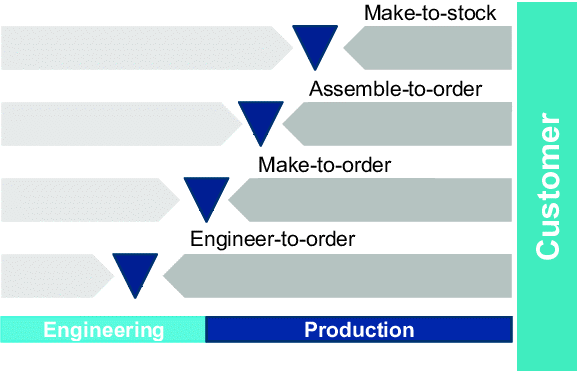
ETO projects customization with CLEVR and Optime Subsea
PLM systems are designed to make the overall management process far smoother. Siemens Teamcenter handles everything from managing customer requirements and design specifications to the coordination between different departments involved in the project.
Companies like Optime Subsea specialize in ETO manufacturing, delivering the equipment needed to drill for oil and gas at eye-watering depths. This means engineering specifications and manufacturing must be aligned perfectly—anything that even slightly deviates from the requirements could be unusable due to the dangers of deploying machinery at such depths.
CLEVR helped Optime Subsea create a roadmap to implement Siemens Teamcenter, helping to organize existing files, CAD vaulting, and access issues. This represented Level 1, which focused on Product Data Management.
Level 2 highlighted the need for serialized structures and general Process Data Management. Serialized structures were established thanks to information from different sources collected in Teamcenter, making it easy for Optime Subsea to differentiate between each project by its specifications. This was especially important for two reasons: Firstly, although Optime Subsea manufactures equipment that broadly serves the same projects—namely deep-sea wells—each project requires slightly different specifications, so making sure these requirements are easily distinguishable is crucial. Secondly, because of the risks associated with deep-sea drilling, the equipment must have clear and auditable material sourcing information to maintain the integrity of Optime Subsea and the industry in general.
Serialization, brought about by PLM as a single source of truth, also allows for the accumulation of records of manufacturing and design, as well as the fulfillment of manufacturing (e.g., welding logs and certificates of conformity). Being able to edit and check against these records while ensuring everything is updated in real-time is key when looking to service pieces of equipment before redeployment or when starting a similar project that meets many of the same requirements. With Teamcenter, these changes can be managed easily, with all stakeholders updated in real time to ensure everyone is on the same page and the project progresses smoothly.
ETO Project management with Siemens Teamcenter and Easy Plan
Project management with Siemens Teamcenter is designed to handle the complexity of ETO projects that involve multiple stages and stakeholders. When a change in customer requirements forces a product redesign, Teamcenter’s tools, which include Easy Plan, ensure that these changes are managed smoothly. Easy Plan simplifies the creation and management of production plans by linking product and process data, enabling real-time updates and collaboration. This seamless integration ensures that all stakeholders remain informed and aligned, allowing the project to progress efficiently while maintaining consistency across the entire lifecycle.
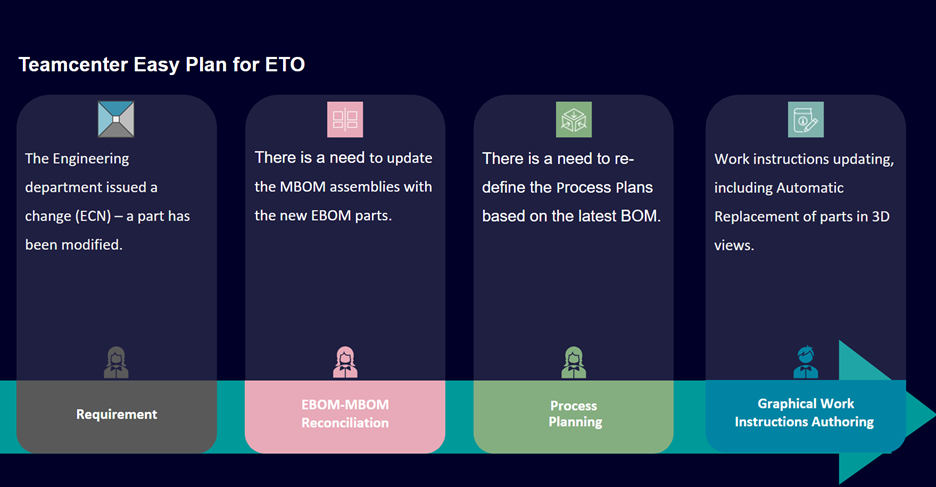
CLEVR
CLEVR delivers digital transformation at scale by implementing Siemens and Mendix solutions to serve industries like manufacturing, retail, energy, and more. We leverage PLM, MOM/MES, and low-code technologies for manufacturing optimization and business process automation while ensuring seamless integration with other core systems like SAP, IBM, and Salesforce. CLEVR brings together technology and industry expertise to provide strategic solutions that streamline operations, drive efficiency, and enable digitalization to fit market demands.

How to Overcome Scaling Challenges in Manufacturing: Gain Inspiration from Manufacturing Companies
So, what are the typical challenges encountered by manufacturing companies, and how can they transform these challenges into opportunities for growth and improvement?
Common Challenges in Scaling Manufacturing Operations
Scaling up is a critical phase for innovative manufacturing companies. It involves expanding production capabilities, managing increased complexity, and integrating new technologies—all while maintaining or improving operational efficiency. Common challenges include:
- Integration Complexity: Scaling necessitates sophisticated integration across systems and processes. Managing the seamless incorporation of new technologies across expanding operations is critical.
- Information Flow: Ensuring accurate information flow across departments becomes more challenging as companies grow. Miscommunication can lead to inefficiencies and errors.
- Resource Management: Efficiently managing increased human and material resources without compromising productivity or quality is essential. This includes recruiting, training, and retaining a skilled workforce.
- Balancing Innovation with Operations: Striking a balance between driving innovation and maintaining stable, efficient operations is crucial for sustainable growth.
By understanding common scaling challenges, manufacturing companies can develop strategic plans that prioritize optimization and digitization. Tailored solutions and expert guidance transform these hurdles into growth opportunities. At CLEVR, manufacturers are assisted in overcoming these hurdles through advanced Siemens and Mendix technology, focusing on optimizing and digitizing operations. But how does CLEVR help achieve this?
How CLEVR Addresses Manufacturing Challenges
As an end-to-end digital transformation partner, CLEVR leverages a blend of strategy, technology, and industry expertise to tackle growth challenges:
- System Integration and Optimization: Leveraging leading technologies like Siemens and Mendix to streamline operations, ensuring seamless communication across systems.
- Enhanced Data Management: Utilizing PLM systems to maintain accessible yet secure critical data, supporting informed decision-making.
- Scalable Solutions: Designing solutions that grow with the business, embedding scalability into the technological foundation.
- Training and Support: Providing comprehensive training and ongoing support to ensure teams effectively utilize implemented solutions.
From Theory to Practice: Real-World Stories from Manufacturing Companies
From implementing Siemens Xcelerator solutions to leveraging Mendix low-code technology, let’s discover how leading manufacturing companies like Optime Subsea, Wheel.me, and tec4U have successfully navigated scaling challenges and driven transformative changes with CLEVR's expertise
1. Optime Subsea
Operating in the specialized subsea oil and gas sector, Optime Subsea faced challenges managing intellectual property and data as they scaled. Initially reliant on basic tools like Excel and isolated CAD systems, they struggled to manage their expanding IP and ensure innovation reliability.
CLEVR introduced them to Siemens Teamcenter, transforming their product lifecycle management, supply chain integration, and operations. CLEVR also trained Optime’s team to use Teamcenter innovatively, enhancing revision control and systematic design data management.
{% video_player "embed_player" overrideable=False, type='hsvideo2', hide_playlist=True, viral_sharing=False, embed_button=False, autoplay=False, hidden_controls=False, loop=False, muted=False, full_width=False, width='1920', height='1080', player_id='172609475408', style='' %}
This collaboration was transformative. Optime maintained a single source of truth for data, crucial for consistency and efficiency, and discovered new operational methods like digital twinning and service lifecycle management. This partnership showcases how expert guidance helps manufacturing companies thrive during scaling challenges in specialized industries.
2. Wheel.me
Wheel.me, a Norwegian robotics company known for its innovative autonomous systems, has experienced rapid growth, doubling its workforce to 80 employees across five locations, including Berlin, Detroit, Mexico, Oslo, and Fredrikstad. This expansion introduced challenges in version control, process management, and international coordination, especially with limited work hour overlaps with the U.S.
The introduction of Teamcenter and the unification of CAD systems under Siemens, guided by CLEVR, provided a robust digital backbone, streamlining operations, enhancing change management, and boosting productivity and quality. Previously reliant on Excel for BOM and a PDM system with minimal version control, Wheel.me struggled with inefficiencies, such as finding crucial CAD files.
Now, with Teamcenter as their PLM system and Rootstock for ERP, Wheel.me has improved change management, aligning engineering, sourcing, and production. They introduced strategic "friction" points to reduce errors and reworks, supporting their lean strategy. Development is divided into an early creative phase and a structured late phase to ensure scalability.

Wheel.me's structured workflow, where data flows from Teamcenter through release processes to purchasing and production, secures data integrity and enhances operational efficiency. Despite initial challenges in automating data flow, continuous feedback loops have maintained data accuracy.
Lessons from Wheel.me's journey highlight the importance of phased implementations, financial foresight, process simulation, and team involvement for successful digital transformation.
3. tec4u
tec4U, specializing in material compliance, developed the Data Cross Material Compliance application in close collaboration with CLEVR. Built using Mendix and recently updated to Mendix 10, this app is central to tec4U's business, serving over 200 manufacturing companies.
CLEVR and tec4U worked together to architect and refine the app, ensuring it meets compliance needs and user expectations. Data Cross helps companies manage complex regulations like REACH and RoHS, safety data sheets, and calculate the carbon footprint of products.
With the new EU Corporate Sustainability Reporting Directive (CSRD) that came into effect in 2023, Data Cross has become even more crucial. It aids companies in meeting rigorous standards for sustainability reporting, part of the EU Green Deal aiming for climate neutrality by 2050.
“We had a demo with a new and bigger customer. After the demo, they were so enthusiastic about the software, that they directly wanted to start using it!“ tec4U
The app's user-friendly design handles over 1,400 user stories, facilitating detailed documentation and evaluation processes required by the CSRD, which demands over 1,000 data points. Automated data flows enhance efficiency, cost-effectiveness, and transparency in compliance.
Continuous collaboration with CLEVR ensures ongoing refinement of Data Cross, keeping tec4U at the forefront of compliance management technology.
The Role of a Trusted Partner in Digital Transformation
For manufacturing managers, automation managers, IT managers, and operational leaders, CLEVR is more than just a technology service provider. CLEVR is a partner in digital transformation in the truest sense of the word, deeply integrating with your team to understand your business from the inside out. With decades of experience helping many companies navigate scaling challenges, CLEVR delivers out-of-the-box solutions that enhance capabilities to innovate and scale efficiently. CLEVR’s expertise in manufacturing optimization and digitization ensures that as your company grows, so do your operational efficiency and capacity for innovation. CLEVR becomes a part of your team, committed to advancing your goals with tailored strategies and continuous support.

The Corporate Sustainability Reporting Directive (CSRD): How to comply in 2024?
A Green Future, Sustainability, and a Better Tomorrow are not just ideals but urgent calls to action. With sustainability issues becoming increasingly critical, bold actions are necessary. The time for waiting is over; the time to act is now.
In this context, the Corporate Sustainability Reporting Directive (CSRD) is set to bring significant changes for European companies, especially in the retail sector. With new requirements coming into effect, many businesses still have much to learn and prepare for.
A survey from December 2023 found that 88% of companies don't feel ready to meet CSRD expectations, and 57% admit they know little or nothing about the new reporting obligations. This is significant since the first reports are due in 2025.
If your company is among those unprepared, you are in the right place. This article will provide a clear understanding of the CSRD, why it matters, and how to comply with its requirements.
But first, what is CSRD?
The Corporate Sustainability Reporting Directive (CSRD) is an initiative by the European Union aimed at enhancing and standardizing the sustainability reporting process for companies. It builds upon the Non-Financial Reporting Directive (NFRD) but brings more rigorous requirements.
CSRD mandates that companies disclose detailed information on their environmental, social, and governance (ESG) practices, with the goal of increasing transparency and accountability. This directive applies to a wide range of companies, including large listed companies, as well as small and medium-sized enterprises (SMEs). By ensuring that stakeholders have access to reliable, comparable, and relevant sustainability information, CSRD seeks to foster sustainable development and facilitate the transition to a more sustainable economy.
Next, let’s delve into what the CSRD means specifically for retail companies and how they can navigate these new requirements.
What CSRD Means for Retail Companies?
For retail companies, the Corporate Sustainability Reporting Directive (CSRD) is not just a regulatory requirement but a strategic opportunity. Proactive tracking of emissions and sustainability data is crucial to ensure compliance and promote a more sustainable future. The retail sector, being at the forefront of consumer interaction, is uniquely positioned to influence and drive sustainable practices. Enhanced transparency regarding ESG metrics can build trust with consumers making purchasing decisions based on a company's sustainability approaches.
Compliance with CSRD will also enable retail companies to identify and mitigate potential risks related to environmental and social issues, leading to long-term operational savings and a more resilient business model.
Benefits of Complying with CSRD
Complying with CSRD offers multiple benefits beyond regulatory compliance:
- Increased Operational Efficiency: Improved data management and integration for CSRD turn a time-consuming process into an efficient, automated workflow.
- Enhanced Transparency: Disclosing detailed information on ESG practices builds trust with consumers and investors.
- Boosted Credibility: Utilizing standardized and accurate data in sustainability reporting boosts credibility and trust among stakeholders.
- Improved Customer Loyalty and Brand Recognition: Transparent and accountable sustainability practices enhance customer loyalty and elevate brand recognition.
By leveraging these benefits, retail companies can turn regulatory compliance into a strategic advantage, fostering sustainable development and ensuring long-term business success.
Moving Towards a Sustainable Future with CLEVR: How do we help you Comply?
CLEVR provides the right tools and solutions to help you report and comply with CSRD based on a Mendix low-code solution. Here's how CLEVR can help you report better:
- Effortless File Uploads: Users can easily upload files through an intuitive interface. Each file is rigorously validated, ensuring that any invalid entries are flagged immediately.
- Secure Data Storage and Transfer: Validated files are securely stored and can be efficiently shared via API integration. This ensures that sensitive data is protected while being accessible to the necessary stakeholders
- Flexibility for Administrators: Administrators are empowered with the flexibility to manage various file types with configurable validation rules. This offers greater control over the data validation process, allowing adjustments to be made without significant technical intervention.
- Minimal Developer Intervention: The solution allows for the seamless implementation of new file types and validation rules. This ensures flexibility and scalability, with minimal need for extensive developer input, making it adaptable to evolving regulatory requirements.
By leveraging CLEVR's solution features, companies can’t only ensure compliance with CSRD but also enhance the accuracy and efficiency of their sustainability reporting.
Retailers have the unique opportunity to lead by example, showcasing their commitment to sustainability and influencing the entire value chain to become more transparent and cooperative. By focusing on sustainability now, retail companies can position themselves for long-term success, ensuring they are ready to meet both regulatory requirements and consumer expectations as the global push for sustainability grows stronger.

Why Manufacturing Operations are more Efficient with Low-code and AI?
This shift is driven by the need for greater efficiency, agility, and innovation in manufacturing processes. Low-code platforms are enabling manufacturers to develop customized applications quicker without the need for deep programming skills.
How do these technologies help manufacturing companies streamline their operations and drive continuous improvement in their operations?
Benefits of adopting Low-code technology and AI in Manufacturing
The incorporation of AI into manufacturing workflows is enhancing predictive maintenance, optimizing supply chain management, and improving quality control. The synergy between AI and low-code technology not only simplifies the development process but also empowers manufacturers to harness complex data analytics and automation capabilities with ease.
With the help of low-code platforms, manufacturers can create AI-powered applications that automate routine tasks, freeing up human resources to focus on more critical and creative tasks.
Improving Efficiency with Intelligent Automation
Intelligent automation through AI and low-code technology helps manufacturers streamline production, reduce downtime, and boost efficiency. Machine learning algorithms enable real-time data analysis, leading to proactive decisions that prevent issues, resulting in higher quality products, improved customer satisfaction, and reduced costs.
Predictive Maintenance with IoT and Machine Learning
AI-integrated IoT devices allow manufacturers to monitor and analyze equipment data in real-time, facilitating predictive maintenance. This minimizes downtime and optimizes production schedules. Low-code platforms enable the development of custom IoT applications to gather and analyze data from various factory floor devices, providing valuable decision-making insights.
Enhancing Quality Control with Vision Systems
AI-powered vision systems have significantly improved quality control in manufacturing. These systems use machine learning to identify defects and anomalies, reducing the risk of faulty products. Low-code platforms allow for the quick development and deployment of customized vision systems, optimizing quality control while saving time and resources.

How Low-code Optimizes Manufacturing Processes: Case of Optime Subsea & the PIN Tool
Optime Subsea, a leading provider of innovative subsea technology, offering solutions for the oil and gas industry, faced a common challenge: while Configuration & Change Management (CM) in Teamcenter was systematic and robust, it remained siloed within the engineering department. This made it difficult for the system to benefit the broader organization and enhance overall company performance. They wanted to leverage CM2 in Teamcenter for managing technical changes due to its effectiveness.
After analyzing the challenge and identifying the needs, here is how CLEVR leveraged Mendix low-code technology to optimize their processes: The PIN Tool
1. Rapid Development with Mendix: With our deep expertise in Teamcenter and Mendix, we quickly developed a tailored Mendix solution for Optime Subsea: The Pin Tool.
2. Creation of the Pin App: We designed their first business process application, the Pin app (Problem/Improvement Notification). This tool allows users to create PINs associated with projects directly from Teamcenter, assign them to users through Azure AD connection, and register issues quickly.
3. Comprehensive Features
- Compatibility with all devices
- Ease of use with Single Sign-On functionality
- Public cloud deployment for accessibility and scalability
- Understandable dashboards and search capabilities
- The ability to add tasks, documents, images, notes, and other team members
- Conduct root cause analyses
4. Enhanced Organizational Performance: By streamlining the process of identifying and addressing issues, the Pin app helps improve overall company performance. It ensures that the Configuration & Change Management benefits extend beyond engineering, impacting the entire organization positively.

This use-case is one real-world example of low-code technology transforming manufacturing. Siemens, a globally recognized manufacturer of industrial machinery and equipment, has used the Mendix low-code platform to extend Teamcenter's capabilities significantly. This extension allows customers to streamline complex processes, integrate various functions seamlessly, and enhance overall efficiency.
CLEVR, as a partner of Siemens

and Mendix, has the expertise and knowledge to develop customized Mendix low-code solutions and expand them into Siemens' portfolio. This collaboration highlights the immense potential of low-code platforms in delivering highly effective, scalable, and user-friendly applications tailored to specific needs.
Low-Code and AI Integration
Low-code platforms like Mendix provide a solid framework for integrating AI technologies and data sources, essential for any AI project. By supporting core AI algorithms, businesses can refine their processes further. Low-code platforms enable rapid prototyping and customization, making them ideal for AI-enhanced manufacturing. Manufacturers can quickly develop and deploy applications that integrate AI capabilities, such as predictive maintenance, quality control, or supply chain optimization.
Moreover, Mendix's visual modeling tools enable cross-functional collaboration between business analysts and data scientists. The low-code platform provides a single collaborative environment for developing AI projects with seamless integration of AI components.
{% video_player "embed_player" overrideable=False, type='hsvideo2', hide_playlist=True, viral_sharing=False, embed_button=False, autoplay=False, hidden_controls=False, loop=False, muted=False, full_width=False, width='1920', height='1080', player_id='169754774828', style='' %}
The future of manufacturing is being reshaped by the integration of Artificial Intelligence (AI) and low-code technologies. This powerful combination promises faster, more cost-effective product development with a strong emphasis on functional applications.
As manufacturers increasingly embrace these advanced technologies, the potential for unprecedented innovation and enhanced efficiency will continue to expand.

Partitions: The Key to Simplifying Complex Product Structures
In today's fast-evolving industries, products are increasingly complex, blending electrical, mechanical, and software elements. This complexity presents significant challenges for traditional product management and manufacturing methods.
Teamcenter's Structure Partitions provide an effective solution by segmenting a product's structure into smaller, manageable "Partitions." This method simplifies focusing on individual components while maintaining a holistic view, streamlining the development process, improving efficiency, and reducing error risks through parallel development and easier change tracking.
Adopting a modular and flexible approach, Structure Partitions are crucial for fostering innovation and enabling swift market response. But in high-stakes sectors like shipbuilding, where the Digital Twin concept is critical, how do companies effectively manage the blend of disciplines that modern products embody?
Overcoming Challenges through Structure Partitions
Consider a ship: it has diverse requirements for organizing its digital twin data. On one hand, there's a need for functional organization, such as grouping all components of a propulsion system—main engine, propeller, fuel supply, etc.—based on their roles. On the other hand, spatial organization is crucial, with sections, compartments, and rooms arranged according to their physical locations.


This aspect of organization—spatial and functional—highlights a significant challenge. For instance, an engine plays a critical role in both the spatial layout of the engine room and the functional operation of the propulsion system. Consequently, it must be represented in both structures, leading to complexities in data management.

While this might seem manageable on a small scale, the challenges magnify with larger products and involved disciplines. Traditional approaches to managing these multi-structured data can strain organizations, especially when changes occur. Issues include:
- Determining who has the authority to change a component's location within the product and ensuring this process is managed accurately.
- Implementing changes across all structures if a component is modified, which is essential to maintain consistency across the digital twin.
These problems often lead to inconsistencies among the various [sub] structures that describe your product. Identifying and resolving these challenges can be both time-consuming and expensive, particularly during critical stages of product development when delays or failures carry significant consequences.
In essence, the task of efficiently managing the digital twin of complex products like ships underscores the need for innovative solutions that can handle the intricacies of both functional and spatial data organization.
How Teamcenter's Structure Partitions Transform Product Management?
Teamcenter's Structure Partitions offer a sophisticated way to manage complex product structures by allowing specific subsets of a product's structure to be viewed in different configurations without altering the actual product structure. This approach enables organizations to meet various structural organization and viewing requirements without resorting to creating multiple substructures or duplicating component instances.
Structure Partitions facilitate the organization of a product in a logical or hierarchical manner, enhancing the way users interact with and understand the product structure. To cater to diverse user needs, Structure Partitions are divided into distinct Partition Schemes, each designed for a specific organizational perspective:
- Partition Scheme – System: Focuses on the system-level organization of components.
- Partition Scheme – Spatial: Organizes components based on their physical location within the product.
- Partition Scheme – Physical: Centers on tangible aspects of the product's components.
- Partition Scheme – Functional: Groups components according to their functional roles within the product.
To maintain clarity and prevent user confusion, only one Partition Scheme of a type is permitted per product. Each scheme can encompass various partitions. For instance, while there may be only one spatial division for a product, the number of spaces—defined as Partitions within the Spatial Partition Scheme—can vary.

A key advantage of Structure Partitions is their ability to represent a single component within multiple Partitions simultaneously, without complicating the overall product structure. For example, a ship's engine might concurrently belong to the Machinery Partition (Functional), Propulsion Partition (System), and MidShip - Engineroom Area Partition (Spatial). This multiplicity allows the same component to be seamlessly integrated into different product views, eliminating the need for complex arrangements of separate substructures.

Through the innovative use of Structure Partitions in Teamcenter, companies can transform the way they manage complex product structures. This approach not only simplifies management tasks but also streamlines how teams view and interact with diverse product requirements, enhancing efficiency and clarity. By reducing administrative overhead and minimizing the risk of errors, CLEVR emerges as a pioneer, offering advanced solutions that empower modern product management strategies. For those looking to elevate their approach to managing product complexities, connecting with Sönke Hoppe for expert advice and support from CLEVR can provide the necessary insights and tools for success.

Siemens Teamcenter: Powering Integrated Ecosystems for Business Efficiency
In a rapidly advancing digital era, the winners are those with not just industry expertise but also access to robust, integrated systems. Siemens, a global leader in industrial manufacturing, is playing a significant role in this area with an ecosystem built around its product - Teamcenter.
Teamcenter, a modern Product Lifecycle Management (PLM) system, bridges people to the information they need to produce top-tier products. It facilitates cross-departmental and geographic collaboration, providing a singular source of product and process knowledge. As the cornerstone of the Siemens Ecosystem, Teamcenter manages and shares data across various applications and systems.
The power of integration within this ecosystem is undeniable. Traditional setups often find themselves grappling with data silos where information is stored in separate systems, creating hurdles for teams to access and utilize the data effectively. The integration offered by Teamcenter eradicates these silos, making all pertinent information readily available across the organization. It fosters improved communication, enhances productivity, and ultimately drives innovation.
Siemens' partnership with CLEVR, a company known for its expertise in digital transformation, further amplifies the power of this integrated ecosystem. This collaboration combines Siemens' robust Teamcenter platform and CLEVR’s deep industry knowledge, providing businesses with a comprehensive solution that aligns with their unique needs.
Benefits of Integration within the Siemens Ecosystem

- Enhances Process Efficiency
- One of the primary benefits of integration within the Siemens Ecosystem is the significant enhancement in process efficiency. With Teamcenter serving as a single platform for managing product data, businesses can drastically reduce the time spent searching for information across multiple systems. This streamlined access to data allows teams to work more efficiently, speeding up product development and reducing time-to-market.
- Fosters Innovative Solutions
- Innovation thrives when information flows freely. By breaking down data silos and facilitating seamless collaboration, Teamcenter opens new avenues for innovative thinking. Teams can leverage the shared pool of product and process knowledge to brainstorm novel solutions, iterate designs rapidly, and bring groundbreaking products to market.
- Provides a Comprehensive View of Operations
- Another key advantage of the Siemens Ecosystem is the holistic view it provides of business operations. By integrating data from various sources into a single platform, Teamcenter allows decision-makers to gain a comprehensive understanding of their product lifecycle. This visibility enables businesses to identify bottlenecks, uncover opportunities for improvement, and make informed decisions that drive operational excellence.
- Enables Data-Driven Decision Making
- In today's competitive business environment, making decisions based on gut feelings or intuition is no longer viable. Instead, businesses need to leverage data to drive their strategic decisions. The Siemens Ecosystem, with Teamcenter at its core, empowers businesses to do just this. The platform provides real-time access to critical data, enabling businesses to analyse trends, predict outcomes, and make data-driven decisions that align with their strategic goals.
- In conclusion, the integration within the Siemens Ecosystem, powered by Teamcenter, offers a multitude of benefits. From improving process efficiency to fostering innovation, providing a comprehensive view of operations, and enabling data-driven decision-making, this ecosystem equips businesses with the tools they need to thrive in the digital age.

The Power of Customized Product Lifecycle Management Solutions
In an era where efficiency, agility, and innovation are the keys to competitive advantage, Product Lifecycle Management (PLM) has emerged as a strategic imperative for enterprises across various industries. PLM, a systematic approach to managing the lifecycle of a product from concept to disposal, serves as the backbone of many organizations, streamlining processes, reducing errors, and fostering innovation.
However, in the diverse and complex world of business, one size rarely fits all. Each industry, and indeed each enterprise within that industry, has its unique set of challenges, requirements, and objectives. This is where the significance of customized PLM solutions comes into play.
In this blog post, we delve deeper into the importance of customization in PLM solutions and how it can transform your business operations. Stay tuned as we unpack the myriad benefits of a tailor-made PLM approach.
Understanding Your Unique Needs
Before embarking on the journey of customizing your PLM platform, it is crucial to first identify and understand your unique business needs. This process involves a comprehensive analysis of your business operations, product development processes, and the challenges you face.
Start by conducting an audit of your current processes. Identify bottlenecks, inefficiencies, and areas where errors frequently occur. Speak to your team members who are involved in these processes - their insights can often shed light on issues you may not have considered.
Next, align these needs with your business goals. Do you want to bring products to market faster? Are you looking to improve cross-functional collaboration? Or perhaps you're trying to reduce the cost of non-compliance? By aligning your PLM platform with these goals, you ensure that the solution you implement is not just a band-aid, but a strategic tool that drives your business forward.
Customizing the PLM Platform
Once you've identified your needs and goals, the next step is to tailor your PLM platform accordingly. This involves customizing the features, workflows, and user interfaces to suit your specific requirements.
For instance, you might need custom dashboards for different roles within your organization, or automated workflows that streamline your product development process. Perhaps you need advanced data management capabilities to handle complex product structures, or integration with other business systems like ERP or CRM.
Remember, the goal of customization is not to add as many features as possible, but to create a tool that is efficient, user-friendly, and meets your specific needs. When done right, a customized PLM platform can drastically improve productivity, reduce time-to-market, and foster innovation.
Choosing the Right PLM Provider: CLEVR
Selecting a PLM provider is a critical decision that can significantly impact your organization's performance and competitiveness. Here are some key factors to consider:
- Industry Expertise: Does the provider have a deep understanding of your industry and its unique challenges? Can they offer relevant insights and recommendations?
- Customization Capabilities: Does the provider offer customization? Can they tailor the PLM solution to fit your specific needs and align with your business goals?
- Integration: Can the PLM platform seamlessly integrate with your existing systems? Is the provider capable of ensuring a smooth implementation process?
- Support: Does the provider offer ongoing support and training to ensure you can fully leverage the PLM platform?
CLEVR ticks all these boxes. With their deep industry expertise, customization capabilities, seamless integration, and robust support, they stand out as a reliable PLM provider. Choosing a provider like CLEVR, who offers customization, ensures that your PLM solution can adapt and evolve with your business needs, delivering long-term value.
Implementing a PLM solution is not just about adopting a new technology; it's about transforming your business operations to become more efficient, competitive, and profitable. Customizing your PLM platform to align with your unique needs and goals can significantly drive this transformation.
Whether you're in the manufacturing industry or any other sector dealing with complex product lifecycles, a tailored PLM solution can be a game-changer. And with a reliable provider like CLEVR, you can be assured of a solution that fits your specific requirements and delivers long-term value.
Don't wait. Contact CLEVR today and take the first step towards transforming your product lifecycle management.
Adapting to Change in Organizations: From Theory to Practice
In the fast-paced world of technology and industry, change management is a pivotal element. Businesses sailing the swift currents of technological progress need to adapt to these new advancements. This adaptation requires alterations not just in their technology, but also in their organizational structure, processes, methodologies, roles, and integrations.
This article will delve into the importance of change management, present its essential components, and shed light on how CLEVR, a leader in digital transformation, steers this process. Guided by our Expert and Business Consultant, Malin Ragnarsson, this article showcases the indispensability of change management, its key facets, and CLEVR's approach to navigating this complex landscape.
The Need for Change Management
In the dynamic business landscape, managing change effectively is vital. Not only does this relate to new technology or software implementations, but it also extends to operational adaptations due to technological advancements like AI and cloud computing. Mergers, acquisitions, regulatory alterations, market trends, and cultural transformations all demand strategic and skillful change management. Without it, businesses risk efficiency losses, non-compliance, missed opportunities and unsuccessful transitions.

Key Components of Change Management
Successful change management revolves around several key tasks:
- Reason for Change and Expected Benefits
- Grasping the reason for change and anticipated benefits is key to change management. This clarity drives the change direction and aligns stakeholders. It's vital to document and communicate the change reasons to those affected. Management must outline the goals and expected benefits, which serve as a measure of the change effectiveness during and post-implementation.
- Change Readiness and GAP identification
- An assessment of readiness is crucial to understand an organization's ability to adapt to change by identifying the gap between existing and future processes. This insight helps comprehend the magnitude of the impending shift. Assigning a Change Manager fosters synergy with the Project Manager, integrating change management tasks into the project plan. Transparent communication about the change's rationale and benefits for stakeholders and employees is key.
- Stakeholder Identification and Analysis
- Identifying and analyzing stakeholders is crucial to determine who will be affected by and can influence a change. This process involves identifying stakeholders like employees adapting to new technology or undertaking new tasks. The results are essential for creating a training plan and communication strategy related to the change.
- Communication and Engagement Strategies
- Effective change management relies on good communication and engagement. Creating these strategies is key for managing change and involving stakeholders. This requires timely, precise communication to relevant parties. For example, supervisors should explain the benefits to employees, while executives should convey the reasons for change and its organizational advantages.
- Training Strategies
- Training strategies play a pivotal role in change management by equipping stakeholders with the necessary knowledge and skills to adapt. Crafting well-suited training plans is part of preparing employees for change, considering the organization's needs and the extent of the change. This could include relevant employee training, process training, and the use of e-learning tools.
- Sustaining the Change
- Maintaining change is a vital final step in change management. After implementation and adaptation, strategies must be developed for long-term sustainability and to reap its benefits. This may include actions like decommissioning old systems, rewarding employees for adapting and offering ongoing training and support.
CLEVR: Your Change Management Expert
CLEVR provides comprehensive change management solutions, tackling the challenges of software implementation. We assign a dedicated change resource to each project, ensuring smooth transitions. Our team consists of APMG and Prosci certified experts who use standardized methodologies. Whether it's a sequential or sprint-based project, our method effectively handles change activities.
Our experts' certifications guarantee a consistent vocabulary and approach during change management, making the process efficient and effective. Partner with CLEVR to maximize your new software implementation benefits.
Contact us today to learn how we can help your business in managing change efficiently.

The Pivotal Role of MES in MOM and Industry 4.0
Manufacturing Operations Management (MOM) has emerged as a vital component in the manufacturing industry, providing comprehensive visibility into all manufacturing processes. This enhanced visibility allows businesses to optimize their performance and efficiency. As reported by Gartner, the implementation of MOM has led to substantial improvements in key performance indicators for companies, and by 2027, Gartner predicts that 80% of manufacturing operations management solutions will be cloud-native and edge-driven, closing the IT/OT convergence gap.
These figures highlight the transformative impact of MOM in enhancing production, efficiently managing inventory, and improving operational performance. Given the significant role of MOM in manufacturing, one might wonder about the part played by Manufacturing Execution Systems (MES) within this framework, and this is what we are going to explore in this article.
-min.jpeg)
The Role of Manufacturing Execution Systems in MOM
The incorporation of Manufacturing Execution Systems (MES) within MOM has further refined manufacturing practices. By offering real-time control over the production process and reducing waste, MES amplifies productivity and promotes sustainable manufacturing practices, connecting and coordinating all shop-floor operations and data in real-time. Building on this, here are some standout advantages of MES:
Enhancing Control and Reducing Waste
The primary strength of MES lies in its ability to offer real-time control over the production process. This means that managers can oversee every step of manufacturing as it happens, adjusting as necessary to ensure optimal efficiency. By identifying and eliminating bottlenecks, MES helps to significantly reduce waste, leading to more sustainable manufacturing practices.
Boosting Productivity
The benefits of MES extend beyond control and sustainability. By automating routine tasks, MES frees up human resources for more complex and strategic activities. This not only amplifies productivity but also improves the quality of output. Furthermore, with MES, manufacturers gain valuable insights into their operations, enabling them to identify areas for improvement and implement strategic changes.
MES and Industry 4.0: A Dynamic Duo
As the manufacturing sector moves towards Industry 4.0, the role of MES in MOM is becoming even more critical. By seamlessly integrating with other advanced technologies like IoT, AI, and machine learning, MES can facilitate smart manufacturing. This involves predictive maintenance, advanced scheduling, and real-time analytics, all of which contribute to enhanced efficiency, flexibility, and competitiveness.
The incorporation of MES within MOM is not just refining manufacturing practices – it's revolutionizing them. With its potential to amplify productivity, reduce waste, and promote sustainable and smart manufacturing, MES is set to play a defining role in the future of manufacturing.

Future-Proofing Your Tech Stack: Why You Don't Need to Switch Systems
In the fast-paced world of technology, businesses often struggle with the need to stay ahead, evolve, and adapt. A common perception is that switching systems is the key to embracing the future. However, there is another strategically valuable option: Future-proofing your current infrastructure through strategic optimization and integration. A key tool in this process is the use of Low-code technologies, empowering organizations to achieve rapid development and customization within their existing systems. Let's explore the benefits...
1. Optimization Within Current Infrastructure
Existing systems often have a robust foundation, which can be enhanced through strategic upgrades and integrations. This approach allows businesses to leverage the full potential of their current infrastructure without the disruption of a complete system switch.
2. Cost Efficiency
System switches can be costly, involving expenses for implementation, potential downtime, training, and data migration. By optimizing the current tech stack, businesses can achieve innovation without the substantial financial investment associated with a complete overhaul.
3. Preservation of Investments
Many companies have made significant investments in their current systems, including software licenses, customizations, and training. Future-proofing within the existing infrastructure allows organizations to preserve these investments and avoid the sunk costs associated with abandoning current solutions.
4. Reduced Disruption to Operations
Switching systems can cause disruptions to daily operations, impacting productivity and potentially leading to a learning curve for employees. Future-proofing within the existing system minimizes these disruptions, ensuring a smoother transition to new technologies without the need for a complete reset.
5. Integration of Emerging Technologies
Modernizing existing systems often involves integrating emerging technologies, such as Low-code solutions, artificial intelligence, and IoT, into the current infrastructure. These integrations enable businesses to stay current with technological advancements without the need for an entirely new system.
6. Customization and Tailored Solutions
Existing systems can be customized to meet evolving business needs. This tailored approach allows companies to address specific challenges and requirements, aligning technology with the unique aspects of their operations.
7. Time-to-Market Considerations
Adopting a future-proofing strategy within the current tech stack can significantly reduce the time-to-market for new innovations. Rapid development and integration of new functionalities, especially through low-code platforms, enable companies to respond swiftly to market demands without the delays associated with system switches.
8. Strategic Partnerships and Support
Leveraging partnerships with technology providers and experts can enhance the capabilities of existing systems. Companies like CLEVR, with expertise in PLM, manufacturing optimization, SAP integration and Low-code solutions, can guide organizations in optimizing and evolving their Tech Stacks without the need for a complete switch.
Future-proofing your Tech Stack doesn't necessitate abandoning your current systems. Instead, it's about optimizing, innovating, and evolving within the existing framework. With CLEVR's extensive domain expertise in Product Lifecycle Management (PLM) and a strategic focus on Low-code technologies, businesses can confidently navigate the path towards digital transformation. It's a strategic bridge to innovation, proving that you don't need to switch systems to stay at the forefront of technology. The journey into the future is about making the most of what you have, guided by a trusted partner like CLEVR.
Stay tuned as we continue to explore how CLEVR is reshaping the narrative of technological evolution, one optimized system at a time.

The Imperative Journey of Digital Transformation in Manufacturing
Today's era of technological advancement has shifted digital transformation from being just a buzzword to an essential pivot for manufacturers. To safeguard their competitive advantage in the fluctuating market dynamics and the ever-evolving customer expectations, it's imperative for manufacturers to develop and execute a robust digital transformation strategy.
The relentless acceleration of technological advancements has left manufacturers at the initial stages of digital transformation. A significant hurdle impeding progress in digital projects is the misalignment between Information Technology (IT) and Operational Technology (OT). This disconnection prevents a holistic view of operations, a vital component for successful digital transformation.
The Indispensable Role of an End-to-End Ecosystem: PLM, MES and Digital Twins
This is where Product Lifecycle Management (PLM) comes into play. PLM plays a critical role in creating an effective end-to-end ecosystem by integrating systems, processes, and people seamlessly. It aids in modernizing IT and OT processes, thus constructing a much-needed bridge in the perpetually changing landscape.
The importance of PLM is emphasized by the anticipated growth of the PLM software market, projected to reach USD 9.22 billion in 2025, showing growth that signifies how instrumental PLM is in steering the journey towards successful digital transformation.
{% video_player "embed_player" overrideable=False, type='hsvideo2', hide_playlist=True, viral_sharing=False, embed_button=False, autoplay=False, hidden_controls=False, loop=False, muted=False, full_width=False, width='300', height='375', player_id='146602007158', style='max-width: 300px; margin-left: 0px; margin-right: 10px; width: 100%; display: block; float: left;' %}
‘We have one of the biggest and strongest partner ecosystem in our industry. And believe me one thing, we are very well on track to further expand this ecosystem and make our partners even more stronger.’
Marcel Milde- Siemens Partner
In the ongoing narrative of digital evolution, Manufacturing Operations Management (MOM) stands out as a holistic approach to oversee various aspects of the manufacturing process. Within MOM, Manufacturing Execution Systems (MES) emerge as a specific software-based solution, playing a pivotal role in shaping this narrative. Manufacturing Execution Systems (MES) have surfaced as a crucial force. By managing and monitoring work-in-process on the factory floor actively, MES provides real-time data that is invaluable in pinpointing inefficiencies, curtailing downtime, and enhancing productivity. The global MES market, expected to grow to USD 17.1 billion in 2025, testifies to its escalating importance in the digital manufacturing landscape.
The journey of digital transformation in manufacturing also introduces us to the groundbreaking concept of digital twins. These virtual replicas of physical assets are revolutionizing manufacturing processes by enhancing simulation capabilities, improving IT-OT integration, and facilitating efficient data collection. The digital twin market, projected to reach an impressive USD 48.2 billion by 2026, mirrors the profound impact of this technology on the industry.
Streamlining Processes with Low-Code (Business Process Automation)
The pivotal role of low-code in digital transformation cannot be overstated. This technology not only simplifies application development but also proves instrumental in optimizing processes within Product Lifecycle Management (PLM). By breaking down silos and fostering collaboration across various stages of product development, low-code automation enhances efficiency significantly. Its capacity to automate repetitive tasks expedites application development, ensuring swift adaptability to changes and maintaining a competitive edge. The projected growth of the global low-code development platform market, expected to reach USD 45.5 billion in 2025, emphasizes its crucial contribution to driving efficiency in the manufacturing sector.
The digital transformation in manufacturing is a complex process that involves the integration of various elements like PLM, MES, digital twins, and business process automation. These tools are not only enhancing operational efficiency but also paving the way for innovative solutions to longstanding challenges. As we delve deeper into the digital age, these technologies will persistently shape the future of manufacturing.
However, to truly succeed in this transformation, you need a trusted partner with the vision, the expertise, the people, and the solutions. CLEVR, a Siemens and Mendix partner, can be that trusted ally for you. As we continue our journey into the digital age, these technologies and partnerships will undoubtedly shape the future of manufacturing. Don't wait for the future to happen; be a part of building it. Contact us today and let your transformation begin.

Industrial Edge: Transforming Factory Management with Siemens, Mendix, and CLEVR
In the dynamic world of manufacturing, the key to success lies not only in efficiency but also in optimizing operational technology (OT). Every second counts, and the ability to harness and analyze the invaluable data generated by machines in real-time can make or break a factory's success. However, the challenge lies not just in collecting massive amounts of data, but in sifting through and saving the necessary information for smarter decision-making.
To meet these needs, industries are revolutionizing their approach by turning to Industrial Edge Computing, a concept that seamlessly connects the hardware on the factory floor to the cloud. This is where innovative solutions provided by Mendix, Siemens Industrial Edge and CLEVR become crucial players. In this article, we'll discuss the elements of Industrial Edge and explore how it is transforming factory management with advanced tools integration.
Understanding Siemens' Industrial Edge Ecosystem in Manufacturing
Industrial Edge Computing is a solution that seamlessly connects the hardware on the factory floor to the cloud, facilitating real-time data analysis. It effectively bridges the gap between physical machinery and digital infrastructure, enhancing both efficiency and responsiveness.
At the heart of this transformative concept is the Siemens Industrial Edge platform. This robust architecture deploys Mendix apps on Industrial Edge devices, serving as the vital link connecting Programmable Logic Controllers (PLCs) to the Siemens Industrial Edge ecosystem. This open, ready-to-use edge computing platform is ideally suited for any manufacturing floor.

The Siemens Industrial Edge platform comprises three core elements:
- Industrial Edge Hub: This is essentially a global repository where customers can centrally distribute purchased or self-developed apps to multiple management systems, enabling the adoption of machine-as-a-service solutions. Custom applications created using low-code solutions like Mendix can be effortlessly brought into this ecosystem, bridging the gap between consumers and producers.

- Industrial Edge Management (Cloud): This software-as-a-service (SaaS) instance of the management system provides a customer-managed system that encompasses custom-made applications, third-party apps, and other solutions from the Industrial Edge Marketplace. It offers easy maintenance and control of edge devices and apps for production sites on a global scale.

- Industrial Edge Device: These industrial PCs interact with machines on the shopfloor (OT) in real-time and provide access to the data they generate. Through Industrial Edge these devices get their ability to communicate, collaborate, and make informed decisions across various manufacturing units.

The Siemens Industrial Edge ecosystem simplifies the interaction between consumers and producers, effectively bridging the IT and OT gap. Built-in connectors make data easily accessible in a consumable format, paving the way for digital transformation.
The Power of Mendix and Siemens Industrial Edge Integration
Mendix, traditionally linked with manufacturing, lacked a direct connection with machines. However, this gap has been bridged with Siemens Industrial Edge (IE), creating a path to full digitalization and automation.
Siemens IE provides an ecosystem for deploying Mendix apps on Industrial Edge devices, connecting the PLC data to the Siemens IE ecosystem. This open, ready-to-use platform effectively turns raw data from the manufacturing floor into actionable insights for process optimization, predictive maintenance, risk identification, and more.
The Siemens IE ecosystem includes an edge device, edge applications, connectivity services (e.g., to the cloud with Insights-Hub), and an edge management platform, all designed for industrial manufacturers. It elegantly layers complex architecture, making it easy to deploy on any manufacturing floor.
The combination of Siemens Industrial Edge and Mendix, along with partners like CLEVR, is transforming manufacturing. It breaks down IT and OT barriers, improves machinery performance, and enables digital transformation.
How CLEVR helps in bridging the IT-OT Divide with Industrial Edge?
Software creation and machine programming are diverse, using different PLC protocols, such as ladder diagrams, structured text logic (STL), and others. As a solution provider, understanding IT and OT to build solutions is challenging, especially when OT is a new territory. Without comprehensive knowledge of both domains and a suitable framework to connect IT with OT, solution development becomes a heavy task.
Consider an industrial manufacturer producing car engine chassis. They need machine X from an original equipment manufacturer (OEM) to ensure top quality. This machine has an industrial edge device for optimal operation, risk assessment, and machine health monitoring. In this scenario, different companies can collaborate through Edge ecosystem to make informed decisions about their machinery and overall performance synchronization. Both parties control their data sharing and independently manage applications in their local app repository.

Solution partners like CLEVR can play a critical role here, they excel in developing solutions for both OEMs and manufacturers. This underscores the immense strength of domain expertise, backed by cutting-edge technology.
The outcome? A collaboration where different companies can work together, discover latent variables, and optimize machine performance. The Industrial Edge ecosystem effectively links consumers and producers, tearing down the barriers between IT and OT with its in-built connectors.
The Mendix, Siemens, CLEVR partnership is pushing manufacturing into a new era. Seize this digital transformation with real-time data, optimized machinery, and IT-OT collaboration. Reach out to CLEVR to learn how we can help you with our expertise, modernize your operations. Together, let's create an advanced, streamlined, efficient manufacturing landscape. In other words, let’s Build Tomorrow Together.
The Mendix App Factory
This blog is about the 'Debunking the App Factory: Actually Getting There ' video and the 'Pairing Governance with Development, From One App to Full Scale ' video. You can watch them by clicking the link.
The elusive Mendix App Factory. Those who have tried googling it probably reached this blog post and not a lot else. But fear not: I will walk you through it and if you read till the end, I’ll give you an even better option. You see, the Mendix App Factory itself does not seem to exist… That’s simply because Mendix decided to call it start, structure, scale on their website, and it’s part of their digital execution program. The Mendix App Factory is mentioned in two Mendix World 2.0 videos:
- Debunking the App Factory: Actually Getting There
- Pairing Governance with Development, From One App to Full Scale
Both videos discuss the Mendix App Factory and the ASML customer case.
What is the Mendix App Factory? I would describe it as a Software Development Model at portfolio level.

What does the framework bring you?

What does the framework look like?

Arjo van Oosten explains part of the model in this blog post. The idea is to go from start, to structure, to scale in around six months. In that same period, the framework is set up. Let’s do a quick walkthrough.
Strategy and transformation
Strategy is where the foundations of the framework are laid. The architecture of the enterprise and the different models for governance are created here – and both are very important. Governance includes the security standards, quality standards and testing process, all key to success.
Portfolio
Portfolio is the input for the framework. It involves processes like ideation, project inflow, estimates, and portfolio management. Basically, what is worth building?
Development and operations
The heartbeat of your Mendix development effort. In this module, the development guidelines and best practices are set up (for governance), while scalability should be covered by an onboarding process. You can see the ‘factory lines’ in the diagram. Each consists of RAD teams building applications. The support process afterwards as well as citizen development are also arranged here.
Foundation and experts
Experts ensure a consistent approach in your development process. Reusable components improve your governance and increase your development speed. And of course, automation – my personal favorite! Here, you ensure properly implemented DevOps practices to build automated quality controls. UX branding ensures a consistent look and feel, which includes a design system. A design system is a UX approach for an entire portfolio, not just a single application. For example: it includes reusable components to allow factory line developers to quickly style in line with the UX branding. And of course, the people to assist your RAD teams with the above.
Value management
In this module, you monitor and measure the real business value using metrics. Mendix claims they have these out of the box.
Another important step is continuously monitoring all the different aspects of the framework. And Mendix has provided a handy compass for just this purpose.

That’s the Mendix App Factory in a nutshell. Nothing too complicated and it looks quite solid. The ASML customer case gave some practical insight into the framework but not much detail. They basically said: “it works”.
Of course, Mendix is not the only one with an App Factory. Our CLEVR offering in essence covers the same as the Mendix App Factory. In addition, we:
- Cover the DevOps part, #LongLiveAutomation
- Have extensive experience in governance and quality control; we developed leading Mendix Developer Tooling: The CLEVR Developer Suite
- Have many years of app-building experience with Mendix with 3.500+ apps deployed
- Offer Business Consultancy, Support & Training
Digital Transformation in the Energy and Utilities Industry: What you Need to Know
The energy and utilities industry is currently undergoing a rapid transformation driven by various factors such as changing energy sources, complex regulations, and evolving customer expectations. With the increasing demand for renewable energy sources and the need for efficient distribution, organizations in this sector are facing new challenges in this digital era. Legacy systems, scarcity of resources, and the requirement to quickly adapt to regulatory changes pose significant obstacles. In this article, we will explore 3 main challenges and discover how CLEVR can help energy and utilities companies overcome these hurdles, drive digital transformation and ultimately, enhance customer service.
What Are the Key Challenges Energy Companies Encounter?
- Legacy Systems Holding Back Progress:
Legacy systems have become a barrier to progress in the energy and utilities industry. These outdated systems are ill-equipped to keep up with the fast-paced economy. They lack the necessary capabilities to leverage emerging technologies like Artificial Intelligence (AI), Machine Learning (ML), Internet of Things (IoT), and distributed ledger technology. As a result, companies find it difficult to evolve at the required speed to meet industry demands.
- Scarcity of Resources and Operational Efficiency:
Another challenge faced by energy companies is the scarcity of resources, particularly skilled workforce. The operational efficiency of energy and utility companies is compromised due to the lack of available workforce. This shortage not only hinders day-to-day operations but also impacts the ability to execute essential tasks efficiently.
- Rapid Regulatory Changes and Compliance:
The regulatory landscape in the energy and utilities sector is becoming increasingly complex. Companies must adapt quickly to meet regulatory requirements surrounding decarbonization, digitalization, and decentralization. Failing to comply with these rapid changes can result in penalties and hinder business growth.
“By 2025, energy companies are likely to implement technologies such as AI/ML (94%), Secure Access Service (86%), Distributed Cloud (89%), and 5G (89%). These technologies will drive innovation, efficiency, and improved connectivity in the energy sector.” Source: Gartner
How CLEVR can help?
CLEVR recognizes the need for assistance in navigating the disruptive transformation happening in the energy industry. Our approach involves collaborating with our customers to establish resilient business models and provide expert guidance in cultivating the necessary technology and know-how essential for achieving success in this rapidly changing market, this includes domain such as Field Services Management, Servitization and Customer Service.
Expanding on CLEVR's distinctive capabilities, the company specializes in delivering tailored solutions specifically designed for companies operating within the energy and utility sector. One of CLEVR's key offerings is low-code solutions powered by Mendix, a leading platform in rapid application development. This empowers energy and utility businesses with the tools to effectively address their unique challenges, streamline operations, and enhance customer experiences. Our commitment to providing adaptable and future-proof solutions ensures that our clients stay ahead in a rapidly evolving market.
Joining hands with CLEVR means embarking on a transformative journey of innovation and success. Our collaborative approach, advanced technology solutions, and commitment to excellence set us apart as a trusted partner in driving business transformation. Contact Us Today and Let’s Build Tomorrow Together.
How Digital Transformation is Revolutionizing the Consumer Products and Retail Industry
The retail sector is experiencing a significant transformation as digital technology reshapes consumer expectations and shopping habits. To stay competitive, businesses must quickly adapt and embrace innovative approaches. According to Gartner, technologies such as Artificial Intelligence (AI)/Machine Learning (ML), Multi-experience development platforms, Distributed Cloud, and Cybersecurity will play a crucial role in shaping the future of retail by 2025. In this article, we will explore the concept of digital transformation in retail and how CLEVR's solutions can assist retailers in adapting to this evolving landscape.
The Rise of Digital Transformation
Digital transformation is now a vital element for success in the consumer products and retail industry, and the COVID-19 pandemic has only intensified its importance. Retailers have had to quickly adapt and innovate to meet the changing needs of customers.
Among the top priorities for leading retail enterprises are growth, enhancing customer experience, and modernizing technology. Approximately 35% of respondents have identified growth as a key focus, with businesses striving to expand their market share, generate higher revenue, and explore new avenues for expansion. This can involve various strategies, including entering new markets, introducing new products or services, or engaging in mergers and acquisitions.
Predictions and Recommendations
According to Gartner's predictions through 2025, data and analytics will become integral parts of business strategy. Retail CIOs can use these predictions to make informed decisions about their digital strategies. Furthermore, a Gartner Research found that 73 percent of the top 100 retail businesses have embraced supply chain technology, highlighting the growing importance of integrating technology across all aspects of retail operations, from concept-to-commerce.
Employing digital technologies is now crucial to provide new revenue and value-producing opportunities. For retailers, this could mean anything from implementing e-commerce solutions to leveraging data analytics for personalized customer experiences.
How CLEVR Can Help?
CLEVR offers a range of solutions designed to assist retailers in their digital transformation journey. By focusing on enhancing customer engagement, optimizing processes, and leveraging advanced retail technologies, CLEVR helps retailers to transform their operations and achieve significant results.
CLEVR's PLM solution for Consumer Products and Retail, empowers retailers to streamline their product lifecycle management processes. This comprehensive platform enables efficient collaboration among different teams involved in design, sourcing, production, and distribution. By digitizing and automating these processes, retailers can reduce lead times, improve product quality, and enhance overall operational efficiency.
CLEVR's Promotion Management solution enables retailers to optimize their promotional activities and drive sales. It provides a centralized platform to plan, execute, and monitor promotions across various channels. With advanced analytics and predictive modeling capabilities, retailers can make data-driven decisions to target the right customers, personalize offers, and maximize the effectiveness of their promotional campaigns.
The digital transformation in retail is not just about adopting new technologies. It's about rethinking and reshaping business strategies to meet shifting consumer expectations. With CLEVR’s innovative solutions and domain expertise, retailers can successfully navigate this transformation and emerge stronger in the digital age. Contact us today to learn more about how CLEVR can help your business thrive in this evolving landscape.
4 Ways Retail Promotion Management Solution Boosts Sales
In today's fiercely competitive retail landscape, where there are no limits to competition, retailers are confronted with a multitude of challenges. The relentless pressure to boost sales is further amplified by rising operational costs and intensified competition from both traditional and e-commerce giants. Amid these challenges, the complex world of promotion management adds another layer of complexity, demanding a delicate balance between engaging customers, optimizing inventory, and maintaining profitability.
That is where CLEVR Promotion Management comes in, offering an end-to-end promotion management platform based on low code that streamlines the entire process from ideation-to-evaluation. With the right solution at their disposal, retailers can plan, execute, and analyse promotional campaigns to maximize revenue. Let's take a closer look at five ways the CLEVR promotion management boosts sales and profits.
1. Maximize sales opportunities with collaborative planning
Effective collaboration is essential for successful promotion management. CLEVR provides a centralized platform that enables retailers to plan promotions and set targets, fostering collaboration among key stakeholders. With the ability to prepare promotions using a marketing calendar, manage campaigns, periods, channels, and plan for stakeholder alignment, this collaborative approach ensures that promotions are executed more efficiently, leading to increased profitability and overall success in the competitive retail landscape.
2. Achieve promotional goals with precision and effective execution
A successful promotion campaign demands meticulous execution. CLEVR's low code based promotion management platform enables retailers to strategically plan, execute, and evaluate promotional activities, encompassing advertising materials such as brochures, with seamless integration of Adobe InDesign features. This comprehensive approach synchronizes both online and offline promotions through API's or data connections, while utilizing a unified workflow management system to closely monitor progress, status, and configurations at every stage.
3. Ensure maximum profitability with performance tracking
Tracking the performance of promotions is crucial to understanding their effectiveness. CLEVR’s promotion management platform not only enables real-time tracking but also offers an Insights Dashboard with actionable insights on historical promotions and real-time data. Additionally, retailers can track goals and insights over time from the category, article, and shop level, allowing for a comprehensive view of performance. Our advanced analytics, in partnership with data scientists, support advanced decision-making, including price, promotion, and markdown analytics.
4. Minimize financial losses and create personalized promotions with AI
The partnership between Competera and CLEVR brings the power of AI to promotion management. Competera's AI-powered pricing optimization solutions enable retailers and brands to set optimal prices and make data-driven decisions. By harnessing advanced data analysis and deep learning algorithms, retailers can minimize financial losses and create personalized promotions that enhance the customer experience. This collaboration offers a comprehensive pricing and promotion solution, providing retailers with a competitive edge in today's fast-paced retail landscape.
In conclusion, CLEVR promotion management platform is a powerful tool for boosting profitability. By fostering collaboration, enabling real-time tracking, providing intelligent analysis, leveraging AI and supporting effective execution, the application empowers retailers to optimize their promotional strategies and reap greater profits. By leveraging the capabilities of CLEVR's promotion management application, businesses can boost sales, improve efficiency, and achieve sustainable growth. So why wait? It's time to take the leap and empower your retail success with CLEVR.

From Vision to Reality: How PLM Transforms Fashion and Retail
Product Lifecycle Management (PLM) is essential for success in the consumer products and retail industry, offering remarkable benefits for retailers. As Product Lifecycle Management (PLM) tailored specifically for retail, it efficiently manages retail products throughout their lifecycle, from concept-to-commerce. Studies have shown that by implementing DLM solutions, retailers can reduce physical sampling by up to 70%.
With the rise of unified retail commerce, omnichannel strategies, and increasing volumes of digital data, implementing robust PLM practices becomes crucial to enhance data organization, accessibility, and security, leading to improved operational efficiency and enriched customer experiences.
Throughout this article, we will discover the key components of PLM implementation in Consumer Products and Retail and explore how CLEVR empowers retailers to manage their processes efficiently and thrive in this dynamic industry.
CLEVR: Revolutionizing CP&R with Limitless Fashion Innovation
CLEVR offers a specialized SaaS solution known as PLM for Consumer Products and Retail, designed specifically for retail, apparel, footwear, and accessories brands. The platform boasts innovation by establishing an end-to-end digital value chain, completely automating the design-to-sales process for its users.
Tailored to meet the unique requirements of each brand, CLEVR's highly configurable solution breaks away from the limitations of traditional fashion seasons. It streamlines the entire production workflow, encompassing ideation, planning, design, merchandising, development, sourcing, sampling, and manufacturing.
By serving as a powerful partner, the platform empowers brands to stay ahead in the fast-paced fashion landscape. Brands can expect to experience a radical reduction in time-to-market, up to 80%, and get significant cost savings in production, driving them towards sustainable success.
Key Benefits of CLEVR’s PLM solutions for Retailers
Traditionally, Fashion brands have typically been limited by fixed seasonal cycles, restricting their creative exploration. However, with CLEVR's PLM solutions, these limitations reduce, and a new era of unrestricted innovation begins.
- Workflow Efficiency
CLEVR's PLM serves as an effective platform in streamlining the entire production workflow. From the initial spark of an idea to its grand manifestation on the runway, every step is optimized for maximum productivity. Automation and seamless collaboration enable fashion brands to quickly meet demand and bring their creations to life, giving them a competitive edge in the market.

- Effective Communication:
Recognizing that teamwork is the key to success, this digital solution encourages effective communication and cooperation among designers, merchandisers, developers, and other essential stakeholders. By aligning their visions, they ensure that the final product embodies the essence of the brand and creates a lasting impact on the fashion world.
- Digital Collaboration and Style Specification:
CLEVR's PLM offers Digital Collaboration Solutions that boost ideation with dynamic digital mood boards for instant inspiration sharing. Advanced Color Management ensures color consistency, expediting product development and the centralized platform effortlessly handles all aspects of products such as colourways, grading, design intent, measurements, and SKUs, ensuring maximum efficiency.

- Sourcing Process Optimization
Optimized sourcing workflows are enabled through automated tech packs and global vendor collaboration, resulting in quicker time-to-market, reasonable pricing, and improved product quality. CLEVR's PLM also offers Smart Collaboration Solutions with Mendix's low-code multi-experience capabilities, activating processes seamlessly on any device and fostering collaboration among teams.
The true power of CLEVR's PLM lies in empowering brands to embrace the future of CP&R and Fashion fearlessly. As the industry continues to evolve rapidly, this innovative solution opens doors to limitless possibilities for fashion brands seeking to make a lasting impact. By automating processes and nurturing creativity through collaboration, CLEVR's PLM paves the way for an exciting era of fashion innovation.
So, fashion-forward brands, are you ready to break free from tradition, streamline your creative process, and thrive in the dynamic fashion landscape? The runway is yours, and the possibilities are infinite. Contact Us today, and step into the world of limitless fashion with CLEVR's PLM solution.

Driving retail digital transformation with Mendix and CLEVR
In the past few years, technology has transformed the way that retailers operate and interact with their customers. From mobile shopping apps to personalized marketing campaigns, retailers are leveraging technology to drive sales, increase efficiencies, and improve customer experiences. However, as technology continues to advance at a rapid pace, many retailers are struggling to keep up with the demands of the modern consumer.
This is where CLEVR and Mendix come in. With Mendix, leader in low-code development platforms, and CLEVR’s industry expertise, it's no surprise that many retail organizations turn to them to speed up their digital transformation process. By using Mendix, retailers can quickly adapt to changes in the market and save costs on creating and deploying technology solutions. Mendix's modular and centralized approach allows retailers to streamline operations, improve customer experience, and increase supply chain efficiency.
In this article, we will explore the benefits of using Mendix and CLEVR’s expertise in retail, provide the latest trends in the field presented by Gartner, and offer tips and advice on how retailers can stay ahead of the curve in today's fast-paced retail landscape.
Why do retailers need Mendix for their Business?
As retailers navigate the ongoing disruption in the industry, staying ahead of the curve has never been more important. One way to achieve this is by leveraging technology to streamline operations and enhance customer experiences. Mendix, the low-code development platform, offers numerous benefits in this regard. So, why do retailers need Mendix applications for their business? Let's dive in and explore some of the key reasons.
Product Design: With Mendix, retailers can develop custom applications that streamline the product design process, from ideation to production. By automating processes and eliminating manual data entry, retailers can accelerate the time-to-market for new products, allowing them to stay ahead of trends and meet consumer demand more effectively.
Supply Chain Management: By providing real-time insights into inventory levels, orders, and shipments, retailers can optimize their supply chain operations, reduce waste, and improve customer satisfaction. Mendix's low-code platform makes it easy to build custom supply chain management applications that integrate with existing systems, allowing retailers to achieve end-to-end visibility across their entire supply chain.
Customer engagement: Customers nowadays expect seamless experiences while interacting with retailers through various channels. This necessitates the need for retailers to have access to real-time data throughout their value chain.
Efficiency Optimisation: Retailers can enhance their agility and adaptability to meet evolving market needs. With Mendix, retail companies can migrate away from mainframes, enhance core systems with new functionalities, or completely replace their legacy system. This ensures resilient and responsive in the face of changing market conditions.
After presenting the benefits of Mendix, let’s now explore the emerging trends in the consumer products and retail industry's digital transformation. These trends highlight the ongoing shift towards innovative technologies and strategies that enable businesses to stay ahead in a highly competitive market. By staying informed about these trends, retailers can effectively leverage digital solutions to optimize their operations and deliver exceptional customer experiences.
Emerging trends in digital transformation for the consumer products and retail industry
Gartner states that it is imperative to prioritize digital transformation to remain competitive in the long run. They described that the current state of the industry requires a comprehensive transformation rather than minor adjustments, even in creative departments such as merchandising.
Gartner identified key trends, including unified commerce, composability, in-store automation which all rely on digital transformation. Retailers are piloting new in-store technology, including automation, edge computing, and IoT, and updating legacy infrastructure and systems to support these changes. As a result, frontline sales associates have more management responsibility and become more accountable, while customers benefit from a more productive and elevated shopping experience.
Moreover, NRF 2023 showcased three major themes that are shaping the retail industry: partnerships, sustainability, and optimism. Vendors emphasized the importance of building a vetted and collaborative "best of breed" partner ecosystem to drive customer value. The topic of sustainability was discussed broadly, with retailers seeking streamlined technology solutions to provide transparency around ESG initiatives, while consumers demand visibility into the impacts of supply chains and operations. Despite the challenges brought about by the pandemic, supply chain crisis, and labor shortage, companies are prioritizing their strengths and looking to grow in the future.
Overall, CLEVR and Mendix's low-code development platform provides retailers with an agile approach to technology solutions, allowing them to respond quickly to changing business needs, lower costs, and achieve more with leaner teams. By leveraging Mendix in areas like product design, supply chain management, and inventory tracking, retailers can unlock new efficiencies, improve customer experiences, and stay ahead of the competition in today's challenging retail landscape.
Are you looking to embark on a digital transformation journey? Consider contacting CLEVR today. Our industry expertise combined with Mendix's low-code development platform can help you achieve your business goals efficiently and effectively. With the emerging trends in digital transformation and innovation for the consumer products and retail sector, there's no time to waste. Start your journey now and stay ahead of the competition.

7 reasons to choose a CLEVR solution for your manufacturing business
As businesses face the digital world's continual evolution, product lifecycle management (PLM) has become a critical component for success. With the rise of low-code technology, companies now have access to powerful tools that can develop their PLM processes and help them stay competitive in a tough market. Following this context, choosing the right low-code company to assist in the development of your PLM system is not an easy task and requires careful consideration and assistance.
When it comes to low-code and PLM solutions, CLEVR is a trusted partner for businesses looking to develop their processes and drive innovation. With years of experience and a proven track record of success, CLEVR has delivered customized solutions that meet the unique needs of each client.
In this blog, we will provide insights for companies seeking to leverage PLM solutions and low-code tools to drive innovation by presenting the seven main reasons why choosing CLEVR as the ultimate game-changer for leveling up your manufacturing business.
Zooming In on CLEVR: More than a low-code company.
CLEVR is a leading provider of PLM (Product Lifecycle Management) solutions, helping clients worldwide build the future by combining technology and industry expertise. With over 20 years of experience, CLEVR offers a dedicated industry and AI/data-science practice, a global training process, a certification network, and a high-quality global support network. CLEVR's team of 250+ professionals deliver continuous value to more than 500 customers across 18 countries. With its extensive industry expertise and the utilization of low-code technology powered by Mendix and PLM solutions provided by Siemens, CLEVR serves a diverse client base. The company is ISO 27001 certified and has dedicated security officers to ensure the utmost security and data protection for its clients.
Moreover, the company specializes in providing comprehensive PLM solutions that help manufacturers to streamline workflows, optimize efficiency, and drive innovation. In the upcoming sections, we will explore in detail how choosing CLEVR can transform your manufacturing business.
7 reasons why CLEVR should be your ultimate choice as a manufacturer.
Choosing CLEVR offers several key advantages for your business. It enables rapid application development through an intuitive visual interface and pre-built components, significantly reducing development time. With its flexibility and scalability, applications built on CLEVR can easily adapt to evolving business needs. By choosing CLEVR, businesses gain a powerful tool to accelerate development, boost productivity, and build scalable applications efficiently. Here are the 7 reasons why you should consider working with CLEVR:
1- Understanding of the industry: CLEVR has a deep understanding of various industries and their unique challenges. They have tailored their low-code platform to meet the specific needs and requirements of different sectors. This industry-focused approach ensures that businesses can quickly build and deploy applications that align with their standards and best practices.
2- Customized Technology Solutions: At CLEVR, they specialize in providing tailor-made technology solutions that deliver exceptional value to their customers. By leveraging AI, low-code technologies and PLM softwares powered by Mendix and Siemens, they create business applications that meet the highest standards in user experience and security. Their approach involves utilizing standard solutions, and data science to enhance business insights.
3- Technical PLM System Skills: CLEVR's low-code platform incorporates technical product lifecycle management (PLM) system skills. This integration allows businesses to seamlessly manage their product development and lifecycle processes within the same platform. By leveraging CLEVR's expertise in PLM, companies can organize their workflows and optimize their product management strategies.
4- Experienced Resources: CLEVR boasts a team of experienced professionals, +180 Mendix certified consultants, who are well-versed in low-code development and application delivery. These resources bring knowledge and expertise, ensuring that customers receive high-quality support and guidance throughout their journey with CLEVR. The availability of experienced resources is crucial for successfully leveraging the capabilities of a low-code platform.
5- Agile Development: At CLEVR, low-code and agile methodology are prioritized to develop growth and learning, enabling flexibility and adaptability to meet evolving business and customer needs. Close collaboration with project managers and CLEVR's delivery teams ensures seamless integration. The project manager serves as a scrum master, facilitating agile practices and overcoming obstacles for smooth progress.
6- Customer Collaboration: CLEVR emphasizes customer collaboration throughout the development process. They actively involve customers in the design, testing, and implementation phases, ensuring that the resulting applications meet their exact specifications. This collaborative approach develops transparency, minimizes misalignment, and leads to higher customer satisfaction.
7- Good Work Environment: CLEVR is known for spreading a positive and supportive work environment. They prioritize teamwork, open communication, and professional growth. This culture contributes to employee satisfaction and productivity, ultimately benefiting the customers who rely on CLEVR's low-code platform.
By choosing to work with CLEVR, businesses can benefit from industry-specific solutions, collaborative development processes, technical PLM system integration, and access to well-experienced resources. These factors make CLEVR an attractive choice for companies looking to accelerate their application development and delivery in the manufacturing field while ensuring alignment with industry requirements.
In conclusion, CLEVR stands out among Siemens and Mendix partners by offering a unique combination of expertise in product lifecycle management (PLM) and low-code (Mendix) software solutions. The focus is on helping customers strategically deploy software to drive value creation. CLEVR’s approach involves deploying multi-disciplinary teams that align technology functionality with business strategy, ensuring a tailored fit. By leveraging industry-leading technologies, they prioritize high standards such as exceptional user experience and security. Additionally, the Academy helps customers with in-house expertise, enabling continuous growth and improvement.
Looking to transform your manufacturing business with CLEVR and low-code technology? Contact us today to learn how we can help you successfully develop your processes and stay ahead of the competition.

How low-code is enabling the shift to servitization in manufacturing?
Over the past few years, there has been a significant shift in the manufacturing industry towards servitization. This involves transitioning from a traditional product-focused business model to a service-oriented one, which has become increasingly popular among companies looking to meet changing customer needs while staying ahead of the competition.
Many manufacturers are now realizing that offering services in addition to their products can not only enhance customer relationships but also drive revenue growth. In fact, according to IDC researchers, digital products, services, and experiences are expected to account for 40% of the total revenue generated by G2000 organizations by 2026.
In this article, you will learn what are the benefits and challenges of servitization for manufacturers, how low-code facilitates the transition towards this approach, and finally how CLEVR, a leading low-code company, can provide successful servitization strategies in field service management for manufacturers.
What is servitization in manufacturing?
The concept of Servitization refers to the transition of manufacturers from only producing and selling products to offering services and solutions that add value to their customers. This business approach allows manufacturers to provide a complete package of services such as installation, maintenance, repair, training, and consulting to create a long-lasting relationship with their customers. By adopting servitization as a business model, manufacturers can generate more revenue streams and increase profitability over time.
What are the benefits and challenges of servitization in manufacturing?
1. Benefits of servitization
Servitization provides a way for manufacturers to differentiate themselves from competitors and offer more value to their customers. By offering ongoing support and services, manufacturers can build closer ties with their customers, which can translate into long-term relationships. In fact, services often have higher profit margins than products, which can help to boost overall profitability for manufacturing companies.
This approach has numerous benefits for manufacturers:
- Differentiation: Servitization provides a way for manufacturers to differentiate themselves from competitors by offering ongoing support and services to customers. This can help to build stronger relationships with customers and increase loyalty.
- Improved profitability: Services often have higher profit margins than products, which can help to boost overall profitability for manufacturers. By offering services alongside their products, manufacturers can increase revenue and profitability.
- Innovation: The shift towards servitization can encourage innovation, as manufacturers look for new ways to add value for their customers. This can lead to the development of new products and services, as well as new business models and processes.
- Long-term relationships: By offering ongoing support and services, manufacturers can build long-term relationships with their clients.
The benefits of servitization are clear, but it is not without its challenges. As manufacturers shift towards this business strategy, they may encounter several obstacles that must be overcome.
2. Challenges of servitization
While servitization offers many benefits for manufacturers, it also presents several challenges that must be addressed for successful implementation. Some of these challenges are:
- Resistance to change: Many companies may be resistant to shift from a traditional product-based business model to a service-based one, particularly if they have a successful product line.
- Investment costs: Implementing a servitization strategy often requires significant investment cost in technology, software, and infrastructure.
- Skills & talents: Servitization requires new skills and talent, particularly in areas such as data analytics, software development, and customer service.
Servitization in Field Service Management (FSM):
Manufacturers transitioning to servitization face significant changes in their field service processes. In fact, some online service providers have set new standards for customer experience while customers expect high response times. To meet these expectations, manufacturers need integrated workflows that allow them to act quickly and optimize first-time-right execution. Moreover, they need to shift from reactive to preventive maintenance, which is now made possible by new technologies like AI and IoT.
One way to manage the changes in the field service process during servitization is through a low-code field service management solution. This technology provides support throughout the journey, allowing manufacturers to start with their current process without significant changes. Low-code technology also enables fast and easy adaptation to future changes, helping manufacturers to stay agile and flexible.
How can low-code facilitate the implementation of servitization in manufacturing?
Manufacturers looking to implement a successful servitization strategy must invest in flexible technologies and software solutions. Low-code is one the solutions that offers speed, ease-of-use, and the ability to integrate with existing systems. This enables manufacturing companies to deliver new applications quickly and stay agile to future adjustments, ensuring they remain competitive and able to respond to changing customer needs.
It is necessary to mention that low-code technology doesn't have to replace existing systems, in fact, it can be used on top of core systems as an additional layer, allowing manufacturers to build and support custom processes. This approach can help manufacturers to achieve the benefits of servitization without having to replace their entire technology infrastructure.
Moreover, low-code technology can also be used to enhance field service management, enabling manufacturers to manage their field service operations more efficiently. By using low-code, manufacturers can easily build and deploy custom field service applications. This can lead to faster response times, improved customer satisfaction, and reduced operational costs.
CLEVR: The smart choice for manufacturers adopting servitization
CLEVR has developed a highly capable field service management tool that can help manufacturers take the first steps towards servitization. This tool provides end-to-end visibility and control over all the key areas of your field service operations, including dispatching, scheduling, field engineer support, and performance tracking. With CLEVR's main capabilities such as work order operations, engineers work planning, workforce management, intelligent dashboarding and more, the tool is designed to fit your business processes perfectly.
In order to smoothly transition to servitization, it is advised to companies to define which elements of the strategy will be most advantageous for their business. Fortunately, with CLEVR's flexible solutions, manufacturers can selectively incorporate the aspects of servitization that suit their specific needs. Our tools are designed to support all approaches and phases of servitization, providing a customized solution that aligns with each company’s objectives and requirements.
CLEVR can provide expert assistance to customers looking to leverage this powerful technology and transform their businesses. The company has a proven track record of success, especially with the use of Mendix as an underlying platform.
Looking to transform your manufacturing business with servitization and low-code technology? Contact us today to learn how we can help you successfully transition and stay ahead of the competition.

Low-code as a competitive advantage to close the data gap
In today's fast-paced digital age, businesses are constantly seeking ways to improve their efficiency, productivity, and performance. By combining data and workflows from different systems and applications to work together seamlessly, businesses can streamline their operations, improve data accuracy, and reduce costs. Mendix is a platform that offers a wide range of capabilities for system integration, providing a comprehensive solution for businesses looking to streamline their operations and reduce costs.
At CLEVR, we understand the unique challenges that manufacturing companies face when it comes to system integration. Many companies struggle with manual workarounds, data gaps, and increased costs due to inefficient processes. That's why we rely on Mendix, the leading low-code application development platform, to provide seamless system integration solutions that bring value to our manufacturing customers.
Close the gaps
One of the strengths of CLEVR is our ability to fill gaps in existing systems using Mendix. We recognize that manufacturing companies often have established systems such as CRM, ERP, MES, and others, but there are still gaps that are filled with paper, email, or spreadsheets. With Mendix, we develop custom applications that bridge these gaps and bring data where it should be.
By having your communication with suppliers in a centralized application and integrated into your toolstack, less time is spent on emails, documentation, and invoices. Extend similar integration to your warehouse, shop floor, and service area, and most companies can save notable amounts of time, money, and frustration.
Increase Efficiency with Automation and Optimization
CLEVR utilizes Mendix to streamline business processes and increase efficiency. Mendix's low-code development approach allows us to automate and optimize operations, reducing manual work and improving productivity. With faster time-to-market for new features and services, our manufacturing customers can stay ahead of the competition and respond to changing market demands more quickly.
Real-time data insights from IoT systems can also be integrated into Mendix applications, providing our customers with valuable information for data-driven decision-making and operational optimization. For example, by monitoring IoT devices and sensors, we can capture critical data on machine performance, production status, and quality. By leveraging this data, our customers can make data-driven decisions to optimize operations, reduce downtime, and improve product quality, resulting in significant cost savings and improved operational efficiency.
Leverage prebuild connectors and resources
Another strength of CLEVR is our expertise in leveraging Mendix's pre-built connectors and APIs. These resources save time for our developers and enable us to deliver new features and services faster and more consistent. By seamlessly integrating with customer-facing systems, such as CRM, we can enhance the overall customer experience and satisfaction, leading to increased loyalty and repeat business. Our deep understanding of manufacturing processes and data requirements allows us to utilize Mendix's capabilities to their fullest potential, providing our customers with a comprehensive system integration solution that meets their unique needs.
Explore CLEVR's Applications and Developments:
At CLEVR, we harness the power of Mendix to create innovative applications that drive transformation and deliver meaningful impact:
- Field Service Management (FSM): Streamline field operations, improve customer satisfaction, and optimize resources with our Mendix-based FSM application.
- Mendix for Siemens Teamcenter (Product Lifecycle Management): Enhance collaboration, streamline processes, and reduce time-to-market with our Mendix-powered solution for Siemens Teamcenter.
- Promotion Management: Boost sales, manage promotions effectively, and gain valuable insights with our Mendix-developed promotion management solution.
- Digital Lifecycle Management: Leverage Mendix's flexibility and adaptability to create custom applications tailored to your organization's unique needs and objectives.
Embrace the future of programming with Mendix, the leading low-code development platform. Experience the benefits of faster, easier, and more flexible application development, and empower your organization to grow and innovate with confidence.
Discover the transformative potential of CLEVR's suite of Mendix applications and developments – contact us today to explore how our solutions can make a difference in your organization.

How Mendix low-code drives innovation and growth
As the digital landscape evolves, senior IT leaders are constantly seeking innovative solutions to drive their organizations forward. Low-code development platforms have emerged as a game-changing technology, enabling rapid application development and empowering businesses to stay ahead of the curve. In this article we will explore the benefits of low-code development, specifically with Mendix as the leading platform, and how CLEVR's suite of low-code applications can help transform your organization.
Main Benefits of Low-Code Development:
Low-code development brings numerous advantages to organizations, including accelerated development, increased flexibility, and adaptability for future growth. At the heart of these benefits is Mendix, a leader in low-code platforms, which offers a powerful solution for IT leaders to leverage in their application development efforts.
Speed and Ease of Development:
Mendix dramatically improves the speed and ease of development compared to traditional software development methods. By utilizing pre-built components and templates, developers can reuse elements across multiple applications, saving time and ensuring consistency. Mendix's support for agile methodology enables rapid iteration based on stakeholder feedback, reducing the time it takes to deliver functional applications. Collaboration tools foster real-time teamwork, streamlining project organization and execution.
Flexibility:
Low-code development platforms like Mendix provide greater flexibility by allowing developers to rapidly iterate, adapt to changing requirements, and respond to stakeholder feedback. Mendix boasts robust integration capabilities, enabling manufacturing companies to connect custom applications with existing systems and data sources, such as ERP systems, MES systems, and IoT devices. This integration unlocks real-time insights into operations, optimizes processes, and informs better decision-making.
Accommodating Future Growth:
Mendix supports future growth through scalability and future-proofing. The platform's ability to quickly scale applications as businesses grow allows for large amounts of data, additional users, features, and functionalities to be easily managed. Furthermore, Mendix is designed to embrace the latest technologies and trends, such as cloud computing, AI, and machine learning, ensuring your applications remain future-proofed and adaptable to evolving technology trends.
Explore CLEVR's Applications and Developments:
At CLEVR, we harness the power of Mendix to create innovative applications that drive transformation and deliver meaningful impact:
- Field Service Management (FSM): Streamline field operations, improve customer satisfaction, and optimize resources with our Mendix-based FSM application.
- Mendix for Siemens Teamcenter (Product Lifecycle Management): Enhance collaboration, streamline processes, and reduce time-to-market with our Mendix-powered solution for Siemens Teamcenter.
- Promotion Management: Boost sales, manage promotions effectively, and gain valuable insights with our Mendix-developed promotion management solution.
- Digital Lifecycle Management: Leverage Mendix's flexibility and adaptability to create custom applications tailored to your organization's unique needs and objectives.
Embrace the future of programming with Mendix, the leading low-code development platform. Experience the benefits of faster, easier, and more flexible application development, and empower your organization to grow and innovate with confidence.
Discover the transformative potential of CLEVR's suite of Mendix applications and developments – contact us today to explore how our solutions can make a difference in your organization.

Why PLM Systems are better with Low-Code
In today's fast-paced manufacturing and production environment, businesses must manage their products' entire lifecycle effectively. This is where Product Lifecycle Management (PLM) comes in, as it provides a comprehensive set of tools to manage the product development process from start to finish. However, as businesses continue to grow and evolve, there is a need to expand the capabilities of PLM systems to meet their unique needs. That is where low-code technology is vital in extending PLM functionalities to the needs of the manufacturing, consumer products, and retail or marine industries.
Adapt to your business & technical needs
One of the primary benefits of expanding PLM Systems like Teamcenter with low-code platforms is customization. While PLM systems can be adapted to meet organizations' unique needs, customization can be a complex process that requires specialized technical skills. Low-code platforms offer a user-friendly application that allows the creation of custom solutions quickly and easily. This means that teams can build custom apps that seamlessly integrate with PLM Systems without requiring specialized technical skills, reducing development time and costs.
Close the gap and integrate with key systems
Low-code solutions can close the gap between PLM and other core systems, such as ERP, CRM, and MES. By integrating these systems, organizations can streamline their business processes and improve data accuracy by eliminating the need for manual data entry and reducing the risk of errors. This integration also allows for a more holistic view of product data, enabling better decision-making throughout the organization.
Make user experience an asset for adoption and usage
PLM systems are powerful tools designed to support the work of engineers and other stakeholders. However, many other roles in an organization work with data stored in their PLM System. Low-code solutions enable the presentation of this data in a user-friendly format tailored to supporting these roles. By improving the user experience through low-code apps, organizations can increase user adoption and overall productivity, as users can easily access the features they need to complete their work. Overall, extending PLM systems with low-code applications provides organizations with a more flexible and user-friendly solution that can be customized to meet their specific needs.
Innovate without disrupting operations and core processes
Low-code technology supports innovation, allowing organizations to prototype and test new ideas rapidly. By using Low-code platforms to expand the functionality of PLM Systems, companies can experiment with new features and functionality without disrupting their existing systems. This enables organizations to quickly identify new opportunities and respond to changes in the market.
CLEVR’s PLM and Low-code solutions
At CLEVR, we have developed several solutions combining Product Lifecycle Management and Low-code solutions that have helped our clients increase productivity, reduce errors, and streamline their business processes. Here are some of our solutions:
- Sales Configurator: This solution uses low-code technology with a Mendix interface to configure which add-ons can be sold for which products. Engineers make this decision based on the product and add-on designs and specifications. The sales configuration can be stored back in the PLM system to keep a single source of truth. The information is used to update the sales catalogue, reducing the number of returns and increasing the first-timeright sales.
- Problem and Improvement Notice: Enable mechanics on the shop floor to send feedback about problems or improvements with specific parts or work steps to PLM Software. Information reaches engineers and designers more reliably, and they can act upon the feedback faster.
- Supplier Portal for Teamcenter: Our Supplier Portal for Siemens Teamcenter improves supplier information flow into Teamcenter. The supplier portal manages specifications and certifications for supplied parts, materials, etc., and makes these available in Teamcenter. The supplier portal can also be integrated into ERP and other systems to get a full 360 view of what is being delivered to you.
- Warehousing Solution: Our Warehousing Solution makes designs available in the warehouse so incoming goods can undergo a first-quality check and be recorded in Teamcenter and ERP systems. QR and Barcode reading increases ease and reliability.
- Purchasing Support Solution: Our Purchasing Support Solution makes designs and parts as defined in the PLM Systems available to your purchasing department, reducing errors and increasing the speed of purchasing.
- Integration with FSM and PLM for Consumer Products and Retail solutions: Our FSM & PLM for Consumer Products and Retail solutions integrate natively with Siemens Teamcenter to give you complete control over the product lifecycle.
The combination of PLM Systems and Low-Code solutions is a game-changer for organizations looking to streamline their business processes and increase efficiency. By using Mendix to expand the functionality of Teamcenter, businesses can create custom solutions quickly and easily, improve the user experience, and experiment with new ideas.
The ability to customize and innovate with low-code technology gives organizations a competitive edge, enabling them to respond faster to changing business needs and remain ahead of the competition.
If you're interested in learning more about how the combination of Product Lifecycle Management and Low-Code can benefit your organization, please contact us for more information. We'd be happy to discuss your unique needs and develop a customized solution that meets your business requirements.

Manufacturing trends in 2023 and beyond
Manufacturing is one of the most important sectors of the economy, and it plays a crucial role in driving economic growth, job creation, and innovation. As we move into the future, there are several trends in manufacturing that are expected to shape the industry and change the way companies operate.
In this future trends article written by Jeroen Hanekamp, we will look at 7 key trends in manufacturing to pay attention to, with a special emphasis on the changing behavior needed in leadership, the use of new technology such as low-code technology, and the importance of the right product lifecycle and supply chain management.
Sustainability is not just a fancy option. It’s a must have
Sustainability is becoming an increasingly important consideration for manufacturers. Consumers are becoming more environmentally conscious, and companies that fail to address sustainability issues risk losing market share.
Manufacturers are starting to take steps to reduce their environmental impact, such as using renewable energy sources, reducing waste, and improving supply chain transparency.

Increased adoption of automation and robotics
Automation and robotics have been steadily gaining ground in the manufacturing industry over the past few years, and this trend is expected to continue in the future. The use of robotics and automation is driven by the need to increase efficiency, reduce costs, and improve quality.
Automation is increasingly used to perform repetitive tasks that are dangerous, dirty, or difficult for human workers. With advancements in robotics technology, it is now possible to automate more complex tasks, such as assembly and inspection.
Automation plays a significant role throughout the entire product lifecycle, including administrative work. By automating administrative tasks, such as data management and workflows, manual errors are reduced, and efficiency is improved. This allows engineers to concentrate on innovation and problem-solving throughout the product lifecycle.

Low-code technology for faster innovation
Low-code technology is a relatively new concept in manufacturing, but it has the potential to revolutionize the industry. Low-code technology allows developers to create applications and software without needing to write code from scratch.
With low-code platforms, developers can quickly build applications with a drag-and-drop interface and pre-built components, reducing time to market and lowering the cost of development. By integrating with other systems, low-code applications can access data and functionality from multiple sources, improving application functionality and enhancing organizational efficiency. This facilitates the breakdown of silos and maximizes the use of available data for companies, ultimately driving innovation and growth.

Increasing importance of cybersecurity
As manufacturers become more reliant on technology, cybersecurity becomes increasingly important. The manufacturing industry is particularly vulnerable to cyberattacks because of the large amounts of valuable data it generates.
Cyberattacks can disrupt production, steal valuable intellectual property, and damage the reputation of the company. Manufacturers need to take steps to protect their systems, including implementing strong passwords, regularly updating software, and investing in cybersecurity training for employees.

Shift towards product lifecycle management
Automation is not just coming to the shop floor. Product Lifecycle Management software (PLM) enables engineers to automate workflows and data management, reducing manual errors and improving efficiency throughout the entire product lifecycle. By automating administrative tasks, such as data entry and migration, and automating change management and compliance checks, PLM software ensures data consistency, accuracy, and completeness.
Modern PLM systems support collaboration and data management across multiple domains, providing a centralized platform for managing product-related data and processes.
By reducing manual errors and improving efficiency, engineers can concentrate on innovation and problem-solving throughout the product lifecycle, which ultimately leads to better quality products, reduced time to market, and increased profitability.

Field service management for efficient service execution
In the manufacturing industry, efficient service execution is critical to success. However, limited workforce availability can create challenges. To address this issue, companies are turning to field service management (FSM) solutions. FSM solutions help manufacturers efficiently manage their workforce and ensure that projects are executed on time and on budget. FSM software can help manufacturers improve productivity, reduce costs, and provide better customer service.
By using customer-friendly and service-oriented applications, manufacturers can improve the customer experience and build a future-proof model for growth. Field Service Management (FSM) solutions can enable real-time visibility into field operations, enabling better decision-making based on up-to-date information. FSM solutions can also aid manufacturers in managing inventory and assets, scheduling maintenance, and handling warranties and service contracts. To stay competitive in a rapidly evolving industry, adaptable and flexible FSM solutions like CLEVR FSM can be crucial. With the ability to modify process logic, CLEVR FSM can be easily customized to support unique business models, rather than forcing businesses into predetermined frameworks.

Improved supply chain management
Effective supply chain management is critical to the success of any manufacturing company. The COVID-19 pandemic highlighted the importance of having a resilient and agile supply chain. Manufacturers need to be able to quickly adapt to changing market conditions, disruptions in the supply chain, and other challenges. By using technologies such as blockchain, artificial intelligence, and the Internet of Things (IoT), companies can improve supply chain visibility, increase efficiency, and reduce costs.

BONUS: Changing behavior needed in leadership
To fully realize the benefits of these trends in manufacturing, it is essential that leaders in the industry adopt new behaviors and attitudes. Traditional manufacturing leadership styles that prioritize control and hierarchical decision-making are no longer effective in today's fast-paced, technology.
Leadership needs to adopt an engaging and collaborative mindset, working with the team to find creative solutions and be ahead of the trend as well as better embed suppliers and stakeholders in the strategic roadmap to deliver business objectives.
.jpeg)

How Intratuin optimizes article management
Intratuin has decided to professionalize the article management of more than 700,000 articles and prepare it for further (international) growth. To realize this, the garden center has called in CLEVR. This expert in business application development brings article management into a Product Data Management and Product Information Management application. This makes the process from a product orientation to the enrichment of product information faster, more efficient, and more flexible. Moreover, the data management department is relieved, and the system load is reduced, while the service to the entrepreneurs of the branches is improved.
In the CLEVR application, Product Data Management (PDM) serves as a portal for product orientation, such as garden sets and cushions. PDM feeds the ERP environment with information from products that are actually added to Intratuin's range. Product Information Management (PIM) enriches this with text and images for a clear view of all channels for implementing the omnichannel strategy. Parallel to the realization of this application, the ERP environment is undergoing an update.
Intratuin attaches great importance to the independence of entrepreneurs of the Intratuin branches. That is why, in addition to the mandatory core range, the garden center also has additional ranges that entrepreneurs can tailor to local needs. Because the entrepreneurs themselves can log in and place orders, an exchange of spreadsheets with the central and local data management departments is prevented. Entering data and checking and enriching data is then one process.
"Of all the parties we spoke to, CLEVR understood us best,” says Michaël Roestenburg, IT and project manager at Intratuin. “We were amazed by their knowledge of retail processes. As a result, the experts at CLEVR know how to connect the application to our business optimally."
What also helps is that with CLEVR we develop in short iterations. The Agile method was new to us, but it quickly proves itself. With this optimization, we lay a solid foundation for now and a flexible foundation for the future. Immediately after going live, we will take further steps, but we are also looking further afield. The article management is ready for further (international) growth.
CLEVR is enthusiastic about collaboration. Business sales Manager René Tusveld explains: "We get a lot of satisfaction from optimizing processes so that data can be used effectively. Intratuin has an extensive range and wants to be very flexible with regard to the local entrepreneurs. This makes further automation and optimization a great challenge. One that is made for us. With the solution, we contribute to the success of Intratuin. That's what we do it for."
Governance and control with Mendix apps
Mendix wrote a blog about low-code principles, We were so excited about this, we’d like to share this blog with you.
“You’re going to let who do what?”
That’s the reaction many professional developers and IT leaders have to the notion of democratizing the development process with low-code and letting non-professional ‘citizen’ developers — business analysts, engineers, domain experts, and others — create applications. Their next reaction often is: If you can’t see the code, how can you be sure that an application adheres to the enterprise’s established standards, best practices, and architectural considerations?
IT’s protective attitude toward its technology landscape was born when computers first reached the fingertips of “average” users. Their concerns were legitimate then and, to a large extent, still are today. Some would argue that, with technology continuously evolving at a breakneck pace, the need to keep a grip on the architecture, tools, and human component is greater than ever. So it is no surprise then, that principle #8 of the Low-Code Manifesto is:
GOVERNANCE & CONTROL:
ROBUST GOVERNANCE AND CONTROL PROCESSES AND PROTOCOLS ARE ESSENTIAL.
Definitions are important here, as there are at least three different flavors of governance. One is about conforming to the internal rules — best practices, standards, cultural norms — to keep people from breaking things. This is our main subject here. Another is about conforming to external rules and regulations, for example, specific regulatory requirements for financial applications. The third is the CIO-level definition, meaning to make sure that IT strategy supports business strategy and delivers quantifiable results. While our focus here is the first definition, it will become clear also that low-code does a stellar job supporting definitions two and three.
Control, on the other hand, means simply control, as in, IT is in control of what happens throughout the entire technology ecosystem — who is allowed access, where they are allowed access, what they are allowed to do there, what tools they are allowed to use. IT needs to be in charge because it is responsible for the integrity of the entire technology stack.
The line between governance and control can be a bit fuzzy. They go hand-in-hand. That’s why we consider them together, as a single low-code principle.
THE MORE FREEDOM YOU HAVE, THE MORE GOVERNANCE AND CONTROL YOU NEED
One of the great benefits of low-code is that it invites a much broader pool of talent to participate in creating applications, including non-technical types not trained in development. Business users can try their hand at building apps or map out their ideas for the technical team. Novice developers can hone their skills building whatever they can imagine. And of course, seasoned developers can use every exciting new technology to push innovation to the limit. Low-code gives creators of every skill level the tools to make all kinds of applications. It gives them freedom to create.
But they can’t have the freedom to cause problems. It’s even more important to have robust controls in place for low-code than in traditional development platforms, precisely so that inexperienced or overly ambitious application makers don’t inadvertently wreak havoc on critical enterprise systems.
When you have a culture of innovation, you have to have strong guardrails. When you’re moving fast, when teams bring diverse skill sets to the process, when teams are given the autonomy to excel — this is when controls are of paramount importance.
But you can’t control everything, nor should you want to. To tie the hands of creativity defeats the purpose. It’s a delicate balancing act, freedom vs. control, innovation vs. risk management. The platform itself needs to promote and enforce the appropriate balance.
PREVENT, DETECT, CORRECT
There are three primary aspects to controlling risk. Prevention, to state the obvious, focuses on keeping problems from starting in the first place. Detection focuses on finding potential or actual issues. And correction, again to be obvious, focuses on fixing what gets broken.
The typical mindset is that preventing a problem is better than having to fix it after it surfaces. The drawback with this approach — and it’s a serious one — is that, when too many controls are embedded, creativity is stifled and the whole process is slowed down, both of which are anathema to a low-code approach. The actual cost of prevention or the opportunity cost when innovation is stymied can be higher than the cost in time and money to make a repair.
The low-code approach focuses more on detection and correction, saving prevention only for the things that can do great damage. The idea is to minimize the impact (or “limit the blast radius”) of any mistakes or missteps. Low-code’s microservices- and cloud-based architectureinherently isolates the fallout when a mistake is made. It also makes it easier and much faster to identify and repair the issue.
That said, low-code does have significant preventive safety mechanisms built-in, particularly, controlling which tools users have access to and giving them building blocks that won’t let them break things. [“Don’t give power tools to small children,” as the saying goes.]
GOVERNANCE AND CONTROL, LOW-CODE-STYLE
Low-code, properly engineered, incorporates all of the time-tested governance and control tools and conventions of traditional development, updates them, and augments them with the powers of the newest technologies, particularly artificial intelligence and automation. In general, low-code is engineered to make it easy for users to do the right thing and hard to do the wrong thing, in three important ways.
To start with, low-code makes many of the technical choices to configure the application, so the developer doesn’t have to. Common and routine tasks are automated, so there are fewer decisions, and therefore fewer errors, to be made.
Then, throughout the process, artificial intelligence guides the developer on best next steps and constantly checks the work.
Finally, with low-code, the entire application lifecycle is infused with automated quality control. Everything that can be automated needs to be automated to ensure quality and compliance: consistency checks of everything, refactoring, identity control, ongoing testing and monitoring, backups, everything.
VISIBILITY, INSIGHT, CONTROL
To exercise effective governance and control requires visibility. If you can’t see what people are doing, you can’t make sure they’re doing the right thing. With low-code’s rich metadata, there is virtually nothing that cannot be measured. Everything is traceable and auditable. Everything can be checked. Everything can be monitored. The insights gained not only help IT leaders to maintain control, but also can help them to make sure everyone is pulling in the right direction to achieve business impact — to satisfy that third definition of governance so dear to CIOs.
Those new to low-code sometimes make the mistaken assumption that, because it’s so easy and fast to use, it must be light on governance and control. In fact, quite the opposite is true: It has all the governance and control of traditional platforms and then some (which also contributes to making it fast and easy to use, to complete that circular thought).
To put a spin on the popular expression: Move fast and don’t break things. Low-code has your back.

Best practice for adding java dependency to Mendix
My journey with Mendix started more than four years ago. Due to the nature of my Mendix projects many times I had to use third-party java libraries and based on that experience two years ago I wrote a blog post on Managing java Dependencies for Mendix Modules. Since then, I have gained more insight into this process and wanted to share it with you.
So the goal of this blog post is to document my learnings and best practices for adding a java library to a Mendix project and see how they can be applied in a practical example.
Excited? Let's go!
Best practice
In my opinion, the best way to add a third party dependency to Mendix is to first set up a separate pure java project (using gradle or maven) that includes the dependency and provides an easy-to-use interface. Then use a shadow plugin to generate a so-called fat jar that contains all dependencies and import that to your Mendix project.
This is to an extent the same message from my previous blog post. However, as you will see from the list below by doing things slightly differently, the list of benefits to using this approach can be greatly expanded. Here is a list of advantages of using the above process:
- Automatically deal with transitive dependencies.
- Almost every java library has other java libraries it depends on. Downloading them one by one is cumbersome, error-prone and not maintainable. Gradle and maven both support dependency management out of the box. They will find and download the right dependencies for the library that you plan to use. Also, because all dependencies are in one jar, any dependencies that are no longer needed are automatically removed on build, thus making for an easy update process unlike so many Mendix modules where developers are asked to manually delete unused or old dependencies when upgrading.
- Avoid version conflicts for transitive dependencies. Unfortunately, Mendix java class loader which is based on OSGI does not handle multiple versions of a dependency. This can be a blocking issue if the library you are trying to use needs to load a specific version of a dependency while Mendix runtime or another Mendix module is using a different version of the same dependency. Thanks to the shadow plugin such dependencies can be shadowed thus enabling the class loader to load them at the same time.
- Get to know the java library in isolation.
- Using a third party library that you are not familiar with is hard enough on its own. Trying to do it in the context of a large Mendix project is a thousand times harder. If something does not work it is impossible to say if the error comes from the library, your java code, the integration between Mendix and java or the Mendix app itself. Also testing and debugging is more complicated and time-consuming when you have to start a Mendix runtime every time.
- Code to the interface that you want.
- Many times the java library will have a complicated interface to use. This is java after all so in order to do something as simple as a function call you will probably need to go through the usual list of suspects: factories, builders and managers until you have an object that you can actually call the method on. It is best to hide this complexity away and build a simple adapter/facade that has the interface that you want and need. An added bonus is that you can swap out the third-party library for another without having to touch the Mendix application.
- Easily set up unit tests that serve as a regression suite.
- This is so important I would like to repeat it ten times in this list. When something does not work in a complex app it is very hard to pinpoint the exact location of the failure. So having some tests gives you a very easy way to check if the problem is in the third-party library or somewhere else in your Mendix logic. Another good reason to have tests is to reduce the risks associated with making changes to your code or upgrading the library to a new version. You could theoretically do this in Mendix but that is much more complicated, resource and time intensive and harder to integrate in your build process compared to gradle or maven.
- Separate version control.
- This is a minor point, but I really prefer keeping the dependencies in separate repositories. Plus you can use a different version control (git) system since you are not limited by Mendix (svn). And git already has good templates for both gradle and maven ignore lists.
Step-by-step guide
To make the above best practice more grounded lets go over the steps for adding a concrete third-party library. How about a markdown parser ? The one module in the Mendix app store about markdown conversion is now 7 years old and uses a deprecated library that is no longer maintained so this would be a nice upgrade.
The goal is to use this library in a Mendix project to convert some markdown text to HTML.
Prerequisites
I will be using Gradle for this guide. Maven can do exactly the same.
Gradle v5.5: can be installed by following the official tutorial . Newer or older versions should also work but this is the one used in this tutorial. It is a command line tool that takes care of dependency management, shadowing and building.
Step 1: Initialize the project
Create a new git project in an empty directory. Then open a command line window and type:
gradle init
This will start the process of setting up a gradle project. Follow the instructions and choose carefully, I recommend the choices below, but you might have other preferences:
- project type: 3: library (no need for a main method)
- language: 3: java
- build script: 1: groovy
- test framework: 1: JUnit4
Once the init command is finished it would have generated a project file structure similar to:
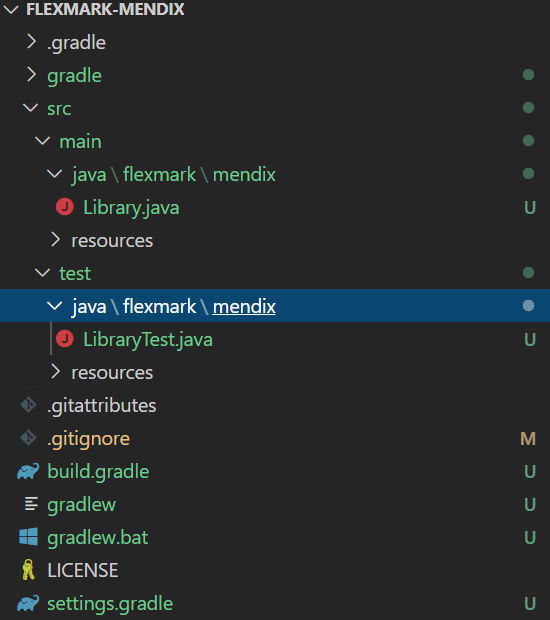
Some important places that we will use are:
- src \ main - this is where the java code goes
- src \ test - this is where the test code goes
- build.gradle - define dependencies, plugins and more
Step 2: Adding a dependency via gradle
The easiest way to do this is to head over to the Maven Repository and search for the dependency you want to add. For example, this is the flexmark dependency On this page there is a code snippet with the command that you can use to add this dependency to your gradle project.
compile group: 'com.vladsch.flexmark', name: 'flexmark-all', version: '0.62.2'
Copy this code snippet and add it to the build.gradle file under dependencies. You can remove other compile dependencies that gradle added automatically, they are just there as an example, but make sure to leave the test dependency in, otherwise the tests will not work.
Step 3: Write and implement an interface to the third party library
Finally, it is time to write some code. You can use any editor or IDE, but I found that IntelliJ works most reliably with gradle. This is important because without resolving the class path to find the gradle dependencies your code will not compile and will throw many errors (and no autocomplete).
Below is a simple interface for converting markdown to HTML and a class that implements it.
package flexmark.mendix;

import com.vladsch.flexmark.html.HtmlRenderer;
import com.vladsch.flexmark.parser.Parser;
import com.vladsch.flexmark.util.ast.Node;
import com.vladsch.flexmark.util.data.MutableDataSet;

public interface MarkdownToHTMLConverter {

 // main method
 String convert(String markdown);

 // factory method
 static MarkdownToHTMLConverter create() {
 return new FlexmarkConverter();
 }
}

class FlexmarkConverter implements MarkdownToHTMLConverter {

 @Override
 public String convert(String markdown) {
 MutableDataSet options = new MutableDataSet();
 Parser parser = Parser.builder(options).build();
 HtmlRenderer renderer = HtmlRenderer.builder(options).build();
 Node document = parser.parse(markdown);
 String html = renderer.render(document);
 return html;
 }
}
Note that classes and interfaces should generally not be in the same file, I only did it for brevity.
Step 4: Writing unit tests
Since this is a library project it does not have a main class. The easiest way to check if something is working is by writing a test. This is actually perfect because it forces us to write tests which we can use whenever we make changes in the future to verify that everything is working correctly.
For the purpose of the post I will add a single simple test. For production usage make sure that your tests cover all aspects of the library that you are planning to use and have realistic input. But do not go overboard, the goal is not to test the library itself, since it is probably well tested already.
package flexmark.mendix;import org.junit.Assert;import org.junit.Test;public class MarkdownToHTMLConverterTest {@Test public void basicTest() {MarkdownToHTMLConverter converter = MarkdownToHTMLConverter.createConverter();Assert.assertEquals("<p>This is <em>Sparta</em></p>\n", converter.convert("This is *Sparta*"));}}
The test can be started from IntelliJ by clicking on the little green Run button. If the tests pass the next step is to package (build) the library so that it can be imported in our Mendix project.
Step 5: Building a fat jar
This feature does not come out of the box with gradle so first we need to install a gradle plugin.
Add the following code snippet at the top of the build.gradle file under plugins (above java)
id 'com.github.johnrengelman.shadow' version '5.1.0'
This adds the plugin to the project and lets us use new commands with gradle. In a command line window type:
gradle shadowJar
This will produce a single jar file that contains all dependencies under build\\libs\\. This process needs to be repeated every time you make changes to the code or dependencies.
Step 6: Shadowing
Shadowing is the process of renaming java packages on byte code level to allow for two packages with the same name to be used in the one java app. This is usually done to avoid version conflicts between two different versions of a package. In gradle packages can be shadowed by adding the following snippet at the bottom of the build.gradle file.
shadowJar { relocate 'org.apache', 'flexmark.mendix.org.apache' }
This will rename all java packages starting with org.apache to flexmark.mendix.org.apache . To confirm that the renaming worked, check the jar file contents with a zip inspector like 7-zip.
To be future proof, it is best to shadow all dependencies, even ones that might not be causing a problem today. Multiple dependencies can be shadowed by adding multiple relocate lines.
Unfortunately, shadowing does not handle libraries that rely on reflection, so if you run into a class loading issue it might be needed to un-shadow the culprit libraries.
Step 7: Using the library in Mendix
Copy the fat jar from build\\libs\\ to your Mendix project directory in the userlib folder.
Then create a Mendix Java action so that the java library can be called from a microflow. The number and type of parameters and return values will vary depending on the use case. Designing good java actions probably deserves a separate blog post. Here I will only mention one trick:
Name the parameters with an underscore at the end. This prevents a known Mendix issue where if a parameter name is a reserved word it will be suffixed in java. The underscore prevents this from happening and is actually not visible when calling the java action in a microflow.
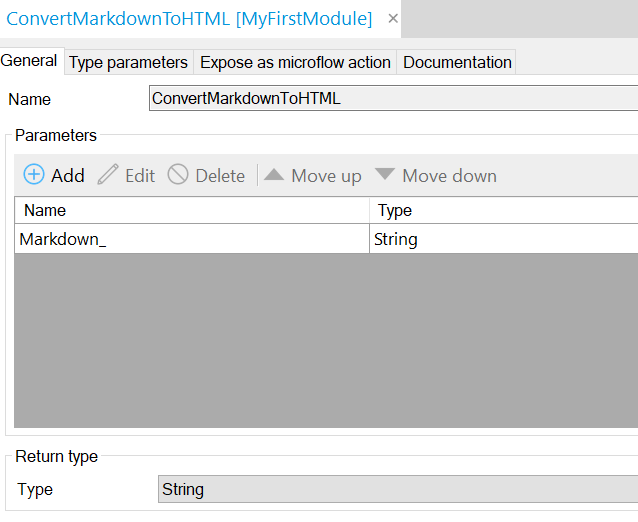
Finally, call the interface that was coded in step 3 from the java action. Because we use a facade to hide away the complexity of the third party library this part is often only a line or two.
import flexmark.mendix.MarkdownToHTMLConverter;
// LINES OMMITED FOR BREVITY@java.lang.Overridepublic java.lang.String executeAction() throws Exception{// BEGIN USER CODEMarkdownToHTMLConverter converter = MarkdownToHTMLConverter.create();return converter.convert(Markdown_);// END USER CODE}
That concludes the step-by-step guide. You can find the entire source code at https://github.com/gajduk/flexmark-mendix.
Wrap up
Adding java libraries to Mendix can be quite tricky. Simply throwing things in the userlib folder is bound to get you into trouble. Over the years I ran into many problems around this which led me to develop the process I described above.
My process is far from perfect though, so if you have any suggestions for improvements please reach out to me via Mendix slack or email, it would be great to learn more.
What is your process for adding third-party dependencies?
I hope you liked this blog post and that it helps you more easily work with java dependencies.
How to add a dark theme to your Mendix app
Yes, I know the title seems a bit too good to be true. Every web app has a lot of custom styling and company branding that needs to be considered when designing a dark theme. Normally, this process takes a lot of time. You have to pick the right color palette, then refactor the CSS to support two different color themes. As a consequence almost the entire CSS has to be rewritten, because honestly nobody truly plans for such scenarios in advance.
So how can all of this possibly be done in just five minutes? Easy, follow the steps:
- Add the Mendix Dark Theme module from the app store to your Mendix app
- Add a nanoflow button (or three) to a layout, navigation or page of your choice
- From the nanoflow call the java script action
JSA_ApplyTheme - Run your app and see the results.
Hopefully you find this module useful, and it helps you build better Mendix apps.
"Wait, wait... you must be asking how this module is actually working. The answer is simple: Magic"
Hmm. It seems like you really want to know. Ok, brace yourselves this might get technical.
The magic
Let me tell you the full story.
One nice winter day I was looking for a way to make the Duolingo website more friendly for my eyes (I'm learning Dutch in case you were wondering). In the past, I have tried several dark theme extensions for chrome and my experience with them was not great. But this time I stumbled upon an extension that worked quite well. Then I thought how much I am tormented every day by all the light Mendix websites like sprintr, appstore and the forum. Turns out the extension was even better for Mendix websites which do not have a ton of animations or complicated styling.

My first idea was to share this extension with everyone, but I am aware that most web users are not thrilled at the idea to install a third party dependency that has access to all their website content. Luckily, after a closer look at the extension it turned out to be completely open source. It even comes with a javascript API so that it can be used from a website without the Chrome extension.
So the module is just a wrapper around this open source library - Darkreader. There was no magic after all 😢
Even though dark reader works pretty well there might be some widgets or pages that need to be tweaked to look even better. Here are a handful of tips, based on my experience of adding dark theme support to a real, working-in-production Mendix app.
Tips
- Start by choosing the primary foreground and background colors. Dark reader will come up with suggestions for you but if picking specific colors based on the company branding will probably look much better. These can be adjusted in the theme options.
- Use the overall settings to tweak the theme to your liking. In my personal opinion, setting grayscale to 0.25 dims most of the very strong colors that Mendix tends to have to an acceptable level without sacrificing too much.
- Invert overly dark or bright images. This can be done by specifying a css selector for the image and passing it in the dynamic theme fix. Check github for examples. Alternatively, some JPGs and PNGs may be replaced with glyphicons, fontawesome or other technologies that support color changing. That is probably yet another reason to prefer icon fonts over PNGs.
- It is a good idea to store user preferences on the
Accountobject. Feel free to use theEnum_Themeenumeration as an attribute type. If you are looking for ways to run the javascript action on load, without having the user click a button, consider the Microflow timer widget. Fun fact, it also supports nanoflows. - Add CSS overrides sparingly. When an element does not look good in a dark theme it is easy to throw in a dark theme css with
!importantand call it a day. But after more carefully checking some offending elements I found that often they had bad css practices like hard-coded inline background colors etc. As it turns out this interferes with dark reader. In that case it was better to refactor the CSS and let dark reader do its thing. I guess you can add dark theme support on the long list of reasons to avoid inline styles. - When applying CSS overrides make use of dark reader CSS variables. This will make it much easier to switch the background and foreground colors in the future. A list of available CSS variables:
darkreader-neutral-background,darkreader-neutral-text,darkreader-selection-background,darkreader-selection-text.
Performance
Dark reader works by constantly scanning your website and generating appropriate dark themed css rules. This can slow down the client especially if there is a lot of dynamic content like animations and charts. There are actually two ways to instruct dark reader not to scan such content:
- ignore image analysis - is specifically for background images
- ignore inline style - will not scan the inline (hard-coded) style of elements (this is specifically for elements that are generated by charting libraries that tend to use a lot of inline styling)
Another, much more extreme option is to ditch javascript entirely and rely only on the generated CSS. I would only recommend doing this if you are sure that your website will not change much in the future, i.e. if the UI was pretty stable for quite some time (think months).
If this is the case for your app, then you can run the javascript locally and export the generated CSS.
DarkReader.exportGeneratedCSS()
You can then add this css to index.html and toggle it with javascript via the disabled attribute.
// index.html, css is disabled by default// <link id="darkreader" href="darkreader-generated.css" disabled="disabled"/>// javascript snippetvar el = document.getElementById('darkreader');var osPreferenceIsDark = window.matchMedia && window.matchMedia('(prefers-color-scheme: dark)').matches;if ( theme == "Dark" || (theme == "System" && osPreferenceIsDark ) ) {el.removeAttribute("disabled");} else {el.setAttribute("disabled", "disabled");}
Conclusion
In this blog post we looked at how to add dark theme support to a Mendix app without having to completely refactor the CSS and spend days in design meetings. My personal hope is that we will see more and more Mendix apps supporting dark theme, especially ones that are publicly available.
Until then, remember you can always use the extension: https://darkreader.org/
If you find the module or the extension useful consider donating to https://darkreader.org/ They truly did a great job with it and deserve our respect.
Progressive Web Apps: Opportunities in mobile interaction | CLEVR
Progressive web apps (PWAs) offers great opportunities for this intermediate form between site and app. In this article, we will look at what PWAs are, how you can develop them in Mendix, and the value they can bring.
Put simply, a progressive web app is a web page that behaves like an app. The technology allows a PWA to work without an internet connection and be added to the home screen of a phone or tablet, without the user having to download it from an app store. A PWA thus offers equivalent performance to a native app, and performs much better than a website in terms of user experience.
"25% of apps are removed from a device after just one use."
Opportunities in customer interaction
Any point in the customer journey where you need intensive digital interaction is an opportunity for a PWA. A PWA is quickly found via the home screen and interaction is quick and intuitive, while the user does not have to download or install anything. This is important because people are installing fewer and fewer apps, and many apps are also quickly deleted. 25% of apps are removed from a device after just one use.

A user usually works with a kind of “hard core” of apps, and in fact would prefer not to install anything at all. This is especially true for people with a device with limited memory, which is already pretty much filled by the standard social media & communication apps, photos and videos. At the same time, users are demanding more interaction. For example, they want to be kept informed through notifications and also be able to view and change their information offline. As far as performance is concerned, users have been spoiled by the tech giants. Whereas a few years ago we were willing to wait 3 seconds for an image to load, now we want to be able to interact with an app or site within a fraction of that. If that doesn’t happen, we are out of there very quickly.
"In industry, we are seeing many PWAs for employees in the field."
Support your process, including mobile and offline
The most appropriate area for the use of PWA is in internal processes. In industry, we are seeing many PWAs for employees in the field. In the Netherlands you can usually assume that a 4G connection is always available, but in the rest of the world this is not always the case. PWAs deliver a much better user experience in those situations and are used to ensure that worklists, forms and documents remain accessible, for example. The Mendix platform already supports many of these types of processes. The addition of PWAs provides a new dimension in this respect. For example, the Product Lifecycle Management System we recently launched with Siemens will be getting a mobile app for quality control of production workflows. This will make it possible for information on semi-manufactured products to be shared directly with the designers.

A similar PWA supports shoe manufacturer Van Bommel in the purchasing of products and materials.
Build faster with greater control
PWAs don’t only offer benefits to users. Building a PWA is similar to developing a website. Building a mobile app for iOS and/or Android is much more work, and also requires expensive specialists. Publishing your app to app stores also takes time and money. We are also seeing that businesses only give limited permission for apps to be installed on their devices. Large organizations often use their own, limited, version of app stores, which you can’t easily get your app into. With PWAs, you don’t have to deal with this, and therefore achieve a shorter time to value. That advantage also applies to updates: you have 100% control and never have to wait for third-party approval.
PWAs with Mendix
Starting in early 2021, Mendix will support PWAs. That means Mendix’s rapid build process will be available to PWAs. A business consultant can take on the entire process, from establishing requirements to delivering the app to a test environment in the cloud. So there is no need to employ software engineers - who are currently difficult to recruit. The consultant builds the data model and creates the screens using drag & drop, i.e. without code. In these, we can then easily build business logic using flow diagrams.
"A low-code PWA that is in production can be modified or expanded by business people or IT administrators, without the intervention of a development team. This provides extra speed and agility."
These indicate what should happen when a user clicks a button, for example, or when a status changes. The app is then ready to be tested. The Mendix platform provides all the underlying technology. Integration with the underlying software such as order management, supply chain, PIM or CRM is also realized quickly in Mendix. A low-code PWA that is in production can be modified or expanded by business people or IT administrators, without the intervention of a development team. This provides extra speed and agility.
Where do PWAs fit into your strategy?
PWAs fit well into the trend that everything needs to be faster and more flexible. PWAs can be a differentiating factor in your digital strategy in several ways:
- Shorter time to market. Flexible, digitized internal processes allow for faster product development and an improved response to changes in your market.

- More digital and innovative thinking. One app project inspires another. Once people see what you can accomplish in a few weeks with a Mendix PWA, the innovative ideas and projects will start coming thick and fast.
- Differentiation and personalization. With PWAs, you easily add interaction to the buying and configuration process to support differentiation and personalization.
- New services. From razor blades to cars and from the hairdresser to the notary: everything is becoming a subscription or digital service. And all those services are supported online with customer portals and apps. PWAs allow you to experiment quickly and with a limited budget, in the search for new opportunities.
Although PWAs are a new functionality in Mendix, the impact on the development process is actually small. Do you have experience in Mendix building interactive, responsive websites? Then building a PWA is hardly different, in theory. In theory, because with a PWA you will probably want to take advantage of the extra features, like offline usage, camera, location data, login and intensive user interaction. Setting this up naturally takes extra time. Low-code platforms like Mendix are being deployed in B2B in a variety of ways, but with the new capabilities, demanding B2C users can also be served increasingly well, and on a larger scale.
20 Mendix Performance Tips (Backed by CLEVR)
Mendix empowers teams to build powerful applications quickly. But as those applications grow in complexity and adoption, performance and strong low code governance become critical success factors.
At CLEVR, our support and expert services teams have worked with hundreds of Mendix apps from small pilots to mission-critical platforms. We know that for business-critical applications, performance is only one part of the equation. If you're also looking to maintain stability, security, and governance as your app evolves, this guide on managing Mendix apps throughout the lifecycle is a great place to start.
In this blog, we focus specifically on performance. Below are 20 practical, field-tested tips to help you build faster, more scalable Mendix applications.
Let’s start at the foundation: your domain model and logic.
Modeling & Logic
1. Minimize Round Trips
Use nanoflows instead of microflows for client-side logic. It reduces unnecessary server communication and improves UI responsiveness.
2. Avoid Large Dataset Retrievals
Always apply filters and use pagination, especially in list views and data grids. Fetch only what you need.
3. Use Non-Persistent Entities Smartly
Think of them as lightweight view models. They help reduce memory use and allow more flexibility in shaping UI data.
4. Pre-Calculate Expensive Values
If an attribute is heavy to compute, consider storing the value instead of recalculating it repeatedly.
5. Split Complex Microflows
Break large microflows into manageable subflows. It makes logic easier to understand, debug, and often faster to execute.
6. Avoid Blocking Commits
Structure your logic with smaller transactions and commit data in a consistent order to prevent deadlocks.
7. Simplify Microflow Expressions
Complex nested expressions are hard to read and slow to run. Break them into separate actions or subflows.
8. Leverage Domain-to-View Mapping
Do not drag your full domain model into the UI. Use non-persistent view models tailored for specific screens.
9. Turn Off Unnecessary Event Handlers
Particularly in background processes or imports. Every handler adds overhead.
10. Limit Use of Reference Sets
For large associations, use linking entities or soft references to improve performance.
Advanced Optimization
As your application scales, these techniques can help push performance even further.
11. Use View Entities (NEW)
Virtual entities defined with OQL are perfect for complex visualizations and aggregated reports.
12. Index XPath Query Attributes
Make sure attributes used in XPath constraints are indexed for faster querying.
13. Optimize List Operations
Avoid manipulating lists inside loops. Use in-memory operations provided by Mendix instead.
14. Leverage Java Actions
For computationally heavy logic, Java can outperform microflows. CLEVR can help you build reusable components.
15. Implement Task Queue or Background Module
Offload scheduled or intensive jobs to avoid UI or runtime slowdowns.
Scaling effectively is not just about performance. It also requires the right architectural decisions and team structures. Explore how low code governance helps you balance flexibility and control.
Frontend & UX
A smooth user experience depends on how lean and responsive your frontend is.
16. Limit Visible Widgets
Use conditional visibility and keep widget trees shallow to reduce page load times.
17. Selective Sync for Mobile
From Mendix 10.19 onward, you can control what data is available offline. Sync only what is necessary.
18. Use Nanoflows for UX Logic
They offer instant responsiveness and eliminate server latency.
Monitoring & Scaling
You cannot fix what you cannot see. Monitoring and proactive scaling ensure your app stays fast.
19. Monitor with Runtime & Performance Bots
MxAssist, Mendix Cloud dashboards, and other tools can alert you to performance issues early.
20. Performance Testing with CLEVR
We help you identify bottlenecks and optimize your application and infrastructure before going live.
Robust monitoring and proactive incident management are essential for business-critical Mendix apps. Discover best practices for stability, change management, and security in our detailed guide on maintaining Mendix business-critical applications.
Need help improving your app’s performance?
CLEVR Expert Services offer audits, strategies, and best practices to get the most out of Mendix. You can also book a free 30–45 minute call with a subject matter expert. No strings attached, just insight.
Learn more
Why Partner with CLEVR?
Performance tuning is more than a checklist. It’s a craft. It requires deep platform knowledge, the right tooling, and a lot of experience.
CLEVR Expert Services provide:
- In-depth performance audits
- Customized scaling strategies
- Best practices from years of Mendix and cloud operationsexpe.
Let your team focus on building features. Let CLEVR make it fly.

A bug free life with ACR: what is ACR exactly?
Hi there, mate! Welcome on board of my ship. I’m taking you on a treasure hunt. Sounds cool, aye? Before we can enjoy all the riches, we have to go through three parts before we arrive at our destination. The first part – which we are about to start right now - deals with recognizing that you, a Mendix developer, are the captain of your own ship. Of course, you need a first mate. Here introduces ACR itself. In the second part of the quest we conquer rough seas, like security, reliability, performance, architecture, maintainability, and project hygiene. We can’t finish a treasure hunt without overcoming obstacles. In part three you better be prepared because their level differs from minor towards blocking. Are you up for the task?

Become the captain of your ship
As junior (Mendix) developer my thoughts were all over the place as I had yet to learn some best practices or to split a task into smaller pieces. I learned from just trying and often failing. Consequently, my work became messy and as the project was organically growing, I tended to forget what I’d done before. Old code that didn’t do anything anymore stayed in my project, I became sloppy with naming conventions and my microflows looked more like a pieces of art than logic made visible. Even though I learned to develop with JavaScript and Java, I quickly realized that Mendix isn’t all that different.
Mendix is a powerful platform and it takes a lot of work out of my hands, but without someone standing at the helm the project goes nowhere. It needs a captain of the ship. It’s up to the developer and their team to design its architecture, to set up security properly, to keep performance in mind, ensure reliability, and doing their colleagues (and future self) a huge favor by creating an application that’s maintainable, clean and understandable in the long run. But even awesome captains are humans and as humans we make mistakes. Therefore, another developer needs to check our work, or in other words: to do a peer review. However, as our project is growing and more entities, microflows, Xpaths, users, etcetera are coming into existence, the more difficult it will be to check on everything that has been done or simply to remember to check on all the best practices throughout the whole application.
Peer reviewing
Imagine, one of your colleagues asks you to do a peer review. You are confident! Yes, there might be many best practices, but when you prepped your team about quality, rules, and techniques to go by, you said: “Did everyone see that? Because I will not be doing it again” making sure that you wouldn’t have to do the same job twice. If by any chance you’ve managed to review all the code whilst wiping the last pearls of sweat from your forehead and patting yourself on the back for your good work, you hear that another colleague committed a big piece of work with Captain Barbossa’s attitude that best practices are more what you’d call guidelines than actual rules.
Meet your first mate: ACR
Wouldn’t it be great if you’d have a first mate that will take the effort of constantly reviewing other people’s work from your shoulders, so you can go back to sailing your ship? This is where ACR comes into the picture. The ACR - Application Code Review - tool is made to simplify the code review process for low-code apps built using Mendix by automating as much of the peer review process whenever and wherever possible. It scans within seconds a Mendix project and detects bugs, performance issues, security vulnerabilities, and more. ACR does this by comparing a Mendix project against a database of development rules based on Mendix best practices and community guidelines.Based on our research of Mendix’ documentation we deducted at least 88 best practices about security and development, and we found 76 best practices concerning (amongst other) community guidelines, and UX design.

Best of all, ACR is available directly on the commit, which means a developer can immediately check the code they wrote themselves long before a potential issue is discovered by one of their peers.
Currently, we have at least 156 rules (and counting!) in our database, which are grouped in categories and/or severity.
Next part of the journey
Congratulations! You just became a pirate captain with an awesome first mate. You are ready to sail out of the harbor. Let’s go.
A bug free life with ACR: the six ACR categories
Welcome back, captain. May I congratulate you once again on your promotion on being in charge of your ship with ACR as your first mate as you demonstrated courageously in part one of our treasure hunt? On this second quest, we are going to sail the six seas, also known as the ACR categories. Did you conquer them already? Then go quickly to the last part of the journey: overcoming minor, major, critical, and blocking obstacles.

ACR Categories
ACR has six different categories, namely security, performance, reliability, maintainability, architecture, and project hygiene. Referring to your experience as pirate captain, I will explain the different types of ACR rules and their importance in the process of developing a high-quality Mendix application.

Security
As a professional captain, you know that on every journey you run the risk of encountering (other) pirates who will try to steal your treasure. And not all treasure is silver and gold, mate! You want to make sure that your crew is sufficiently trained to keep those thieves at bay.
In the case of your Mendix application, your most valuable asset you want to protect is its data and functionality. The ACR security rules’ main task is to make sure you won’t forget to close any back doors where a hacker or unauthorized user may slip in. It will tell you if it has found any security issues, potential vulnerabilities, or unsafe dependencies.
Examples of security rules
- Access rules in multi-tenant apps should lead to CurrentUser;
- Published Rest and Web services should require authentication;
- Constants should not be used for sensitive information;
- Microflow called from the client should apply entity access rules.
Reliability
While you are defying stranger tides, you want your ship to be reliable. Imagine the horror if at one point you must climb the crow’s nest to keep your feet dry before docking.
ACR rules in this category often point to buggy code in your application. Buggy code is code that is likely not working as intended. These rules spot patterns that can cause code to fail, are prone to bugs, or as something the user might interpret as a bug like unresponsiveness or unexpected behavior.
Examples of reliability rules
- Variable CurrentUser should only be used in a user context;
- Expressions for “then” and “else” in an “if” statement should be different;
- Only variables that are not empty should be returned or assigned;
- MM and mm tokens should be used correctly in parse/format date-time functions.
Performance
If you ever find a time machine to the 18th century and got yourself on the run for British soldiers, you want your ship to be fast. Ideally, you want someone to whisper: “I've heard of one, supposed to be very fast, nigh uncatchable” or shout out “It’s the fastest ship in the Caribbean!”. Therefore, you don’t want that any of your crew members forgot to put up the sail which causes you to slow down.
Coming back to the 21st century, likewise, you don’t want to risk that your users or stakeholders go elsewhere, simply because you don’t deliver the performance they expect from you.
ACR performance rules will be your trusted right hand to keep an eye on any (inefficient) code that could slow down your app.
Examples of performance rules
- Loops should not have loops inside;
- Commits should take place outside of a loop;
- Checking for empty on associations should be done without retrieving;
- Not/or expressions in XPath should be avoided when the path goes over an association.
Maintainability
*Sniffs* - what’s that funny smell? Oh no! It seems like you and your crew members forgot to make sure all the food on the ship will last for a couple of weeks and slowly it has started to rot. To make matters worse, you just found out that even though you clearly instructed that only one type of knot should have been used, that five different knots are circling on deck. What a mess. You can’t even blame the rum.

As you don’t want your ship to stink, you also don’t want smelly code in your application. Smelly code probably does what it should, but it’s hard to maintain. As new features are built, smelly code tends to develop into real issues. Rules in this category point to various code smells if it’s simple to fix.
Examples of maintainability rules
- URL endpoints should not be hard-coded;
- Entity should have a maximum of N access rules;
- Exclusive split should have a descriptive caption;
- Styling should be done using sass.
Architecture
Your ship can’t sail if it falls apart in the first big storm it encounters. Therefore, the architectural elements must be well designed.
The same goes for your application. Like maintainability rules, architecture rules point towards smelly code. The big difference is that these violations require a major refactoring of the app to solve its vulnerabilities.
Examples of architecture rules
- Associations should only rarely be cross-module;
- Microflows should not call themselves;
- Inheritance should be limited to 2 levels;
- Entities should not inherit from a system entity;
Project Hygiene
Finally, as a proud captain, you want your ship to be spotless. You feel your cheeks flush if someone would even think of your ship the Dirty Driftwood instead of the Black Pearl.
Therefore, project hygiene rules are all about the cleanliness of your code, like naming conventions, documentation, folder structure, and so forth. It will be easier to find what you are looking for, you don’t have to bother your colleague what they meant, and it’s just more ecstatic for the eye.
Examples of project hygiene rules
- Entity names should be unique across the project;
- Only folders should be the direct children of a module;
- Layouts should be prefixed properly;
- Large entities should have documentation.
The end game
Wow, I couldn’t have done it any better myself. You’re truly becoming a real pirate with your knowledge about the ACR categories. I think you are up for the last part of our quest: The end game, in which you’ll face a whole bunch of severe violations.
A bug free life with ACR: violations and their severity
Hello captain, can you believe we’ve come this far already on our treasure hunt? In part one of our journey, we saw you stepping into your role as captain with ACR faithfully on your side. In the second part of the quest, you steered both your ship and your Mendix application through the six seas, also known as the ACR categories. Now, we are facing the end game. These are ACR violations that could have different levels of severity. If you have overcome these issues, we can finally put our hands on the treasure.
Severity
Next to sailing the six seas of ACR Categories, another way your first mate ACR can organize the rules and the potential violations, is by severity. These are closely related to the six categories.

Blocker
Code with blocking violations should not be deployed to a production system. Period. If not, your ship will sink, the app will crash or corrupt data or hackers (pirates) could gain access to the system or its data. For example, a strong password policy needs to be set. A rule with a blocker severity is always connected to a security rule.
Critical
Critical rules must be fixed as soon as possible. Although your ship may sail and your app may run, these violations point to code that is very susceptible to bugs and performance problems and/or has security vulnerabilities. Security, performance, and reliability rules fall into this severity.
Major
Developers should be careful with these violations. These violations will not crash the application but are likely to cause problems if left untreated, such as lower development speed. In rare cases, violations might be real bugs. Performance, reliability, architecture, and maintainability rules can point out major violations.
Minor
Your ship and app project will go into the wild without any problems. But remember that you shrunk when someone called your precious Pearl the Dirty Driftwood? To prevent this kind of name-calling, look out for maintainability and project hygiene rules that will help you keep your app bright and shiny.
Treasure
What shines in my eye? It’s the treasure! It’s within our reach. Can you see it? It’s a bug-free life! It has been my pleasure to take you on this adventure. Before our ways part, I have one last note with you to share:

One last note
Whether you want to sail the six seas or can’t wait to develop brilliant Mendix applications, time spent on peer reviews that could be outsourced to a tool, might not be time well spent. As we’ve seen, it’s prone to errors, overlooking best practices, repetitive, and may not even your top priority. So, be savvy and get ACR onboard and integrated it into your developing routine.
I mean, you don’t want ACR to say to you:
"This is the day you will always remember as the day you almost caught all the (potential) bugs in your code manually."
Will you? 😉
Application Code Reviewer 2.0 release
The new ACR, but first; the journey
We recently released the new design for the SMART Digital Factory. Our focus was on the Application Code Reviewer, but we also redesigned the Application Model Security tool and the CI/CD solution. It looks great!

Of course, as the product manager, I have seen the project grow from solely designs to becoming the new ACR. One of the dangers of witnessing the entire process is that it might become ‘normal’ as you get used to the small changes made throughout time. Therefore, it is important that you make a comparison between where the product was before and where it is right now, so you see the difference.
The same applies to the rest of the team, it may seem ‘normal’ to them as well. That is why I made that comparison after I opened the new design of ACR. I was blown away, I said “wow”. I feel humbled and amazed when I see what the team achieved in such a short time. And make no mistake, I truly believe we have the best team there is (yeah sorry I honestly think so) so to be amazed should not be taken lightly.
To be clear, when I speak about the team, I am talking about everybody that contributed to this project from designers, to Mendix developers, to the business side, our clients, to our product development team. They all did their part in creating this amazing new ACR.
The new designs are not the result of only hard work. It is the result of a group of people working together as a team, people who laughed, enjoyed themselves and supported each other each day. It does not matter if you work at CLEVR are a Mendix developer, designer or, business consultant, be proud of what you do and who you are, and enjoy yourself, then you will fit right in the team.
That is what I love about my job, I get a front-row seat in seeing the results of what the organization can achieve when everybody works together.
For everybody that worked or is currently working on this project, you can be proud of your work, I sure as hell am!
Let us walk through the changes.
The new ACR
Slick design
We gathered a lot of insights from our userbase and made some overall changes, like new graphs, drop-downs, coloring, styling, etc. it is an ongoing list. You will notice these changes throughout ACR. We hope you enjoy them, and they improve your day.
The dashboard

The left side of the dashboard was a bit discouraging when you first scanned an existing application, the fast number of violations with the severity coloring was not very welcoming. We changed that. ACR now shows you the violations per category for a quick selection. We also included the blocking and critical violations filter so you can quickly identify what is your main priority.
The right side of the dashboard now allows you to quickly switch between relevant trend graphs (yes, we added more graphs). This gives you a quick overview of the project’s development over time.
Below you have a quick overview of the most recent new/fixed violations to make your life even easier.
The violations
But we did not stop at the dashboard.

We made it easier for you to select multiple checkboxes and allow list violations and much more.
Revisions
We need revisions before we scan our app, right? We made it easier to manage them and give you the information you need right away.

Of course, there is much more, but we would not want to rob you of the pleasure of finding it out yourself.
All of this had one end goal, to enable you to develop Mendix application at the speed of light while maintaining the highest quality. We hope that you feel enabled by us to become an even better Mendix developer when you use the new ACR. If you have not tried it out yet, please do a free trial, you will not regret it!
One last thing, I really hope you feel that wow too when you use ACR, it would make us happy.
Getting started with React Native and Mendix
This blog is about the 'Getting Started with React Native' video, presented by Danny Roest from Mendix. You can watch the video here.
In this session, Danny goes over the combination of React Native and Mendix and the implications of that architecture, then proceeds with a demo of how to build a custom native pluggable widget.
React Native and Mendix
Mendix chose React Native mostly because it was adopted so well by large companies and because of the active community that’s working to create components for all kinds of device integrations. React Native also aligns with the component-based architecture of Mendix.
Danny goes over the architecture of a Mendix native app, with detailed explanations for what each component does.


Out of the box, Mendix supports many native capabilities and UI elements, but it also offers the option to customize the UX by leveraging custom widgets, JavaScript actions and custom styling.

{{cta('8876e954-dd4f-4149-851f-d6df8a06714e','justifycenter')}}Building a Timeline widget for Mendix native mobile
In this hands-on example, Danny gave a step-by-step demonstration of how to create a timeline widget based on a popular React Native component.
The main steps in building such a widget are:
- Trying to identify an existing React Native component that can be used as a starting point
- This is the easiest way to get started without having to write Swift or Java code
- Include it in your Mendix project using the most basic example that you can find
- After confirming that this step works you can proceed to
- Connect the widget with actual data from your Mendix application
Commentary
For someone who has been around since hybrid apps were the hot new thing, it’s incredible to see how fast Mendix is moving. Support for truly native apps with over-the-air updates is a killer feature that, combined with the numerous out-of-the-box components, makes Mendix the strongest low-code platform for app development.
On a similar note, if you’ve ever built a dojo widget (I have built at least a dozen), then you’re familiar with some of the issues that came along with it. The new pluggable widget architecture addresses a lot of these issues. Specifically, the ability to use a list of objects as datasource without having to jump through hoops like retrieve over association with JavaScript or sending XPath as string. Even more significant is the option to include other widgets as part of your widget. That makes it really easy to customize the look and feel of widgets within the safety of the modeler, instead of having to do everything with JavaScript/HTML. Both changes are very welcome additions that address real pain points for widget builders.
If you're interested in learning more about what kind of mobile applications can be built with Mendix, check out the showcases of Nutricia and Retourplaza, both built by my talented coworkers at Mansystems.
Mendix workflows: what we know so far
This blog is about the 'Workflow: The Ultimate Springboard for Intelligent Automation' video, presented by Daniel Dam from Mendix. You can watch the video here.
Workflows is a brand new technology being added to the Mendix ecosystem. Think of them like asynchronous long-lived microflows. Where a microflow is blocking and expected to complete in a few seconds, a workflow can span several days.
This makes them perfect for modeling and automating business processes in an intuitive way. They remind me of IFTTT but they’re much more powerful and less technical thanks to the Mendix platform.
Unlike microflows which are modeled left-to-right, workflows have a preferred top-to-bottom direction. Similar to microflows, workflows have activities and conditions. Activities come in two types: user tasks, e.g. show a page; and system tasks, e.g. send an email. One important new feature is the ability to get a result from an open page based on which button is clicked to close the page. This will be great for building approval dialogs, as you can see from the screenshot.
{{cta('8876e954-dd4f-4149-851f-d6df8a06714e')}}Unlike microflows which are modeled left-to-right, workflows have a preferred top-to-bottom direction. Similar to microflows, workflows have activities and conditions. Activities come in two types: user tasks, e.g. show a page; and system tasks, e.g. send an email. One important new feature is the ability to get a result from an open page based on which button is clicked to close the page. This will be great for building approval dialogs, as you can see from the screenshot.
Workflows can have parameters just like regular microflows. In addition, each workflow has a persistent state that includes the status, current step ID, and custom data added by developers to that workflow to support their use case, e.g. orderNumber. The state can be used to store intermediary results from the various workflow activities.
It’s possible to call microflows from a workflow, but not nanoflows. On top of that, workflows can be combined in a hierarchy by calling a workflow from another workflow. To make it easier to start building workflows, Mendix will offer pre-built workflow templates that can be used a starting point and further customized to suit your needs.

Just as with microflows, workflows are a standard document in a Mendix app. They can be built in either Studio or Studio Pro, and are deployed together with the app. A single app can have multiple workflows, and workflows can span across apps by leveraging Data Hub and by calling workflows from other apps that are exposed via REST/SOAP.
For the end user, there will be a central admin area where they can see all their workflows as well as whether any action is required from the user’s side – such as approval. This central repository supports managing workflow tasks, analytics, notifications, and more.
Although this was not confirmed by Mendix, it’s very likely that like Data Hub, workflows will be a separate service outside of the standard Mendix license. No release date was given but I expect workflows to be available somewhere in Q2 2021.
That’s everything we know about workflows so far. If you have some additional insights, please share them with me and I will gladly add them to this post.
Do you have additional questions about workflows or do you have a specific use case already in mind? Let me know via Slack – I’m curious to see all kinds of scenarios that workflows can help with.
Build an automated chatbot with programmable voice
This blog is about the 'Build an Automated Chatbot with Programmable Voice Using Speech-to-Text' video, presented by Jan de Vries and Ryan Mocke from Mendix. You can watch the video here.
“Hey Mendix, when do you expect our next delivery?” Talking to a Mendix application is possibly not the first idea that pops into your head when brainstorming new business solutions. The good news is: it’s certainly possible.
The Mendix platform itself is evolving rapidly. Over the last few years, more AI assistance has been added to the platform. During Mendix World 2.0, more AI-related features were announced, like the static performance analyzer and even a runtime analyzer . One of the benefits of using Mendix is the ease with which you can integrate external services. And that means using AI-driven services in your application is accessible for you as a creator.
Live build webinar
During Mendix World 2.0, Ryan Mocke demonstrated how to build a working chatbot by using speech-to-text and Mendix in less than an hour. And that was even with time left for questions.
A chatbot might seem intelligent due to its human-like skills, but it’s only as intelligent as the underlying database. Ryan starts the session by immediately breaking the romantic idea of a fully functional chatbot that runs on its own, out of the box. I believe it’s good to point this out, as this has been my experience with most AI projects as well.
“To the user, chatbots seem to be “intelligent” due to their informative skills. However, chatbots are only as intelligent as the underlying database.”
Peter Gentsch, AI in Marketing, Sales and Service
During the demonstration, Ryan had to use AWS Alexa, Twilio, ngrok and Mendix to make his solution work. In this architecture, Alexa is responsible for the user interaction via speech-to-text and text-to-speech. Next, the Twilio bot interprets the input and extracts the relevant data. This data is sent to a Mendix application, which determines what needs to happen next and what Twilio’s response should be.

For those of you who have worked with AWS Alexa before, you might think: “why use Twilio instead of AWS Lex, the conversational interface service from Amazon?” During the Q&A, it became clear that using Twilio enables you to build your conversational logic once, while serving it over multiple channels afterwards. In practice, this means that the same chatbot can be used via WhatsApp, Slack, Facebook and many more. By using a service like Twilio, you make sure that your smart assistant works not only via Amazon’s smart speaker.
Takeaways
As Simon Black joined the session later on, both presenters offered valuable insights during the wrap-up. One of the main takeaways is that in general all chatbots share the same core concepts: conversational interfaces always include intents (triggers), entities (the thing you want to act on) and tasks (what needs to happen with the entity). When building a chatbot using Twilio, for example, the chances are that you’ll be able use comparable services as well.
There was also a short discussion on the value of these services. Expectations are that conversational user interfaces will become more of a commodity in the coming years. This is part of Gartner’s prediction that seamless multi-channel interfaces will be standard in the near future. It’s important to keep in mind that people are not looking for a long discussion with their smart speaker. Simon claims that it’s more realistic for end users to ask short questions like “what does mortgage mean?” Because you must admit: even at home, interaction doesn’t go much further than “turn on the lights.”
Next steps
Chatbots will become a more common concept in app development as part of the multi-channel experience. Low code needs to fulfil an important role: making the bot genuinely intelligent. Gartner predicts that apps will leverage the best of all platforms. Think about ordering office supplies via your smart speaker while confirming your credit card details via your mobile device. When using microflows in Mendix, building this logic will be much faster.
In summary, I would definitely recommend watching the video on the Mendix World 2.0 platform. For me, it was unexpected that the Mendix application became the backend workhorse only, instead of the actual user interface. I will definitely dive into this further and explore the powerful possibilities of conversational interfaces with Mendix.
Fostering a scalable, collaborative culture with Continental
This blog is about the 'Fostering a Scalable and Collaborative Maker Culture with Continental' video, presented by Sven Fleischer from Continental. You can watch the video here.
Changing the way software is developed, how applications are created, and how they’re delivered within a company can be quite a challenge – as you might already know. Choosing the right technology can significantly boost your chances of success. But changing technology will not solve the problem on its own. Describing what the transition will look like to service owners, developers, and end users is crucial in gaining buy-in. In most cases, this is not only important – it’s a critical success factor.
Sven explains in detail how Continental is tackling this challenge, incorporating Mendix as the corporate low-code platform with a totally new way of developing and delivering apps to users. The journey started in 2018 and is still gathering speed. I really encourage you to watch the speech yourself: it gives great insights into the thought process, decision-making and consequences at Continental.
In short, here’s what Continental did and still does to bring the collaborative culture of creation into the company. A special team was founded within Continental – not to create all the apps, but to encourage people within the company to be part of a “makers club” – to contribute to the new working culture.
The clear mandate of this team is to create awareness of Mendix technology, foster transparent decision-making processes, and provide guidance to future makers in terms of best practices, templates, reusable modules, and so on.
The team is made up of project managers, enterprise architects, service owners, agile coaches, and internal developers. With these experts involved in projects, Continental can enforce the principles of agile software development, lead team members through the app lifecycle process from prototype to working application, and make sure that platform tooling is applied during development and implementation.
There are great tools especially designed for the Mendix platform to assist developers and operators in their daily work: ATS (to automate testing), APD (to meet performance challenges faster), in combination with AQM from Software Improvement Group (to deliver highly maintainable applications at speed) and ACR (to simplify the code review process).

With this team in place, Continental managed to raise awareness of the Mendix platform, encourage people to contribute to the application landscape and internal communities, and increase adoption rates within the Continental audience. From my point of view, I really enjoy my day-to-day work with the development teams and the discussions about Continental’s vision for the future.
Building apps with beautiful UI design | CLEVR
This blog is about the 'Building Apps with Beautiful UI Design' video, presented by Chris Hodges , Mendix. You can watch the video here.
When we think of interfaces, we only think of digital examples – like apps and smartphones. But what we don't realize is that interfaces are all around us. Most things we interact with have one or two interfaces. To the end user, the interface is the product: it's what we can see and touch. Most users will understand how to use an interface just by getting on and using it.

When we think about app design, we often hear about user experience (UX) design and user interface (UI) design, which can be confusing. While UI design is an important part of the app-design process, it’s only a subset of the much wider field of UX design.
Chris Hodges tells us to look at UX design like an iceberg. While 10% of the iceberg is visible above water, 90% cannot be seen because it lies beneath the surface – it’s what gives the iceberg its structure and stability.
User experience design can be looked at in a similar way: 90% of the effort to create a great user experience for an app lies beneath the surface, in its usability design, interaction design, information architecture and user research.
Much like the iceberg, the remaining 10% is user interface design – the part that the user actually sees and interacts with. Building good apps is not just about creating a great visual appearance. It’s about what goes on beneath the surface as well.
Most designers use these four golden rules when designing user interfaces.

Put your user in control
By putting users in control, we give them a sense of mastery of the user interface. They know all the shortcuts and how they can make the application work for them.

Make it comfortable
By building control and comfort into a user interface, you’ll make the user feel less frustrated using the application.

Reduce cognitive load
Cognitive load refers to the amount of processing power that a user requires to operate your interface. Good UI design requires the least possible amount of cognitive load.

Make it consistent
If we make the UI consistent, we make the app easier to learn. There are three types of consistency to aware of:
- Visual consistency – how buttons look and what colors and shapes are used.
- Functional consistency – the interactive elements on the page and the actions that can be performed.
- User expectations – most users are not newbies and have prior knowledge of apps. So you don’t want to deviate too far from those expectations.
In the video, Chris Hodges shows you how to apply these four rules in your process as a developer building an app.
A big question here is: “Should designers code, or developers design?”. I think very few people can do both. But respect and understanding between designers and developers is crucial. The more we can fill in the gap between the two fields, the better the end result will be.
How to run your own low-code maturity assessment
This blog is about the 'Identify & Address Development Gaps: How to Run Your Own Low-Code Maturity Assessment' video, presented by Mike Tarentino, Dir. Strategic Consulting, Mendix. You can watch the video here.
“Low-code success doesn’t just happen, it’s planned for. While this is true, the fact is that no success can just happen. You need to take a holistic approach to achieve your ultimate goals”.
That’s how director of strategic consulting at Mendix, Mike Tarentino, started the Mendix World session “Identify & Address Development Gaps: How to Run Your Own Low-Code Maturity Assessment”.
Every organization follows its own path to low-code maturity. With over 20 years of experience in low-code implementation, we have identified key indicators that can be assessed to determine an organization’s maturity.
{{cta('8876e954-dd4f-4149-851f-d6df8a06714e','justifycenter')}}
We have combined our experience with the Mendix digital execution practice to deliver an out-of-the-box maturity scan for your organization. As Mike explained in his ondemand session at Mendix World, the maturity model starts with the 4 Ps:
People
The people you choose to fill out your Mendix teams are crucial to your success
Portfolio
Identify the right projects and create a project portfolio of quick wins and high-value
initiatives
Process
Change the way you work by establishing rapid development processes
Platform
Improve operational efficiencies, reduce time-to-market, and foster business and IT collaboration

All of these aspects are vital for low-code implementation, but they are all interdependent. One cannot function at its peak without the other. You need the right people to build items in the portfolio, but the portfolio can only be filled correctly with the right people. Conversely, you can have the brightest minds in the world, but if they are not backed by the right processes, they won’t be able to perform at their highest level.
Implementing the 4 Ps doesn’t happen overnight. Mendix takes a progressive approach, also known as the 3 S’s:
Start
Prove first value quickly (convince business)
Structure
More apps, more complexity, more teams. Start with governance to maintain speed & quality
Scale
Mendix as a strategic component in the IT organization. Governance and onboarding of new members is optimized.

The CLEVR Maturity Scan has taken the 4 Ps, 3 S’s, and 20 years of experience and merged it all into one model, providing the Mendix community with a one-click overview of your organization’s low-code maturity.
Score for Start maturity Score for Scale maturity


In addition to the Mendix maturity model, we can provide your organization with valuable insights. We help you pinpoint your maturity level and provide you with a roadmap for a truly holistic approach to reaching low-code maturity. With our maturity scan, we can help you address areas that need improvement to start accelerating your digitalization.
Find out more about how we envision maturity in our free ebook.
Future of Enterprise low-code
This blog is about the 'The Future of Enterprise Low-Code' video, presented by Sheryl Koenigsberg and Gordon van Huizen. You can watch the video here.
This video, featuring Sheryl Koenigsberg’s interview with Gordon van Huizen about the future of enterprise low-code, addresses many of the new topics raised in the keynote speech. The interview goes from why low-code is booming to how low-code is being used and extended, along with a few examples. It gives context to the new features on the horizon.
I've put together an overview of my main takeaways from the interview:
Low-code is the future of app development and now is the time to digitalize to remain competitive. Particularly during this pandemic, low-code is key to finding new ways to work with customers, partners, or internal colleagues. Low-code allows you to experiment and get solutions out quickly.

Low-code was first used at the departmental level, but now we’re seeing a shift to innovation and experimentation and an evolution in the enterprise, with things like legacy replacement.
Low-code follows the trend on how people interact with systems - from desktop, laptop and mobile into new forms of interactions:
- Conversational
- Voice
- Augmented reality
- Wearable devices
All brought together as multi experience. Not just additional channels, but users communicating simultaneously through channels, switching back and forth, with a backend system that is always there, doing things on their behalf. This really demands a new way of approaching the user journey.
The core principles of low-code are:
- Abstraction, for example through visual modeling, and
- Automation, a new layer with asynchronous workflows and of course new algorithms with AI
Which new domains can you tackle with low-code? What will a maker need to do moving forward? We’ll look at some aspects of enterprise IT:
- Data is less and less part of the app. How to make it easier to discover and leverage data.
- Workflow or process automation is the connection to multi experience and a new high level of abstraction to better talk to the business.
- AI helps us with cognitive services, natural language processing, intelligent OCR, and a lot more.
When it comes to the low-code developer, Mendix removes the details they don’t need to worry about. We see they don’t build things from scratch anymore, but they instead build sophisticated solutions out of building blocks. These building blocks are not just widgets, modules or interfaces, but a complete set of features called app services that are valuable when contextualized to a specific domain, and even more valuable when multiple app services are bundled together in a template. And don’t forget that app services and templates are still customizable and expandable to specific domains, user needs, and new technologies to come.
Concrete examples of fine-grained app services to full-blown templates:
- 3D visualization
- Natural language processing
- Document processing. Analyze, apply natural language processing, use workflow to determine where it needs to go next, human or machine.
- A standard product life cycle (PLM) software product that will be launched in Q3 2020¹
Is this a big investment for Mendix and does Mendix have all the domain and technology expertise?
- No platform vendor is ever going to cover all domains and technology
- Mendix envisions an eco-system. Contributors can add app services and templates to a marketplace
Note¹
Mansystems/Flowfabric is currently in close collaboration with Siemens to develop PLM. It will be the first partner-developed product template within the marketplace for Mendix Industry Solutions. Gordon did not give a product template example in the interview, which is why I added the one I’m familiar with.
Introducing low-code to industrial automation with Mendix
This blog is about the 'Introducing Low-Code to Industrial Automation with Mendix and Industrial Edge' video, presented by Volker Franze, Thomas Haneder and Oliver Narr from Siemens. You can watch the video here.
One step further
The industry is in motion. The industrialized world has come a long way since the introduction of steam-powered machines in the 18th century. Since that time, which is now labeled as “Industry 1.0”, the world has changed dramatically. When electricity and the first electric motors were developed, the industry took a huge step forward. “Industry 2.0” took over and steam-powered machines died out. With the development of electronics, computers, and IT, Industry 2.0 was no longer an accurate description. Logically, “Industry 3.0” followed. That's where we are now, right?
{{cta('8876e954-dd4f-4149-851f-d6df8a06714e','justifycenter')}}
No, not really. We are currently transitioning to the next stage in the industrialization: “Industry 4.0 ", where digitalization is one of the most important and inevitably expanding sectors and, in my honest opinion, a business-critical step that needs to be taken to be able to cope with competition in the market.
Why this blog?
The motivation to read into this is certainly keeping up with the increasing speed that industrialization gained after steam machines were first introduced. The 18th century, where the journey of industrialization started, was not that long ago. We live in interesting times, full of new developments in research, new technologies, and a growing need for digitalization. Businesses around the globe realize that their technologies will be redundant in the foreseeable future.
Interfaces, monitoring, flexibility, efficiency, cloud computing, latency, reliability, and economics – they're all buzzwords that describe the current moment.
Data plays a crucial role in modern industry. Different systems solve different custom use-cases – that's how it's been for a long time now, and it's also one key component in Industry 4.0. Sounds contradictory, right? Well, that's until you think one step further and explore the vast world of Industrial Edge by Siemens, which is featured in the video. Industrial Edge aims for combination of IT and OT elements by allowing for modular extension. The technical aspects are quite interesting, as well, but I would like to highlight one of the core statements here:
“On the shop floor, everyone is a maker!”
What does that mean for you and your business? Well, the Mendix philosophy of enabling “citizen developers” to create basic applications on short timelines, bundled together with their expertise in working machinery wields huge potential: growing your business by giving everyone the chance to make data more accessible and understandable. A lot of high-tech machinery already comes with built-in sensors and some functionality for interfacing data, but it might be hard to manage. With Industrial Edge, you can set up a core app running on site to display dashboards or graphs. Use cases could include service workflow optimization, visualizations for bills of material, shifts plans or maintenance routines. A beneficial side effect is also the delegation of computing power to several units instead of letting one cloud computer do the heavy lifting on mountains of generated data. On-site apps can refine the data locally and send that refined information to cloud or IT systems.

A whole new world
Even though I work in this field, it's hard to keep up with the pace of change – but it is never too late to get on board! Physical machinery will always need to be refined for cost and load-efficiency, which means that digitalization topics will be sticking around for a long time to come. With the development of new artificial intelligence (AI) systems for these machines, this trend will not stop. It will probably continue to change, as it has done in the past, but it is always better to keep up with trends in smaller increments. Imagine having to update an Industry 1.0 site to Industry 4.0. Watching this and the other Mendix World 2020 entries is worth your time, and I highly recommend that everyone tap in, have a chat in the Mendix Slack channel, check out the active community in the forum and, of course, get in touch with CLEVR to find out how you and your business could join in and benefit from the fresh wind Mendix and Siemens Edge bundle are bringing in as they approach pioneer digitalization in new and exciting ways.
Building WCAG Compliant Accessible Apps
This blog is about the 'Building WCAG Compliant Accessible Apps' video. You can watch the video here.

One of the leaders within Mendix, Chris Hodge, strives to makes apps accessible to everyone – and in this session he brings this important topic to the forefront. He explains exactly what web accessibility is, and shows some hands-on ways to make apps accessible for all.
Accessibility is often forgotten about or seen as an afterthought. But neglecting accessibility means missing out on business opportunities by excluding people. More importantly, a properly accessible application will benefit all of your users – think of it as inclusive design.
This is a topic close to my heart. I challenge YOU to close your eyes and discover your own app with a screen reader! Once you understand what it entails to be dependent on assistive technology like screen readers, it really makes you appreciate your own capabilities and motivates you to make your apps usable for everyone.
The good news is: with Mendix, that’s possible. Though Mendix will give you the tools you need, it will not automatically ensure your app complies with all the details of the WCAG 2.1 AAA Guidelines. You’ll still need to design and implement these in your own app.
At CLEVR, we’ve created many public governmental apps. A good example: for Het Kadaster (the Dutch land registry and mapping agency) we’ve built a fully accessible app to change plot borders. So if you need help, please don’t hesitate to reach out to one of our consultants.
"Go Make It For Everyone"
Beat the new normal of application development
Low-code application platforms like Mendix have transformed the world of software development. More and more organizations have chosen a low-code-first strategy. The speed, agility, and efficiency it brings have become the new standard. The low-code market has rapidly matured, with Siemens' acquisition of Mendix being the final piece. The last, unjustified doubts around the possibility of building the most complex and secure applications disappeared and have been replaced by trust.

Low-code platforms clearly play a critical role in accelerating the development of any single application. However, low-code platforms can also be too much of a good thing, especially when organizations don’t have the right processes in place to manage simultaneously developing lots of complex applications that need to be deployed at scale.
Low-code platforms can also be too much of a good thing
The issue organizations face today is that, while it’s getting simpler to build and deploy applications, accomplishing that goal consistently at scale remains a significant challenge.
The new normal
The pressure is on for developers. Everyone in the organization is looking to developers when it comes to delivering high-quality applications at high speed. With the new standard, stress to keep pace with the speed of low-code has become the new normal. The benefits in terms of speed of application development that low-code development inherently provides can easily be lost when development, testing, and management processes are out of control. It is a paradoxical problem that needs a solution. Developing complex applications at scale without compromising speed and quality requires organizations to think through the tools and processes they're using across the entire development chain.
The 3-plus-1 low-code QA approach
Developers need to be equipped with the right tools to beat the new normal. Mendix recognizes the power of our tools, which are exclusively designed for its platform: ATS (to automate testing) and APD (to rise performance challenges faster), in combination with AQM from Software Improvement Group (to deliver highly maintainable applications at speed). There is one tool missing in this combination: ACR - Application Code Reviewer. This tool simplifies the code review process for low-code apps built with Mendix. That’s how the 3-plus-1 low-code QA approach was born. It covers the optimization from code creation to testing, as well as the bigger picture of maintaining a new application in the context of the whole application landscape.
QA tools for testing and maintenance are crucial to ensuring quality, but to simultaneously speed things up, it's even more important to improve code – and low-code – creation. You have the opportunity to accelerate in the early stages of the development process. Almost all development teams do peer code review, even on a low-code platform.
The real challenge IT leaders face is finding a way to make the code review process as painless as possible for everyone.
The only way to achieve that goal is to ruthlessly automate as much of the peer review process, whenever and wherever possible. Developers who want to beat the new normal need to embrace code reviewing.
First-time-right coding
Even though Mendix's low-code platform reduces the amount of code that needs to be manually developed, developers still need to check each other’s code. The issue is finding a way to achieve that goal that doesn’t slow down the application development process. The best thing about platforms like Mendix is that more applications can be developed faster than ever. Of course, that also creates more code that needs to be reviewed. Application Code Review (ACR) is a cloud-based tool developed by CLEVR and specifically designed to accelerate the code review process for low-code applications using the Mendix platform. ACR is a personal assistant for developers and provides real-time support during coding.
Consistent code that different developers can understand quickly accelerates the development process. Continuously reviewing other people’s code only to find the same errors over and over isn't just discouraging; it also has an adverse effect on morale. ACR solves this problem by providing a platform that automates much of the code review process using the same best practices defined by the Mendix platform. ACR is available directly on the commit, which means a developer can immediately check the code they wrote themselves, long before a potential issue is discovered by one of their peers.

The benefits of finding errors faster
Too many organizations underestimate the business value of getting code right the first time. High-quality code not only improves the speed at which applications are built, it makes them easier to maintain and support. If organizations want to reduce costs, it's important to start checking the code as early as possible. After all, the sooner errors are found, the less painful and expensive it is to fix them for all concerned.
By embracing the 3-plus-1 low-code QA approach, developers can beat the new normal of deployment stress that the speed of low-code development brings.
Thanks to the real-time feedback on coding, the developer learning curve is steeper than ever before. Improving coding skills has never been this easy. By using ATS, APD, and AQM in combination with ACR, you can guarantee quality without sacrificing development speed.
Say good-bye to the new normal and welcome to the world of right the first time.
Clicking a button guide for dummies | CLEVR
Imagine you want to click a button on a website. How would you do it? Intuitively everyone knows how to do this. But what if you want the button to be clicked programmatically so that for example it tests that the app is working correctly. In that case, a more rigorous set of steps for clicking a button is needed. Here is a simple algorithm (in pseudo-code) to accomplish this task:

Although this algorithm seems to work for most straightforward cases it is nowhere near robust enough for real world use. Let us look at some of the situations where this algorithm fails.
1. Button is outside of the viewport
This is a very common scenario, but is easy to overlook. Often, at the start of testing/development there is very little data so that when showing a list view or a template grid it all fits neatly on one screen. But as more data is added elements start to flow out of the viewport. In that case a user needs to scroll to the button before clicking it. Scrolling can be emulated with selenium, but it is often the responsibility of the developer to ensure elements are scrolled into view.
2. Button is not rendered yet
As is well known, Mendix is a single page application. That means that different pages in a Mendix app are not really different HTML documents that need be loaded, instead the entire UI is managed dynamically with javascript. This means that waiting for the document to load, a standard practice with Selenium, does not work, as new element can be added later. Therefore when clicking a button we need make sure that we wait until the button is added to the DOM. A more advanced version would also check if the button is visible for the user by checking for display: none.
3. Button is rendered but disabled
When a button is clicked in a Mendix app, usually other buttons are disabled for the duration of the action. When a button is disabled it is still possible to move the mouse over it and press the mouse button, but the actual click event is not triggered. For the click function to work properly it needs to detect if a button is disabled and if yes then wait until it is enabled before clicking.

4. Button is obscured by other elements
So far, it was not important where the mouse was moved to, so long as it is inside the button. By default selenium moves to the middle of the button, except when it doesn't. This creates a problem because sometimes, e.g. in navigation menus, part of the button is overlaid behind other elements. In that case it is important to click the part of the button that is visible, as clicking a part that is overlaid might actually trigger a click for a completely different button (see screenshot).
This is a quite tricky issue. For the navigation menu one approach would be to target the icon instead of the entire button. One has to be careful since not all buttons have icons.
A similar problem is with check boxes and radio buttons where the center of the div (marked with a red x in the screenshot) happens to be between the clickable parts. (very interesting bug to troubleshoot as it only occurs for labels with a certain width)

5. Button HTML structure changes
When building an app with Mendix, developers do not have to worry about HTML. The Mendix platform takes care of this. However, what many developers oversee, is that this HTML often changes when new Mendix versions are released. This has implications for testing, especially for the selector that is used to identify elements.
To give only one very recent example, for some time all widgets had the following attribute data-button-id="10.Testpp.Page.actionButton2" - notice the last part which matches the widget name in Studio. Unfortunately, after the Mx8.8 release that attribute was changed and now only shows data-button-id="10_191" which is not as useful anymore when it comes to identifying widgets.
Such changes happen constantly so if you ever decide to upgrade the Mendix version of the app it will happen that many of your tests are no longer working correctly. This is especially troublesome since when upgrading to a new Mendix version you want to test that the app remains functionally the same, and that might be hard to do if your tests are not working.
Final algorithm
Based on all the above points the algorithm can be updated as follows:

This version of the algorithm although much better is still far from perfect and there are other edge case cases that need to be addressed. To name but one, what if the button is outside the viewport, but scrolling to it leaves it hidden behind a sticky header/footer. Intuitively a user would scroll a bit more until the button is visible. However, selenium tries to minimize scrolling so it will never scroll more than necessary. The outcome is that the click does not register or even worse, some other element from the header/footer is clicked by mistake (another fun bug to troubleshoot).
It turns out that the simple task of clicking a button is not as simple. At CLEVR we struggled with many of the above issues on a daily basis. This led us to develop the Application Test Suite, a testing tool that abstracts away the complexities of selenium and lets you focus on actual functional testing for your Mendix application.
How can ATS help you to click a button?
One of the built/in functions in ATS is Click Widget and it implements the algorithm above, but also includes special handling for many other edge-cases and browser and selenium inconsistencies. Moreover, all ATS functions include a so called Magic wait routine. This intelligent wait understands the Mendix runtime and makes sure that no clicks are attempted if Mendix is busy with opening a page, running a button action, refreshing with conditional visibility and many other scenarios.
In addition to click widget, ATS has over 200 other functions available out of the box and built specifically for Mendix widgets. For every function we guarantee compatibility between Mendix, Selenium and browser versions. If you are testing Mendix applications, value your sanity and would rather spend your time creating test cases than fighting with the inner workings and version inconsistencies in Selenium and Mendix HTML structure, then give ATS a try.
Thank you for reading this blog and happy testing!
Low-code application performance diagnostics for Mendix
A doctor for your Mendix application is now in the cloud
There is nothing more frustrating to users and developers alike than performance issues. As applications become increasingly complex, finding the root cause of any performance issue becomes more daunting than ever. To address that issues, Mendix in collaboration with CLEVR provides a unique set of tools as a cloud service, dubbed Application Performance Diagnostics (APD) for Mendix, that enables developers and IT teams to pinpoint the source of any performance issue.
IT teams should think of APD as the equivalent of a physician for your Mendix applications. APD for Mendix has more in-depth knowledge of your Mendix application than most developers could ever dream of having. APD for Mendix knows precisely where your application is hurting, which saves everyone involved a lot of pain, time and money.
APD for Mendix just as importantly enables IT teams to embrace best Mendix DevOps processes that ultimately make it faster to deploy high-quality applications. The choice is yours. IT teams can either learn to live with their existing application pains or they can consult a local physician in the form of APD for Mendix that, like all doctors, is sworn to secrecy.
Best of all, our APD for Mendix physician keeps learning about potential issues that might afflict Mendix applications. In fact, the latest release of APD for Mendix provides access to a bevy of additional new capabilities.
Release of APD
Formally known as the CLEVR APM tool, CLEVR today announced the formal launch of a rebranded APD service for Mendix low-code applications as a complement to third-party application performance management (APM) platforms. The APD moniker better reflects the capabilities of the CLEVR offering at a time when APM platforms continue to expand and evolve.
We’re now moving beyond simple monitoring because our strength is in knowing where in the Mendix model the cause of the performance issue lays. We believe both APD and a third-party APM platform can be used side-by-side. APD for Mendix, however, goes beyond tracking simple metrics such as CPU and memory utilization.
APD focusses on
- Collecting statistics of your Mendix app usage, both from the app (server) and the users (browser),
- Using the statistics to see how your app performs,
- Finding places to improve or spots that need immediate attention,
- Seeing trends and outsmart issues before they even surface,
- Recording user activity, so developers can see what is happening on a lower level.
What’s new?
The new name (APD) is not the only thing that has changed.
- APD is a part of CLEVR SMART Digital Factory. As such, APD has an open API
- With the growth of our customer base, we felt the need to work on the architecture and scalability of APD
- Off course, we keep adding support for the latest Mendix releases
- We improved the already extensive safeguards in the APD agent
From the release notes
The following features changes are a bit more technical but also worth mentioning
- The SMART Digital Factory can use APD functions like statistics snapshots and recording via the open API
- Also, for SMART Digital Factory users APD can now run your unit tests from our CI/CD via the APD agent
- The APD browser agent has been redesigned to communicate through the runtime agent, instead of directly to the APM manager, to reduce network bandwidth consumption.
- The APD manager has an improved queuing mechanism to handle higher loads
- The APD data cleanup has improved performance
- The APD runtime agent also has many small improvements
- Off course we keep adding support for the latest Mendix releases
- The safeguard for memory usage is enhanced to not stop our APD service on occasional memory spikes
The Mendix Application Performance Diagnostics tool (APD) is a commercial add-on service for the Mendix Platform that enables IT teams to diagnose performance issues right away.
To schedule a demo of APD, please visit
{{cta('4f0048f8-8e68-4436-92cf-2e25d7847f6e')}}
Common date time parsing mistakes made in Mendix
Date time operations is one of those topics that are ubiquitous in programming but do not receive a lot of attention. It is somehow expected that humans intuitvely understand time since we deal with it so often in everyday life. As a result, many developers make silly mistakes when working with date time. In this blog post, we will look at some of these mistakes specifically when parsing/formatting date time.
Sorted by frequency of occurrence from least common to most common (and subtle).
A: Month vs minute
Lowercase “mm” stands for a minute in an hour, but uppercase “MM” stands for the month in a year. It is easy to mix them up.
Examples:
parseDateTime('2015-05-21', 'yyyy-mm-dd')
parseDateTime('13:37', 'HH:MM')
B: Now wait just a second
Lowercase “s” is for seconds but uppercase “S” is for milliseconds which is used much less often.
Example:
parseDateTime('13:37:01', 'HH:mm:SS')
C: What day is it? Well it's the 42nd of February of course.
Lowercase “dd” stands for day of the month, but uppercase “DD” stands for day of the year. Although there are valid use-cases for the latter the lowercase version is used much more often.
Example:
parseDateTime('2020-02-11', 'yyyy-MM-DD')
D: It is 17 PM o'clock
Lowercase "a" is used to denote AM or PM. It should only be used in combination with lowercase "h" which is in the range 1-12. Using "a" in combination with the uppercase "H" makes little sense.
Example:
formatDateTime($DateTime, 'HH:mm a')
E: Fun with hours
Uppercase “H” is in the range 0-23, while “h” is in the range 1-12. On the other hand, “K” is in the range 0-11 but “k” is in the range “1-24”, which is non-standard and should be avoided.
Lowercase “h” is usually used singly (rather than requiring exactly two digits), and always in conjunction with an AM/PM specifier – as otherwise, it’s ambiguous. “H” is usually used as “HH”, so that 5 am is represented as “05” for example.
Example:
parseDateTime('13:37', 'hh:mm')
F: Who are you calling week?
This one is by far my favorite. Unlike all other errors on this list which are fairly easy to detect with a few tests, this one is almost impossible to detect. That’s because, for most dates, week year (uppercase "Y") and year (lowercase "y") give the same result. To catch this bug testers need to write cases for the last week of the year for the specific years where the value of y and Y are not the same. I will not even try to explain the reason behind this. If you want to learn more check this link.
Example: formatDateTime(dateTime(1987,12,31)', 'dd MMM YYYY') → results in "31 Dec 1988" 🤯🤯🤯
I hope you enjoyed reading this post and that it helps you make less mistakes in the future!
Automatic code reviewer for Mendix
The automatic code reviewer for Mendix checks for over 100 rules in different categories such as security, performance, and maintainability. There are also around 40 reliability rules whose goal is to find bugs in your app such as the ones above.
Don't wait, sign up for free and experience the power of automated code reviews first hand: https://content.mansystems.com/acr-trial-request. No credit card required.
How to speed up your Mendix app: when and where to run logic
Welcome to the third and final part of this series that focuses on application performance. To recap, part 1 outlined a high-level process for dealing with performance concerns. Part 2 showed how important xas requests are and how to improve page load times by reducing their number.
The focus in this part will not be on eliminating requests, but rather on deciding when and where to run logic that is needed when opening a page.
Do you remember the sample application from the last post? As a reminder, it was an app that supports the planning of tasks per different resources. In the last post, we managed to reduce the page load time from 5 seconds to 1.8 seconds by eliminating xas queries. This was done by either grouping requests or replacing microflow calls them with nanoflows.
Exhibit A
Next, we continued by running another APM analysis of the page load time. The analysis showed that almost half the page load time (750 milliseconds) was spent in a single microfow named CalculateChartValues. That was the next obvious target for optimization.
The microflow CalculateChartValues aggregated the number of tasks by category and priority. The data was then presented in a nice chart¹ like so

Let's inspect the open page microflow. It uses an NPE as a container object, and a lot of information is attached to this NPE, including the chart value.

Main open page microflow.

Each action calls the same microflow (below) but with different arguments

Each action call calls the same microflow (below) but with different arguments
And finally at the bottom of the call stack:

The code is tidy and organized. There are no obvious performance red flags such as commits inside loops or slow retrieves. On the contrary, the database retrieve is followed nicely by an aggregate function. This is a well-known optimization technique in Mendix and the query in question took only 5-10 ms on average. That time would be hard to improve upon. Indexes would probably not help, and might even make things slightly worse².

Each retrieve+count is taking 10 milliseconds. In total this added up to 500 milliseconds.
But when we look at the APM measurements the root cause for the long duration becomes obvious. Note that there are 10 different categories. Multiply this by 4 different priorities and we get a total of 40 combinations. The retrieve+aggregate although generally a good practice, was making things really slow. In this case, it would be much better if all the tasks are retrieved once at the start and then counted using a combination of filter+aggregate as shown below

Replaced retrieve+aggregate construct with filter+aggregate
By running this new version through APM we see an incredible speed up. The microflow execution time drops from 500 ms to 17 ms³.

By retrieving at the very start and then using filter+count the total time dropped to just 17 milliseconds.
Now you are probably thinking that it is not possible to go lower than 17 milliseconds.
But, what if the chart values are not calculated at all when opening the page. What if the chart values are calculated in advance and stored in the database. In that case, when the page is opened the chart values only need to be retrieved from the database.
There are two main way to go about storing calculated values in the database:
- Use object events (before/after commit/delete) to keep track of any changes, or
- Periodically re-calculate the values
Clearly option 2 does not give accurate statistics all the time⁴, but it is much easier to implement and is less likely to cause additional performance concerns elsewhere in the app (where the objects are committed/deleted). Also, with option 2 we can happily reuse our microflow for calculating the chart values so the chances of introducing an error are smaller. The end result:

The fastest option is not to calculate anything at all and instead retrieve pre-calculated values from the database.
Now that is a nice speedup, wouldn't you agree. This exhibit illustrates how performance can be improved by shifting the time of execution. Instead of calculating values when a page is opened, those values can be calculated beforehand and stored in the database. This is an excellent approach for improving page load time. Sometimes, however, it can be really hard to pull off as is the case in
Exhibit B
We all know that virtual attributes are bad for performance. They run every time when an object is retrieved regardless if the attribute is needed or not. So we cringed when we saw that the most executed microflow on the server was one for virtual attributes.

In addition to profiling microflows, APM gathers statistics on the number and duration of all microflow executions. This statistic makes it easy to figure out what are the most time-consuming microflows.
At first glance, this looked like an easy win, because refactoring the use of virtual attributes is really simple: precalculate them in a before or after commit event and store them as a normal attribute. However, in this case, that was not possible. It turns out that, the virtual attribute was showing a user-friendly string of the relative time from when a task was finished:

Obviously, this could not be done in a before commit event because the string needs to change all the time. Another alternative would be to use a scheduled event, but that would probably be even more inefficient as values will be updated all the time even when they are not needed at all.
The solution became clear when we figured out that the string was not used in excel or rest calls, but only on two pages. Instead of calculating a string value in a microflow, we could build a small custom widget that shows the relative time. This was reasonably easy to do. It turned out, that we didn't even have to do that as the format string widget already has this option.

With this final optimization in place, the page load time of the task application was finally below 1 second. Don't forget, at the start, the page took on average 5 seconds to load.
This performance issue perfectly illustrates the conflict between performance and maintainability. Building a widget or customizing an existing one might seem like only an hour or two of work. But what if the customized widget gets a new version with some critical bug fix or a great new feature. More time has to be spent porting the customization again. If there is a change in the Mendix client API, this might completely break the application. Using custom widget (or customized app store widget) might offer better performance, but that comes at the cost of more maintenance effort.
That concludes the exhibits. You can download the source code from the Mendix app store.
Summary
To summarize, in this series first, we discussed when and how to approach performance concerns. Then we looked at xas queries and some tricks on how the number of such queries can be reduced. Finally, in this post, we saw how load times could be reduced by shifting the computation in both space and time (calculate in custom widget instead of a microflow and precalculate).
Thanks for taking the time to read this blog post, and I hope it helps you develop faster apps!
¹In the attached samples, I reproduced the same conditions from the original app, but I replaced the chart with a simple table. This choice of representation is not relevant to the performance optimizations that are done.
²Adding an index to a database does not always improve performance as described nicely in this article.
³It would be fair to mention that in this simplified example, the entities have only a few attributes and associations. The speedup in real-world situations would probably be less dramatic. Finally, when retrieving objects in bulk like this, one also needs to consider if the result will fit in memory. This can be problematic if there are many or large attributes or lots of objects.
⁴As developers, we need to make sure that it is acceptable for the precalculated values to be slightly inaccurate when using this method. In addition, this has to be communicated to the user (e.g., by showing a message) to avoid any confusion. In some cases, if real-time numbers are needed you can add a refresh button that triggers a recalculation on demand.
How to speed up your Mendix app: xas
This post is a part of a series on application performance. To quickly recap, the previous post presented a high-level process for handling performance concerns in a Mendix application. It also outlined how and what metrics to gather to best diagnose performance problems.
The focus of this blog post will be xas. Now, some of you are probably wondering,
What on Earth is xas?
As you probably know, Mendix apps are what is called Single-Page-Applications (SPA). This means that navigating between different screens in the app does not reload the whole page, which gives a feeling of responsiveness. Of course, the layout of the screen and the data still has to be loaded somehow. This is done using xas, a Mendix technology for executing dynamical queries (which is part of the Mendix Client API).
Mendix uses xas to get pages, layouts, snippets as well as data (both by association and from database). Furthermore, xas is also used to commit and delete persistent objects and also to invoke microflows from the client. Given how ubiquitous xas queries are, it is no wonder that they are very important for the performance of your application.
How does xas affect the performance of my Mendix application?
HTTP is used to relay xas requests from the client to the server. This means that each request has at minimum to travel to the server, be processed and then travel back to the client.
First let us look into the travel time. Depending on the location of the server and the client the round-trip time alone can be significant (50 to 400 milliseconds). Quite often, one xas request leads to another, for example after loading a page with a data grid, next data for the grid needs to be loaded. Unfortunately, the data for the grid can only start loading after the page has loaded. The result? If a request to the server takes roughly 100ms, then loading the page will take at least 200ms because the requests have to be done sequentially, i.e. one after another.
Next, let us turn our attention to the second big performance factor in xas request: the time it takes for the server to handle the request. One of the most important things to note here is that there is only one database and a limited number of servers (in my experience usually one). If the server/database is already busy with other xas requests, then it will take longer to handle new requests. That is why it makes sense to minimize the number of xas requests.
Enough theory, lets see an example
As promised we are going to look at real-world application where I together with a colleague worked as a performance consultant. For obvious reasons, I am not allowed to use the analysis and model of the real application, so instead, I rebuilt a minimal working example (MWA). This MWA has all the essential features of the real application that I want to focus on in this post.
Exhibit A
The performance issue in this application that we were to fix was simple: the most used page in the app took an unacceptably long time to load. To give you an idea, the page loaded in 5 seconds when only a single user was logged in. This jumped to 8 seconds on a normal day with a handful of users. Just imagine having to wait that long for a page to load. This was driving the employees crazy, and so the company asked us to help. The page in question hosted a planning-timetable. Various resources were booked by time slots as shown below (the real app looked much better)

And so me and my colleague set of. Our end-goal was to bring the time down to 1 second.
We started by measuring the performance using APM. APM has an excellent feature for analyzing xas queries that measures the true load time as experienced by the user. It turned out that most of the time (roughly 3 seconds) was spent loading the time slots data! The data was loaded in many small xas requests, each of which only took a few hundred milliseconds or so. But, put together this amounted to several seconds. That was a strong clue. A quick inspection of the model uncovered the following design for the timetable

Can you see what was causing the performance issue? Can you think of a way to fix it?
Have a minute to think about it then read along to see what we did.
The problem is that the tasks are loaded per resource. This made a lot of sense from a design perspective and was the simplest possible solution. However, it was a considerable strain on performance as it resulted in many individual xas requests to load the task for each resource separately. You don't have to take my word for it, see for yourself in this nice visualization by APM.

An APM analysis of the page load time, showing the individual xas requests being made and their duration as experienced by the user.
The fix was to reorganize the page so that the time slots are loaded in a single big request. To preserve the layout we used some simple css¹. The resulting page model was

At this point, our confidence was high that the fix will give much better performance. But we did not go by gut feeling. Instead, we deployed the fix and ran it through APM again to check that it was really working. The results speak for themselves:

The load time of the page went from 1.7 to 0.7 seconds. The results for the real application were even more dramatic. The time slots load time went from 3 seconds to 200 milliseconds. This brought the total page load time from 5 seconds down to just over 2 seconds.
Before continuing with the next exhibit, let me point out that this is a classical example of simplicity vs performance. To improve the performance of the page we had to introduce additional complexity. Thus, it is very important that it was backed by exact measurements from APM.
Exhibit B
Encouraged by our success, we went on a mini crusade and to eliminate all unnecessary xas requests. What follows is something I am sure every Mendix developer can relate to.
The page had a nice message that showed the full name of the logged-in user. As is well known in the Mendix community the full name is not a property of the System.User entity, but is a property of the Administration.Account entity. So to display the full name, one needs to obtain a reference to the account object. In the application, this was done with the following microflow

The database retrieve is a very simple solution, but results in an unnecessary request to the database. Because Administration.Account is a specialization of System.User the $currentUser variable can be directly cast to an Account. This is an old trick that I picked up at Mansystems and I think it is worth sharing

This gets rid of the database retrieve, but we are still left with the microflow call. Surely, there is no way to get rid of it. Or is there?
It turns out that since the release of Mendix 8 there is. The trick is to use a nanoflow in place of a microflow as a data source and use a javascript action to get and cast the current user. The javascript in question is only a few lines long and is available in the app store.
/**
* Gets the current account from the session.
*
* If the currentUser does not exists or is not of type account returns empty
* @returns {MxObject}
*/
function CurrentAccount() {
// BEGIN USER CODE
return new Promise((resolve, reject) => {
try {
if ( ! mx.session ||
mx.session.getUserClass() !== "Administration.Account") {
resolve(); // return empty
return;
}
mx.data.get({
guid: mx.session.getUserId(),
callback: function(currentUser) {
resolve(currentUser);
},
error: function(error) {
reject(e);
}
});
} catch ( e ) {
reject(e);
}
});
// END USER CODE
}
This makes it possible to completely eliminate the xas request as confirmed by APM.


Incredible isn't it? The end result is a nice speedup of the page load time from 168 (using database) to 42 milliseconds (with nanoflow):

To be clear, the idea is not to demonstrate how to retrieve the current account, but more broadly how performance can be improved by replacing microflows with nanoflows. Honestly, with the introduction of javascript actions, there is almost no logic that can not be ported to a nanoflow. In the real application, we managed to shave off 400 milliseconds by replacing a few microflow calls with nanoflows. At this point, the page was loading in 1.8 seconds.
That concludes the examples. You can download a project with both examples from the app store.
Summary
In this blog post, we saw how minimizing the number of retrieves can greatly speedup loading pages. This can be done for example by replacing a microflow call with a nanoflow or grouping several retrieves in a single request.
Stay tuned for the next blog post in the series. To be continued...
¹ In our case, the css relied on the fixed ordering of resources. Inspect the app or check the source code for all the details. An alternative approach would be to flag the last object in the row or add dummy objects to signal the start of a new row (e.g. a task that always starts at 6 AM).
How to speed up your Mendix app?
Building applications is hard. Building fast applications is even harder.
Why do we even care about speed?
The reason could not be simpler: Faster applications have higher chances of attracting and retaining users¹. Below is a nice chart the shows how user conversions drop as response times increase.

User conversation rates drop off sharply as page load time goes up. Based on real data from Walmart. The actual conversion rates are unknown thus the missing axis, but the relative proportions are exact. Credits to https://www.webloungedesign.com/development/how-and-why-to-optimize-the-image-on-the-site/
Some of you might argue: I don't have to worry about conversion rates, mine is a business process application, my users have no choice, they have to use it. Apart from the users having an awful experience (which is a reason enough IOP), one also has to consider the time and costs of the user, or in this case the employees. For example, if a clicking a button or opening a page takes 10 seconds and a user does it 100 times a day, then 15 minutes of the day is wasted in waiting.
But that's not the end of it. There have been many studies which show that if users are frequently waiting for longer times (typically over 5 seconds) they are likely to switch to doing something else while waiting (e.g. checking phone). The probability increases the longer the users have to wait. By the time users are back to check on the progress a minute or two might have elapsed. This can easily turn 10 seconds to a minute and 15 minutes to 90 minutes a day wasted because the application is slow to respond.
How to build a fast Mendix application?
The simple answer is: You don't. This might seem contradictory considering how I just explained that speed is very important, but hear me out. Speed is important but that does not mean it has to be part of every user story. The simple reason is that during development it is hard to predict which parts of the application will be slow. It has been shown, time and time again that programmers are terrible at predicting performance bottlenecks.
That is completely understandable if we consider that most applications today are built on top of a complex ecosystem with multiple "black-box-like" layers of abstraction and extensions. Furthermore, it is virtually impossible to predict how performant a certain design will be in the real world using real data. The only way to say anything about performance with certainty is to deploy the solution and measure the performance in the real world.

Credits to https://xkcd.com/1691/
Even if programmers could somehow predict performance issues it still might be a bad idea to spend time optimizing during regular development. To repeat a quote that all programmers probably know already: Premature optimization is the root of all evil. One of the main reasons for this is that performance optimizations introduce complexity in the application.
Over time as the application grows, more and more premature optimization is implemented. This makes it progressively harder to maintain the existing code and add new features to the app. In other words, the complexity that arises due to performance optimizations, starts to conflict with other software quality metrics such as maintainability, testability, usability and other bilities. So now we have a classical dilemma, the application needs to be fast and therefore needs to have performance optimizations, but at the same time optimizations hurt our ability to maintain the application and add new features.
The solution...
is to avoid premature optimization on gut feeling alone. Instead, deploy the application and measure the performance with real data and real users. Based on the measurements pick the most used and slowest parts of the application and optimize those. As is common in many activities, the 80/20 rule applies here as well, i.e. it is likely possible to remove most (80%) of the performance problems with only a small effort (20%).
Since the performance optimizations are based on real data and only implemented where really necessary, the amount of complexity introduced in the application is kept to a minimum.
How to measure the performance of a Mendix application?
As mentioned before the performance measurements need to be done under real conditions with a control group of users or with all the users. You need to monitor what the users are doing and how long it takes to load pages and process clicks. Based on this data you can prioritize which pages and microflows to optimize first. Remember that we are looking for activities that take a long time to complete, but also activities that happen often.
For example, an excel upload that takes 30 seconds sounds terrible. But if it only happens once per day then the most you can save by optimizing it is 30 seconds. In most cases, this is not worth the development effort. On the other hand, if opening a certain page takes 3 seconds, but it happens 1000 times per day then it is probably worthwhile to invest some effort and bring the loading time down. If the developers manage to drop the loading time down to 1 second, then the total savings are more than 30 minutes per day!
So what you want to measure is: duration of microflows and page loads as well as the number of times the microflow is called or the page is loaded. It would be even better if one can see directly how much each action in a microflow and each widget in a page contributes to the response time.
Tools
There are many ways to monitor performance for a web application. The simplest way is to manually add log statements. Clearly, this does not scale well and pollutes the code with distracting log statements. A better way is to use a tool for monitoring. Mendix is java based so tools for monitoring java also work for Mendix application. Such tools include JMX, AppDynamics and NewRelic. However, these tools work on the low java level of functions and classes and it takes extra effort to relate the metrics to the Mendix level of microflows and pages.

Another option is to use APM a performance monitoring tool built specifically for the Mendix platform. Out of the box APM gathers and reports metrics on the load times for pages and microflows (average, total and 90 percentile²) as well as numbers of execution. On top of that, it shows the duration of each action in a microflow and each HTTP call while opening a page. All this information is organized and presented logically on the Mendix level of pages, widgets, microflows and actions. This makes it extremely easy to determine which parts of your application are having performance issues.
Summary
This blog post is a part of a series focused on performance. It presents a high-level process for handling performance concerns in a Mendix application. It also outlines how and what metrics to gather to best diagnose performance problems.
In the next two posts, we will look into concrete performance problems in a Mendix application. I will show you how to detect performance bottlenecks and how to fix them.
To be continued...

Why Mendix + Siemens is greater than the sum of the IoT parts
After some initial hiccups, the rate at which organizations are investing in Internet of Things (IoT) project to digitally transform their organizations is starting to rapidly increase. Organizations of all sizes are discovering that instrumenting processes by adding sensors to everything from medical equipment to generators provide access to not only more actionable intelligence, it also sets the stage for applying machine learning algorithms in ways that will drive a forthcoming Industry 4.0 revolution.
One of the early IoT pioneers is Siemens, which as one of the largest conglomerates has a product portfolio spanning everything from medical diagnostic equipment to locomotives. As part of an effort to make it simpler to build IoT applications for that massive portfolio, Siemens has launched two strategic initiatives. The first is creating a MindSphere Cloud, a platform-as-a-service (PaaS) environment based on the open source Cloud Foundry project that can be deployed on multiple public clouds, including Amazon Web Services (AWS), Microsoft Azure and Alibaba cloud.

The second strategic Siemens initiative was spending $730 million in cash to acquire Mendix, a provider of a low-code application development environment that runs on top of the same Cloud Foundry base as MindSphere Cloud.
At CLEVR, we couldn’t be more pleased about the scope of the opportunity these investments represent for our customers. Mendix has always provided the ideal framework for enabling developers and business teams to collaboratively build “smart” applications. Extending Mendix smart applications into the realm of IoT, however, requires different types of user interfaces, application logic, data integration, connectors, and eventually machine learning services. In addition, the sensors relied on by IoT applications to collect data don’t generate the business-level events that a Smart App can listen to and act upon. Sensors emit raw data that needs to be first cleaned before patterns can be detected. The processing of that data will generally need to occur at the network edge before it can be combined with data from other systems. Once that’s accomplished, additional application logic and advanced forms of predictive analytics then need to be added to automate IoT processes in near real time.
The MindSphere platform simplifies a lot of this effort via a cloud-based service that not only provides IoT connectivity, it also includes asset management, timeseries storage, event management, data processing, and analytics services. Mendix then provides the visual development tools that translate all that lower-level data into analytics and predictive models that can be infused with machine learning algorithms to apply artificial intelligence (AI) to IoT applications.
Mendix notes that organizations across the spectrum are already using its platform to build a wide range of IoT applications. An airline company employs an IoT application to shows where equipment is located based on the next task required of an engineer. A festival organizer delivers personalized services via sensors and wristbands. The only limit to how IoT can be applied to either accelerate or automate a business process is the imagination.
At CLEVR, we’re prepared to help organizations to tap into the innovative ideas of their employees and customers to bridge the physical and digital world in ways that create a truly transformative customer experience. We’ll not only work with your team to build those applications, CLEVR is committed to making sure your team gains the skills needed to build and deploy IoT applications on their own anytime and anywhere they find a need.

Adding Application Test Suite to a CI/CD pipeline | CLEVR
There are many great resources on the topic so just a short explanation: Continuous integration refers to the practice of creating a build as new code is committed and running automated tests against that build to verify that everything works correctly. Continuous delivery is the ability to automatically release any new code, usually with a single click.

In a way continuous integration is the basis for continuous delivery by 1B requiring that the application can be automatically deployed in order to run test which in turn 2B provide evidence that new code does not break the application. The primary focus of CI/CD is automation.
How does ATS fit in CI/CD?
The Application Test Suite (ATS) is a low-code tool for automated testing on GUI level, specialized for Mendix applications. As such it can provide great value to development teams by frequently running a so called regression test suite. ATS has two options for setting this up: 1B schedules and 2B the ATS API.
Schedules is a light-weight alternative for CI/CD that is meant for small companies. It requires minimal set up and no external infrastructure. The scheduling and configuration is all done on the ATS platform itself and alerts can be sent when the tests finish. On the other hand, the ATS API offers a much more versatile approach for automating the testing process. As such it is geared towards large companies that have multiple apps and require more control and a centralized place to manage and monitor the whole CI/CD pipeline.
Smart Digital Factory
To help companies that want to incorporate CI/CD in the development process Mansystems has launched the concept of the Smart Digital Factory which comes with a set of tools specifically geared to Mendix development such as ACR, ATS, AMS and APD. The toolkit includes a CI/CD pipeline solution that comes with out of the box support for many Mendix related task such as creating deployment packages, creating and restoring backups and runningautomated tests with ATS. The toolkit is great for companies that are committed to the Mendix platform and do not want to invest resources to set up and maintain their own infrastructure.
ATS Jenkins plugin
That all said, as part of the dev team for ATS, I am aware that many users of ATS already have existing infrastructure for CI/CD. So in this blog post I want to show how to integrate ATS into your existing pipeline, with specific focus on Jenkins. I choose Jenkins because of its ubiquity.

Although Jenkins is very popular it can be quite overwhelming and not easy to extend especially for people with no coding experience. In order to enable everyone to use ATS in combination with Jenkins I decided to write a custom Jenkins plugin. On Github you can find both the source code and the plugin package.
In order to run an ATS test case or test suite with this plugin you only need to add a single build step to Jenkins and specify the application id, an API token and a job template ID. No additional configuration and no explicit HTTP requests or XML parsing.

Optionally, failed tests can be automatically rerun. Forcing tests to fail at least twice is a good strategy to deal with flakiness. To understand why, I recommend reading this great post. When executing an ATS build step, if the tests fail the Jenkins build will also be marked as failed. Additionally, ATS will log information to the console, which relates the build to jobs in ATS.

Installation
This plugin is installed manually. To do this, go to your Jenkins dashboard and navigate to

Under Advanced you should see the option to upload a file. Click Choose file and then Upload.

Now you can add the build step Run ATS tests to your Jenkins Build.
Summary
The motivation for this blog post was twofold. First, I wanted to develop a Jenkins plugin that is simple to use and requires no coding skills. The plugin package is free to use for everyone. Second, by making the plugin open source I hope to provide a starting point and guide for people looking to integrate ATS into other CI/CD tools.
Thanks for taking the time to read this blog post, and I hope it helps you develop great apps!

How SAP and Mendix can accelerate your s/4Hana migration
The path most organizations will prefer to take when it comes to digital business transformation is always going to be the one that provides the most flexibility for the future. In environments that have invested heavily in SAP applications, that almost invariably means upgrading to SAP applications running on top of the SAP HANA in-memory database.
The challenge organizations face is that while they need SAP applications to provide the foundation for mission-critical business applications, they also need to be able to quickly create applications that will differentiate themselves from rivals. After all, customizations and extensions are how organizations create the flexibility and agility required to truly differentiate themselves.
S/4HANA
The challenges SAP customers face when migrating to the latest iteration of SAP applications, however, is substantial. Only 16% of SAP customers have migrated to S/4HANA, which is required by 2025. As part of that process, new and existing extensions and customizations have to either be added or re-implemented to run on top of the SAP HANA in-memory database. Organizations can deploy S/4HANA today with a “clean core”, an SAP best practice, while using Mendix to customize the environment by creating extensions that run side-by-side.
Once migrated, both S/4 and the associated Mendix apps run on the same HANA database. In fact, Mendix is the only low-code platform to run natively on the SAP HANA database. That’s crucial because SAP applications are extremely rigid. As a service that is offered by SAP of the SAP Cloud Platform “SAP Cloud Platform Rapid Application Development by Mendix“ opens up a clear migration strategy based on a SAP offered development stack, using a common security and governance model, delivered via support for HANA.

SAP S/4 applications
Customizing SAP applications has historically required a massive investment in professional development skills. Now Mendix is the only application development platform that enables developers and business executives to collaboratively build and deploy digital business applications leveraging all the critical data stored in SAP applications. In effect, Mendix teaches those massive SAP applications how to dance to the music of a modern digital business process!
To facilitate the building of those applications SAP makes it possible to take advantage of a low-code approach of Mendix, which require much less development expertise to create unique processes and workflows. The best part is those extensions can run in their own environment apart from the core SAP S/4 applications.
SAP HANA Data Management Suite
One of the primary benefits of the SAP Cloud Platform RAD service by Mendix is the simplified access to the SAP HANA Data Management Suite for real-time analytics processing. The ability to embed real-time analytics into applications will surface the critical actionable intelligence required to drive new classes of digital business applications.
A second major benefit is that amount of data that can be accessed in memory substantially increases. As Intel Optane DC persistent memory becomes available, it will become a lot more common for development teams to find themselves accessing SAP HANA databases with 6TB of data or more that can be persistently accessed in memory to drive near real-time applications.

The low-code approach to building these applications enable by Mendix make possible for cross-functional teams within organizations to iterative develop new classes of digital business applications that without SAP HANA would not have been possible to build. Rather than waiting for professional developers to craft what they think how a digital business process should be constructed, business users working in enterprise environments can collaboratively share their insights and expertise as low-code applications are built at a higher level of abstraction than traditional development tools.
In some cases, advanced end users will be able to use visual tools to build applications on their own within the context of a set of guidelines defined by IT operations teams.
There’s a global shortage of developers that limits the number of applications any organization can build at one time. As organizations look to embrace digital business process transformation, the size of their application development backlog is starting to increase. There simply are not enough professional applications developers to keep pace with the demand for new applications. By employing Mendix to build applications at a higher level of abstraction, the rate at which applications can be built and deployed substantially increases as professional developers and business users collaboratively build more applications faster. Mendix uniquely allows development teams to both reduce the time and application cost of digital business transformation.

Mendix ATS is the answer to your manual testing problems
When you are developing applications in an Agile manner, continuing to rely on manual testing simply doesn’t make the grade anymore. It’s easy enough to test new functions during an agile sprint. Things become intensely problematic, however, when those functions and every element of the application that has been previously developed- needs to be tested over again, otherwise known as regression testing. The challenge most development teams run into is that as the application increases in size, they simply run out of time to run all the regression tests required if they are relying on manual testing processes.
The only effective way to overcome that issue is to automate tests whenever practical. Test automation not only saves lots of time running those tests, it also frees up application testers to focus on more critical tasks.
MENDIX APPLICATION TEST SUITE (ATS)
Given that need to automate an ever-increasing number of tests, it’s not surprising that test automation tools are one of the hottest categories in all of application development. There’s no shortage of testing tools to choose from, but if your organization needs to automate the testing of low-code applications built using the Mendix low code platform, we’re confident you’ll agree that the Mendix Application Test Suite (ATS) sets itself apart in terms of both the quality of the tests that can be run and the ease at which tests can be constructed.
TEST AUTOMATION TOOLS
To better appreciate the unique capabilities of Mendix ATS, let’s first consider the current state of application testing tools. Most of the test automation tools that execute tests at the graphical user interface level fall broadly into two categories.

The first category are tools such as Selenium Webdriver that require coding skills to set up and configure a framework, as well as analyze, debug and maintain test cases. These types of tools are generally made available for free via open source projects. They provide a high degree of freedom in terms of the type of tests that can be constructed. The issue is they are quite labor intensive to set up and maintain. Most organizations need to hire specialists to maintain testing environments built using these tools. Not only does that get expensive, business leaders, end users and other non-technical stakeholders are also not likely to understand test cases developed in code, let alone be able to contribute to creating and running them in any meaningful way.
At the other end of the spectrum, there are testing tools such as Ranorex, Tosca and TestComplete that abstract away most of that complexity. These commercial tools are typically supported by a vendor that has created a testing experience that works right out-of-the-box. Not only do these tools require a minimal amount of skills to set up, they are also more accessible to non-technical users because they rely on high-level functions to run tests. The downside, however, is that most of these tools are not optimized for a specific platform. In fact, the number of test functions supported tends to be limited. Any extensions made to optimize these tools or test specific functions in application specifically for a platform such as Mendix requires either a programmer or tester with coding skills to develop them. The paradox is that despite the limited number of functions supported, some of these tools provide so many options to configure that it’s roughly akin to being presented with a cockpit without ever having flown a plane before!
Ideal testing environment
In our opinion, a testing environment ideally should:
- Make it easy to create, set up, and run test cases quickly;
- Be simple enough for everyone on the development team to understand and use
- Keep the time required to maintain test cases to an absolute minimum.
Let’s look at how Mendix ATS meets those requirements. As a cloud-based service, Mendix ATS substantially reduces the amount of time required to set up and configure a testing environment. There’s no need for expensive specialists to spend weeks setting up a test framework. Development teams can literally start creating and running test cases in minutes. Improvements, fixes, and maintenance of the overall framework are automatically delivered via regularly scheduled updates.
A built-in recorder function in Mendix ATS makes creating test cases simple. In sharp contrast to other record and play back tools, those recordings within Mendix ATS result in a script consisting of high-level functions specific to Mendix being created that act on Widgets. Of course, these functions can also be used to manually build a script, if that is what you prefer. Having functions on the Widget level means there is no need to try to create a robust locator for a certain web element, then write some code to act upon that element such as clicking it, or setting a value, and subsequently guess how long to wait before the page is ready for the next test step. Functions such as ‘Click Widget’ or ‘Set Value’ require just a few parameters, either recorded or manually added, and you’re good to go! Better still, all these functions have a built-in smart waiting mechanism, so tests don’t fail right away or, worse yet, wind up taking way too long to execute.
Those high-level functions also result in the development of scripts that everyone on the team can easily understand , including those who are not all that tech-savvy. That capability will go a very long way indeed toward improving collaboration across the development team.
Finally, Mendix ATS greatly reduces the time and effort spent on test case maintenance. Every test automation engineer that has ever worked with Mendix has experienced the frustration of getting a test case up and running, only to discover a certain Widget is technically changed in an upgrade of the Mendix Modeler. In terms of functionally and visual appearance nothing seems to have changed in the application, but under the hood, something has clearly changed. Test cases break down and development needs to start all over again. Analyzing the problem, building new locators, and then repeating that for every instance of this widget is a giant pain! Fortunately, there are two ways Mendix ATS enables developer teams to work around these issues.
First off, functions in Mendix ATS are backward and forward version compatible with the Mendix platform. If you use a function that addresses a certain widget, that same function, with the same set of parameters, will work for that Widget across all versions of the Mendix runtime that are officially supported by Mendix*. Upgrading to a new modeler? Using different modeler versions in different environments? No problem, you have one script that works on every version.

A second way Mendix ATS addresses this is that with a few clicks of a mouse sections of a test case can be modularized. These so-called extracted actions support input and output parameters and can be easily reused across many test cases. If something changes in the way your action should address the application, fix that issue only in the extracted action itself, and every test case that uses it will be fixed as well.
As great as all that sounds, there’s one other thorny issue development teams may encounter even within Mendix ATS. Development teams could easily encounter a situation in which the recorder doesn’t recognize your custom-built Widget, or you need to do something else that Mendix ATS does not yet address at the widget level. To counter this, Mendix ATS is not restricted to the functions on the (standard) Widget level. Mendix ATS also allows development teams to build their own functions. That can be accomplished either out of its standard building blocks, or you can go ‘wild’ with Selenium-level actions and JavaScript execution.

Load test your Mendix application | CLEVR
The success or failure of any application development project almost invariably comes down to performance. No matter how useful or cool an application may be, if it takes too long to run end users won’t adopt it. Months, sometimes even years, of coding can easily wind up being all for naught.
Because of that fundamental fact of application development life, we at Mansystems obsess about performance. We like to make sure things are done right the first time every time. That is why as a Mendix Performance Specialist I get especially excited about things like the load testing tools developed by the Application Performance Management (APM) research and development team.
In this blog post, we’re going to cover the critical role load testing plays in ensuring a great application experience is both attained and maintained.
What is Performance Testing?
Performance testing is important because it provides insights into how an application behaves and performs. Performance testing enables development teams to test response times, processing times, and throughput rates. Just as importantly, performance testing plays a critical role in helping development teams to determine if the infrastructure capacity available is sufficient to achieve a performance goal.
Naturally, there are different types of performance tests spanning different aspect of the application. In this blog post, however, we’re going to focus specifically on load testing.
What is Load Testing?
Load testing is the process of placing additional demands on an application, system, or device and measuring its response. It involves increasing the load on the system until it reaches a limit consistent with what would be expected should that application be deployed in a production environment. As the load on the application increases, load testing tools provide sights into resource usage, thresholds, and overall throughput.
To automate the process of generating those loads, researchers at Mansystems developed a load generation bot specifically designed for low-code applications developed using the Mendix platform. That tool not only tracks protocol messages that are sent between the browser and the Mendix runtime, it also feeds data into the Mendix APM platform.
Now, development teams can precisely control how loads are generated and even record and playback load scripts. Everything from Mendix login security and Mendix 7 object hashes to mapping Mendix identifiers from responses to requests is all automated. Load tests can be based on either user count or throughput. During the test, we can interactively change the number of users or the requested throughput. A timer links multiple protocol messages to the links that users click on to keep track of user experiences. Timers are created automatically via the same agent running in the browser that starts the recording.
Best of all, because we use the same agent everywhere, we can use our multi-tenant cloud manager to connect to bots running on-premises or in the cloud. The agent includes our bot software to allow development teams to record and playback in their own modeler for development and testing purposes without ever having to configure a bot themselves.
Beyond Load Testing
Load testing often gets mixed up with endurance, volume, scalability, spike or stress testing. While many forms of testing incorporate load testing, development teams should have a distinct process for different types of testing scenarios, including:
- Endurance testing relies on load testing tools that are run for an extended time period to identify, for example, memory leaks.
- Volume testing focuses on large volumes of data.
- Scalability testing measures the ability of the application to scale up or scale out as different functions are invoked.
- Spike testing relies on load testing to verify application stability as system activity and the number of concurrent users increases over time.
- Stress testing simulates the behavior of the application beyond peak load and normal conditions.
What Can You Expect from Us?
In this blog post, we showed the importance of performance, the different types of performance testing, and how we can do load testing with Mendix Apps. Development teams, of course, can always rely on a Mansystems Performance Specialist to conduct any type of performance test they want. We naturally subscribe to agile testing methodologies to ensure quality, repeatability, and to minimize costs, accurate estimates of time spent testing. In the meantime, remember to test early and often!
Worldwide expansion software with a service
AMERSFOORT, NETHERLANDS – July 29, 2021 – CLEVR, the company that helps enterprises accelerate their digital transitions through the enormous power of low-code and no-code development solutions, today announced the launch of an international expansion of the CLEVR brand and the company’s unique business model.
When Mansystems and Flowfabric, two leading Mendix partners, merged to create a superpower in services and software development, they named the combined company CLEVR. The company now employs a hybrid business model, equal parts solution and services, that it calls Software with a Service (SWAS). The model is designed to assist the legions of people around the world involved in the daunting task of digitalizing enterprises: CIOs and enterprise architects, product owners, medium-sized-business owners and IT service providers.
Developing with low-code and no-code platforms is among the hottest trends in tech, and widely recognized as a way to dramatically accelerate and simplify software development. The CLEVR team relies on the Mendix platform, recognized by research firms Forrester and Gartner as a world leader in low-code and no-code. Not only has CLEVR accumulated years of expertise creating problem-solving software apps with Mendix, but the company now employs more expert Mendix developers than any other. Despite the hype surrounding so-called citizen developers, these experts supply the knowledge, experience and creative thinking enterprises need to realize the full benefits and value of low-code and no-code tools.
“There is a silent revolution happening in software development, hiding in plain sight,” said Angelique Schouten, who took over as CLEVR CEO in March. “And that’s the rise of low-code and no-code, a visual approach to software development with the power to accelerate the world’s digital transition. However, I believe many of the low-code and no-code companies are selling a false promise. Low-code and no-code by itself is not the solution to all your challenges because you still need to consider security, architecture, infrastructure and performance when developing software applications. If you use low-code and no-code solutions and don’t consider these areas, you’ll run into enormous problems when apps become more complex, start to scale and support business-critical processes.”
Part of CLEVR’s business is offering professional services and assisting companies – in financial services, energy, government and manufacturing – to create dynamic and useful applications that advance at a high velocity their own or their customers’ digitalization efforts. CLEVR helped the City of Rotterdam build greater functionality around a video-call application that enabled residents to communicate with their local government digitally during the pandemic. With CLEVR’s assistance, the service eventually featured a document exchange, payment services and tools that allowed citizens to transact business, such as register births and marriages, by enabling them to identify themselves through DigiD, the Dutch government’s digital ID system.
The future of fashion and retail with Mendix
A cloud-native product lifecycle management system developed by CLEVR, the fast-growing technology solutions company, is now on the SAP Store.
Building on a rich history serving brands such as Marlies Dekkers, Van Bommel, and the Amsterdam Fashion Institute. CLEVR combines deep fashion and retail industry knowledge with market-leading expertise in Mendix low-code to deliver a solution that accelerates the design to sales process. Mendix DLM for Fashion and Retail:
- Uses a digital twin to innovate and reduce physical sampling.
- Provides a single source of truth that aligns teams.
- Cuts time to market.
Low-code powers the future of fashion
Produced under an OEM deal, Mendix DLM for Fashion and Retail harnesses the flexibility of low-code to power the future of fashion. It integrates with your system landscape (e.g., SAP ERP) and allows you to connect silos, improving collaboration both internally and with suppliers. Modernizing the process from design to delivery.
With integrated 3D modelling, you can go straight to e-commerce with photo-realistic product images. Capture, mine, and reuse design and production data to make the products of tomorrow. And deliver them to consumers on the platforms of the future. With personalisation being a trend in retail and fashion, this keeps you at the cutting edge.
Jeroen Hanekamp, CLEVR CEO, said: “We are proud of the technical and commercial quality of the Mendix DLM for Fashion and Retail solution, this recognition by SAP underlines that.”
Hanekamp noted the close partnership between CLEVR and Mendix. This is based on decades of experience that allows CLEVR to leverage the Mendix platform’s strengths, to meet industry challenges now and in the future.
Available in more than 200 countries and territories, the SAP Store is the online marketplace where customers can find solutions from SAP and trusted partners. Providing real-time access to innovative solutions that can digitally transform your business.
CLEVR combines expertise in both standard software and low-code solutions. “Our customers are global leaders focused on delivering the products and services of tomorrow. CLEVR helps them build the future – by harnessing our software and industry expertise,” said Hanekamp.
CLEVR and Mendix will be showcasing the solution at retail’s big show, NRF, in New York in January 2023.
The CLEVR Way to Change: CEO Jeroen Hanekamp Discusses Diversity, Inclusion, and Innovation
In today's interview, we have the privilege of hosting Jeroen Hanekamp, the CEO of CLEVR, a leading company in the world of digital transformation. Known for his dynamic leadership, Jeroen has been instrumental in shaping CLEVR's culture and strategy, with diversity and inclusion at the forefront. As in this month we commemorate International Women's Day, Jeroen shares his insights on the importance of gender equality, the strides made so far, and the challenges that lie ahead. He also highlights how diversity and inclusion are not just moral imperatives but strategic advantages that drive innovation and problem-solving within CLEVR.
This conversation is a testament to CLEVR's commitment to fostering an environment where everyone is valued and celebrated. Let's dive in and learn how we can all be more CLEVR in our pursuit of a diverse, equitable, and inclusive world.
A warm welcome to Jeroen Hanekamp. We're happy to have you with us today as we delve into an issue that is pivotal for our times – diversity and inclusion. Let's begin on a personal note. Your eldest daughter aspires to be a doctor, a profession that has seen a significant shift in gender balance in the Netherlands. How does this influence your stance on equality?
Jeroen Hanekamp: It's truly a source of inspiration to observe the strides we've made since the time Aletta Jacobs shattered stereotypes to become the first woman to acquire a medical degree in the Netherlands, almost a century and a half ago. Despite formidable opposition, she blazed a trail for future generations, demonstrating the power of resilience and determination.
Seeing the progress we've made since then is truly inspiring. It strengthens my belief that change is possible, even in the face of great adversity. But it's also a reminder that progress doesn't come easy. It requires continuous effort, courage, and commitment. This belief strongly influences my stance on equality. We have made substantial strides, but there's still more ground to cover. And this isn't just about my daughter or women aspiring to be doctors; it's about everyone, regardless of their gender, having equal opportunities to pursue their dreams.
Aletta Jacobs also campaigned for women's right to vote. It seems that today, we still need people pushing for inclusivity, equity and diversity. What are your thoughts on this?
Jeroen Hanekamp: It's unfortunate, but true, that these issues don't confine themselves to countries with more restrictive laws or traditional societies. They're prevalent even in Western countries, often perceived as progressive. Consider the gender pay gap, for instance. Despite advancements, women in many parts of the world, including Western nations, continue to earn less than their male counterparts for performing the same work. This is a clear indication of systemic inequality that we have yet to fully dismantle.
And then there's the issue of gender-based violence, a violation of human rights that affects millions of women and girls worldwide. It persists in every corner of the globe, crossing cultural, social, and economic boundaries. This is a stark reminder that our societies still have deeply ingrained prejudices and biases that we need to confront and address.
So yes, we need individuals who will stand up against injustices, challenge the status quo, and pave the way for a more equitable society, much like Aletta Jacobs did all those years ago. These issues are too important to be sidelined, and it's incumbent upon each one of us to do our part in driving change.
Let's bring this closer to home - CLEVR. Can you share your reflections on diversity and inclusion within your company?
Jeroen Hanekamp: At CLEVR, our commitment to diversity and inclusion is not just about checking boxes or meeting standards. It's an integral part of our identity and strategic vision. We believe that every individual brings a unique perspective and set of skills to the table, and it's this diversity that fuels innovation and drives us forward in the dynamic landscape of digital transformation.
Diversity for us isn't limited to gender—it encompasses a broad spectrum of characteristics like age, religion, disability, educational background, and socio-economic status. We strive to create an environment where everyone feels valued and respected for who they are and what they bring to the team.
Inclusion, on the other hand, is about ensuring that these diverse voices are heard and have equal opportunities to contribute and thrive. It's about creating a sense of belonging, where everyone can fully participate in our company's life and decision-making processes.
But let me also acknowledge that as much as we strive for diversity and inclusion, it's a journey, not a destination. We're proud of the strides we've made, but we also recognize that there's always room for improvement. We continuously challenge ourselves to learn, grow, and do better in fostering a truly inclusive workplace.
Could you explain more about why diversity and inclusion are so crucial in your industry?
Jeroen Hanekamp: Certainly. In the rapidly evolving field of digital transformation, diversity and inclusion serve as catalysts for innovation. A diverse team brings a multitude of perspectives to the table, fostering creativity and unique problem-solving approaches.
Understanding our diverse client base is another critical aspect. By mirroring this diversity within our team, we can better anticipate their needs and challenges.
Moreover, an inclusive culture attracts top talent, promotes continuous learning, and enhances adaptability—a crucial trait in our fast-paced industry.
In essence, diversity and inclusion are not just ethically right; they're also business imperatives that drive innovation, client satisfaction, and competitiveness.
Interviewer: Thank you, Jeroen. Throughout our conversation, it's become evident that diversity and inclusion are not merely on-trend topics at CLEVR. They form the essence of your company's culture and contribute to its success and growth.
Jeroen Hanekamp: Indeed, our commitment to diversity goes beyond moral or ethical considerations—it's a strategic advantage that enhances our resilience and adaptability in the dynamic digital transformation space. It is allowing us to anticipate changes, respond rapidly, and maintain a competitive edge.
We believe that our strength lies in our diversity and expertise. By embracing different perspectives, experiences, and skills, we enhance our collective intelligence and creativity. This inclusive environment empowers us to come up with innovative solutions and make a significant impact for our customers.
As we wrap up this conversation, Jeroen, what final thoughts would you like to leave us with?
Jeroen Hanekamp: I invite you all to envision a world of gender equality—a world devoid of bias, stereotypes, and discrimination. At CLEVR, we strive to not only imagine this world but actively work towards creating it. We aim to inspire inclusion, support change, and embody the spirit of being CLEVR in our approach.
Let's remember that the journey towards a more inclusive world isn't confined to a single day, it's a daily commitment. Let's continue to push for change and Build Tomorrow Together.
Thank you, Jeroen. We look forward to seeing how CLEVR continues to champion diversity and inclusion.
Industry Veteran Hired as CFO at CLEVR
Former EVBox, BlueCielo and AVG executive to drive buy & build strategy.
Amersfoort, April 28, 2021 – the supervisory board of directors of low-code and no-code Software-with-a-Service provider CLEVR has appointed Rob Blasman (54) as its new Chief Financial Officer (CFO). The former EVBox, BlueCielo and AVG executive will join the recently appointed CEO, Angelique Schouten, to scale the business internationally and pursue a buy-and-build strategy. The appointment is effective as of July 1st 2021.
Blasman has over 3 decades of experience in scaling software and technology businesses internationally through IPOs, funding and mergers and acquisitions. He most recently prepared EVBox for its IPO in the United States. Blasman started his career at Ernst & Young, after which he joined various software and technology companies incl. Baan / SSA Global / Infor, Torex, AVG Technologies, BlueCielo and lastly EVBox. Blasman brings extensive international experience having lived and worked in Chicago, the United States for four years, and in Prague, Czech Republic for another two years.
On his appointment, Blasman said: “CLEVR has huge potential to grow. It provides a compelling suite of industry specific software solutions and unique expertise enabling our customers to operate smarter by automating and optimizing core business processes. And that is what I look for after having scaled other companies before.”
Angelique Schouten, CLEVR CEO: “Rob is a firm believer of our mission to be the global leader in low-code and no-code sector specific Software-with-a-Service solutions. I cannot wait for him to join and help accelerate our continued growth by building a great company and team. With his experience in scaling strong knowledge-based technology companies together with his ambition I am confident that we can successfully accelerate and execute such an expansion. Finding our CFO was a crucial step together with uniting the three companies Mansystems, FlowFabric and BlockBrains under one brand.”
Mendix to unveil a new SaaS solution
- Mendix PLM for Fashion and Retail is a new visually rich low-code cloud-native solution offering SaaS and adaptive SaaS subscription models
- Mendix PLM for Fashion and Retail developed in collaboration with CLEVR enables companies to manage their product development process from ideation to e-commerce
- Mendix PLM for Fashion and Retail will drive sustainability in a fast-changing world where augmented fashion will become the new normal
BOSTON – February 17, 2022 – Mendix, a Siemens business and global leader in enterprise application development, today announced Mendix PLM for Fashion and Retail, a new SaaS Product Lifecycle Management (PLM) solution targeting the Fashion and Retail industries, developed in partnership with CLEVR, a leading global low-code consulting and application development company.
"Currently, e-commerce is exploding in the fashion and retail industries. Large and emerging brands are adjusting to the paradigm shifts affecting the industry. Trends such as personalization, sustainability, metaverse and the effects of digital 3D design have challenged brands and companies to adapt and fit into the new paradigms. Mendix PLM for Fashion and Retail was designed to address these challenges," said Rohit Tangri, Global VP of Portfolio Strategy and Business Development at Mendix. "Assets from the design integrations are directly usable for stakeholders collaboration including supply chains, e-commerce, meta-commerce, AR and multi-verse applications. This accelerates the speed of innovation delivering value to our customers.”
Mendix PLM for Fashion and Retail provides an easy-to-use visual interface. Its True 3D Integration capabilities accelerate collaboration on product design and creation of accurate bill of materials by unlocking the metadata within 3D authoring applications for usage with the PLM solution. Multi-experience capabilities enable collaboration across the value chain and embedded mass photo-realistic image generation shortens time to market, allowing users to go direct to e-commerce or metaverse catalogs with designs.
“The Mendix PLM for Fashion and Retail solution is an addition to our strategy of providing high value low-code solutions built on the cloud-native Mendix platform. Leveraging the Mendix platform enables solutions with industry-leading capabilities in multi-experience, integration, and time to value,” said Ron Wellman, head of industry clouds at Mendix. “We intend to continually enhance our industry ecosystem by identifying and bringing to market solutions that provide immediate results for our customers. The Mendix industry vertical strategy is to work internally and with key industry partners to build and market a specific set of assets and solutions including, data source connectors, support for APIs and workflows, accelerator templates, and adaptive solutions.”
Getting this revolutionary solution developed required the speed of an excellent low-code platform and close collaboration between Mendix and CLEVR. "Partnering with the undisputed market leader in low-code, Mendix, will enable revolutionary digital transformation in the fashion and retail sector” said Angelique Schouten, CEO at CLEVR. “Together we will drive sustainability across the design-sales process in a fast-changing world where augmented fashion is gaining ground and will become the new normal. Brands and retailers must weave the digital thread into their DNA, and rejuvenate their production processes and that is why we have developed this specific solution."
Mendix solutions provide the advantages of a commercial off-the-shelf (COTS) solution with the benefits of a best in class low-code platform. Customers receive immediate benefits of a COTS solution with shorter time to value, superior integration and native multi-experience support.
For more information please https://www.mendix.com/solutions/mendix-plm-for-fashion-retail/

PREMIUM INC. Selects CLEVR to implement Mendix Digital Lifecycle Management to connect their ecosystem
CLEVR is delighted to announce that PREMIUM INC. a Dutch house of athleisure-wear brands has selected and implemented the Mendix Digital Lifecycle Management for Fashion & Retail solution to help support its expansion. The entrepreneurial culture and passion for quality are core values for driving growth at PREMIUM INC. “We are ready to leave the excel sheets behind and take a step ahead towards clear overviews, better insights into our sustainability, sharing information among departments and shortened communication lines.” PREMIUM INC’s Buyer Footwear & Product Manager, Jeanette Berends comments.
Built on Mendix’s leading low-code application platform, DLM for Fashion & Retail is a flexible, short-time-to-value solution that allows collaboration between a brand or retailer and their vendors. CLEVR, a platinum-level Siemens solutions partner and leading Mendix partner, rapidly implemented the low-code solution at PREMIUM INC.
As PREMIUM INC. continues to grow, the necessity for a composable cloud native product lifecycle management solution became increasingly apparent. Jeanette Berends: “We tested multiple technologies, this one stood out with its many possibilities, no limitations and user-friendliness.”
Future-proofing PREMIUM INC.
The Mendix DLM for Fashion & Retail solution provides flexibility and scalability required for the fashion and retail industry. With this implementation, PREMIUM INC. now enjoys a solution that is tailored to their specific business processes, built to scale, and nurtures continuous product and process innovation. Fundamental agility ensures that CLEVR can respond rapidly to PREMIUM INC's evolving needs. Jeanette Berends: “We are glad to be working with CLEVR. There is a team ready to support when needed. We collaborate closely and they come up with solutions we could not come up with.”
As the partnership unfolds, CLEVR looks forward to being an integral part of PREMIUM INC's journey, supporting its growth, and contributing to its ongoing success. Fostering lasting partnerships is at the core of CLEVR's ethos, and this endeavor marks the beginning of what promises to be a robust and enduring collaboration.

CLEVR appoints former Nutmeg and Monument executive as UK MD
Amersfoort, The Netherlands - CLEVR, the low-code and no-code (LCNC) Software-with-a-Service (SwaS) provider, announced the appointment of Michael Winfield to lead its Financial Services business unit, UK-based. He will spearhead CLEVR’s global go-to-market initiatives for retail banks, lenders, building societies, insurers, pension providers and asset & wealth managers.
“Low-code and no-code is the next technology revolution, following in the footsteps of the cloud revolution,” said Angelique Schouten, CEO of CLEVR. “Michael has been in the driver’s seat of regulated entities such as Monument, Nutmeg, Octopus and Janus Henderson. His first-hand operational experience with core processes can help financial organisations ride this wave of innovation. This makes him the natural choice to lead our activities in this sector.”
CLEVR is a rapidly growing technology services company. Its Mendix-based SwaS-offering is ideal for financial services companies that want to unleash the power of low-code because their organisational growth and innovation are constrained by commercial off-the-shelf (COTS) SaaS solutions and developer shortages, whereas CLEVR’s COTS offering can easily be customised. LCNC offers development speeds 10x faster with analysts predicting that 75% of all development will be done on LCNC platforms within 5 years.
“Low-code accelerates speed, flexibility and adaptability that high-code often falls short on,” said Michael. “LCNC will free incumbents from the shackles of lengthy technology implementations. For start-ups, it can radically reduce time-to-market which has become a competitive necessity. Too many businesses are suffering in silence, struggling with backlogs and priority calls they simply wouldn’t need to make if they embrace low-code. CLEVR’s focus on sustainable digital success and its track-record at over 400 customers, made this the right company for me.”
Michael has over 20 years financial services experience, most recently at Monument Bank where he built out various operational functions ahead of the bank receiving its full licence from the UK regulator. Before that, he served as a strategic consultant and he was part of the launching team at Nutmeg, the first and largest digital wealth manager platform in Europe.
Outcome low-code no-code survey
- Survey of 1,000 C-Level executives reveals awareness doesn’t line up with breathless predictions about technology’s growth
- Surprisingly, nearly 40% of chief technology officers (CTO) in North America acknowledged never hearing of low-code and no-code software development
- This is a sharp contrast to Europe, where only 24% of CTO’s are unaware of the technology
AMERSFOORT – August 12, 2021 – CLEVR, the company that helps enterprises accelerate their digital transitions through the enormous power of the Mendix low-code and no-code (LCNC) development solutions, today announced the results of a survey that shows a shockingly high number of executives from North America have yet to hear about no-code and low-code software development.
More than a quarter (27%) of the C-suite executives from North America surveyed revealed that they were unaware of the technology. The level of knowledge about LCNC was even low when it came to chief technology officers (CTO) in North America, traditionally the savviest tech people within an organization. Of those surveyed in North America a whopping 38% acknowledged not knowing anything about LCNC. That contrasted sharply with their European counterparts. Only 24% of CTOs based in Europe were unfamiliar with the technology.
Angelique Schouten, CLEVR’s CEO, warns that companies that haven’t incorporated LCNC into their development stack are simply operating at a disadvantage. Schouten is a member of the team that enabled the first banks in the world to operate fully in the cloud based on Ohpen’s AWS cloud-native core banking engine. She knows plenty about the headaches involved with traditional development within organizations. Schouten maintains that LCNC is at the forefront of a silent revolution among developers and managers who seek to cut back development time and cost. Software has become the beating heart of business and countless companies around the globe are in one stage or another of digitizing their processes. LCNC is a visualization-based “drag-and-drop” development technology that eliminates the need to create code from scratch and is a far faster, more flexible and a less costly way to build solutions.
“The environment feels a little like when cloud technology was beginning to take off and many businesses thought it was the same thing as iCloud or Dropbox,” Schouten said. “They had no understanding of the kind of impact it would have on their organizations. Back then, there was little understanding of the cloud’s power and what it could bring to larger organizations and start-ups alike. LCNC is on the same track. Only through better understanding of LCNC can leaders extract all the value the technology has to offer.”
The power of LCNC to transform the building of software solutions is on its way, according to the experts. By 2024, Gartner predicts that 75% of large enterprises will use at least four low-code development tools for IT and citizen development initiatives. Another sign of that is those executives surveyed who are aware of LCNC, apparently heard enough positive things to try it. According to CLEVR’s survey, no less than 78% of the C-level executives surveyed and who indicated that they were aware of the LCNC trend, confirmed that they are using some form of the development tool within their organization. In another testimonial for LCNC’s effectiveness, those respondents who are using LCNC were asked to list the top five reasons why: 71% indicated the technology’s superior speed; 45% said it was less expensive; 44% said it was more adaptable to change; 36% indicated that it was easier to train people to develop apps and 33% said it was more scalable (33%). Interestingly, 16% stated that one of the reasons they chose to develop with LCNC was that it was more fun.

Karssen and Pijselman Strengthen Supervisory Board
Barneveld, 27 March 2020 – Robert Pijselman (53) and Marcel Karssen (58) have been appointed to the Supervisory Board of Mansystems and FlowFabric. In addition to supervision, they will fulfil the roles of sounding board and inspirer, focusing on realising the growth potential. Robert has the role of chairman and Marcel acts as a sounding board in his role as supervisory director. Robert and Marcel join Crevan O’Grady and Joerg Klasmeyer, completing the Supervisory Board. Together they will be advising the new organisation that was created after the merger of Mansystems and FlowFabric at the beginning of March.
With the expansion of the Supervisory Board with Robert and Marcel, the Supervisory Board is well represented in various areas.
Robert brings to the table valuable experience to take the new organisation to the next level. In recent years he has held the position of CEO and investor in various IT and telecoms companies. He has also held and continues to hold positions on the supervisory boards of various organisations. For example, he is currently also active as Chairman of the Supervisory Board of the Software Improvement Group and PQR. Marcel brings 40 years of experience to the table, of which 30 years in financial and operational management positions in the software industry. His experience with the low-code platform Mendix, in particular, is of great added value. He worked there as CFO, with responsibility for finance, legal, HR, recruitment and IT.
Robert Pijselman on his appointment: “The combination of Mansystems’ technical knowledge and FlowFabric’s market-oriented approach offers the opportunity to develop high-quality solutions for various markets. The companies offer a good mix of talent, knowledge and skills in a world that is using more and more low-code applications. I’m looking forward to supporting the teams with the knowledge and experience that has been brought together in the Supervisory Board”.
Marcel Karssen: “Mansystems and FlowFabric are both fast-growing Mendix partners, and in my time at Mendix it was a pleasure to work with them. I was therefore immediately delighted when I heard about the merger of the two companies. Together, these businesses can achieve even more success. I look forward to contributing to their further success and supporting management as an advisor”.
Arnold Zwart: “As CEO of Mansystems and FlowFabric, I am very pleased with the appointment of both gentlemen to the Supervisory Board. They are of great added value with the knowledge and experience they bring to the table. There was an immediate click and a sense of familiarity. Together we can achieve our growth ambitions and strive for even greater success.”

Competera and CLEVR partner AI pricing and promotion
Competera, the industry leading provider of AI-powered pricing optimization solutions, is thrilled to announce its latest partnership with CLEVR, a technology solutions provider that helps clients drive value through the deployment of innovative software. This new collaboration brings together two industry leaders with decades of experience in their respective fields to offer retailers and brands a complete pricing and promotion solution.
With over 500 customers, including industry giants such as Siemens, Continental, Rituals, and ING, CLEVR has built a reputation for excellence in product lifecycle management (PLM) and low-code software solutions. Their team of more than 250 low-code and PLM experts, located across Europe, provide top-notch services, tooling, and training to businesses across a range of sectors.
Competera's AI-powered pricing platform has revolutionized the retail industry by enabling retailers and brands to set and maintain optimal price positions through AI-generated recommendations. By analyzing billions of possible price combinations and factoring in 20+ pricing and non-pricing factors, the platform's deep learning algorithms help clients minimize financial losses while increasing customer trust.
Through this new referral partnership, Competera will partner with CLEVR helping customers seeking assistance with promotional management, as well as offering customers deeper analytics for pricing or promotions requiring them. This partnership will enable clients to access a comprehensive pricing and promotion solution, offering unparalleled value and driving business success.
"We are excited to partner with CLEVR to offer our clients a complete pricing and promotion solution," said Alex Galkin, founder and CEO of Competera. "By combining our expertise in AI-powered pricing with CLEVR’s experience in product lifecycle management and low-code software solutions, we are confident that we can help businesses across all retail industries and markets achieve their goals."
“By completing our low-code and product lifecycle management expertise with the unparalleled AI-powered pricing platform from Competera, we will offer retailers and brands the most comprehensive pricing and promotion capabilities in the market—a unique proposition in times where innovation plays a differentiating role”, complemented Jeroen Hanekamp, CEO of CLEVR.
With this new partnership, Competera and CLEVR are poised to revolutionize the retail industry and drive lasting value for their clients.
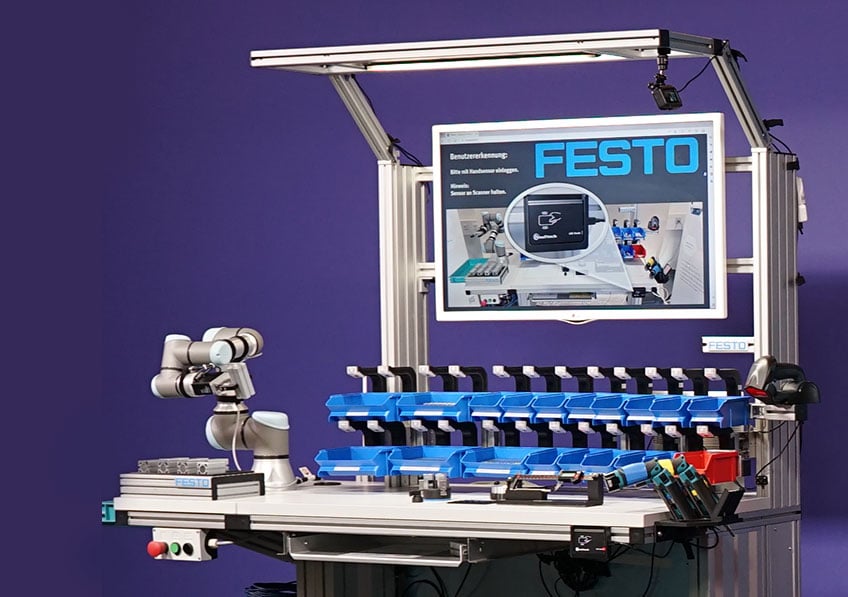
Festo and CLEVR: Initiative to Revolutionize Industrial Automation
Amsterdam, Esslingen, March 8, 2023— Industry leaders Festo and CLEVR have announced the release of CLEVRAssist, a groundbreaking new AI-based solution that is set to transform the field of industrial automation. The new technology will enable machines to learn and adapt to their environments, offering a range of benefits to manufacturers, including increased productivity, reduced downtime, and improved safety.
The Future of Industrial Automation
CLEVRAssist is the result of a joint research project resulting from the collaboration with the Festo Learning Center - the education and training institute of Germany's leading international automation technology company - and the German Research Centre for Artificial Intelligence (DFKI). Together, the three partners have developed a prototype industrial assistance workstation that enables true interactive and situational learning: Festo designed the semi-automated assembly workstation with all the necessary automation components, while DFKI developed the sensor technology as well as the AI-based analysis of human movement data.
Intelligent and adaptive qualification concepts from Festo
Festo Learning Center is an important qualification partner for the industry and has developed a prototype industrial assistance workstation that provides instruction and guides users through each step of the partially automated process. In this prototype industrial workstation, data generated in the work situation is collected by the automation components and the system recognises, for example, whether a certain part of the appropriate length has been installed, or whether a torque wrench has been used correctly. Klaus Herrmann, Head of Research at the Festo Learning Center, emphasises that the new generation of assistance and learning systems needs to be context-sensitive, intelligent, and adaptive to support workers to gain the more advanced qualifications they need.
Real-time activity tracking and process mining with AI from DFKI
DFKI has addressed the challenge of deploying artificial intelligence (AI) to identify and analyse movement patterns based on the sensor-based human movements captured at the assistance workstation. DFKI developed an AI component that collects position data from sensor points on the wrists, elbows, and/or torso in a real-time activity tracking mode and performs process mining based on neural networks. The AI generates personalised recommendations for action that are tailored to the human user in the form of context-sensitive and personalised recommendations for the next work step.
Software in control: CLEVR's low-code application
The CLEVRAssist app brings together all the data flows and manages communication with the user. It operates at three main levels to achieve this: the cloud-based Mendix platform, IoT interface to collect all the data from the workstation's peripheral devices, and digital mapping of data in its processes. The CLEVR application handles communication and interaction with the learning human at the assistance workstation in accordance with didactic best practices and dynamically adapts the assistance to the personal needs of the user.
"We are excited to bring CLEVRAssist to market as the core of a new generation of digital assistance systems," said CLEVR’s CEO, Jeroen Hanekamp. "With CLEVRAssist, we are leveraging the latest technology in low-code software and automation, combined with AI-based analysis of movement data, to provide a unique solution that enables true interactive and situational learning."
In conclusion, CLEVRAssist is a game-changing technology that has the potential to revolutionize the field of industrial automation. By enabling machines to learn and adapt to their environments, the technology offers a range of benefits to manufacturers, including increased productivity, reduced downtime, and improved safety.
With the combined expertise of Festo and CLEVR, CLEVRAssist is poised to become the go-to solution for industrial automation in the years to come. To find out more about this collaboration, a case study has been put together by all the parties—it can be accessed here .

CLEVR signs contract to drive digital transformation
Amersfoort, 21st June 2023 — CLEVR, a leading provider of low code and PLM software solutions, is excited to announce a partnership with Kongsberg Maritime, a global technology leader in the maritime industry. The collaboration between CLEVR and Kongsberg Maritime aims to accelerate Kongsberg Maritime’s internal digital transformation journey.
This recent partnership showcases Kongsberg Maritime's trust in CLEVR's expertise and advanced software solutions. CLEVR will support the company to further develop a key internal tool for digital workflows. Implementing a comprehensive digitalization roadmap will be a key part of the deliveries from CLEVR. Over the next years, CLEVR will provide its services to support Kongsberg Maritime in the digital transformation of their internal workflow and processes.
As a strategic partner of Kongsberg Maritime, CLEVR will contribute its deep industry knowledge and technical expertise to further realize Kongsberg Maritime’s digitalization roadmap. Leveraging their extensive experience in PLM software solutions, CLEVR provide valuable insights, guidance, and best practices to develop our customer’s operations.
Magnus Normann, CRO at CLEVR, expressed excitement about the partnership, stating, "Kongsberg Maritime's decision to partner with CLEVR is a testament to our commitment to delivering exceptional value and becoming a true strategic partner to our customers. We look forward to embarking on this transformative journey together, empowering Kongsberg Maritime with our state-of-the-art software solutions and strategic counsel."
By harnessing PLM software solutions, Kongsberg Maritime will unlock new levels of operational efficiency, streamline processes, and enhance collaboration across their entire value chain.

CLEVR and STACKIT Cloud Team Up
CLEVR, a digital transformation leader blending PLM, MOM/MES and Low-Code technology expertise, announces a strategic partnership with STACKIT, a prominent provider of sovereign cloud infrastructure solutions. This collaboration marks a significant milestone in both companies' efforts to enable and enhance digital transformation for businesses worldwide.
CLEVR has long been recognized for its expertise in manufacturing optimization and business process automation empowering organizations to optimize their operations and achieve unprecedented efficiency. STACKIT, a brand of Schwarz Digits – the IT and digital division of Schwarz Group, with its commitment to delivering scalable and secure cloud infrastructure, has garnered a strong reputation in the industry.
By combining CLEVR's innovative and expert approach to technology deployment with STACKIT's robust sovereign infrastructure, clients can expect a comprehensive suite of services that caters to changing market demands and adheres to the highest standards of cybersecurity and compliance ensuring data sovereignty. With this partnership CLEVR and STACKIT offer a European alternative to the well-known global cloud hyperscalers.
Key highlights of the partnership include:
- Enhanced Cloud Capabilities: Clients will benefit from a seamless integration of CLEVR's expertly developed applications based on Siemens and Mendix technology and STACKIT's state-of-the-art infrastructure, resulting in a powerful and scalable cloud ecosystem.
- Optimized Performance: The collaboration aims to provide businesses with optimized performance, ensuring even faster and more reliable application deployment and hosting that aligns with the dynamic needs of today's digital enterprises.
- Security and Compliance: CLEVR and STACKIT highly prioritize the security and compliance requirements of their clients. The partnership strengthens security measures and compliance protocols, offering a secure environment for sensitive data and business critical operations. All STACKIT data centers and servers are located in Germany and Austria and are therefore subject to the highest data protection standards that apply worldwide. The STACKIT infrastructure is certified according to C5 type 1 and meets one of the highest standards of cybersecurity. STACKIT also has ISAE 3000, ISAE 3402, ISO27001, ISO20000 and ISO50001 certification.
- Innovative Solutions: The joint efforts will further enable delivery of innovative and tailored business process automation that leverages technologies like artificial intelligence and machine learning to enhance the efficiency and effectiveness of our customers’ digital transformation journeys.
"With our collaboration with STACKIT we are able to offer our clients a European, sovereign, highly secure and compliant cloud alternative for hosting their business-critical applications," said Jeroen Hanekamp CEO of CLEVR. "This collaboration reflects our shared interest to delivering excellence to our customers.”
Walter Wolf, Board Member at Schwarz IT, also a brand of Schwarz Digits added, "The partnership of our STACKIT portfolio with CLEVR is a key step and critical element to further fuel our vision of an independent Europe – digital, leading. This partnership is another great building block to set new standards in terms of performance, security and innovation for sovereign cloud offerings.”

CLEVR appoints Angelique Schouten as new CEO
Company is advancing global expansion in order to meet demand for digital and automation solutions and services
Amersfoort, March 8, 2021 – the supervisory board of directors of low-code and no-code solutions and services providers Mansystems, FlowFabric and BlockBrains has appointed Angelique Schouten (43) as its new Chief Executive Officer (CEO). In this position, she succeeds Arnold Zwart, who founded and developed the organization over the last twenty-five years to become the largest global-Mendix partner. The appointment is effective as of March 1st 2021.
Schouten spent close to nine years at Ohpen building the world’s first cloud-native software-as-a-service (SaaS) core banking engine, based on the Amazon Web Services (AWS) cloud. Before that, she worked for companies like Aon, ING and DCE Consultants and she has founded several start-ups. She is also a founding board member of Holland FinTech and has co-authored two bestselling books: Monkey Money Mind and The WealthTECH book. Schouten holds a Master’s in General Management from Business University Nyenrode and a Bachelor in Commercial Economics from Fontys University.
Strengthen operations and drive global expansion
The company services close to 300 customers in 17 countries, has a team of 200 people with offices in the Netherlands and Germany. Schouten will focus on scaling the business internationally and pursue a buy-and-build strategy. Her international experience in the SaaS and FinTech sector and proven track record in scaling companies to the next level make her the right person for this role.
“The challenge is how the ever-growing demand for development-, engineering- and delivery power in the world is met. A demand which is still a lot bigger compared to what can be delivered. On top of that, the desire for digitalization and innovation, and the ability for customers, businesses and users to influence and control this directly, is also increasing. People want the freedom to create,” says Angelique Schouten, CEO of Mansystems, FlowFabric and BlockBrains. “I believe that the low-code and no-code movement will play a pivotal role in achieving this and it will move many industries and businesses forward. Our team places the power of digitalization and innovation into the hands of business owners and citizen developers. Launching new solutions become a matter of days and weeks, instead of months or even years and I am excited to be part of this movement.”
Inclusive leadership
Robert Pijselman, Chairman of the Supervisory Board of Mansystems, FlowFabric and BlockBrains: “The company is poised for major international expansion in the low-code and no-code market by creating a truly global footprint both organically and by future mergers and acquisitions. Angelique’s experience in scaling strong knowledge-based technology companies and her inclusive leadership experience makes us confident that we can successfully accelerate and execute such an expansion. What makes the combination of companies unique is that we developed our own intellectual property with technology that enables our consultants to test security, scalability and performance of the applications during the building process of our sector specific applications and tooling, and we believe that Angelique will take this to the next level.”
Crevan O’Grady, partner at Volpi Capital, added: “We have invested in the company because we were attracted to the potential for growth in the low-code space, of which Gartner forecasts that by 2025 70% of application development will be in low-code. Developers still remain in short supply and the COVID-19 pandemic has driven further demand for digital and automation solutions and services. With the appointment of Angelique we believe that the company can scale globally and further develop its sector specific solutions and services which fulfill this demand. She is welcomed by a very knowledgeable and experienced team.”

CLEVR Welcomes Tim Claes as New Chief Executive Officer
Amersfoort, 27 August 2024 - CLEVR today announced the appointment of Tim Claes as its new Chief Executive Officer, effective September 1st, 2024. Tim will replace Jeroen Hanekamp, who will be appointed to the Supervisory Board to ensure an effective transition of leadership and continue supporting CLEVR’s growth ambitions as a leading digital transformation partner in manufacturing optimization and digitalization.
Tim brings tremendous experience, having spent more than 25 years in the ICT sector.
He has held various senior management positions – both in sales and in operations.
For the last 4 years, Tim was Chief Commercial Officer at 9altitudes, a leading European system integrator, present in 9 countries, specialized in the full end-2-end digital thread including solutions from Microsoft (such as ERP, CRM, BI, Low-Code) and PTC (such as CAD, PLM, IOT and VR). He spearheaded the company’s growth resulting into a strong footprint in the European manufacturing, wholesales & distribution and technical services industries.
“Technology is changing the world faster than ever, but in the end, it is all about people! I feel blessed I had the opportunity to work with so many different people across different regions. I can’t wait to get acquainted with the people from CLEVR. Together, we will continue to build a better tomorrow.”
– Tim Claes
Tim started his career as entrepreneur within Axias, and later joined Realdolmen as Business Strategy Manager. In that function he was responsible for sales and strategy within the Enterprise Solutions division. During 2012-2013 he joined Astadia for almost
2 years, where he was first active in the UK as VP EMEA, and later as COO for their American operations. In November 2013 he rejoined Realdolmen as Managing Director for the Business Solutions division, and later was promoted to Chief Commercial Officer, overseeing sales, marketing and internal communications.
Tim has published several management books, sharing his valuable insights on leadership and digital transformation. Tim understands as no other that a successful digital transformation is much more than only digitalisation. He holds his own digital transformation community, under the umbrella name of Trends Applied.
“We are delighted to welcome Tim as our new Chief Executive Officer. Tim is a dynamic, values-driven business leader who has a strong commercial accumen and an excellent track record of delivering digital transformation solutions to mid-market and enterprise customers across Europe and Americas. He has exceptional leadership capabilities, proven go-to-market effectiveness, and strong experience in building organizations that help customers optimise and automate their business processes. The Board looks forward to Tim realising the full potential of CLEVR as a winning digital transformation business which delivers long-term growth and value for all its stakeholders.”
– Robert Pijselman, Chairman CLEVR
Robert Pijselman also said: “I would like to take this opportunity to thank Jeroen for his leadership of CLEVR. The changes he has made to the company’s strategy, structure and organisation leave CLEVR far better positioned for success. Jeroen will continue to support CLEVR by joining the Supervisory Board and being a voice of expertise and knowledge amongst our partners, such as Siemens and Mendix.”
Tim said: “I am delighted to join CLEVR. CLEVR is a leading expert in digital transformation that is uniquely positioned in the Siemens and Mendix ecosystem to serve its customers in manufacturing optimization and Low-Code digitalization. We have a talented and ambitious team that is very customer focused and makes a true difference every day. In the time I have spent getting to know the business and its customers, I have only become more convinced by the strength of CLEVR’s fundamentals and of its clear growth potential. The team and I are fully committed to proof that we are the trusted advisor of our customers when it comes to enabling their digital transformation. We have an exciting journey ahead of us.’’

CLEVR acquires Digitread
- CLEVR makes inroads in the $26 billion a year PLM space and Siemens software ecosystem
- Digitread is pioneering manufacturing and marine implementation services and solutions in highly specialized market
- CLEVR’s expertise in low-code and Mendix will help Digitread build sophisticated PLM solutions faster and more efficiently
AMERSFOORT – August 17, 2021 – CLEVR, the low-code and no-code Software-with-a-Service specialist, announced that it has acquired Digitread, one of the world’s rising stars in Product Lifecycle Management (PLM) system integration and a platinum-level solution partner of Siemens. The acquisition immediately raises the profile of CLEVR’s geographic and vertical expansion within the industrial, manufacturing, marine and energy industry. The deal is supported by management and funded by CLEVR’s majority shareholder, London-based Volpi Capital.
For years manufacturing organizations and their suppliers have needed greater digitalization for their supply chains and production processes. The recent COVID-19 crisis exposed this, when many marine, manufacturing and engineering-to-order companies had to accelerate their digitization efforts and transformation. PLM and Mendix add-on solutions ensure process optimization, big data information integration and utilization to produce a sturdy digital backbone and maximize operational excellence.
Digitread enables us to combine PLM rock stars with CLEVR’s low-code Mendix champions,” said Angelique Schouten, named CLEVR CEO in March. “Very few companies can do what Digitread does, configuring and integrating some of the world’s most complex systems in the industrial, manufacturing and marine space. We’ll combine Digitread’s high-touch approach with CLEVR’s high-tech expertise and help manufacturing companies across the globe complete their digital transformations by offering off-the-shelf solutions and highly specialized consultancy services.”
Headquartered in Norway, with offices in Germany and Lithuania, Digitread is one of the most recognized and trusted names in PLM, a market that generates $26 billion a year. Digitread’s 100+ customers include companies such as Kongsberg Maritime, Nexans and OneSubsea.
“Everyone at Digitread is excited about working shoulder to shoulder with CLEVR,” said Magnus Normann, Digitread’s CEO. “PLM systems are product biographers. PLM is the process of managing a product and data from concept through design, manufacturing, service and finally disposal. With the help of monitoring tools, they convey detailed digital stories about products to managers, enabling them to increase sustainability, identify weaknesses, perform preventative maintenance, refine product performance or inform them on how to build new products. Low-code and no-code technology will help tell that story. The combination of skills and knowledge is good news for our customers.”
Financial terms of the deal were not disclosed.

2022 low-code predictions
Fast-Growing Low-Code Consultancy Firm Reveals Digitalization Trends That Will Shape Businesses in 2022
AMERSFOORT – December 14, 2021 – CLEVR, the low-code and no-code Software-with-a-Service provider, today announced its list of four technology predictions, all of which reflect the shifting digital landscape. As one of Mendix’s longest standing low-code go-to-market partners, CLEVR helps organizations achieve greater organizational agility, improve customer satisfaction, and reduce technical debt.
“The ongoing pandemic demonstrates that businesses must continue to practice an extreme form of Agile to ensure business continuity,” said Angelique Schouten, CEO of CLEVR. “Meanwhile, more organizations are becoming digital-first because that’s what their customers expect. However, the definition of ‘digital’ continues to evolve in interesting ways that will become even more evident in 2022.”
Following are the 2022 predictions from CLEVR’s executive staff.
1. Digital experiences will be built faster and be of higher quality.
Customers expect companies to provide them with more than a mobile or web application. They want experiences similar to those provided by Google and Amazon. While time to market can provide a competitive advantage, quality is equally important for B2C and B2B organizations that want to attract new customers and employees and retain existing ones.
“Quality will become even more important than before. Not only do we need to deliver value faster, we need to make sure the quality is flawless,” said Wouter Van Dee, manager of professional services at CLEVR. “At a minimum, we’ll see low-code support for DevSecOps which helps ensure security or maybe even DevQualOps which assures security, performance and stability.”
2. The developer shortage will become even more pronounced
Creating and maintaining a digital business requires developers and IT professionals who understand how the tech stack works. However, since the pandemic accelerated digital transformations and digital-first business strategies, there simply aren’t enough professional developers to keep companies competitive moving forward.
“Gartner expects that four out of five products and services will be built by people who work outside the IT environment,” said Schouten. “The only practical way to make that happen is to take advantage of low-code and no-code platforms which enables business and IT to collaborate on innovation and making ideas real.”
3. Enterprises will use low-code and no-code in tandem to accelerate innovation
Low-code platforms were designed for professional developers. No-code platforms target “citizen developers” who are power users working in lines of business. If those platforms share a common code base, like Mendix, then professional developers can easily finish or enhance the work citizen developers started versus rewriting those applications completely. Low-code automation will also help accelerate innovation by shortening the time it takes to build proofs of concept (POCs), products, and services.
“In 2022, more organizations will realize that low-code and no-code can accelerate and help scale innovation and growth hacking. In fact, Garter expects 75% of enterprise applications will be built with low-code,” said Van Dee. “Mixing and matching low-code platforms from multiple vendors slows software development and release velocity. One of the reasons CLEVR is growing so quickly is that clients and prospects recognize the benefits of using no-code and low-code solutions and tooling made by the company based on the Mendix platform.”
4. Business workflows will become self-learning
Low-code and no-code will help more organizations build dynamic business processes that are self-learning. Rather than needing an advanced data science degree or a Ph.D. in statistics to take advantage of AI and machine learning, professional and citizen developers will be able to use the visual tools low-code and no-code platforms provide to self-learning business workflows. In manufacturing, digital twins will become the norm with some of them capable of acting autonomously.
“We expect to see automated factories that have fully-defined digital twins which are created, simulated, verified and connected to robotic production,” said Magnus Normann, tribe lead PLM at CLEVR. “Low-code and no-code will also enable fully integrated solutions for industry manufacturers by bridging key domain solutions such as product lifecycle management (PLM), enterprise resource planning (ERP), customer relationship management (CRM), and manufacturing execution systems (MES) with low-code developed apps that have rich business logic.”
Learn more about CLEVR or connect with CLEVR on LinkedIn.

CLEVR Adds Two FinTech Heavyweights to Management Team
The company that employs low-code and no-code software-development tools to help enterprises speed up digitalization, names former Aegon Bank and Mambu execs as new COO and marketing chief.
AMERSFOORT – August 25, 2021 – CLEVR, the company that helps enterprises accelerate their digital transitions through the enormous power of the Mendix low-code and no-code (LCNC) development solutions, today announced the appointment of former Aegon Bank executive Bianca Joustra as chief operating officer, and former Mambu marketing lead Jeroen Coenen as vice president of marketing.
By adding Joustra and Coenen, well respected and experienced veterans of the financial services sector, CLEVR beefs up its expertise in the category, one of the most vital to the company. CLEVR recently launched a sweeping expansion effort into new geographic regions and verticals that include financial services, retail, manufacturing, healthcare, logistics and the public sector.
“The appointment of Bianca and Jeroen are in line with CLEVR's commitment to accelerate the digital transformation of the financial services industry,” said Angelique Schouten, CEO CLEVR. “To truly make an impact within this sector, you need experience at incumbents, challengers and FinTech firms alike. That is exactly what Bianca and Jeroen bring to the table with Bianca’s experience at Aegon Bank and challenger bank KNAB and Jeroen's experience of scaling one of the fastest growing FinTech companies and unicorns, Mambu."
Joustra will oversee all of CLEVR’s professional services, including the project delivery and support operation. Before joining Aegon Bank/KNAB, Joustra worked 11 years at BNP Paribas Personal Finance as COO and Managing Director. There, she helped triple the company’s total mortgage portfolio and managed the creation of a new business line. No doubt, Joustra will bring an elite level of competitiveness to CLEVR, as she is a former elite athlete. She played several years for the Netherlands national korfball team.
“CLEVR is a leader with their Software with a Service business model and also has international reach,” Joustra said. “Angelique’s enthusiasm and excitement about CLEVR’s mission is also contagious. I immediately caught it from her. We both like to exceed expectations and give all our pursuits everything we have. I look forward to working with her and the rest of the CLEVR team.”
As a former HP, Microsoft, SAP and Salesforce marketing executive Coenen has plenty of international experience. He also helped build the marketing team at Berlin-based Mambu, which provides the platform banks use to build a modern banking or lending architecture. In his new marketing position at CLEVR, he will be responsible for expanding the marketing team, and will oversee growth hacking, product marketing, branding, design, and communications.
“I joined CLEVR after seeing their impressive customer lists, about 400, everyone from ING, Achmea, Rituals, Siemens Financial Services, Eneco to T-Systems – great companies,” Coenen said. “If they rely on CLEVR when it comes to accelerating their digital transformation, that says a lot about the strength and potential of the company. Also, I’ve competed against Angelique. I've always admired her enthusiasm, ideas and relentless determination. She’s a marketer pur sang, and I look forward to now working side by side with her. I've worked for a lot of companies, enterprise companies, mid-sized, startups, but this is a unique challenge.”

CLEVR Transfers Mendix Quality Tooling to SIG
CLEVR, a leading provider of Siemens and Mendix solutions and digital transformation services, today announced the strategic transfer of its Mendix quality tooling and related customer contracts to Software Improvement Group (SIG).
This move allows CLEVR to sharpen its focus on core competencies while ensuring the continued enhancement and support of these technologies through SIG’s expertise in software quality assurance.
Elevating Our Commitment to Excellence
The acquisition encompasses CLEVR’s proprietary low-code Mendix quality assurance technologies:
- Application Test Suite (ATS)
- Application Performance Diagnostics (APD)
- Application Code Reviewer (ACR)
By transitioning these assets to SIG, CLEVR is confident that its customers will benefit from SIG's extensive experience in traditional and AI-driven software quality assurance. SIG, founded in 2000 and headquartered in Amsterdam, empowers businesses and governments globally to achieve success with reliable and robust IT systems.
A Strategic Move for Growth
“This transfer aligns perfectly with our strategic vision,” said Jeroen Hanekamp, CEO of CLEVR. “It enables CLEVR to focus on reselling, delivering, and supporting (PLM, MOM, low-code) software solutions. Partnering with SIG, we are confident that our technologies will continue to evolve and thrive under their stewardship, allowing us to better serve our customers with innovative and high-quality services.”
Continued Support and Future Prospects
SIG will maintain and support all versions of ATS, APD, and ACR until the end of 2026, ensuring a seamless transition for CLEVR’s customers. There will be no disruption to current services, and SIG’s comprehensive support will help customers maximize the potential of these tools.
Luc Brandts, CEO of SIG, emphasized the synergy of this acquisition: “We are excited to integrate CLEVR’s Mendix-related technologies into our portfolio. This acquisition not only enhances our offering but also strengthens our relationship with CLEVR, Mendix, and Siemens. We look forward to helping our new customers build high-quality software applications and improve their scalability, quality, and security.”
Going forward, CLEVR and SIG will further strengthen their partnership and continue collaborating in the Mendix low-code domain to bring significant advancements to the ecosystem.

CLEVR Launches Augmented Reality Field Service Management Solution
Product designed to reduce millions of kilograms in CO2 emissions, reduce up to 25% in costs and tackle staffing challenges by first-time right on-site jobs and remote assistance.
AMERSFOORT – September 8, 2021 – CLEVR, the low-code and no-code Software-with-a-Service provider, today announced the appointment of Kay Lankheet as lead for the newly created business unit and the launch of CLEVR Field Services Manager (FSM). This new software solution is designed to dramatically cut costs, shrink the carbon footprint and tackle staffing challenges for companies that dispatch skilled technicians to customers’ homes.
CLEVR’s Field Service Manager is specifically built to meet the needs of companies that provide end-to-end services to homes, offices, and stores, a market expected to top $9 billion by 2026. The back-end application, portals and mobile app software covers the full field service process from installation, maintenance, and repair, including job intake, preparation, planning, route optimization, execution, payment and all the way to archiving. The solution will soon contain a Remote Augmented Reality Assistance option, which empowers smart-home installation companies to provide remote support via a two-way video call and augmented reality (AR), guiding customers through a process of fixing minor issues by identifying and pointing at objects in the real-world, in real-time. This feature is especially valuable today when companies are faced with dire shortages of skilled field workers.
“Field services is an area crying out for new, digitalized, efficient processes,” said Kay Lankheet, Squad Lead for CLEVR’s Field Service Manager business unit. “Our off-the-shelf solution is easy to use and offers a significantly shorter go-to-market time: just a couple of weeks. CLEVR Field Service Manager enables incumbents and start-ups alike to offer highly digitalized offerings leading to significant cost reductions amounting to millions, an improved customer experience and perhaps most importantly of all, reduced carbon footprint of installation companies by up to 25%.”
CLEVR developed Remote Assistance in partnership with Econic, a leader in the e-home industry. Econic seeks to transform 1 million homes to self-powered dwellings called e-homes. Every e-home consists of many sustainable energy solutions, including solar panels, heat pumps, meters, and batteries. The task of delivering millions of installations in a scalable, reliable, high-quality manner that provides high customer satisfaction is extremely challenging. CLEVR Field Service Manager is empowering Econic to deliver on this promise.
“Econic expects that Remote Assistance will cut down on-site inspections of all new installations by 25%,” said Vincent Damen, product manager for Econic. “By 2023, we will grow to 200,000 new installations annually. A single inspection costs $148.00 (125 euros), so with the projected number we estimate saving $7.1 million (6 million euros) annually as well. In addition, remote assistance will significantly reduce the need to drive to on-site locations by 1 million kilometers, which roughly translates to reducing CO2 emissions by 170,000 kilograms.”
CLEVR plans to expand Field Service Manager's capabilities to adjacent market segments such as home security, home-appliance installation, waste management, energy and utilities, telecommunications, IT infrastructure installation and maintenance.
Learn more about CLEVR or connect with CLEVR on LinkedIn.

CLEVR Joins Mendix’s ISV Program
Global Software-with-a-Service Provider Delivers Unique PLM Offering for the Retail, Apparel, Footwear and Accessories industry to streamline ideation, design, merchandising, product development and sourcing.
CLEVR announced today that it has become an official Mendix Independent Software Vendor (ISV) Partner. CLEVR and Mendix partnered up for a new visually interactive Product Lifecycle Management (PLM) solution with key capabilities like collection planning, digital mood boards, material management, 3D native design and vendor collaboration.
The Mendix ISV Program is available for partners that are looking to monetize their domain expertise by selling unique customer-centric solutions, like PLM. The program provides an ideal set of benefits to enable businesses to successfully develop, bring to market, sell, and deploy software solutions built on Mendix's leading low-code development platform.
Through the program, CLEVR will deliver a unique PLM solution for the retail and fashion industry. By eliminating the need for numerous different and fragmented data sources, users of the solution will save up to 20% of their time that they were used to spend searching for all product-related information within the organization. CLEVR PLM integrates seamlessly with 3D design software like Browzwear and Clo3D. These integrations provide more sustainable and time-saving ways of working with regards to sampling processes because product development is 3D driven, and fewer physical sample cycles are required, reducing your brands’ time-to-market by 20% on average. Another distinction is the focus on vendor collaboration. CLEVR PLM provides a vendor portal to facilitate communication between all stakeholders within the supply chain e.g., brands, material suppliers, and production facilities. This way of working allows our customers' global organizations to work as one single team across different geographies and locations throughout the supply chain.
The PLM solution signifies an important impact to designers, product developers, merchandisers and sourcing departments within the fashion industry as well as suppliers and manufacturers. The added Mendix capabilities allow the solution to be adaptive through easy customizations, have a quick time-to-value and integrates easily with other systems.
Angelique Schouten, CEO at CLEVR: “Our 300+ customers always expect us to deliver best-in-class solutions. Being the largest Mendix Expert partner globally, we continuously include all our experiences across all projects and customers into our out-of-the-box PLM solution. We are happy to join the Mendix ISV Program. This partnership allows us to deliver even more vertical-specific solutions, like PLM, in the future also via this channel.”
Rohit Tangri, Global Vice President, Industry and Partner Solutions & CSO at Mendix, said, "The Mendix ISV Partner Program will enable CLEVR to deliver innovative solutions, initially for the retail and fashion industry, on the Mendix low-code platform. We are excited to have CLEVR as a new addition to our growing ISV Program as this partnership will enable them to offer a customer-proven and visually interactive PLM solution for the retail, apparel, footwear and accessories.

CLEVR Announces Strategic Partnership with Primera to Accelerate Digital Transformation in Retail
CLEVR, a leader in helping retail companies thrive through digital transformation, is excited to announce their partnership with Primera, a prominent name in retail, with more than 540 convenience stores in The Netherlands, welcoming over more than 46 million customers a year. Primera’s stores offer items such as magazines, greeting cards, gift cards, tobacco, lottery, office supplies, and gifts as well as services like postal handling. This collaboration signifies a pivotal step for Primera in becoming a more digitized, data-driven organization.
Primera has selected CLEVR to guide their digital transformation journey, targeting significant enhancements in their promotional processes. Historically, these processes were marred by inefficiencies and potential inaccuracies due to manual systems. With CLEVR's expertise, Primera is transitioning to a robust, automated promotion workflow system, eliminating outdated methods and improving overall efficiency and data accuracy.
"Our partnership with CLEVR represents a strategic pivot towards advanced digital solutions that streamline operations, enhance accuracy, and foster cross-functional collaboration across our departments.", said Angelo Ridderhof, Manager Digital Business & Innovation at Primera. "CLEVR's approach has exceeded our expectations by setting a new standard in how we manage our promotions and forecast the promotional budget."
The CLEVR promotion management solution is at the heart of the commercial process. This cloud-based, low-code application built on Mendix has been refined over many years to become the industry standard, providing flexibility, rapid deployment, and extensive customization capabilities. This allows Primera to:
- Digitize and automate the entire promotion lifecycle, from planning to execution.
- Enhance efficiency and reduce the time needed to launch promotions.
- Preparation to improve data integrity and analytics for better decision-making.
- Foster real-time collaboration across marketing, sales, and supply chain teams.
Jeroen Hanekamp, CEO of CLEVR, noted, "Our mission is to empower retail companies like Primera to harness the full potential of their digital capabilities. We're delighted to see the tangible benefits our collaboration brings to Primera, and we're excited about the future of this partnership."
The implementation has already yielded significant results for Primera, improving promotion execution and enabling a data-driven approach to their marketing strategies. Primera is now better positioned to manage its marketing efforts across multiple channels efficiently, including digital and traditional advertising mediums.
“Our next step is to link the internal promotion process to the cash register. This broadens the scope, touches another department and creates even more efficiency.”, said Leonie Buitenhuis, Business Analyst at Primera.
Based on check-out registrations
Receive personal news and updates in your inbox


