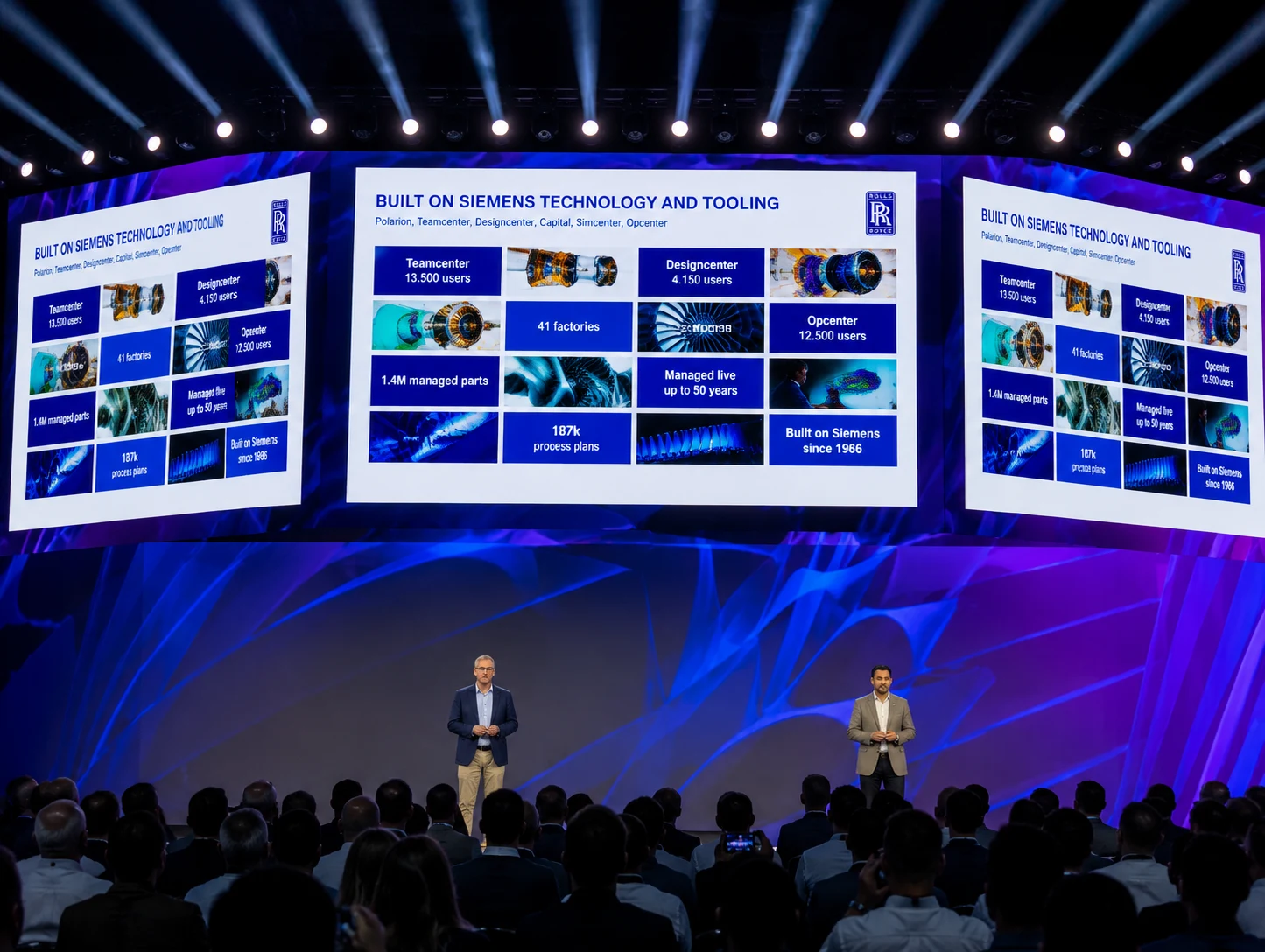
Every year, Siemens Realize LIVE brings together manufacturers, engineers and technology leaders to explore where the industry is heading and how that future is taking shape in practice. Product updates, roadmap announcements, and technology highlights across sessions, customer stories, and partner discussions have shown this year that manufacturing is no longer about optimizing individual technologies. It is about connecting systems, intelligence and people into one coherent whole. This shift is particularly visible in how AI in manufacturing is evolving from isolated use cases into connected, operational systems.
This shift builds on a long standing ambition within the industry to create connected environments where data flows seamlessly across PLM, ERP, MES and supplier networks, improving efficiency, visibility and decision making. The introduction of AI further expands this landscape, not only increasing the potential for automation and insight, but also raising critical questions around how these capabilities can be translated into measurable and scalable operational value.
Here are the 4+1 ideas that defined Realize LIVE 2026 and what they mean for the future of manufacturing.
1. AI is becoming operational, not experimental
For years, AI has been positioned as a powerful tool, supporting individuals through copilots, predictions and insights. At Realize LIVE 2026, it became clear that this phase is evolving toward execution at scale.
AI use cases in manufacturing are moving from assistance to orchestration within real workflows. Instead of responding to prompts in isolation, it is being embedded into processes where it can support decisions, coordinate systems and automate multi step activities across the lifecycle.
The introduction of Intelligence Center X signals this transition explicitly. By connecting enterprise data, lifecycle context and workflows in a governed environment, organizations can deploy AI agents alongside people as part of a hybrid workforce, moving from isolated pilots to production level execution with traceability and control.
The question is no longer whether AI works. It is how organizations embed it into connected systems and structured workflows, with the governance required to deliver consistent, measurable and scalable value.
2. Connected systems matter more than isolated innovation
Despite continued investment in digital transformation, many manufacturers still face challenges when it comes to scaling innovation across the enterprise. The underlying issue is not a lack of technology, but a lack of connectivity, particularly across PLM, ERP and MES integration layers that are essential to enable scalable AI in manufacturing.
Across organizations, systems remain fragmented, data is distributed across silos, and AI initiatives are often introduced as isolated pilots. While these efforts deliver local improvements, they rarely translate into measurable impact across the full product lifecycle.
In manufacturing, design, engineering, production and service are inherently interdependent. As a result, optimizing individual components in isolation does not drive systemic improvement. Connecting their existing systems into a cohesive digital thread does.
This is exactly what our CEO, Tim Claes, emphasized in his keynote, framing this challenge and opportunity through what he defined as the Holy Trinity of Manufacturing:
- PLM as the backbone for product data and the digital thread
- Smart factory as the layer connecting IT and OT, enabling visibility and control across operations
- Low code and AI as the orchestration layer that connects systems, workflows and decision making
Individually, each of these domains delivers value. However, the real impact emerges when they operate as part of a connected system. This is increasingly becoming the approach that manufacturers adopt to remain competitive and relevant in a rapidly evolving market.
3. Sustainability is becoming part of everyday engineering
Another strong signal from Realize LIVE was the shift in how organizations approach sustainability in manufacturing and compliance.
Regulation is tightening, particularly in Europe, where frameworks such as CSRD, REACH and emerging requirements like the Digital Product Passport are forcing organizations to provide detailed visibility into materials, sourcing and environmental impact across the entire value chain. Adding to it the pressure specific industries face such as aerospace and defense to improve their margin, and the stricter compliance requirements and growing expectations from OEMs and partners, sustainability can no longer be a separate reporting activity, but a factor that directly influences cost, risk and competitiveness.
During his keynote, Gerrit Kiefer, our Head of Solutions and Customer Success Management in Germany, demonstrated how this transition is already taking place in practice. Together with tec4U, he showcased how compliance and sustainability can be embedded directly into engineering workflows, enabling organizations to:
- Integrate regulatory requirements directly into PLM and design environments
- Ensure full traceability of materials, components and suppliers across the product lifecycle
- Reduce manual effort in compliance reporting through automated data capture and validation
- Identify risks and compliance gaps earlier in the design phase, where they can still be addressed efficiently
- Align cost, sustainability and engineering decisions by making all relevant data available in one connected workflow
- Accelerate time to compliance while maintaining control and auditability across processes
4. The rise of the orchestration layer
With the introduction of Intelligence Center X, Siemens clearly articulated a strategic focus on establishing an orchestration layer that connects enterprise data, workflows and AI agents into a cohesive and scalable system. An orchestration layer acts as the architectural component that enables data orchestration, workflow coordination and AI execution across systems.
The implication for manufacturers is significant. Most of them have already invested heavily in core systems such as PLM, ERP and MES. So instead of building new systems, they can activate and connect what already exists.
At CLEVR, we have consistently been advocating that large scale rip and replace strategies are no longer sustainable, nor necessary. Over time, engineering logic, domain knowledge and process intelligence have become deeply embedded within existing systems. Replacing these foundations would not only introduce risk, but also discard valuable intellectual capital.
Instead, manufacturers can introduce an orchestration layer on top of their current landscape, enabling them to connect workflows, embed intelligence and extend capabilities without disrupting what already works.
4+1. Technology is ready. Organizations are not
If there is one thing we can safely extract from Realize LIVE 2026, it is that that the challenge is no longer technological. Manufacturers today have access to advanced PLM platforms, connected factory systems, low code environments and increasingly powerful AI capabilities. The building blocks for transformation are already in place.
Yet many AI adoption initiatives in manufacturing continue to stall. At CLEVR, we see this pattern across organizations every day. Workflows not fully understood or mapped, decision logic remaining implicit, unstructured data, or connected in a way that enables reliable, cross-system execution.
Embedding intelligence into workflows requires more than deployment. It requires clarity on how decisions are made, where responsibility sits, and how humans and systems interact.
This means the next frontier to address is organizational in nature. Manufacturers need to design workflows that are clearly defined, decisions that are explicitly structured, and governance models that can be translated into executable logic. Only then can AI agents operate reliably, make autonomous decisions within defined boundaries, and scale across the enterprise with consistency and control.
5 actions manufacturers can take today
First, the focus needs to shift from adding more tools to connecting existing ones. Most organizations already have the core systems in place. The real opportunity lies in linking them into a coherent digital thread across design, engineering, production and service.
Second, AI initiatives need to move beyond experimentation. Instead of isolated pilots, the emphasis should be on embedding intelligence into real workflows where it can deliver measurable impact. This requires clear governance, defined decision boundaries and a strong orchestration layer.
Third, transformation strategies need to become more pragmatic. Large scale, multi year replacement programs are increasingly difficult to justify. A leave and layer approach allows organizations to start with what they have, extend it intelligently and deliver value incrementally.
Fourth, sustainability and compliance should no longer sit on the sidelines. By integrating these requirements directly into engineering and product development processes, manufacturers can turn them into a competitive advantage rather than a constraint.
Finally, organizations need to rethink how people and technology work together. As AI becomes embedded into operations, new roles, responsibilities and ways of working will emerge. Designing this deliberately is critical to making transformation succeed.
Think big with a clear vision for your organization, start small with one workflow that delivers immediate value, and scale fast once the approach proves effective.

Find out how CLEVR can drive impact for your business

FAQ
Can't find the answer to your question? Just get in touch
