The EU battery passport: How PLM and MES get you ready for February 2027
Four months. That is all that is left before the EU's first mandatory digital product passport goes live. From 18 February 2027, every EV battery, light means of transport (LMT) battery and industrial battery above 2 kWh placed on the EU market needs a digital battery passport. No passport, no market access.
This is not just an automotive problem. Grid-scale, C&I and most home storage systems count as industrial batteries, and that market is booming. SolarPower Europe's European Battery Market Outlook 2026–2030 reports 36 GWh of new storage installed in Europe in 2025, up 48%, taking total capacity past 100 GWh. Annual installations are expected to exceed 50 GWh in 2026 and reach 138 GWh by 2030.
The question for manufacturers, pack assemblers and storage integrators is no longer whether to prepare, but whether your product and production data can deliver what the passport demands. That is where PLM and MES come in.
What the EU battery passport actually requires
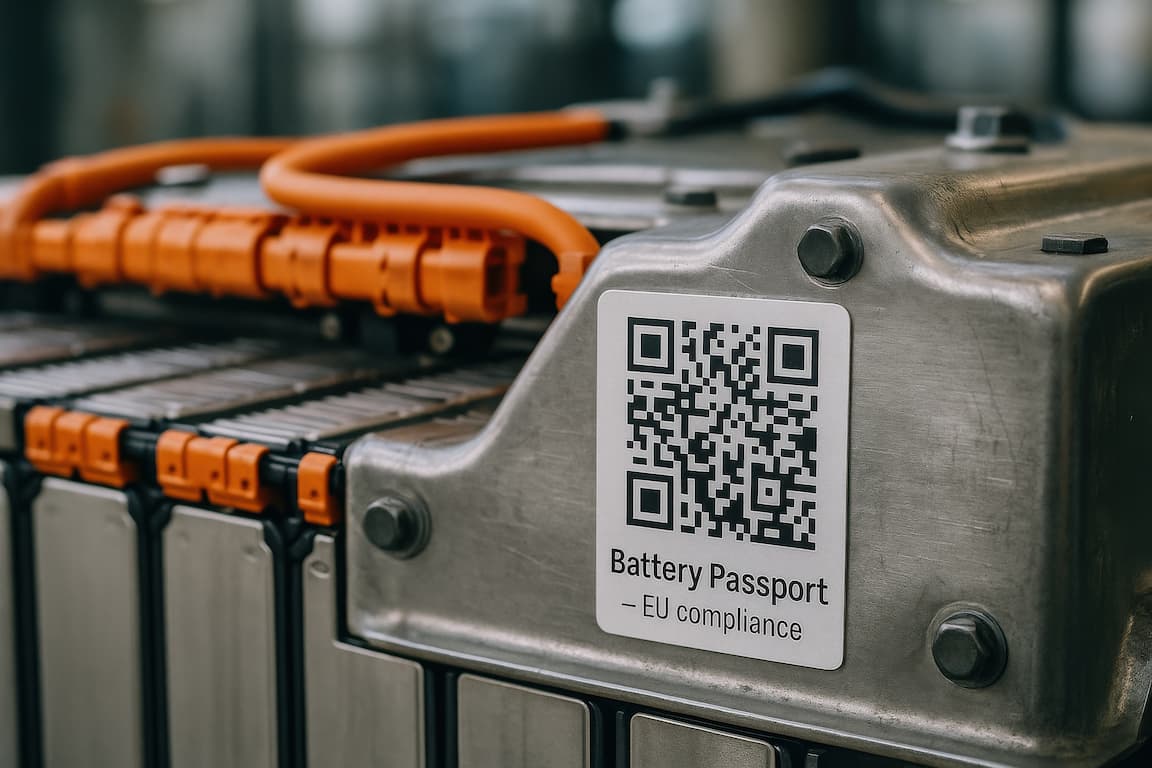
The passport is created by Article 77 of the EU Batteries Regulation (EU) 2023/1542, with its content defined in Annex XIII. It is an electronic record per individual battery, reached through a QR code on the product and linked to a unique identifier.
Three categories are in scope from 18 February 2027:
- Electric vehicle batteries, regardless of capacity.
- Light means of transport (LMT) batteries, such as e-bike batteries.
- Industrial batteries above 2 kWh, including stationary storage for the grid, C&I sites and most homes.
The Battery Pass consortium translated the regulation into a data attribute longlist of roughly 90 mandatory data points, now formalised in DIN DKE SPEC 99100. They span product information, material composition, carbon footprint, recycled content, due diligence, performance and durability, circularity and dynamic state-of-health data. Access is tiered between the public, parties with a legitimate interest such as recyclers, and authorities.
What the Commission clarified in 2026
- The registry is live. The EU Digital Product Passport Registry opened on 20 July 2026. Operators verify themselves with a qualified electronic seal and register each passport's identifier.
- Whoever finishes the battery owns the passport.The Commission's battery passport FAQ (September 2026) places responsibility with the operator that completes the working battery, usually where the BMS is fitted. Suppliers can enter data on its behalf, but legal responsibility stays with the operator.
- Second life means a new passport. A repurposed battery, such as an EV battery turned into stationary storage, needs a new passport linked to the old one.
- The date is not moving. The Environmental Omnibus (Omnibus VIII) amends parts of the regulation, but not the passport deadline. EUROBAT and RECHARGE are lobbying for a phased rollout; that is a position, not law.
What is still open
The implementing act on who may access restricted data missed its 18 August 2026 deadline; Taylor Wessing expects adoption in Q4 2026. Carbon footprint and recycled content follow their own timelines, and due diligence reporting starts in August 2027. In short: the deadline is fixed, the rulebook is not, so your data architecture must absorb changes without a rebuild.
A data problem, not a QR-code problem
It is tempting to treat the passport as a labelling exercise: generate a QR code, host a page, done. But the QR code is the easy part. The hard part is the data behind it, which lives in many places:
The pattern is clear: the designed product lives in PLM, the produced product lives in MES. The passport needs both, per battery, consistent and up to date across a life that can span a decade or more.
The companies that will struggle in February are not those without a passport platform. They are those with product data in spreadsheets, as-built records that cannot be traced to a design revision, and no clear view of which cell lot went into which pack.
PLM: The product backbone of the passport
A battery passport is a structured description of a product, and your Product Lifecycle Management (PLM) platform already owns that description. With PLM for manufacturing on Siemens Teamcenter or Teamcenter X, PLM delivers four things the passport needs.
- One trusted source for the as-designed battery
Chemistry, capacity, weight, cell format and pack structure are all defined in the engineering BOM. Pulling passport data from PLM instead of spreadsheets gives every field an owner, a release status and a revision: data you can defend to a market surveillance authority. - Material compliance built into design
Capturing supplier material declarations against parts in PLM means hazardous substances and critical raw materials are checked while the design is still changeable, not after the first production run. The same structure supports recycled content reporting later. - Carbon footprint as a design parameter
The carbon footprint is declared per model and plant, and future rules foresee performance classes and maximum thresholds. That makes CO₂e a design constraint, just like cost and weight. Teamcenter Product Cost Management lets engineers compare the cost and carbon footprint of alternatives early, as we explored in AI in product cost management and sustainability. - Change management that keeps the passport up to date
A new cell supplier, a firmware update or a different cathode blend can all change passport data. Formal change management in PLM ensures every relevant change triggers a passport update, with a full history of who changed what and why, including the dismantling and spare part information recyclers need.
MES: The production evidence behind every passport
PLM describes the battery you designed. But a passport is issued for each individual battery, and only the shop floor knows what went into it. That is the job of your MES, part of a Manufacturing Operations Management (MOM) landscape built on solutions such as Siemens Opcenter.
- A unique identity per battery
Every passport needs an ISO/IEC 15459-compliant identifier linked to the QR code. MES assigns it when the battery is completed and ties it to the work order and the date and place of manufacture. - Full genealogy from cell to pack
Because the passport sits with whoever finishes the battery, pack assemblers and storage integrators inherit the data work for components they did not make. A complete as-built genealogy connects supplier data on incoming cells to the finished product, and answers a recall or an authority's question in hours, not weeks. - Test results as performance data
Capacity, internal resistance, power and round-trip efficiency are measured at end-of-line testing. Captured in MES, they become passport performance data and the baseline for later state-of-health reporting. - Plant-level data for the carbon footprint
The footprint is declared per manufacturing plant. Energy use, scrap and yield from MES, combined with IoT data from Siemens Insights Hub, turn estimates into measured figures.
The realvalue: Closing the loop
Released designs flow from PLM to the shop floor; as-built data, deviations and test results flow back. When a battery deviates from its released design, its passport reflects it. That digital thread from as-designed to as-built is exactly what the regulation asks you to prove.
From compliance to the agentic enterprise
PLM and MES give you the data, but a passport is a living record: created at production, updated on change, extended on repurposing, closed at recycling. Across thousands of batteries, dozens of suppliers and an evolving rulebook, manual processes will not keep up.
This cross-system, rule-heavy, auditable work is what the agentic enterprise is built for: humans and AI agents working side by side on trusted data, inside governed processes. Enter Siemens Intelligence Center X (ICX), announced at Realize LIVE 2026 and built on Mendix. As our colleague Gerrit Kiefer explained in Make processes intelligent, ICX combines four capabilities on one governed foundation. Here is how they map onto the passport.
Knowledge graph: One connected view of every battery
Graph Studio connects the design revision in Teamcenter, the genealogy in Opcenter, supplier declarations in ERP and BMS field data through one ontology, instead of copying them into yet another database. The passport becomes a governed view on that graph, with lineage for every field.
Machine learning: From records to predictions
AI Studio runs models on that contextualised data: predicting state of health from test and field data, flagging production anomalies that may affect durability claims, or identifying the best second-life candidates in a storage fleet.
Agentic applications: Let agents do the legwork
With the Mendix AI platform, teams build agentic applications such as:
- A passport readiness agent that checks each model against Annex XIII and flags missing or inconsistent fields before release.
- A supplier data agent that requests, validates and chases material and carbon footprint declarations.
- A change impact agent that detects when an engineering change affects passport data and proposes updates.
- A regulatory watch agent that maps new implementing and delegated acts to your data model.
Orchestration and trust: Humans stay accountable
Legal responsibility stays with the company placing the battery on the market, whoever enters the data. Mendix Workflows orchestrate agents and people in one traceable process: an agent prepares, a human approves, the system publishes. The ICX trust layer adds guardrails, logging and access control, so every update has an owner, a timestamp and a data lineage. That is how AI becomes a compliance asset instead of a risk, and what we call intelligent enterprise orchestration.
A practical roadmap to 18 February 2027
Four months is tight but workable. We recommend this sequence:
- Confirm scope and role (now). Which products are EV, LMT or industrial batteries above 2 kWh? For modular storage, check whether units share a BMS, since their combined capacity then counts. If you finish the battery, the passport is yours.
- Assess data gaps (November). Map the roughly 90 attributes against PLM, MES, ERP and supplier data, with a source, owner and quality level per field.
- Secure supplier data (November–December). Agree written authorisations, data clauses, formats and update triggers with cell, module and material suppliers.
- Connect the digital thread (December–January). Link released PLM data with serialisation, genealogy and test data in MES. Start your EU registry verification early.
- Pilot one product family (January). Create, publish and update a passport end to end, including an engineering change and a repurposing scenario.
- Go live and scale with agents (February onwards). Roll out across product families and automate with governed agents, ready for due diligence reporting from August 2027 and the obligations that follow.
Meanwhile, watch the access rights act: its draft, expected around year-end, decides who can read the restricted parts of your passport.
How CLEVR helps you get passport-ready
The battery passport is the EU's first mandatory digital product passport, not its last: the Ecodesign for Sustainable Products Regulation extends the same logic to many more products. A quick QR-code fix means starting over for every next regulation. Connected PLM and MES data, orchestrated by governed agents, builds a foundation for better traceability, faster recalls, smarter design and new second-life business models.
As the largest dedicated Siemens and Mendix partner in Europe, with more than 30 years of industry experience, CLEVR helps manufacturers and energy and utilities companies connect Teamcenter, Opcenter and existing systems into one digital thread, extended with agents through Intelligence Center X. We start where you are: A scope and data gap assessment, a pilot, and a roadmap to scale.
February 2027 is closer than it looks. Let's make sure your data is ready before your batteries are.

Find out how CLEVR can drive impact for your business

FAQ
Can't find the answer to your question? Just get in touch
