There is a moment in every major technology shift when the early signals stop being signals and start being reality. I believe we have crossed that threshold with Artificial Intelligence, and specifically with what is now being called Agentic AI.
For most of the past decade, AI has been something we used as a tool. We prompted it. We queried it. We marveled at what it could produce when we asked the right question. But that framing, AI as a sophisticated assistant, is becoming outdated at a remarkable speed.
Agentic AI doesn't wait to be asked. It pursues goals, executes plans, coordinates tools, and adapts to changing conditions, all with limited human intervention. The shift from reactive to proactive AI is subtle in concept but enormous in consequence.
What "Agentic" actually means
I want to be precise here, because this term gets used loosely. An agentic AI system is defined by five characteristics:
- Goal orientation: it works toward an objective, not just a single response.
- Multi-step reasoning: it plans sequences of actions, not just the next word.
- Tool use: it calls APIs, queries databases, triggers workflows.
- Memory and context: it retains state across interactions.
- Adaptability: it responds to changing conditions without being re-prompted.
The practical difference is stark. Instead of asking an AI to draft a market analysis, you assign an agent to monitor a market continuously, synthesize trends, and alert you when action is needed. Instead of manually coordinating procurement, you deploy an agent that tracks inventory, identifies suppliers, validates pricing, and within defined limits executes purchase orders automatically.
AI used to answer our questions. Now it's starting to do our work.
Why now? The convergence moment
Several forces are converging in 2026 to make Agentic AI viable at enterprise scale for the first time. Large language models now have reliable multi-step reasoning. Orchestration frameworks for coordinating multiple agents have matured. Low-code platforms like Mendix have dramatically lowered the barrier to building agentic systems. And the business case is becoming impossible to ignore.
The risk of waiting, and the risk of rushing
I want to be honest about both sides of this picture, because the data tells a nuanced story. Yes, adoption is accelerating dramatically. But Gartner also warns that more than 40% of agentic AI projects risk cancellation by 2027, due to escalating costs, unclear business value, and inadequate governance.
This is not a reason to hesitate. It is a reason to act thoughtfully. The organizations that will win are not those that move first. They are those that combine speed with structure. Those that understand what they are building, why, and how to govern it.
At CLEVR, we have been deploying agentic AI in production across manufacturing, financial services, healthcare, utilities, and retail. And the single most consistent finding across every deployment is this: the technology is rarely the bottleneck. The workflow, the governance, and the people most often are.
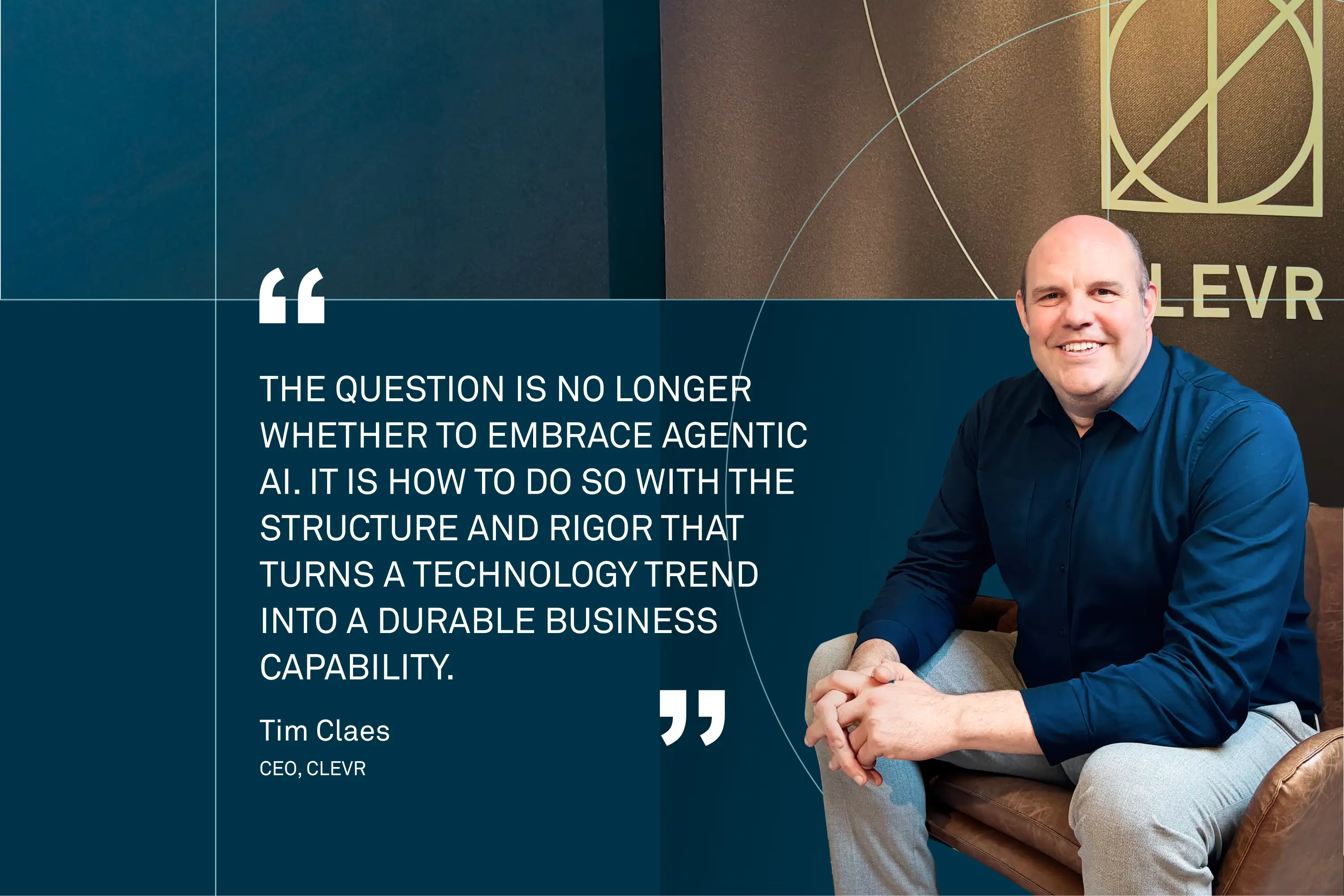
The question is no longer whether to embrace Agentic AI. It is how to do so with the structure and rigor that turns a technology trend into a durable business capability.
What this series covers
Over the next four weeks, I will explore the building blocks of an enterprise-ready agentic AI strategy. The role of workflows, how Mendix has evolved into an agent orchestration platform, what agentic AI means specifically for PLM, ERP, and CRM environments, and the change management disciplines that make adoption sustainable.
This is a series for technology leaders and business leaders in equal measure, because the agentic transition is not a technology program. It is a business transformation.
Five weeks. Five posts. One practical guide to building the AI-powered enterprise, without tearing apart what already works.
Follow along and share with a colleague who is navigating this transition.
Article originally published here.

Find out how CLEVR can drive impact for your business

FAQ
Can't find the answer to your question? Just get in touch
