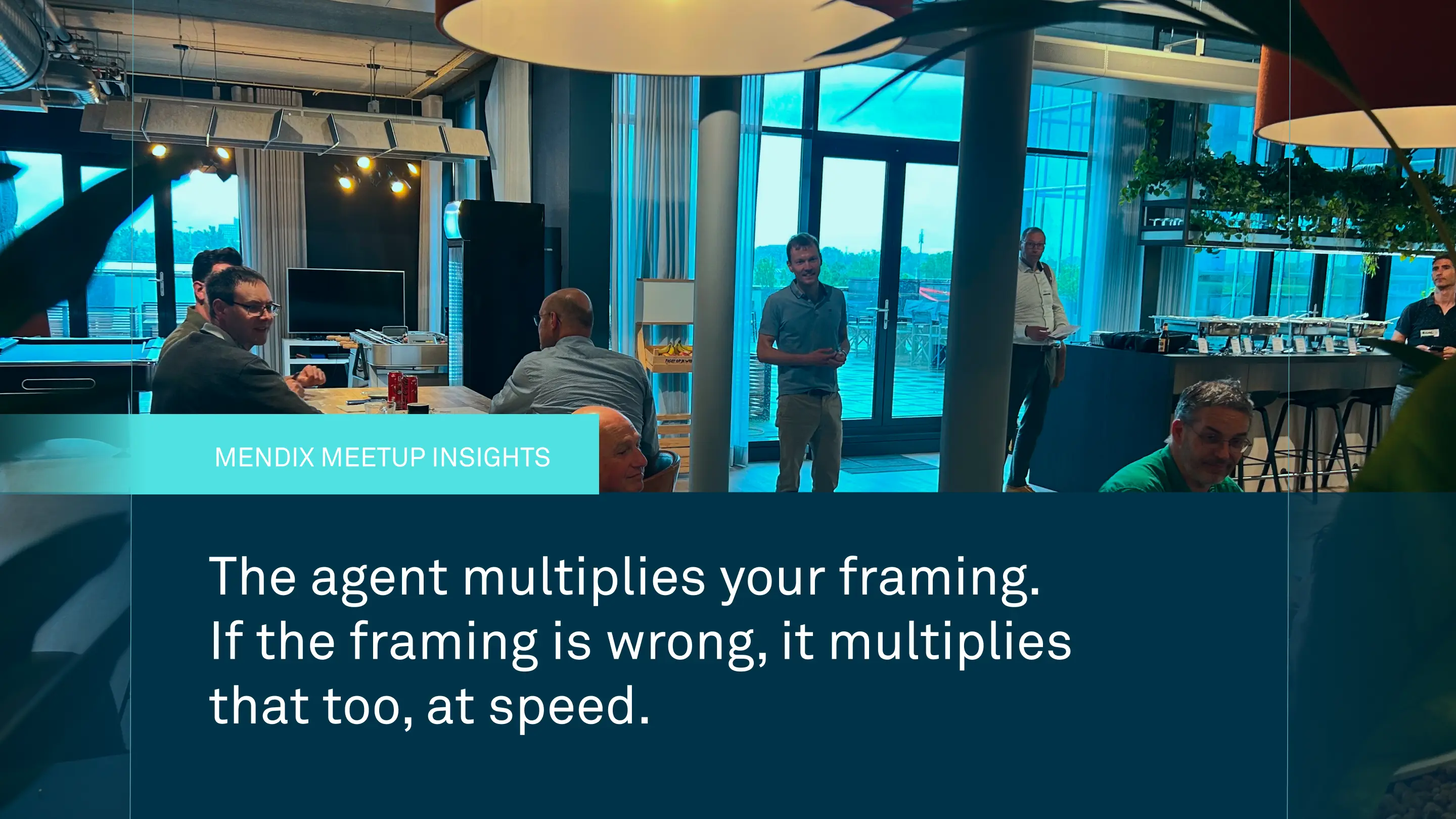
Part 1 of 4, from the Mendix Community Netherlands Round Table in Amersfoort, June 2nd, 2026. Four questions came out of the evening: what is left for the consultant to do, whether we can trust an agent to do it, whether the platform still earns the choice, and who is still buying.
Roughly twenty Mendix consultants spent an evening arguing about one thing, even when they thought they were arguing about something else. Not whether the agent can build the app. We mostly agree it will. The argument was about what that leaves for us to do.
This was the Round Table on June 2nd, in Amersfoort. Three tables: Alpha, Delta and Foxtrot. A bank of 34 statements about agentic AI, a live app to vote in, and a generous hour to fight it out. Sixteen of them voted, 42 votes in all. What I was glad to see afterwards, reading it all back, was that nobody at the tables actually panicked about being replaced. The mood was not “are we finished?” It was “so what is the job now?”
So what were we actually arguing about?
Understand, analyze, build
One table put a clean frame on it. Software work has three mental stages: understand, analyze, build. The path from a vague request to a working thing.
Here is the uncomfortable part. The agent is getting very good at the build. The typing. Almost everything worth saying about the next few years sits in what that does, and does not, do to the other two.
A story from Alpha made it concrete. A consultant had been on a project building a customer portal, moving a company off paper forms and into a Mendix app. The product owner had spent two weeks writing user stories, clean ones; every form turned into a neat ticket. Then someone asked the question that should have come first: what did we actually sell here, do we automate paper or do we automate processes? We automate processes. The stories were wrong. Two weeks of careful work, pointed at the wrong thing, and all of it had to be written again.
Now run that through an agent. You get the same great stories, he said, but not the correct thing. Faster, cleaner, and just as wrong. Or, as the table put it: AI is not making a mistake. It is doing exactly what you told it to.
That is the whole argument in one anecdote. The agent multiplies your framing. If the framing is wrong, it multiplies that too, at speed. Understanding the real problem and deciding what is actually worth building are not the easy parts you rush through on the way to the code. They are the part that decides whether the code was worth writing.
Does that mean only the seniors survive?
You can read all of that as bad news for juniors. If the value is judgment, hand the work to the people who already have it and let the agent cover the rest. The room did not buy it. Asked whether teams now only need senior orchestrators and no juniors, 80% said no. The reasoning was simple. Judgment does not arrive with the job title. You build it by doing the work, including the parts a machine can now do for you. A table that quietly stops growing juniors is a table that runs out of seniors in a few years, with nobody left who learned how the thing actually fits together.
The shape people kept reaching for was not “expert” but T-shaped. A project with five T-shaped people beats a project with five experts, as one consultant put it: people who challenge the business and challenge the testing, instead of “I just want to do pure development.” The agent does not remove the need for that. If anything, it raises it.
So what did we keep calling the value?
Strip out the noise, and the same answer surfaced, in different rooms and different words. The value was never really the speed.
What they named instead was the unglamorous, durable stuff. The model two people can read together. The conversation between business and IT that happens around it. Even if the AI generates the whole thing, one consultant said, it is still good that you can fall back on a readable application and go through it together. When a production issue lands on your desk at the wrong hour, you want a flow you can read, even if an agent wrote it.
That readable model is part of what is still ours: holding the conversation, owning what ships. Whether it is also the lasting case for Mendix as a platform, the question that split the room hardest, is a fight for another day.
So far this sounds comfortable. It isn’t.
One thing should keep you honest, and it is not the one you would expect. The new breadth carries a new risk. Being T-shaped is good until it is too much. Ask an AI for a range date picker, and it will happily find one on GitHub and install it, along with whatever someone hid inside it. You have an info-stealer on your website without knowing it, as one consultant put it. You are T-shaped a little too much. The agent will reach for tools you never vetted, and the responsibility for what it reached for is still yours.
Which is why the cleanest idea of the night was not about trusting the agent at all. It was about boundaries: give it read-only access, do not hand it the tool to do the dangerous thing, and put a human on the actions that are hard to undo. Gate the irreversible, not the agent. And, said on the record by the host of that table: the gate is for now, not forever. It will move to three, without a doubt. Trust gets earned, gates come off, and today’s careful consensus has an expiry date.
So what does the consultant become?
Less of a builder, for sure. The agent is taking the build, and it is welcome to it. What is left is the part that was always the actual job, the part we sometimes hid behind the typing: working out which app is worth building, holding the conversation between the people who have the problem and the system meant to solve it, deciding what is safe to automate, and being able to read and stand behind what ships.
The agent can write the app. It still cannot tell you which app is worth writing, and it will not be in the room when the wrong one goes live. That, it turns out, was always the job.
That is the first of the four questions the evening threw up. The next one sits directly underneath it: if the agent is doing the building, can we trust it to? More on that next time.
We got through a handful of the 34 statements. The rest are still in the bank. What if we continue the conversation online? Let me know if you would be interested, and I will figure out a format to do so.
Originally published here.

Find out how CLEVR can drive impact for your business

FAQ
Can't find the answer to your question? Just get in touch
