The Dutch Emissions Authority (NEa) is the independent national authority which implements and monitors the market instruments available that contribute to a climate-neutral society. The NEa is the appointed organization to implement and monitor the European Emission Trading System (EU ETS) for the industry in the Netherlands, as well as the Energy for Transport regulations. NEa manages complex reporting, compliance, and verification processes that are critical to the integrity of the Dutch and European carbon market.
To support this mission, NEa needed to move beyond fragmented, manual ways of working, and together with CLEVR, they developed the Emissions Trading Portal (EHP) and a broader application landscape that enables the organization to respond faster to changing legislation, improve data quality, and reduce administrative burden for both internal teams and regulated companies.
The result is more than a modern IT environment. It is a future-ready digital foundation that helps NEa execute climate policy with greater control, agility, and confidence.
The challenge: Keeping pace with regulation through manual, error-prone processes
NEa operates in a highly dynamic regulatory environment, where European and national climate legislation continues to expand in scope and complexity. At the same time, the organization must manage sensitive reporting processes involving large volumes of emissions data, strict deadlines, and high financial stakes for participating companies.
“There were all kinds of Excel spreadsheets in circulation, with different versions,” says Bas Kroon, Product Owner at NEa, illustrating how manual processes created an increasing burden for both NEa and the companies submitting reports, while also raising the risk of inconsistencies, delays, and errors.
The challenge was not only technological, but operational. Every regulatory change required formats, workflows, and checks to be updated manually, making it difficult to respond quickly and reliably. As data volumes grew and new reporting domains emerged, the limitations of this way of working became increasingly clear.
NEa required a more structured, digital approach that would strengthen data quality, simplify reporting, and provide the agility to implement future legislation without starting from scratch each time.
That is where CLEVR came in.
The solution: A scalable ecosystem built on Mendix for climate regulation execution
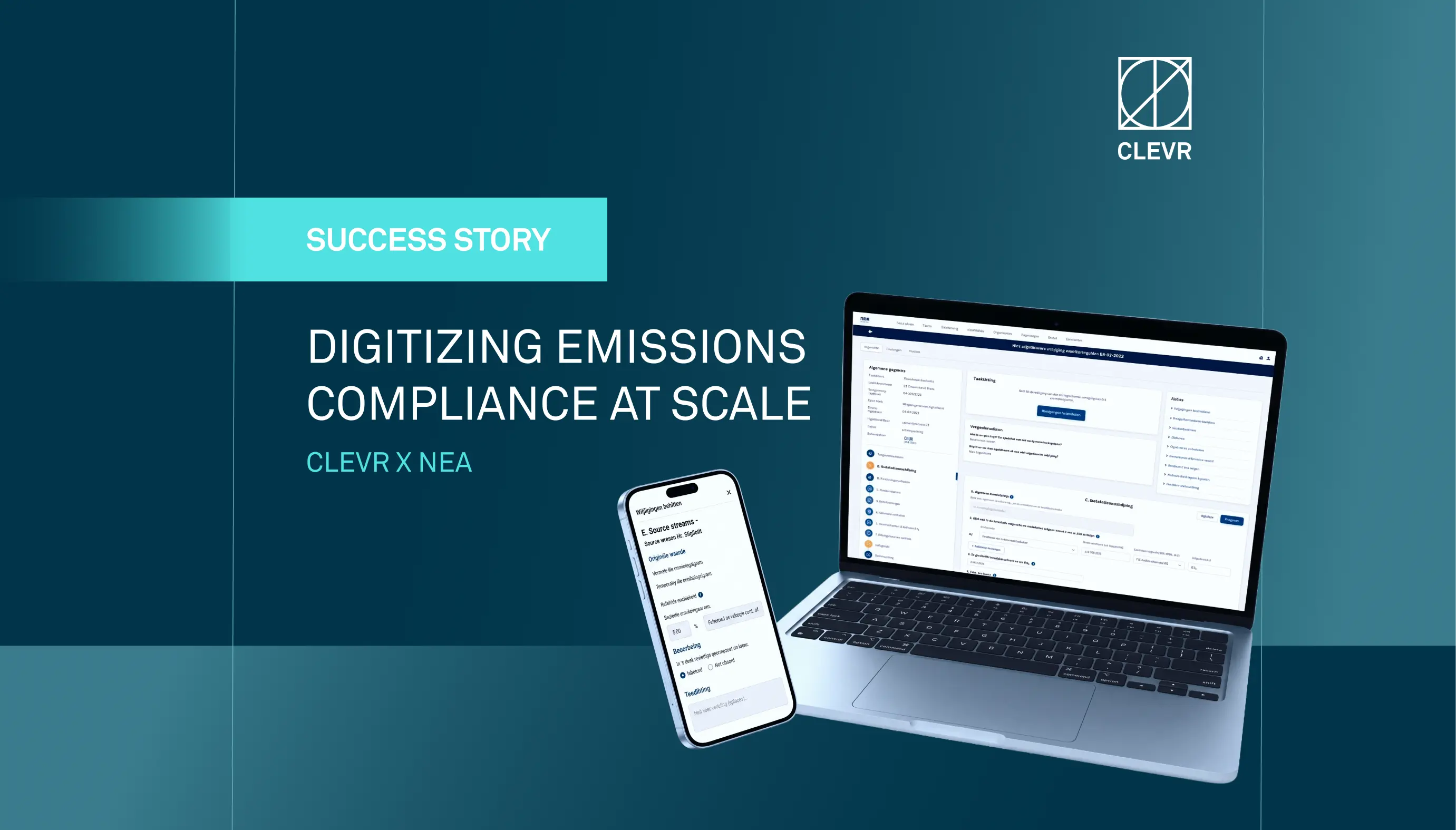
Together with NEa, CLEVR developed a digital foundation centered around the Emissions Trading Portal (EHP), which expanded into a broader ecosystem of connected applications and services. The goal was not just to digitize existing forms, but to redesign how regulatory processes are supported end-to-end, with greater structure, traceability, security, and flexibility.
“At the core of the solution is a workflow-driven platform that brings together versioning, approval management, comparison across document versions, and identity management in one structured environment,” says Michel van den Bempt, Business Consultant at CLEVR. “That gives NEa much greater control over its processes, while also improving efficiency, data quality, consistency, integrity, and security for everyone involved.”
Built on the Mendix low-code platform, EHP is further strengthened by smart integrations with key national systems, including:
- Chamber of Commerce integration to automatically synchronize company details
- eHerkenning integration for secure digital identification and access
- Identity and access management features including secure authentication and role-based access
In addition, CLEVR helped NEa extend this foundation to support additional regulatory domains and use cases, including new reporting obligations, inspection and enforcement processes, and adjacent applications for communication and access management.
This modular architecture allows the organization to incorporate new legislation and requirements much faster, while maintaining consistency across the broader landscape.
Impact: From fragmented reporting to compliance, control, and agility
The impact of the transformation goes well beyond digitization. By moving from rigid Excel-based processes to a scalable digital platform, NEa has significantly improved how it manages reporting, compliance, and regulatory change.
With users rating the new interface an 8.1, the benefits extend across both external user groups and NEa’s internal teams:
- A 100% compliance score for EHP reporting in 2023 (reports submitted correctly and on time)
- A major reduction in manual and Excel-based process complexity
- Improved data quality, consistency, and traceability
- Helps reduce the administrative burden for companies submitting emissions data
- Supports faster implementation of new legislation and reporting requirements
- A more agile and scalable digital foundation for future climate-policy execution
- Greater efficiency for internal teams working under growing regulatory pressure
- A stronger basis for inspection, enforcement, and secure digital collaboration
The solution also proved its value when speed mattered most. New capabilities such as the CO2 Levy Register were brought live within the existing foundation in a short timeframe, showing not only the agility of the architecture, but also the strength of the collaboration behind it.
Collaboration: Building long-term capability for a changing regulatory landscape
Since 2019 CLEVR has consistently helped NEea build both digital capability and organizational readiness. What started as a Mendix engagement around an existing system evolved into a broader strategic role spanning architecture, modernization, governance, application expansion, and enablement.
“We have been working with CLEVR since the beginning,” adds Bas. “Together with us, they develop and maintain the apps, not only for emissions trading but also for the newer applications that followed. The team has grown significantly over the years, from five people to fourteen,” reflecting the long-term commitment and growing trust that have shaped the partnership over time.
With that foundation in place, CLEVR remains a strategic partner in supporting the next phase of the NEa’s digital journey.
Find out how CLEVR can drive impact for your business